Culture & Civilization: The First English Translation of Mendelssohn’s Answer to the Question “What is Enlightenment?” (Part II)

As should be apparent by now, my collection of hobby horses includes an interest in old translations of now-familiar texts.1  The interest is not entirely idiosyncratic, nor is it entirely irrelevant to my labors in that open-ended field known as the “intellectual and/or “conceptual history.” Exploring how earlier translators wrestled with terms that we now take for granted opens a window the way in which new concepts migrate from one language into another. That this process is hardly simple becomes clearest when the noise in translations becomes apparent.

Moses Mendelssohn’s answer to the question “What is enlightenment?” is a particularly interesting example. As I discussed in the previous post in this series, he maintained that difficulties in answering the question that had been posed in the Berlinische Monatschrift could be traced to the fact that (1) the word Aufklärung was of relatively recent vintage and (2) could only be understood in the context of two other important new-comers: Bildung and Kultur. When Dan Dahlstrom, Bert Kögler, and I were doing our translations of Mendelssohn’s essay in the 1990s, we had a luxury that our anonymous and neglected nineteenth-century predecessor lacked: well-established conventions for dealing with these terms. Our only problem was what to do with Bildung — a term that we could easily have rendered as “culture” were it not for the need to use that word to translate Kultur. In contrast, our predecessor was confronted by a semantic field consisting of finely drawn distinctions between terms that are just beginning to be rendered into English.

The German Museum and its “Proprietors”
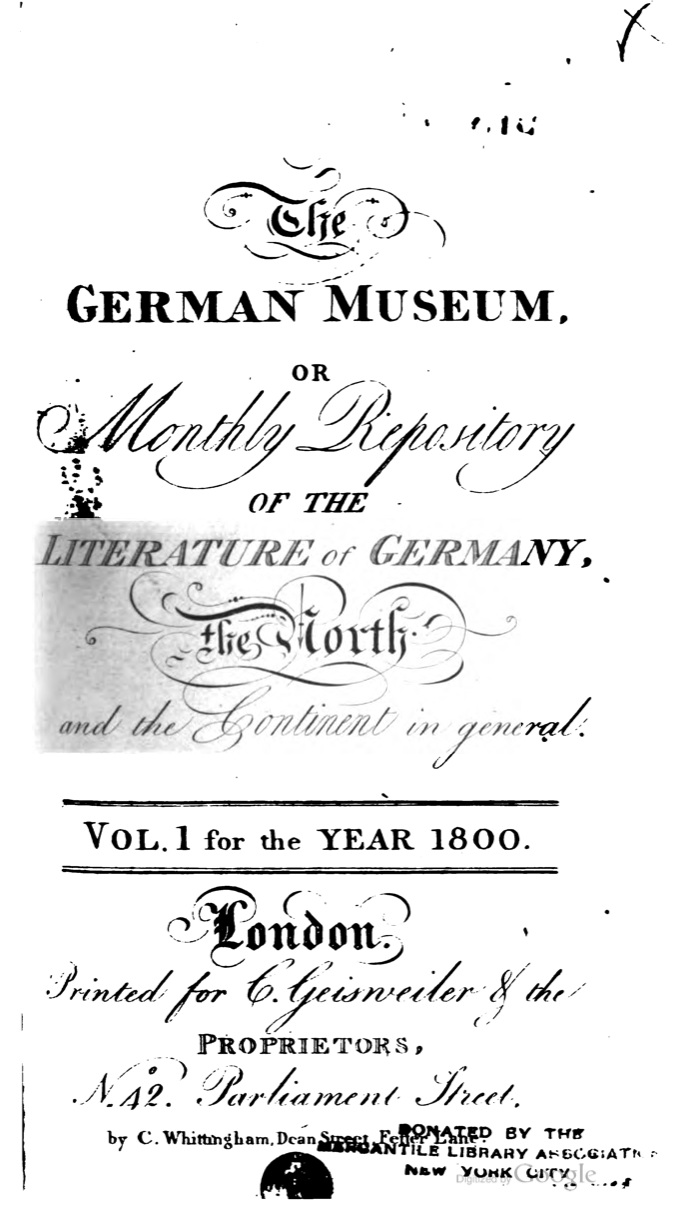
1800_The German MuseumSince the translation was published anonymously, there is no way of knowing whether the translator was (like Bert, but unlike Dan and me) a native German speaker, though given what we now know about the German Museum, I suspect that was likely. In the decade since I first worked on the German Museum, we have learned more about the editors of the journal and the broader context from which it emerged.2 In my article on the OED’s definition of “enlightenment,” I relied on Bayard Quincy Morgan and A. R. Hohfeld’s 1949 survey German Literature in British Magazine in crediting the editorship of the journal to “J. Beresford.”3 The current scholarship assigns editorial responsibility to Constantine Geisweiler, Peter Will, and Anton Willich.

There is a helpful discussion of the émigré bookseller and publisher Geisweiler (born Constantine de Giesworth) in a post on the Gothic Vault Facebook page. He seems to have arrived in London in the early 1790s and first enters the historical record when he married the German noblewoman Maria Countess Dowager of Schulenburg in 1799. Maria had already attained a measure of fame for her translations of various plays by August Friedrich Ferdinand von Kotzebue — who, at this point, was enjoying a measure of popularity in England (one of his plays turns up in Mansfield Park) — and the Geisweilers seem to have done their best to take advantage of the Kotzebue craze. But by 1806 Geisweiler had given up publishing and moved into the wine trade. Little is known about his later life except that Maria died in 1840 and, shortly afterwards, Constantine entered the Kensington House Lunatic Asylum, remaining there until his death in 1850.

Geisweiler had been aided in his publishing endeavors by Peter Will, an émigré clergyman who translated various Gothic novels into English (by now, it should be clear that we are dealing with interesting people).  After the collapse of the German Museum, he left London for New York (where he was a minister to a German congregation) and then moved on to Curacao (preaching to a Dutch congregation). Eventually, he moved back to southern Hesse, where he established his own publishing house in 1839.

The philosopher Willich was best known of the three — both among his contemporaries and (thanks to Rene Wellek’s account of his role introducing Kant into England) to later scholars.4 Willich attended Kant’s lectures from 1778-1781 before setting off to Edinburgh where he studied medicine in the early 1790s and supported himself by offering German lessons — his students included Walter Scott. He moved to London in 1798 and gained employment (and, according to rumors, protection from creditors) by taking up the position of physician to the Saxon ambassador. In addition to his brief stint with the German Museum, he was also an editor for the Medical and Physical Journal. Finally, he too, jumped on the Kotzebue bandwagon with a translation of a biography of the playwright.

The editors of the German Museum (or, as they called themselves on those rare occasions when they found it necessary to speak collectively to their readers, the “Proprietors” of the journal) did little to identify themselves or their translators. Geisweiler was listed on the front page as the journal’s “printer.” Willich’s name appeared on the articles he wrote. And the initials “P.W.” — presumably the hard-working Peter Will — can be found at the end of quite a few of the translations.5 But all that appears at the close of the Mendelssohn translation is the letter X.  Since I’ve not undertaken a systematic examination of the initials at the close of articles there is little point in trying to guess who might have done the translation. It may be enough to reflect on the challenges that X would have faced in attempting to put Mendelssohn into English.


Culture, Mental Illumination, and Civilization

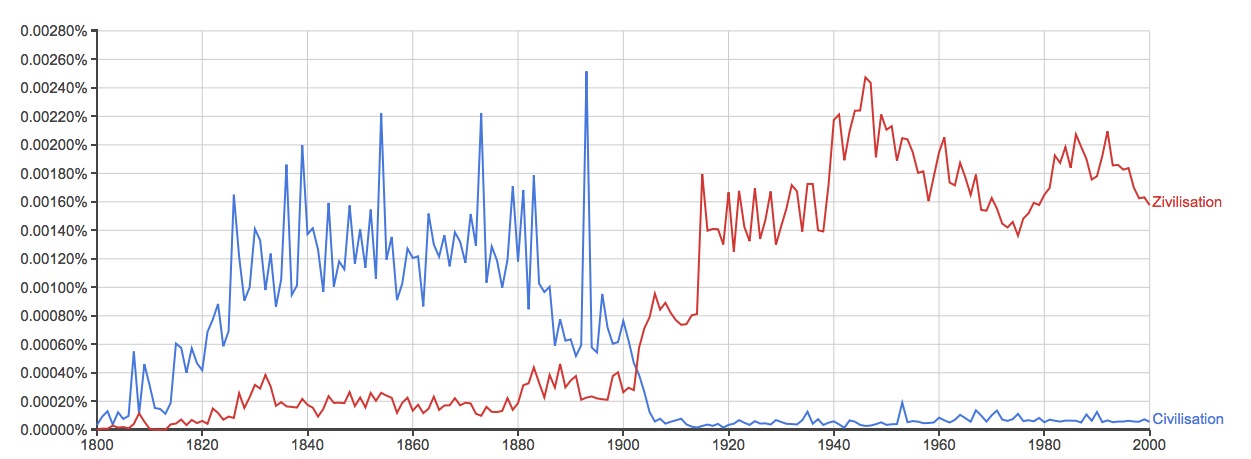
Then, as now, the easiest term to translate would have been Kultur — a French loan-word that appeared in Mendelssohn’s original draft as Cultur. A glance at an Ngram for the two spellings indicates that the French C was quite tenacious (can this possibly be correct?!). It is not until the start of the twentieth century that the Germanized spelling becomes consistently more frequent.
Civ and Ziv

While Aufklärung would have presented greater problems in 1800, it is clear that the German Museum had a convention for translating it: “mental illumination.” A review of C. D. Vosz’s Das Jahrhundert der Aufklärung in the first volume referred to the book as “The Age of Mental Illumination” (I:435-436) and Georg Joachim Zollikofer’s “Der werth der grössern Aufklärung der Menschens” was translated as “An Estimation of the Advantages arising from the Program of Mental Illumination” (I: 396-403). A quick check of Volume II (the one volume that, to date, I have processed using OCR software) yields eight occurrences of the phrase “mental illumination” but none of “enlightenment” or “Enlightenment.”6 In contrast, “enlightening” used quite frequently (a total of twelve times, two of which occur in the text of the translation of the Mendelssohn essay). “To enlighten” occurs four times (“to enlighten the understanding of the multitude” (3), “to enlighten a whole nation by facts” (321), “a school to enlighten us” (343), and “endeavors to enlighten the nations” (477)). The translator strayed from the convention only slightly, preceding the words “enlightening the mind” with “intellectual improvement.”

Finally, confronted with problem of how to translate Bildung, the translator adopted a solution that never occurred to me (and, I suspect, would not have occurred to either Dan or Burt): civilization. That it wouldn’t have occurred to us has at least something to do what happened after 1800.

A Brief History of Bildung

Bildung is a word with a complicated history.7 It turns up quite frequently in Pietist theology, which — reviving elements from late medieval mystics such as Meister Eckhart and Heinrich Seuse who had presented Christ as the ideal “image” (Urbild) for a union of the human and the divine — used Bildung to denote the process by which individuals form themselves into the image of Christ through the performance of good works.8 It was also been used in the natural philosophy of Paracelsus, Böhme, and Leibniz to denote the development or “unfolding” of certain potentialities within an organism.9 In Klopstock, Wieland, Herder, and especially Goethe, it came to denote the ideal of an “aesthetic individualism,” in which individuals viewed the cultivation of their personalities into harmonious wholes as something comparable to the creation of a work of art — an ideal which could find support in Shaftesbury’s notion of a unity between the morally good and the aesthetically beautiful.10 For members of the educated middle class who came to positions in the bureaucracy and the clergy by virtue of their talents and education, Bildung served as a social ideal that stressed the virtue of individual self-cultivation over the accident of noble birth.11

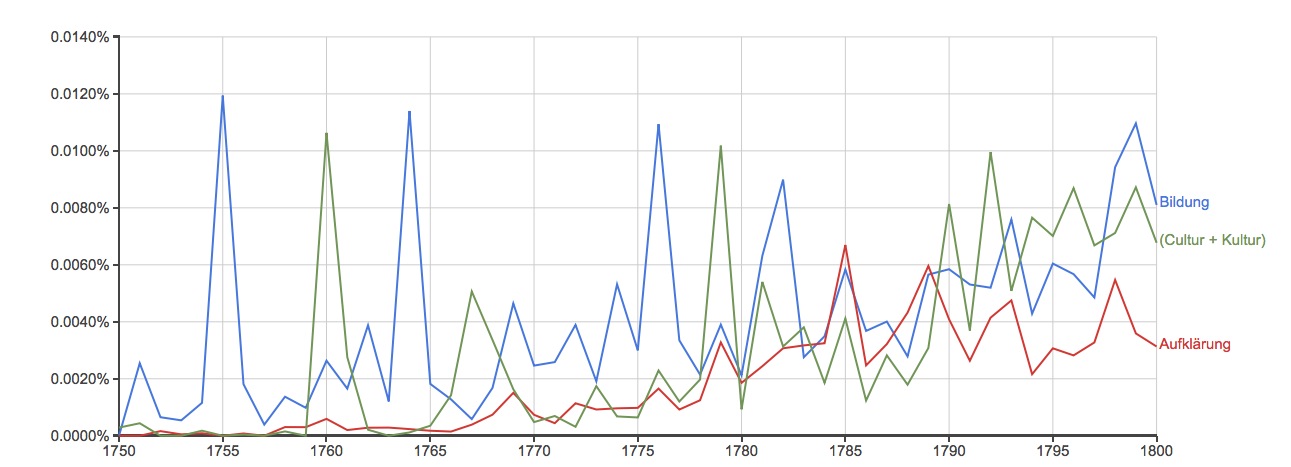
That Mendelssohn regarded Bildung — despite this rich and complicated history — as a new-comer might have had something to do with the publication, a decade earlier, of Herder’s Auch eine Philosophie der Geschichte zur Bildung der Menschheit (1774). Ngrams for eighteenth-century texts are, of course, probably useless (if only because the sample of eighteenth-century that would have been sitting on library shelves when Google did its scanning can hardly have been representative of the corpus of texts published during the period) and the problems are even greater in the case of eighteenth-century German texts (e.g., what sorts of texts would North American and English libraries be collecting?). But it is, I suppose, of some interest that, among these alleged newcomers, Aufklärung seems to have been the last to catch on, with a slow ascent beginning in the middle of the 1760s and a sudden uptick around the time that Zöllner asked his famous question in the Berlinische Monatsschrift.
Bildung, Aufklärung, Kultur to 1800

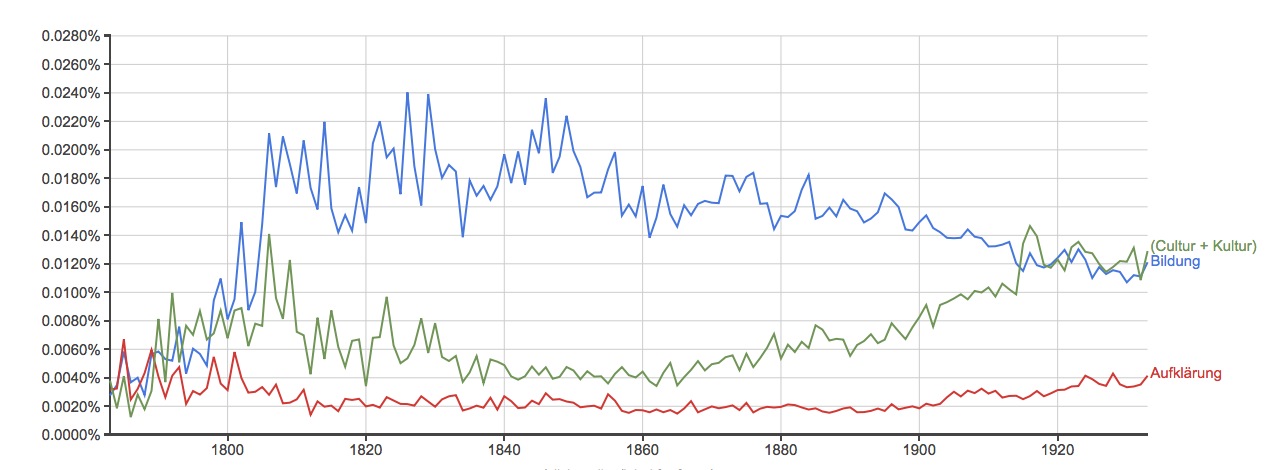
More revealing, perhaps, is the trajectory of the three terms over the century and a half between Zöllner’s question and the advent of National Socialism.
Bildung, Aufklärung, Kultur to 1933

Bildung would seem to be the most successful of Mendelssohn’s three newcomers, with a rapid ascent during the two decades after his essay. Kultur exhibits a somewhat more modest climb, a sudden descent (as Bildung continues its rise), followed by a steady increase from 1860 onward. The lines for Bildung and Kultur join around the time of the cessation of hostilities in 1918. It would, of course, be necessary to spend some time poking around in the snippets to see what is taking place here, especially since a fair number of the occurrences of Bildung are likely to be the result of the emergence of pedagogy as a discipline and discussions of public education. But it bears remembering that Aufklärung, which consistently lags the other two terms also has close connections to pedagogical concerns.

Substituting Erziehung for Kultur yields the following:
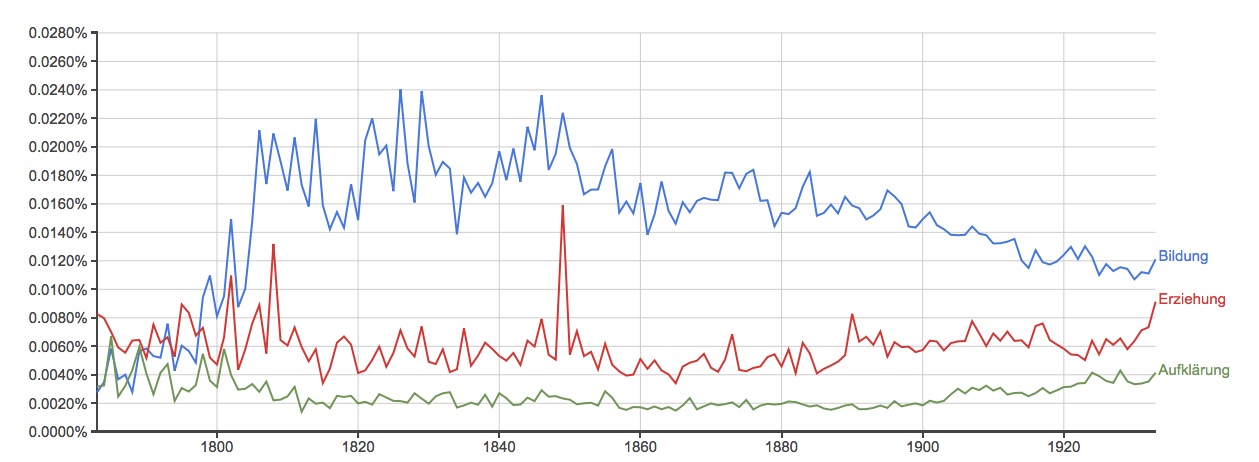
Bildung, Erziehung, Aufklärung to 1933

This Ngram, even more than is usually the case, leaves us with more questions than answers. Among the more important is the question of how many of the uses of Bildung and of Aufklärung over this period are simply discussions of education in the more specific sense that is typically associated with the term Erziehung? But that question, however important, is not the one that concerns me here. My interest lies with X’s decision to translate Bildung as “Civilization.”

Culture, Civilization, and the “Destiny of Man”

There were at least two reasons why it would have never occurred to me to translate Bildung as “Civilization.” The first has something to be said in its favor. The other is more problematic.

The best reason for avoiding “Civilization” is that it is out of sync with the religious resonances associated with Bildung. While “Education” doesn’t do much to convey these resonances either, it has the relative virtue of not ruling them out. Since at least Locke, English speakers have had the resources for differentiating the civil from the ecclesiastical and, employing these resources, have been able to argue that civil interests do not include the care of souls. Bildung, in contrast, has quite a bit to do with the care of souls and those of us who tend, almost instinctively, to think like John Stuart Mill (even if we haven’t read him) tend to think that the sort of care of souls that goes under the rubric of “cultivating individuality” is something that is best conducted beyond the reach of the state. And as those of us who have actually read On Liberty know, a good deal of what Mill was doing in the book rested on the account of Bildung that Wilhelm von Humboldt had provided.12

That X was likely unaware of these resonances is in keeping with his handling of what may well be the most crucial — and as well as the most underdeveloped — concept in Mendelssohn’s essay: that of the “Bestimmung des Menschen.” Dan and Bert, perhaps thinking of the famous essay by Fichte that carried the same title, rendered this as “vocation of man.” I considered that option, but went with “destiny of man,” in part because I wanted to capture the way in which the German Bestimmung allowed Mendelssohn to suggest that the definition of humanity lies in its destiny: it is what it becomes.
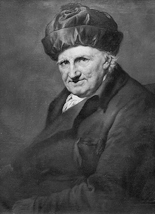
Spalding_155x216The term itself had been popularized by the clergyman Johann Joachim Spalding’s Bestimmung des Menschen (1748). Like Mendelssohn, Spalding was a member of the Berlin “Wednesday Society,” a secret society (known, privately, as the “Friends of Enlightenment) whose membership included the important figures in the Prussian bureaucracy, the Berlin clergy, and leading figures in Berlin intellectual life like Mendelssohn and Friedrich Nicolai.13 There is much to be said about Spalding’s book and, fortunately, Michael Printy has written a superb article on it, which appeared about a year ago in the Journal of the History of Ideas.14 Go read it (I’ll wait).

As Mendelssohn saw it, Bildung was composed of a theoretical side (which he termed “enlightenment”) and a practical side — “culture”). The goal towards which Bildung was oriented was defined by the Bestimmung des Menschen. It was the telos that the process of Bildung sought to attain and, in order to achieve that goal, it was necessary to bring the contrasting imperatives of Aufklärung and Kultur into harmony. Here is how I translated the paragraph where most of the work gets done (I must confess that I wince when I see Bildung translated as “education,” but — as I explained in the earlier post — it strikes me as the best of a set of bad options).

The more the social conditions of a people are brought, through art and industry, into harmony with the destiny of man, the more education this people has.

Education is composed of culture and enlightenment. Culture appears to be more oriented towards practical matters: (objectively) toward goodness, refinement, and beauty in the arts and social mores; (subjectively) towards facility, diligence, and dexterity in the arts, and inclinations, dispositions, and habits in social mores. The more these correspond in a people with the destiny of man, the more culture will be attributed to them, just as a piece of land is said to be more cultured and cultivated, the more it is brought, through the industry of men, to the state where it produces things that are useful to men. Enlightenment, in contrast, seems to be more related to theoretical matters: to (objective) rational knowledge and to (subjective) facility in rational reflection about matters of human life, according to their importance and influence on the destiny of man.

I posit, at all times, the destiny of man as the measure and goal of all our striving and efforts, as a point on which we must set our eyes, if we do not wish to lose our way.

Perhaps the most striking feature of X’s translation is that it doesn’t quite know what to do with Bestimmung des Menschen.  X opted for “condition of man” as a translation, turning a term denoting a goal that must be achieved into a state that one has. This is coupled with a tendency to emphasize the political connotations associated with the term “civilization.” For example, the first paragraph of the passage quoted above was rendered (the complete translation can be found in an earlier post):

The more the state of society of any nation is made to harmonize through art and industry with the respective conditions of men, to so much greater degree of civilization has that nation attained.

What we have lost here is any sense that the goal that Bildung attempts to achieve transcends public life, a point that is essential if we are to understand the tensions that will later surface in Mendelssohn’s essay when he explores the way in which the destinies of “man as man” — that is, people as human beings — and “man as citizen” — human beings as members of political societies. The goal of Bildung is emphatically not simply to improve the “state of society of any nation” — it is to improve society. To understand the normative force of that word for eighteenth-century thinkers it might be worth recalling how Mendelssohn’s friend Lessing understood the true mission of the Masonic movement: to undo the divisions that civil society had introduced among human beings by bringing them together into a society that encompassed all.

But while I think “civilization” doesn’t work as a translation for Bildung there is something about the choice that makes me reluctant to be too hard on X. This reluctance is bound up with my second, and less definable, reason why it would never have occurred to me to translate Bildung as “civilization.” Long before I knew about Spalding — indeed, long before I knew about Mendelssohn’s essay — I was already convinced that Bildung was a uniquely German word and “civilization” was, of course, French. Having read Thomas Mann, I knew that, in the run-up to the slaughter that began at the end of the summer of 1914, Kultur and Zivilisation had become opposing principles: Germans use the former, French use the latter, and the no-man’s land between them would be filled with rotting corpses.

While X’s choice of “civilization” as a translation for Bildung may have missed the particular nuances of Mendelssohn’s argument, there is something about it that gets to the heart of what Mendelssohn was attempting to do. The “Jewish Socrates” found a concept in the work of his Christian colleague that might be put to use in defining the tasks of enlightenment. That sort of bridging of divisions was also the goal of the Wednesday Society, whose rules forbad its members from calling each other by any titles they might hold and from talking about topics that were tied too closely to their vocations. The goal was to meet as human beings and talk about matters of common concern, a goal that — as Margaret Jacob puts it in her great study of the Masonic movement — amounted to attempting to live the enlightenment.

X’s search for an English word that might serve as a translation for the German Bildung was, in its own way, a small part of that same project. And so, of course, was the larger project of the German Museum: to enlighten English speakers about the efforts that German speakers were making to enlighten themselves. Even if the European Enlightenment had regional variations, it attempted to speak a common language, a language that might permit people from different nations to become members of that cosmopolitan community of readers and writers that would be sketched in that other famous answer to Zöllner’s question. Measured against that effort, perhaps X’s difficulties with Bildung hardly matter.

Courcelette, October 1916

Courcelette, October 1916


  1. The earliest public manifestation of this interest was a somewhat idiosyncratic article that was a great deal of fun to write: “A Raven with a Halo: The Translation of Aristotle’s Politics,” History of Political Thought, VII:2, (1986) 295-319 
  2. For what follows, I am indebted to two articles by Barry Murnane, “Radical Translations:  Dubious Anglo-German Cultural Transfers in the 1790s,” in (Re-) Writing the Radical:  Enlightenment, Revolution and Cultural Transfer in 1790s Germany, Britain and France, ed. Maike Oergel, Spectrum Literaturwissenschaft/spectrum Literature 32 (Berlin: De Gruyter, 2012), 44–60 and “Gothic Translation: Germany, 1760-1830,” in The Gothic World, ed. Glennis Byron and Dale Townshend, Routledge Worlds (Abingdon: Routledge, 2013), 231–42 and to the discussion in John R. Davis, The Victorians and Germany (Lang 2007) 54.  There is a passing discussion of the German Museum and of Peter Will on p. 62 of Rudolf Muhs’ article “Geisteswehen: Rahmenbedingungen Des Deutsch-Britischen Kulturaustauschs Im 19. Jahrhundert” in R. Murhs, J. Paulmann, W. Steinmetz, eds. Aneignung und Abwehr. Interkultureller Transfer zwischen Deutschland und Grossbritannien im 19. Jahrhundert (Bodenheim, 1998) 44-70. 
  3. Bayard Quincy Morgan and A. R. Hohlfeld, editors, German Literature in British Magazines 1750-1860 (Madison, Wisconsin: University of Wisconsin Press, 1949) 47-49.
  4. René Wellek, Immanuel Kant in England 1793-1838 (Princeton: Princeton University Press, 1931) 11-15. There are passing citations of the German Museum on 15 and 18, the fruits, presumably, of Wellek’s encounter with the copy in the Houghton Library that I would read some seven decades later.
  5. In Volume II (currently the only volume that I’ve run OCR software on), there are at least ten articles credited to “P. W.” (while the text is clean enough to yield a fairly good OCR layer, I doubt it catches everything). In contrast, two very short pieces are signed “M. G.” (presumably Maria Geisweiler, the married name of Countess Maria von Schulenburg, though there is also one M. S., which could conceivably also be by her). None are signed A. W. or C. G.
  6. I’m in process of converting the other two volumes and would be happy to share the finished products (to the extent that Google’s copyright claims permit) with anyone who would be interested in working with them (what is currently available on Google consists of image files only).
  7. The standard discussions include Rudolf Vierhaus, “Bildung” in O. Brunner, W. Conze, R. Koselleck (eds.), Geschichtliche Grundbegriffe I, 508-551, Hans Weil, Die Entstehung des deutschen Bildungsprinzip (Bonn: Bouvier, 1930), and W. H. Bruford, The German Tradition of Self-Cultivation: ‘Bildung’ from Humboldt to Thomas Mann (Cambridge: Cambridge University Press, 1975).
  8. See E.L. Stahl, Die Religiose und die Humanitätsphilosophische Bildungsidee (Bern, 1934), 97-101 and Hans Sperber, “Der Einfluss des Pietismus auf die Sprache des 18 Jahrhunderts,” Deutsche Vierteljahrsschrift für Literaturwissenschaft und Geistesgeschichte, VIII (1930), 508-9.
  9. Vierhaus, 510
  10. See David Sorkin’s wide-ranging discussion in “Wilhelm Von Humboldt: The Theory and Practice of Self-Formation (Bildung), 1791-1810,” Journal of the History of Ideas 44:1 ( 1983): 55-73 and his shorter account in The Transformation of German Jewry (Oxford: Oxford University Press, 1987) 16-7.
  11. Hans Rosenberg, Bureaucracy, Aristocracy, and Autocracy 182-6 and Fritz K. Ringer, The Decline of the German Mandarins (Cambridge, MA: Harvard University Press, 1969) 8-12, 15-25, 86-90. For a discussion of the transformation of the concept within German neo-humanism in the two decades after Mendelssohn’s essay, see Anthony J. La Vopa, Grace, Talent, and Merit 264-78
  12. What we (or, at least what I) don’t know is how much of Mill’s acquaintance with German philosophy may have had something to do with his contact with Sarah Austin, the sister of Harriet Taylor (the object of Mill’s affections) and the wife of John Austin (the great English jurist). I’ve said a few things about her in an earlier post, but someone should spend more time working on this interesting woman.
  13. I’ve written about them in a variety of places, including the introduction to my collection What is Enlightenment?.
  14. Michael Printy, “The Determination of Man: Johann Joachim Spalding and the Protestant Enlightenment,” Journal of the History of Ideas 74:2 (2013): 189–212.
Posted in Uncategorized | Tagged , , , , | 2 Comments

Review of Samuel Fleischacker, What is Enlightenment?

My review of Samuel Fleischacker’s What is Enlightenment? (Routledge, 2013) has now been published on Notre Dame Philosophical Reviews.  Readers of this blog will likely find Fleischacker’s work of interest and my comments on it somewhat predictable.  I can only hope that, like Tristram Shandy, “my hobby-horse … is no way a vicious beast; he has scarce one hair or lineament of the ass about him.” And I trust that everyone is properly grateful for the existence of  Notre Dame Philosophical Reviews, a peerless demonstration of what academic publishing might become in the age of digital reproducibility.

470px-George_Cruikshank_-_Tristram_Shandy,_Plate_V._My_Uncle_Toby_on_his_Hobby-horse

Posted in Uncategorized | Tagged | Leave a comment

Moses Mendelssohn, “On Enlightening the Mind”

The text that follows is the first English translation of Moses Mendelssohn’s 1784 response to the question “What is enlightenment?” The anonymous translation appeared in 1800 in the second volume of The German Museum, a short-lived journal edited by the London-based German emigres Constantin Geisweiler, Peter Will, and Anton Willich. The transcription that follows retains the original spelling (including the rendering of Mendelssohn’s name in the title) and pagination. For a discussion of the translator’s choices and  possible implications, see the accompanying posts on this blog.

MOSES MENDELSOHN: ON ENLIGHTENING THE MIND

[39] THE terms intellectual improvement, or enlightening the mind, cultivation, and civilization1, are as yet scarcely naturalized in the German language. Their use is almost confined to books. By the majority of mankind they are scarcely known or understood: but can this be considered as a proof that the objects these words represent are new or foreign to us? Certainly not. It is said of a certain nation, that they have no words for virtue and superstition, and yet no small portion of each may justly be ascribed to them.

Common usage, however, although it apparently tends to establish a distinction between these nearly synonymous words, has not yet had time to fix the boundaries of each.

Civilization, cultivation, and intellect, are modifications of social life, the result of the industry and exertions of mankind to improve the general happiness.

The more the state of society of any nation is made to harmonize through art and industry with the respective conditions of men, to so much greater degree of civilization has that nation attained.

Civilization may be divided into cultivation and enlightening the public mind, the former of which seems to be chiefly practical, and to consist of refinement, beauty, and perfection in mechanics, in the arts, and in the manners of society of talents and industry in the arts, and of moral inclinations and propensities. The more these agree with the condition of men, the more cultivation may they be said to have acquired, as a piece of land is said to be better cultivated, the more industry has been bestowed on it, so as to produce things useful to mankind; but on the other hand, enlightening seems to relate principally to theory or rational knowledge, and a facility to reason on the affairs of life according to their importance and influence on the condition of men.

[40] I consider the condition of man as the grand measure and end of all our exertions and labours, and as a point which we must constantly keep in view, if we would avoid losing ourselves in conjecture and speculation.

A language becomes enlightened by means of the sciences, and it becomes cultivated or polished by means of social converse, poetry, and eloquence. By the former it becomes more adapted to objects of theory, and by the latter to those of practice. Both together give a language that quality which is denominated civilization.

The highest degree of cultivation is called refinement. Happy is the nation whose refinement is the effect of cultivation, and of an enlightened state of the public mind, whose external lustre and polish arises from an internal solid basis of truth and virtue.

An enlightened state of mind is to cultivation what theory generally is to practice, knowledge to morality, and criticism to taste. Considered in themselves, they stand in the nearest relation to each other, although they very often appear totally distinct.

It may be said that the inhabitants of Nuremberg and of France are more cultivated, those of Berlin and of England more enlightened, while the Chinese are highly cultivated, but very unenlightened: the Greeks possessed both these qualities. They were a highly civilized and polished nation, as their language is a highly civilized and polished language. In general the language of a nation is the best measure and criterion of their civilization, as well as of the more or less enlightened state of the national mind, and of the expansion of that mind as well as of its strength.

Farther, the actual condition of men may be divided into, 1. the condition of men considered as men, and, 2. the condition of men considered as citizens.

In considering the subject of cultivation these objects coincide, as the value of all practical perfections depends alone on their influence on social life, and must accord with the actual condition of men as members of society. Men as men require no cultivation, but even in this point of view they require much enlightening.

From the rank and profession of men in civil life arise certain duties and rights, and therefore in proportion to these require various talents and abilities, habits and inclinations, manners and customs, and degrees of cultivation and refinement; and the more these accord with the various ranks and professions of men, that is with their respective conditions as [41] members of society, the more cultivation that nation may be said to have attained.

To each individual, different theoretical knowledge, different abilities to acquire that knowledge, and different degrees of enlightened instruction, are necessary according to their various ranks and professions; but that species of improvement which regards men as men, is generally independent of the distinction of ranks, while that which regards men as citizens, is modified according to their ranks and professions in life. The condition of men, therefore, is here the measure and the end of their exertions.

According to these rules the enlightening the public mind of any nation will he regulated, 1st, by the degree of knowledge they possess; 2d, by the importance of that knowledge, that is, relatively to the actual state and condition of men as men and as citizens; 3d, by its extension through the various ranks and classes of society; 4th, by the nature of their professions and vocations: and were the degree of this enlightening of a nation to be measured by a fourfold compound ratio, the component parts thereof separately taken, would be found to be themselves composed of other more simple ratioes.

The enlightening of the man may not always accord with that of the citizen. Many truths there are, which, however useful to men as men, may sometimes prove injurious to them as citizens. Here we must weigh the consequences. A collision may also arise between the essential or the accidental condition of the man, and the essential or accidental condition of the citizen. Were men deprived of their essential condition as men they would sink into brutes; deprived of their accidental condition, they would not be the elevated beings they now appear. Without their essential condition as citizens, the political constitution of society would cease to exist; without their accidental condition, society would no longer retain its due subordination.

Unhappy is that country where the essential condition of the man does not harmonize with the essential condition of the citizen; where the degree of information which is indispensably necessary to men, cannot be extended through every class without danger to the political constitution.

But when the accidental condition of the man comes in competition with the essential or accidental condition of the citizen, rules must be established, according to which exceptions may be made, and competitions may be decided.

When the essential condition of men is unfortunately brought into a state of opposition with their accidental condition, when men dare not explain certain useful and [42] ornamental truths to mankind at large, without undermining the foundations of religion and morality, the instructor of his fellow-citizens who has a due regard to virtue, will act with caution and prudence, and rather permit prejudice to continue, than banish truths with which it is so intimately united. This maxim, however, has certainly proved the strongest bulwark of priestcraft, and we are indebted to it for many centuries of barbarism and superstition. As often as men were willing to destroy this evil, it took refuge in the sanctuary; and yet the friends of mankind will, even in the most enlightened periods, obey this maxim.

The more excellent any thing may be when perfect, says a Hebrew writer, the more prejudicial is it when corrupted and depraved. A rotten piece of wood is not so unpleasant as a corrupted flower; nor is this so disgusting as the putrid body of an animal; and this again is less horrible than a human corpse in a state of corruption. Thus it is with cultivation, and the enlightening the mind. The more valuable they may be at their first breaking forth, the more are they to be dreaded when in a state of corruption and destruction.

The abuse of this enlightened state of mind weakens the-moral sense, leads to insensibility, egotism, irreligion, and anarchy. The abuse of cultivation gives birth to licentiousness, hypocrisy, effeminacy, superstition, and slavery.

Where the enlightening and cultivation of mankind advance with equal pace, they become to each other the best security against corruption, and that civilization of any nation, which, according to the above definitions, consists of cultivation and an enlightened state of the public mind, is therefore the least liable to corruption.

A civilized nation has no other internal danger to fear than the excess of its national happiness, which, like the most perfect health of the human body, may be called either in itself a disease, or at least a passage to it. A nation which has through civilization attained the highest pinnacle of national happiness, is for that very reason in danger of falling; whereas it cannot rise higher: but this would lead us too far from the question before us.

  1. Aufklärung, Kultur, Bildung [footnote in original]
Posted in Uncategorized | Tagged , | 9 Comments

The First English Translation of Moses Mendelssohn’s Answer to the Question “What is Enlightenment?”: Part I

Last summer I wrote a series of posts on the choices involved in translating Kant’s answer to the question “What is Enlightenment?” into English. Attempting something similar for Moses Mendelssohn’s answer to the same question, which appeared three months before Kant’s in the same journal, would be a less promising undertaking. In what turned out to be a massive duplication of efforts, Daniel Dahlstrom, Hans-Herbert Kögler, and I all produced translations of the essay in the late 1990s and, while they differ on a few points, there is not a lot to be learned from comparing them.1 As we labored away on what each of us assumed would be the first translation of Mendelssohn’s essay into English, none of us was aware that, almost two centuries earlier, an anonymous translation of the essay had been published in the second volume on an obscure British called the The German Museum.2 That translation turns out, as we shall see, to be very interesting.

The German Museum

The German Museum was a short-lived publication (two volumes appeared in 1800 and a third in 1801) with the ambitious agenda of trying to convince an Anglophone audience of the virtues eighteenth-century German literature and philosophy at a time when British opponents of the French Revolution were busy constructing an image of Germans intellectual as atheist Jacobins Hell-bent bent on destroy all that good Englishmen cherished. As the Anti-Jacobin Review warned its readers,

such a scene of corruption as Germany now exhibits, an English mind shudders to contemplate. The young women, even of rank, uncontrolled by that natural diffidence, unchecked by that innate modesty, which at once heighten the allurements of, and serve as a protection to, beauty, but which have been destroyed by the fatal infusion of philosophical principles, consider the age of puberty as the period of exemption from every social restraint, and sacrifice their virtue to the first candidate for their favour, who has the means either of captivating their fancy, or gratifying their avarice; while the dreadful number of abortions serves to proclaim the frequency and extent of their crime!  …  In short, the boundaries which separate virtue from vice appear to be entirely removed, and the beset cement of society is consequently dissolved (Anti-Jacobin Review IV (August-December 1799, xii-xiii)

I first became interested in the journal early in 2001, altered to its existence by a passing discussion in Bayard Quincy Morgan and A. R. Hohlfeld’s 1949 survey of German literature in British periodicals.3 At that point, copies of the German Museum were hard to find, with WorldCat listing fewer than a dozen sets in existence. Fortunately for me, one of them was located just across the river in the Houghton library at Harvard. It took several days for the staff at Houghton to figure out where the volumes had been shelved (while waiting for them to show up, I amused myself with the Anti-Jacobin Review) and when the three large volumes were finally rolled over to the table where I was working, I discovered a few call slips with what appeared to be name of the last person to have requested them: René Wellek. As I began my reading I wondered whether I was the first person to turn these pages since Wellek did the research that produced Immanuel Kant In England, 1793-1838 seven decades earlier.

Copies of The German Museum are no longer difficult to find: Google scanned the set that now resides in the New York Public Library, a set that was previously owned by H. G. Fiedler, the editor of the Oxford Book of German Verse (1938), a collection that would serve as my introduction to world of Goethe, Schiller, and Hölderlin. Fiedler’s copy of the German Museum now resides on my iPad, which allows me to browse the pages of a publication from the dawn of the nineteenth century during my morning commute. Jonathan Richman was right: the modern world is not so bad.

Translating Mendelssohn

Mendelssohn’s text does not present the translator with the sort of difficulties Kant’s posed. Contemporaries praised Mendelssohn’s style for its elegance and clarity and he avoided those paradoxical formulations (e.g., “selbstverschuldeten Unmündigkeit”) figure so centrally in Kant’s account. But the essay does pose at least one significant challenge and, as is the case in the Kant essay, it arrives at the very start. Here’s Mendelssohn’s opening paragraph:

Die Worte Aufklärung, Kultur, Bildung sind in unsrer Sprache noch neue Ankömmlinge. Sie gehören vor der Hand bloss zur Büchersprache. Der gemeine Haufe verstehet sie kaum. Sollte dieses ein Beweis sein, dass auch die Sache bei uns noch neu sei? Ich glaube nicht. Man sagt von einem gewissen Volke, dass es kein bestimmtes Wort für Tugend, keines für Aberglauben habe; ob man ihm gleich ein nicht geringes Maass von beiden mit Recht zuschreiben darf.

Here’s how I translated it:

The words “enlightenment”, “culture”, and “education” are newcomers to our language. They currently belong only to literary discourse. The masses scarcely understand them. Does this prove that these things are also new to us? I believe not. One says of a certain people that they have no specific word for “virtue”, or none for “superstition”, and yet one may justly attribute a not insignificant measure of both to them.

The problem that confronts any translator is what to do with the last of the trio of words that appear in the first sentence. The difficulty is not that Bildung defies translation into English: there are any number of words that will work and, in contexts such as this, “culture” will usually do quite nicely.

But Mendelssohn takes that option of the table by juxtaposing Bildung and Kultur, with Kultur denoting the “practical” aspect of Bildung (i.e., the improvement of mores and customs) and Aufklärung designating the “theoretical” side (i.e., the spread of scientific and technical knowledge). Since Kultur will, inevitably, be translated as “culture,” the translator is left with nothing but bad choices when it comes to translating Bildung. Both Dahlstrom and I opted for “education” — which (as I went on to explain in an apologetic footnote) doesn’t quite work in this context.   Kögeler decided to leave it untranslated and explained the range of possible meanings in a footnote.

Our anonymous nineteenth-century predecessor took a very different approach:

The terms intellectual improvement, or enlightening the mind, cultivation, and civilization, are as yet scarcely naturalized in the German language. Their use is almost confined to books. By the majority of mankind they are scarcely known or understood: but can this be considered as a proof that the objects these words represent are new or foreign to us? Certainly not. It is said of a certain nation, that they have no words for virtue and superstition, and yet no small portion of each may justly be ascribed to them.

The German Museum’s translator was content to insert an asterisk after the word “civilization” and, at the bottom of the page, placed a footnote that simply lists the three German words, without explanation or apology.

When I first came upon this translation I didn’t take much notice of the use of “civilization” as a translation for Bildung. But, coming back to it after a decade and a half, that choice strikes me as an object lesson in what we can learn from looking at old translations.

Enlightening the Mind and Cultivating Morality

In 2001, what caught my attention was the prolix translation of Aufklärung “intellectual improvement, or enlightening the mind” — six English words to translate one German term. The translator’s avoidance of the (to us) obvious choice of “enlightenment” was in keeping with the early nineteenth-century practices, which favored the use of “enlightening” (which, as I discussed in a previous post, had been used in Richardson’s translation of Kant’s answer to the question) or “illumination” (which was the term employed, among other places, in the Anti-Jacobin Review).

The general practice in the German Museum was to render Aufklärung as “mental illumination.” A search of the scanned text on Google books turns up no appearances of “enlightenment,” but 38 uses of the phrase “mental illumination” (23 of them in first volume) and 17 occurrences of “enlightening,” usually coupled with “the mind” but sometimes standing on its own (five of the uses of the word are in the Mendelssohn translation). In contrast, “culture” turns up less frequently: five times in the first volume, eight in the second (though three of the uses have to do with agriculture), and five in the third.

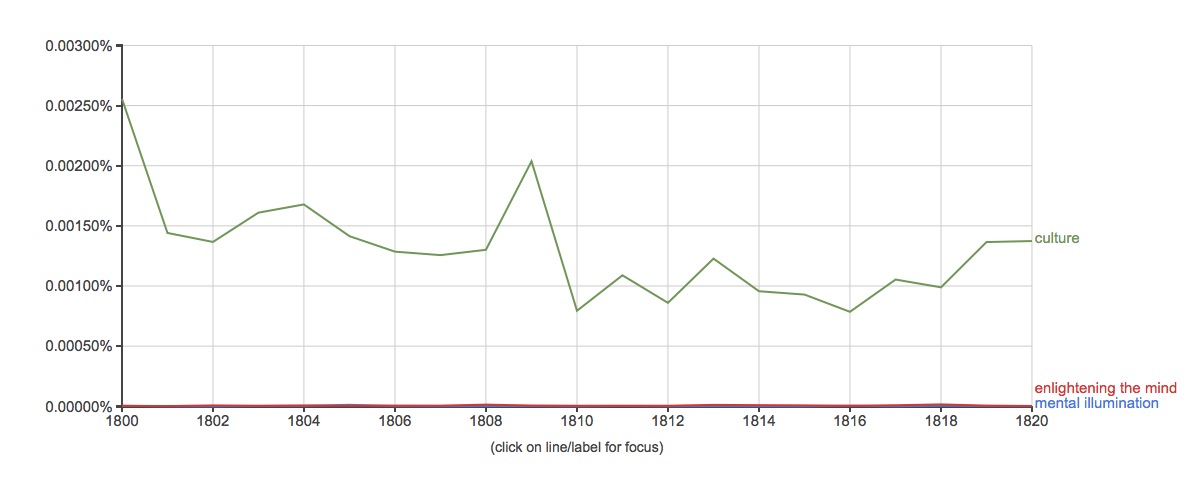
The German Museum’s affection for “mental illumination” and “enlightening the mind” was somewhat idiosyncratic. Plotting the two terms against “culture” over the first two decades of the nineteenth century yields the following:

Mental Illum,Enlightening,Culture

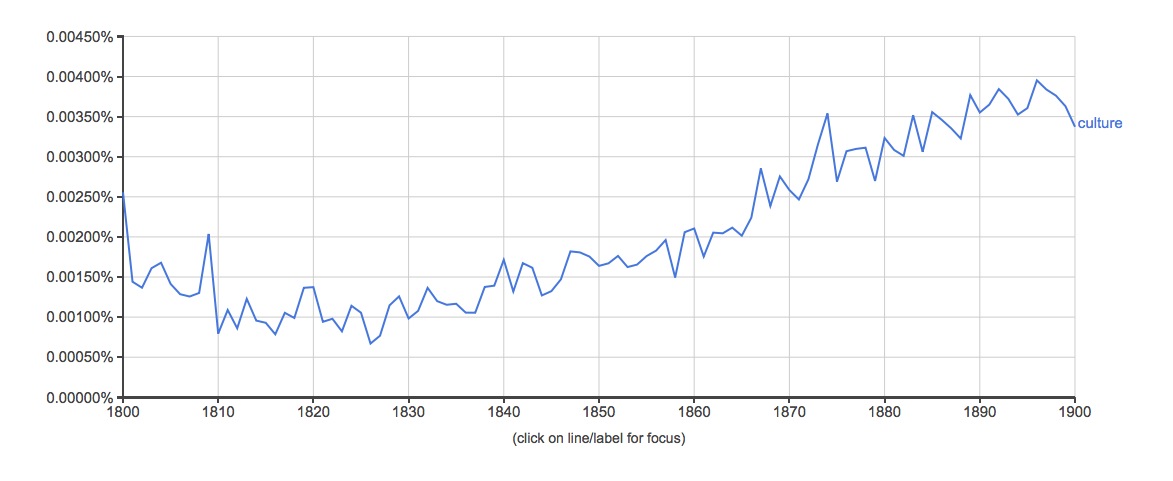
About the only surprise here is that the use of “culture” seems to be dropping. But a look at what happened to “culture” across the entire century provides a different picture:

Culture nineteenth century

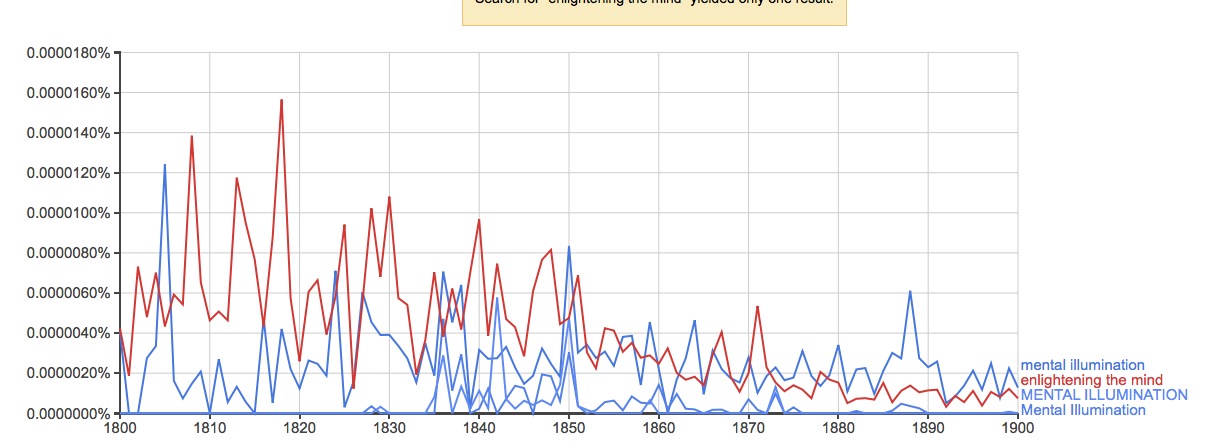
We can get a better sense of the career of “mental illumination” and “enlightening the mind” if we can take “culture” out of search (and make the search case-insensitive):

Illum and Enl nineteenth century

Again, what we find here is not entirely surprising: terms favored of the German Museum decline over the course of the century. The only thing that is unexpected is that the terms survived as long as they did, but a glance at the text samples suggests that in the last third of the century both terms are being kept in circulation chiefly in religious works.

As is usually the case, we learn a bit more from looking at the text snippets that Google provides. They show that “mental illumination” was turning up in such publications as The Monthly Magazine (“the King of Prussia and his amiable Queen rival with each other in displaying their laudable zeal for the promotion of mental illumination”), the London Medical and Physical Journal (“Greece, in her brightest day of mental illumination, would have deified the discoverer of the circulation of the blood”), and the English translation of Condorcet’s Outlines of the Historical Progress of the Human Mind (“a more general diffusion of the philosophical ideas of justice and equality, and lastly by the slow but sure effect of the progress of mental illumination”). The phrase “enlightening the mind” turns up in Dugald Stewart’s Elements of the Philosophy of the Human Mind, editions of the works of Alexander Pope and Samuel Johnson, and Samuel Miller’s Brief Retrospect of the Eighteenth Century (1803), a “sketch of the revolutions and improvements in science, arts, and literature,” written by a New York Presbyterian minister with connections to the American Philosophical Society and the History Society of Massachusetts. It would appear, then, that “mental illumination” and “enlightening the mind” did more or less the same work that would subsequently be done, more economically, by the word “enlightenment.”

Mendelssohn on Language and Concepts

By now it should be apparent that I have a certain weakness for staring at graphs of infrequently used words and savoring the peculiar text snippets that Google provides. In the present case, however, this peculiar habit is not without a certain justification. Mendelssohn, after all, began his answer to the question “What is enlightenment?” not, as Kant did, by defining the term, but instead with a claim about language use and, in the second paragraph of his answer, he offers the following suggestion about the relationship between language usage and concepts formation. Here’s how the 1800 translation renders it:

Common usage, however, although it apparently tends to establish a distinction between these nearly synonimous words, has not yet had time to fix the boundaries of each.

By the time Mendelssohn got around to answering the question “What is enlightenment?” he had been thinking about the relationship between words and concepts for close to three decades.4

As early as 1756 he included a discussion of the origin of language in the commentary he appended to his translation of Rousseau Discourse on the Origins of Inequality.5 Three years later he wrote an extensive review of Johann David Michaelis’s prize-winning response to the Berlin Academy’s question for 1759, “What is the reciprocal influence of the opinions of a people on language and of language on opinions?” for Nicolai’s Letters Concerning the Latest Literature and at about the same period wrote a manuscript on the development of language and its relation to thought.6

Mendelssohn maintained that progress in reasoning both fosters and is made possible by the development of “arbitrary signs” that allow for more complex and subtle understandings of relationships than is possible through the use of either “natural signs” (which are the direct effect of natural causes, for example smoke as a sign of fire) or “imitative signs” (sounds that mimic natural objects, either through verbal interjections or hieroglyphics). “The more men develop themselves [sich bilden],” he argued, “the more logical and abstract their ideas become, the more withdrawn their language is from the sensual expression of nature” (6/2:11). The possession of signs that are no longer tied to the materiality of objects fosters a process of abstraction and comparison that is “enlightening” (6/2:11).

Nowhere is Mendelssohn’s conviction that there is an intimate relationship between the development of language and the clarification of concepts more evident than in his discussions on the development of moral philosophy. At the start of Jerusalem, he observed that the “ingenious errors” of Thomas Hobbes — like those of Spinoza in the area of metaphysics — prompted efforts to clarify the relationship between right, duty, power, and obligation. The fruits of those efforts at clarification “have become so intimately fused with our language” that today the refutation of Hobbes “seems to be a matter of common sense” that is accomplished “by language itself” (8:106). It was this conviction that the development of conceptual distinctions was bound up with the development of language goes a long way to explaining why he argued, in his essay on enlightenment,

A language becomes enlightened by means of the sciences, and it becomes cultivated or polished by means of social converse, poetry, and eloquence. By the former it becomes more adapted to objects of theory, and by the latter to those of practice. Both together give a language that quality which is denominated civilization [Bildung].

I have, once again, quoted from the 1800 translation. But when I was doing my translation of Mendelssohn’s article, it never have occurred to me to translate Bildung as “civilization.” I suspect that this tells us something about the difference between the world in which Dahlstrom, Koegeler, and I live and that of our nineteenth-century predecessor. I will discuss that in the second part of this post.

In the meantime, for those who might be interested in reading the German Museum‘s translation, I have posted a copy of it here.

1800_The German Museum

  1. See Hans-Herbert Koegeler, “Reason, Tradition, and Critique:  Mendelssohn’s Essay on Enlightenment,” Public Culture 6 (1993): 201–217, James Schmidt, ed., What Is Enlightenment?: Eighteenth-Century Answers and Twentieth-Century Questions (Berkeley: University of California Press, 1996), and Moses Mendelssohn, Philosophical Writings, ed. Daniel O. Dahlstrom (Cambridge: Cambridge University Press, 1997).
  2. Moses Mendelsohn [sic]. “On Enlightening the Mind,” German Museum II (1800) 39-42
  3. Bayard Quincy Morgan and A. R. Hohlfeld, editors, German Literature in British Magazines 1750-1860 (Madison, Wisconsin: University of Wisconsin Press, 1949).
  4. I’m much indebted to Leah Hochman’s discussion of these matters in her 1999 doctoral dissertation Sign, Art, and Ritual: Aspects of Moses Mendelssohn’s Theory of Language (Boston University).
  5. Mendelssohn, “Sendschreiben an den Herrn Magister Lessing in Leipzig”, Gesammelte Schriften Jubiläumsausgabe 2:107-9
  6. The review of Michaelis appeared in Literaturbriefe 72-5 (December 1759); see Mendelssohn, Gesammelte Schriften Jubiläumsausgabe 5/1:105-118. For the essays on language from the same period see “Über die Sprache” and “Notizen zu Ursprung der Sprach” in Mendelssohn, Gesammelte Schriften Jubiläumsausgabe 6/1:3-28
Posted in Uncategorized | Tagged , , | 6 Comments

Tracking the Reception of Kant’s Answer to the Question “What is Enlightenment?”

As Dan Edelstein once observed, scholars have gotten into the habit of using Kant’s 1784 to the question “What is enlightenment?” as a convenient “one-stop shop for defining the Enlightenment.”1 There is a tendency to assume that because Kant was obviously an important eighteenth-century thinker, his attempt to explain just what was taking place at the close of the eighteenth century played a significant role in how the period was understood. Since I am as guilty of that tendency as the next person, I was somewhat taken aback when I first read Gisbert Beyehaus’ 1921 article on Kant’s “program of enlightenment” and came across his complaint that previous scholars had tended to treat Kant’s answer in a “step-motherly” fashion.2 At the time, I wrote this off to the tendency that scholars have to make it seem as if they are breaking new ground, even in those cases when they are moving down well-trodden paths (and, in any case, there was enough in Beyerhaus’ article that was new to me to get me interested in the context of Kant’s answer).

Recently it occurred to me that the Google Ngram might provide a quick (albeit dirty) way of exploring the reception of Kant’s essay. Matters are made somewhat easier by the fact that the famous opening paragraph of Kant’s contains a combination of words that is unlikely to occur in any other text unless it is quoting or discussing Kant’s article: the famously paradoxical formulation “selbstverschuldeten Unmündigkeit” (I’ve discussed the problems of translating this phrase in an earlier post). Further, Kant places this phrase at the very start of the essay, in a paragraph that has tended to be the most frequently quoted part of the essay. So, I figured, plugging selbstverschuldeten Unmündigkeit into the Ngram Viewer might provide a rough sketch of the reception of Kant’s essay. Here are the results:

Screenshot 2014-02-23 18.01.23

Readers who are familiar with the peculiarities of the Ngram may notice that I’ve left Google’s default smoothing on. Turning off the smoothing results in a somewhat different — and I suspect more accurate — picture of the discussion of Kant’s essay, with intermittent, but relatively intense, interest in the essay in certain years (note the peaks at 1799 and 1839):

Screenshot 2014-02-23 18.04.28

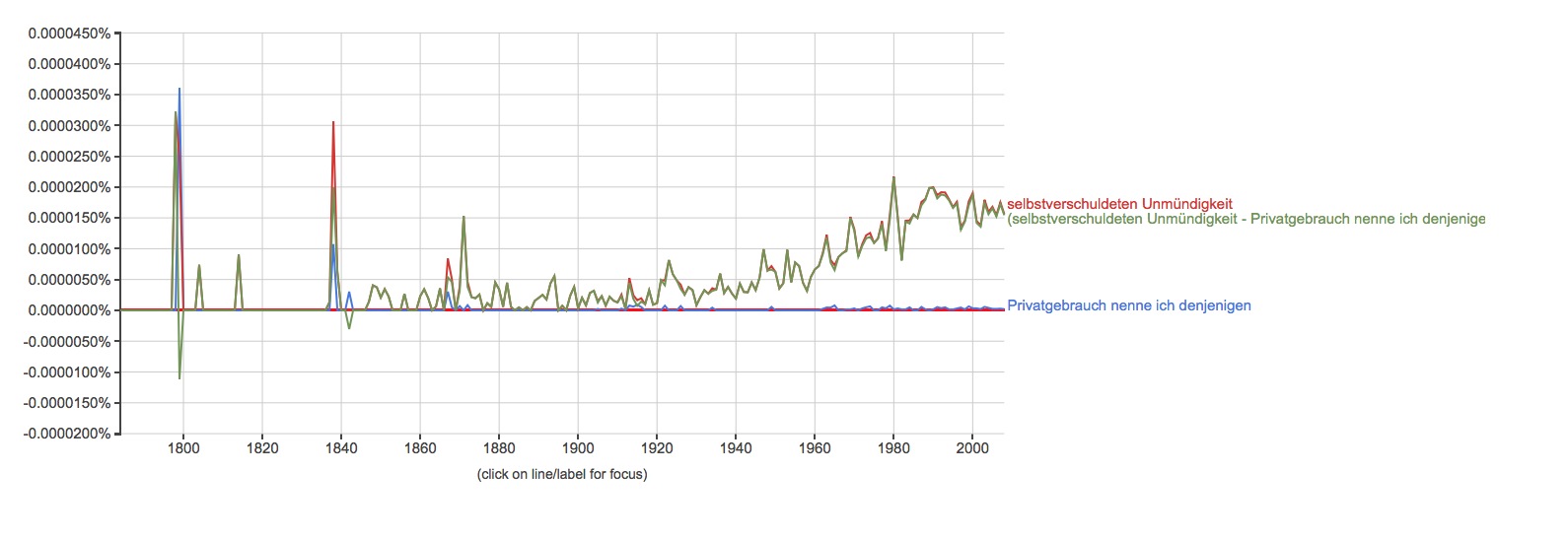
Looking at the samples Google provides confirms that most of the texts are, indeed, quoting the opening of Kant’s essay (in other words, “selbstverschuldeten Unmündigkeit” is not a term that turns up very frequently in contexts other than a discussion of Kant). But it also indicates that the peaks we are seeing in 1799 and 1839 are, in part, being driven by editions of Kant’s works, as opposed to actual discussions of Kant’s essay. Since I’m more interested in the latter than the former, it would be useful to screen out the occurrences of the phrase that occur in republications of Kant’s essay. Fortunately, the Ngram provides a way of doing this.

It is possible to construct an Ngram that subtracts the occurrences of one phrase from another and plots the result. The trick, of course, is to come up with another phrase in the essay that, while unlikely to occur in  texts from the period other than Kant’s essay, will probably not be turning up on the Ngram unless Kant’s entire essay is being reprinted. After playing around with a few possible contenders and checking to make sure that they weren’t phrases that were likely to turn up in contexts other than editions of Kant’s essay, I came up with “Privatgebrauch nenne ich denjenigen” (which appears at the point where Kant introduces his distinction between public and private uses of reason, but is not an interesting enough passage to stand on its own as a quotation).   Here is the result:

Screenshot 2014-02-23 18.21.15

Since it may be easier to make sense of this by actually looking at the Ngram itself (where Google gives you the ability to highlight different lines on the graph), it would be worth opening this link in a separate window and playing around with it as you read what follows (obviously, this is easier if you have a really big monitor). The green line shows us the result for all of the uses of “selbstverschuldeten Unmündigkeit” that occur in texts that do not also include the phrase “Privatgebrauch nenne ich denjenigen.” It is my suspicion that this provides us with discussions of Kant’s essay, as opposed to editions of Kant’s essay. One way of appreciating the differences between editions and discussions is to go to the Ngram itself and move the cursor between the graph for “selbstverschuldeten Unmündigkeit” and the one for “selbstverschuldeten Unmündigkeit – Privatgebrauch nenne ich denjenigen.” Notice how the subtraction of the term dampens the peaks at 1799 and 1840? What is being eliminated here are Kant editions.

I am perplexed by the negative result on the “selbstverschuldeten Unmündigkeit – Privatgebrauch nenne ich denjenigen” line right before 1800. If it is accurate (and I doubt it is), this would indicate that there are more occurrences of “Privatgebrauch nenne ich denjenigen” than of “selbstverschuldeten Unmündigkeit,” hence the tipping of the line into negative territory. While I suppose it could have been the case that was a flurry of discussion of Kant’s public/private distinction, I doubt it. What is more likely, I suppose, is that we probably should not trust what we are seeing for the 1799 results at all. If we simply limit ourselves to the post 1801 data, what we see is a discussion of Kant’s essay that is more or less dormant until shortly before the peak at 1840, has a lesser peak at 1870, and then begins a persistent rise around the beginning of the twentieth century. That rise around 1900 conforms rather nicely with what we’ve seen in earlier discussions of the gradual fading of the various pejoratives that once preceded the work Aufklärung, a fading that I’ve suggested might mark the point when Aufklärung stopped being a contested term denoting a process that could be explained in a variety of ways and began to be used to denote a (no less contested) historical period.

Of course, nothing that I have said here speaks to Beyerhaus’ complaint that, prior his essay, scholars had treated Kant’s essay in a “step-motherly” fashion.  But it does cast some light on a more basic question:  just when did scholars begin to deal with Kant’s essay at all.

  1. Dan Edelstein, The Enlightenment: A Genealogy (University Of Chicago Press, 2010) 117.
  2. Gisbert Beyerhaus, “Kants Programm der Aufklärung aus dem Jahre 1784,” Kant-Studien 26 (1921) 2-16, 2.
Posted in Uncategorized | Tagged , , , | 1 Comment

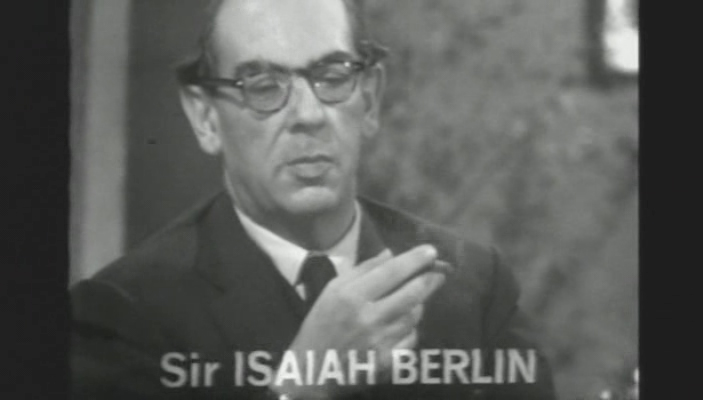
A Note on a Recently Published Letter from Isaiah Berlin on the “Counter-Enlightenment”

Having concluded a series of posts on the history of the concept of counter-Enlightenment, I’d planned to move on to other things. But, in the immortal words of Michael Corleone, “Just when I thought I was out … they pull me back in.”

In my case, “they” are the series of spiffy new editions of Isaiah Berlin’s writings that Princeton University Press has been publishing, which arrive decked out with new introductions and intriguing additional elvis-costello-get-happy-inner-78252materials. Their appearance presents me with the same temptation that the reissues (first on Rycodisc, then on Rhino) of the Elvis Costello oeuvre used to present. I would tell myself that I didn’t really need another copy of Get Happy! (though I think everybody ought to own at least one).  But — unable to resist the prospect of an alternative version of “I Stand Accused” — I would eventually break down and buy one. Since I already owned Vico and Herder and Magus of the North, I took a pass on Three Critics of the Enlightenment the first time around, but the most recent edition looks quite tempting and when Princeton offered the opportunity to look at an online examination copy, I took it.

The new version includes a December 1993 letter from Berlin to Mark Lilla, who reviewed Magus of the North for the New York Review of Books and had some reservations about Berlin’s affection for the various unsavory characters who populated the counter-Enlightenment. In response, Berlin offered an explanation of his general approach:

… by temperament I am liable not to write about thinkers I approve of — I take those for granted — I find it not very interesting to praise thinkers for what I agree with, but prefer their enemies, who, however vicious and destructive at times, as they certainly were, discovered chinks in the armour of the Enlightened, important chinks, which do make valid points against them — and which cause one at any rate to think, to realise that one can’t swallow them whole, that some of the results of their teachings did lead to deplorable results (496-497).

This is followed by a paragraph in which Berlin emphasizes that “of course” Diderot and Lessing (“two of my favorite thinkers in the eighteenth century”)

did not in any way lead to the horror of uniformity, and in the end the Gulag (497).

With that out of the way, Berlin goes on to offer an extended critique of Lilla’s review.

Lilla responded with a letter that closes with a postscript that reminds us of how little was known about the history of concepts like “Counter-Enlightenment” back in those dark ages when the only way to find out about the history of concepts was to read lots of books or ask someone else:

I have been unable to track down the history of the term ‘Counter-Enlightenment’.’ I find it first in English in your essay and, simultaneously, in Lewis White Beck’s history of German philosophy (1968). I had assumed that it was a simple translation of the German Gegenaufklärung, which had its own history, but I have been unable to uncover it. There is no entry on the term in German dictionaries, Philosophical Wörterbucher, or even the Geschichtliche Grundbegriffe I have even asked Reinhardt Kosellek about it, but he had no idea of its provenance. Do you, by any chance? (505).

This sparked yet another long letter from Berlin, which closed with the following:

Finally, the ‘Counter-Enlightenment’: I have no idea who used it first. It has been attributed to me, and I should like to think that to be true, but I cannot tell. Before I read your letter I had no idea there was such a word as Gegenaufklärung – so it is certainly not a translation of it by me. I modelled it on the word counter-Renaissance, which is the title of a book. More than that I do not know: I should like to think that I invented this useful word (511).

The claim that he term “modelled” the term on “counter-Renaissance,” is a somewhat more emphatic version of the account of the origins of the term that Berlin had given two years earlier in his interview with Ramin Jahanbegloo, which also alluded to Hiram Haydn’s book as an inspiration. 1 Berlin had previously cited the book in his 1972 essay on “The Originality of Machiavelli” and it turned up again in the “Bibliography” that was appended to his Dictionary of the History of Ideas article on Counter-Enlightenment.2

But what may be of greater interest here is his claim that he “had no idea there was such a word as Gegenaufklärung.” I suspect that time and memory could have been playing tricks on him: as I’ve discussed in an earlier post, the term became rather common in  German accounts of Romanticism and it is difficult to believe that, however fleetingly, Berlin would not have come across it here. Confirming that suspicion would require checking the text of those German works cited by Berlin in his discussions of late eighteenth- and early nineteenth-century thinkers, would pull me back in even further.

  1. Isaiah Berlin and Ramin Jahanbegloo, Conversations with Isaiah Berlin (New York: Scribners, 1991) 69-70
  2. The Machiavelli essay originated as a 1953 lecture. There is a copy of “a lightly edited transcript” of what would seem to be a somewhat later lecture on Machiavelli available from the Isaiah Berlin Virtual Library, but it does not contain a reference to Haydn or, indeed, anyone else: it has no footnotes.
Posted in Uncategorized | Tagged , | 5 Comments

Isaiah Berlin and the “Counter-Enlightenment”: A Reassessment (Fabricating the “Counter-Enlightenment” — Conclusion)

Since the middle of October I have been attempting to trace the history of the concept “counter-Enlightenment.” I set out on this venture convinced that Zeev Sternhell’s account of the history was wrong and confident that the sketch that I had offered a few years ago in a paper delivered at the meetings of the American Historical Association captured enough of the story to need only relatively minor adjustments. My agenda in commencing these posts was to figure out just what those adjustments might be. But one of the peculiar features of carrying out this exercise (an exercise that, as Hegel somewhat snidely described his friend Schelling’s early publications, amounts to “conducting one’s education in public”) is that it sometimes leads in unexpected directions.  While I have already run into quite a few surprises along the way (e.g., the diversity of German uses of the term, the unexpected appearances of the term in English during the first half of the twentieth century, and so on), the biggest one came at the end.

Like most people who have written on the topic, I blithely assumed that Isaiah Berlin would loom large in the account I was constructing.  While it has been obvious for some time that Berlin did not actually invent the term, he is generally viewed as having played a central role — if not the central role — in popularizing it. On that point, both his admirers (e.g., Joseph Mali and Robbie Wokler) and his critics (e.g. Zeev Sternhell) could agree.1

However, as my survey of uses of the term has come closer to Berlin’s first employment of the term in his 1973 entry on the topic in the Dictionary of the History of Ideas, I have begun to suspect that this way of thinking about Berlin’s role rests on a false premise: namely, that his use of the term marked a significant change in the way in which the concept was being used.  After working my way through the myriad uses of the term by American historians, literary critics, and social critics during the 1950s and 1960s, I have found myself wondering whether it makes sense to assume that the appearance of Berlin’s entry in the Dictionary of the History of Ideas had much impact on the use of a term that, by 1973, was by no means unfamiliar.  There are good reasons for continuing to see Berlin as closely associated with the concept.  But I think that there is little reason to see him as having had a significant influence on the way in which the term was being used.

An Overview of Usage 1950-1974

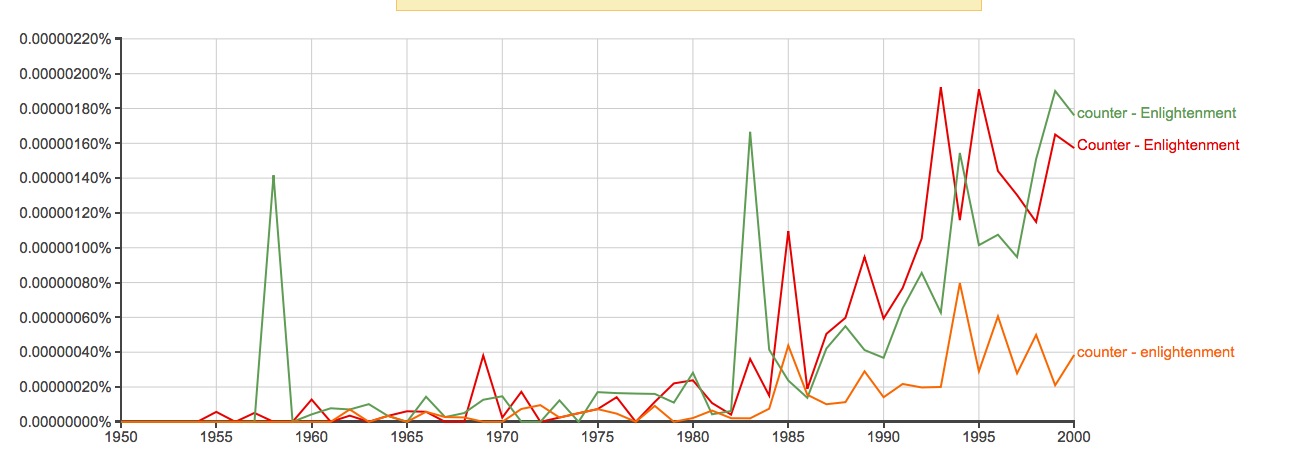
If we look at an Ngram of occurrences of the term “counter-Enlightenment” during the last half of the twentieth century what is perhaps most striking is that Berlin’s article in the Dictionary of the History of Ideas does not appear to have had much of an impact on the frequency with which the word was used.

Counter-Enlightenment 1950-2000

It appears that, when Berlin wrote his article on the concept, he was discussing a term that had been used, off and on, throughout mid-1950s (working my way through the various texts that used the concept prior to Berlin’s famous article has been one of the main reasons why this series of posts have taken so long to complete).

Which, if any, of these uses of the term he might have known about remains, and probably will remain, an open question. He had been in contact with Trilling from 1952 and the two kept up a lengthy (albeit, rather uninteresting) correspondence until Trilling’s death in 1975, but there is no solid evidence that he was aware of the exchanges between Trilling and Barrett in Partisan Review. It is hard to see how he could have avoided coming across the term Gegenaufklärung in the course of his reading of German histories of philosophy, but I have not done a systematic search of the texts he cites to see whether the term in there. At this point, all that can be said with any confidence is that when he wrote his article on “Counter-Enlightenment” for the Dictionary of the History of Ideas he took up a term that had been used by scholars working in a number of different disciplines.  He was the first to write an extended discussion of the concept, but he was far from the first to employ the term.

Further, it would appear that his initial use of the term had little or no immediate impact on the subsequent popularity of the term. The major uptick in usage came in the wake of the publication of Against the Current, though the peak usage of the term would not arrive until around 1995. Isaiah Berlin was an early adopter of a term that, for reasons unrelated to his use of it, was already in the process of entering into a broader usage.

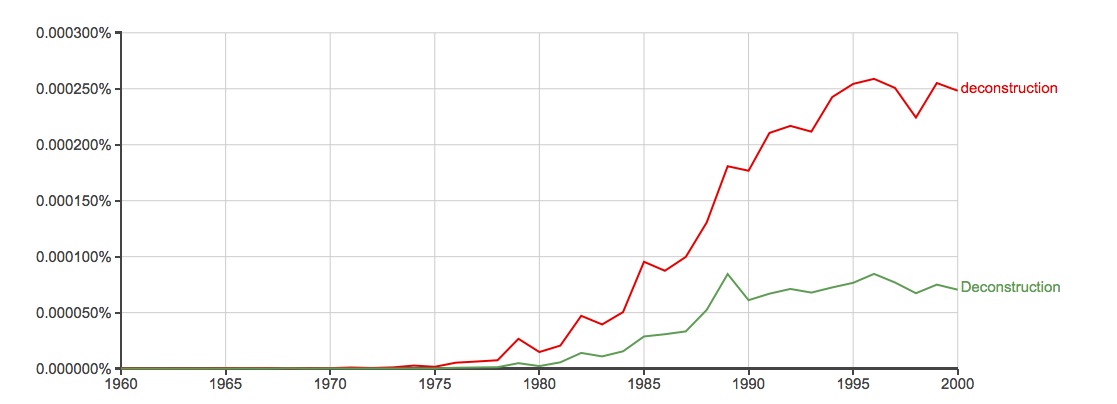
To appreciate this point, it might be useful to contrast the Ngram for “counter-Enlightenment” with that of a term that would enter into general usage over the next few decades:

Deconstruction

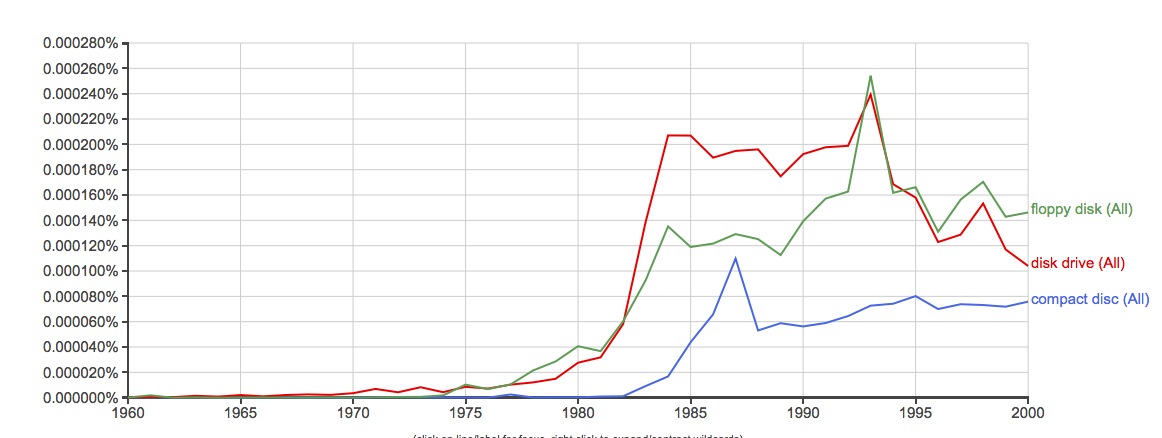
This is what it looks like when someone invents a term that catches on and is taken up by others. Unlike “counter-Enlightenment”, the trajectory of “deconstruction” resembles the pattern of usage for those words that are used to designate things that needed to be invented before we could name them.

Drives

In contrast, “counter-Enlightenment” was a term that was employed to designate traditions of thought for which we already had a variety of names (e.g., “enemies of the Enlightenment,” “critics of the Enlightenment,” “Romantics,” etc.).

The idea that “counter-Enlightenment” was term that had only recently been coined was implicit in the question Ramin Jahanbegloo posed to Berlin in a 1991 interview: “Who invented the word ‘counter-Enlightenment?”  It is worth noting that Berlin seems (rightly, I think) to have been taken aback by the question:

An American wrote a book on “Counter-Renaissance”. I don’t know who invented the concept of “Counter-Enlightenment.” Someone must have said it. Could it be myself? I should be somewhat surprised. Perhaps I did. I really have no idea.2

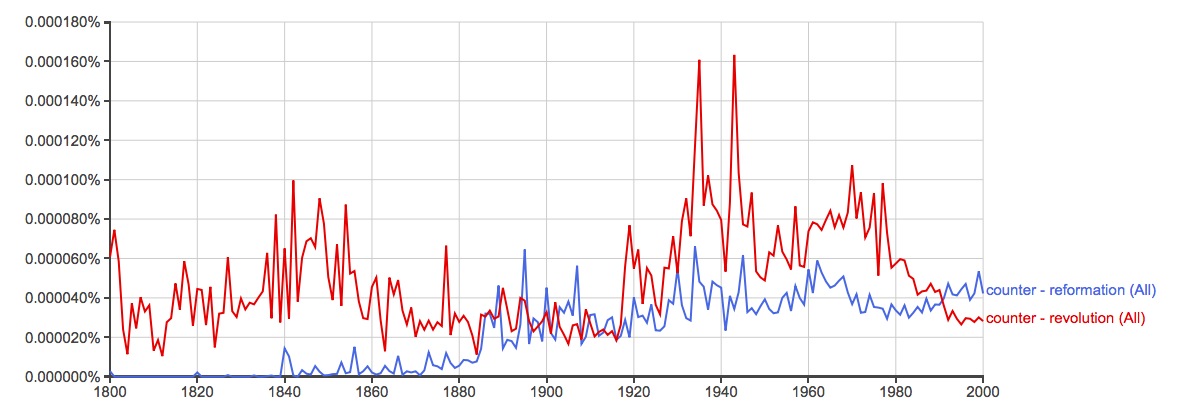
Berlin had every reason to have been confused. “Counter-Enlightenment” is not the sort of term that needed to be “invented.” The pieces from which it could be constructed had been lying around since the close of the eighteenth century and the terms “counter-Reformation” and “counter-revolution” served as readily available paradigms for showing how it could be assembled.

Counter Rev and Ref

That Berlin began his puzzled response by recalling Hiram Haydn’s 1950 book on The Counter-Renaissance suggests that he was aware of the ubiquity of such constructions.3

It could, nevertheless, be argued that though Berlin’s 1973 entry in the Dictionary of the History of Ideas may not have popularized a term that already enjoyed a limited usage among specialists, the republication of the article in Against the Current marked the point at which the term began to enter into a broader usage. This interpretation has some support in the Ngram for the term (especially if we assume that it might have taken some time for Berlin’s discussion of the term to reach a broader audience.  But it is essential to know whether those who were making use of the term after 1980 were actually influenced by Berlin, rather than continuing to draw on earlier patterns of usage.

Dan Edelstein recently called my attention to the uses to which the data visualization tools now available on JSTOR can be put. While I’m not entirely confident in the results I’ve gotten from playing around with them, they allow us to distinguish articles that use the term “counter-Enlightenment” from articles that employ both the terms “counter-Enlightenment” and “Isaiah Berlin.” The rationale for drawing such a distinction is that, just as early articles that employed the term “deconstruction” would have been likely to mention Jacques Derrida at some point, so too an article that invoked the “counter-Enlightenment” — were it, in fact, a term that had entered into general usage because of Berlin’s discussion of it — might be expected to mention Isaiah Berlin at some point. But this does not appear to be the case.

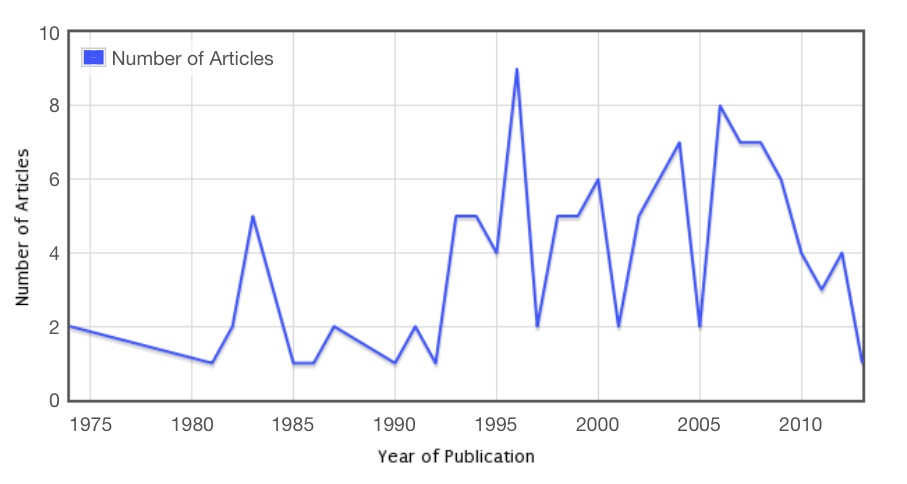
Here are plots of the number of articles using the term “counter-Enlightenment” (or its variants: JSTOR searches are case-insensitive) and those in which both the terms “Isaiah Berlin” and “counter-Enlightenment” occur.4

Counter-Enlightenment JSTOR

Counter-Enligthenment

Berlin & Counter-Enlightenment

Berlin & Counter-Enlightenment

The main point to take away from this is that while the “counter-Enlightenment” turns up with some regularity in articles archived JSTOR over the last quarter of the twentieth century, there are only five years in which Isaiah Berlin’s name appears in more than a third of the articles in which the term “counter-Enlightenment” appears: 1974 (66%), 1981 (33%), 1983 (39%), 1994 (36%), and 1996 (32%). Some of these results are easy to explain: 1974 (which saw a paltry three uses of the term) was the year after the publication of the Dictionary and two of those uses of “counter-Enlightenment” mention Berlin. The 1981 results were likely influenced by the appearance of Against the Current, which was widely reviewed. The Magus of the North was published in 1993, which may explain the results from 1994, while the figures from 1996 may have something to do with the publication of the collection The Sense of Reality and John Gray’s study of Berlin (which included a chapter on “Romanticism and the Counter-Enlightenment”), a combination that provided an opportunity for a series of articles offering a general assessment of Berlin’s career. I have no idea what explains what is going on in 1983.

None of this, of course, rules out the possibility that Berlin’s work may, in ways too subtle to document, have inspired others to take up the term. But it does suggest that those who were using the term felt little need to credit him for a concept that he had allegedly popularized.

Having spent more than enough time attempting to assess Berlin’s alleged role in popularizing the concept, it may be useful to explore some of the ways in which the term “counter-Enlightenment” was being used before 1973, particularly in the wake of what was assumed (prior to Henry Hardy’s recent inventory of uses of the term) to have been its first appearance in English: the use by William Barrett in the Partisan Review. JSTOR turns up 15 article that used the term between 1949 and 1973.  A considerably less reliable search on Google Books lists 58 items using the word during the same period, though this figure is inflated by the usual combination of bad metadata, repetition of items, and texts that cannot be accessed to confirm that there is actually anything present.5 Still, we have more than enough examples from this period to suggest that the term was being used, in slightly different ways, by a number of scholars (some of them with clear connections to each other) working in three areas: 1) literary criticism, 2) intellectual history, and 3) social theory. So let’s stop counting texts and start reading them.

Literature & the Counter-Enlightenment

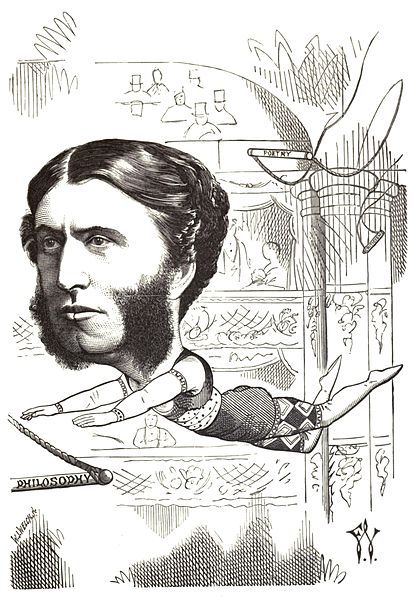
One of the earliest uses of the term by a literary critic was directly inspired by the 1949 exchanges between Barrett, Chase, and Trilling in Partisan Review: William Van O’Connor’s 1950 discussion of Lionel Trilling’s Critical Realism” in the Sewanee Review.6 O’Connor had worked with Trilling in the late 1940s and received his doctorate in 1948. His article took the publication of Trilling’s Liberal Imagination as the “occasion for a general examination of Trilling’s critical position” (482).

Matthew Arnold

Matthew Arnold

O’Conner began this examination by reiterating the parallel Trilling himself had drawn (in the brief introduction to The Liberal Imagination) between his position and that of John Stuart Mill and proceeded to flesh out Trilling’s analogy with a series of quotations from the Partisan Review exchanges (since the article contained no citations, the provenance of the quotations would have escaped most readers):

Matthew Arnold, himself an ardent liberal, took it upon himself to criticize the liberal mind. Lionel Trilling, our best student of Arnold and one of our most astute critics, has devoted himself both in fiction and criticism to examining those assumptions of the liberal mind that are themselves serious threats against a democratic liberal order.

Many liberals tend to think themselves morally, politically, and philosophically above their fellows; but Trilling has reminded them that even they, “the residuary legatees of the Enlightenment,” are subject to error, that in its pride liberalism will “unless purged and enlightened by a critical effort of great seriousness inevitably corrupt and betray itself into the very opposite of its avowed intention of liberation.” (482).

O’Conner returned to the Partisan Review exchanges a few pages later, noting, “One of Mr. Trilling’s most significant points is that the Enlightenment is merely one aspect of our intellectual heritage.” He went on to quote Trilling’s charge that “contemporary liberalism seems incapable of responding to the realistic values of Romanticism which, equally with the idealistic values of the Enlightenment, are properly part of its heritage.”7

To the extent that O’Connor had much to say about the Enlightenment, his characterization amounted to the usual set of clichés: e.g., “Another of our inheritances from the Enlightenment is the assumption that knowledge is only that which can be tested and labeled genuine in a scientist’s laboratory” (489). Somewhat predictably, he saw the Enlightenment as narrowly “rationalistic,” which enabled him to follow Trilling in presenting the counter-Enlightenment as a necessary corrective: it is “a movement that does not destroy but that qualifies and modifies our rationalistic tradition” (490).

These same moves were repeated, some two decades later, in Francis Russell Hart’s account of the English Gothic novel.8

Seen from our perspective, the Gothic signals a counter-enlightenment, climaxing an era naive in the fervor of its scientific naturalism, its rationalism, its benevolism, its commitment to the norms of “common sense.” The Gothic novelist, still “enlightened” but imperfect in his skepticism, gave to fiction a post-Enlightenment preoccupation with the preternatural, the irrational, the primordial, the abnormal, and (tending to include the rest) the demonic. (86)

Hart went on to argue that, while the function of the Gothic was to “rehabilitate” the “extra-rational,” this might best understood as an attempt to extend rather than reject the Enlightenment by “adopting and complicating” its “most representative literary invention, the novel” (86). This sets the stage for the claim that the Gothic novel represents

the reflection in fiction of the counter-enlightenment premise John Stuart Mill located in the Germano-Coleridgians: the Enlightenment had erred from a totally inadequate conception of human nature (88).

It is difficult to avoid the impression that, in discussions such as this, the author is working from a manual written by Trilling, checking off each move as he proceeds.9

Similar tropes can be found in the emerging field of American Studies, where a counter-Enlightenment was being assembled from some of the same figures who had been discussed in the studies by Chase that sparked the Partisan Review exchanges in the first place. For example, Leo Marx, in a discussion of the methodology of American studies that dates from shortly after the publication of his influential Machine in the Garden (1964), noted,

Writers like Thoreau and Melville,on the other hand, whose intellectual affinities were with the romantic turned the device [i.e., the image of the “machine in the garden”] into a dark counter-Enlightenment metaphor of contradiction.10

It should also be noted (as I discussed in the previous installment in this series) that Daniel Aaron, who had played a role in shaping this field, had already employed the term a decade earlier in his 1954 American Quarterly article “Conservatism, Old and New.”

Finally, the term appeared in a 1961 article on Thomas Mann’s Doctor Faustus by Joseph Frank, who would later gain fame as a Dostoevsky scholar. Frank’s early career had included studies at University of Wisconsin, a stint as a reporter in Washington during

Joseph Frank

Joseph Frank

World War II, a doctorate from Chicago’s Committee on Social Thought, and occasional articles for Partisan Review. What is perhaps most striking about his piece on Doctor Faustus is its stress on a “counter-Enlightenment” that includes considerably more troubling thinkers than the assortment of “Germano-Coleridgians” and Romantic poets typically invoked by those who followed Trilling’s lead.

Far from treating the counter-Enlightenment as a useful corrective to the “rationalist” excesses of the Enlightenment, Frank reminded his readers of its more problematic role in recent history.

After the defeat of Germany in the first World War, German culture was inundated by a flood of doctrines and attitudes exemplified by such names as Spengler, Ludwig Klages, Bachofen, Ernst Junger, Stefan George and tutti quanti. All these novelists, philosophers and, poets, Mann noted in an important article on Freud (1929), stress “the impotence of spirit and reason while … by contrast contrast the powers of the lower regions, the dynamic of of passion, the irrational, the unconscious, is exhibited with bellicose piety.” Whether or not, the writings of these men served as the intellectual and spiritual precursors of Nazism; Thomas Mann, who felt this whole movement as a perversion of his own deepest values, recommended Freud as an antidote in the courageous struggle he waged both as publicist and artist against this movement.11

The article to which Frank referred was Mann’s 1929 lecture Die Stellung Freuds in der modernen Geistesgeschichte, which had been originally delivered in May 1929 before the Munich Democratic Students’ Club and which sought to counter the National Socialist valorization of myth by situating Freud’s work in the context of a struggle between the Aufklärung and the Gegenauklärung that stretched back into the nineteenth century.12

Thomas_Mann_Freud_in_der_modernen_Geistesgeschichte_1929Unlike “Freud and the Future” — Mann’s later, and more famous, discussion of Freud — the Munich lecture was never translated into English, which meant that Mann’s discussion of the Gegenaufklärung would remain unknown to his Anglophone audience. The peculiar task that Mann set for himself, at a time when (as Anthony Kauders has documented in a useful article) Freud’s alleged “rationalism” was routinely denounced by Weimar psychologists who took their lead from Klages, Heidegger, and others who judged Freud insufficiently appreciative of the nurturing powers of mythos, was to defend psychoanalysis as “the only form of modern anti-rationalism which does not invite reactionary abuse.”13 In developing this argument, Mann took his point of departure from Nietzsche’s own complex stance towards the Enlightenment, which Mann characterized as an effort to press the forces of reaction into the service of a new Enlightenment. Mann, as Frank explained, was abundantly aware that things had not worked out as Nietzsche had hoped:

… while Nietzsche saw himself as carrying forward the banner of Enlightenment inscribed with the names of Petrarch, Erasmus and Voltaire, there is a little doubt that his own work had given a mighty impulse to the counter-Enlightenment holding the field in the Twenties. “Following in Nietzsche’s footsteps” Mann writes, “whose battle against Socrates’s enmity to instinct so pleases our prophets of the unconscious … following in his footsteps all the anti-rational tendencies of the 19th century have continued to our own day; In the more extreme cases, of course, not so much in his footsteps as over his body” (23).

While there is much here that needs to be sorted out (including a further discussion of just what Nietzsche might have been doing with Aufklärung and Gegenaufklärung in the peculiar sketch discussed in the opening post in this series) for now it may be enough to note that the relationship between Enlightenment and counter-Enlightenment that Mann was articulating in this lecture was far removed from the way in which it was understood by those admirers of Trilling whose understanding of the Enlightenment seems to have been limited to the set of cliches circulating among admirers of English Romantics for at least the last century. Nowhere is the disjuncture between Frank’s discussion and Trilling’s clearer than in the passing comments on Freud’s 1929 lecture that appear in the chapter on “Freud and Literature” in The Liberal Imagination.

The chapter originated in a 1940 contribution to a Kenyon Review symposium on Freud’s legacy.14 Though the absence of references of any sort makes it difficult to be sure, it would seem that Trilling’s comments on Mann’s “first essay on Freud” are directed at the Munich lecture (it does not help that it is unclear whether Trilling’s German was good enough for him to be able to follow Mann’s argument). Trilling takes Mann to task for failing to appreciate the degree to which Freud’s position was “militantly rationalistic” and “positivistic”:

If Freud discovered the darkness for science he never endorses it. On the contrary, he makes attendant upon his rationalism all the ideas of Enlightenment that have traditionally gone along with it and that give no validity to myth or religion; he holds to a simple materialism, a simple determinism, to atheism, to a rather limited sort of epistemology (41).15

While Trilling grants that this “rationalistic positivism” was the source of “much of Freud’s strength and what weakness he has,” it quickly becomes clear that Trilling’s chief concern lies with Freud’s weaknesses:

The strength is the fine clear tenacity of his positive aims, the goal of therapy,the desire to bring to men a decent measure of earthly happiness. But upon the rationalism must also be placed the blame for the often naïve scientific principles which characterize his early thought — they were later much modified — which consist largely in theories for his theories a perfect correspondence with an external reality, a position which, for those who admire Freud and especially for those who take seriously his views on art, is troublesome in the extreme (41-42).

What is perhaps most striking here is Trilling’s failure to comprehend either the political context in which Mann was working or the relationship between progress and reaction that he would go on to develop in Doctor Faustus. But to understand any of this, Trilling would have had to appreciate that “the counter-Enlightenment” was populated by nastier figures than Mill’s clubby Coleridgians and that the Enlightenment was neither as rationalist nor as narrow as he assumed.

History & the Counter-Enlightenment

The term also appears quite frequently in works written by historians during the 1950s and 1960s and, in most cases, serves as a way of designating the period that follows — and is populated by thinkers who are opposed to — the Enlightenment. Indeed, the usage seems to be so well-established and consistent that I suspect that it is likely that the term was a commonplace among historians well before Berlin’s article in the Dictionary.

For example, as early as 1955 it turns up in a Stanford University doctoral dissertation on Feuerbach, where it functions as the title of the opening chapter, which sketches the intellectual climate to which Feuerbach was reacting.16  The historian Henry May used it the next year in an article which, summarizing an unpublished 1952 lecture by Henry Nash Smith (who, like Daniel Aaron and Leo Marx was a pioneer in the field of American Studies), explained that Smith contrasted

two diametrically opposite points of view which … have divided our culture since 1910. One he calls the realistic-progressive view and the other the counter-enlightenment; the one takes for its standards measurable welfare and humanitarian progress and equality; the other values only the individual imagination, nourished on tradition, holding out desperately against a mechanized culture, and accepting if necessary alienation and despair as the price of its survival.17

It turns up again, though in a somewhat different sense, in a review of a book on the development of the concept of academic freedom in the United States:

The Enlightenment liberated the academic mind, as it did others, but it also produced a counter-Enlightenment, an incredible proliferation of sectarian colleges. By 1860 the 182 widely scattered American colleges were, by European standards, provincial colleges. Its professors were generally regarded, and all too often regarded themselves, as paid purveyors of tradition, not as free men with the professional right and professional function to discover and teach new truth.18

Two years later, a reviewer of Maurice Crouzet’s L’Epoque Contemporaine: A La Recherche D’une Civilisation Nouvelle offered a few reflections that echoed Daniel Aaron’s characterization of American universities as awash in a “counter-enlightenment.”

One wonders, as one goes along, is it merely one’s North American touchiness,or are the strictures on the United States not rather more conventional and barbed than any of the comments about the Stalin era? Will time and distance justify the characterization of American intellectual and university circles as now enjoying “a counter-enlightenment,” while the Soviet scene is dismissed obliquely as being the product of “the special conditions in which the Soviet Union has existed since 1917”?19

By the 1960’s the term was being used in ways that suggest that it had become a device for characterizing periods that, in some cases, were rather far removed from the immediate context of the eighteenth-century Enlightenment. For example, readers of the 1964 textbook An Age of Controversy: Discussion Problems in Twentieth-Century European History would have encountered the following:

Among the descriptive labels that have been proposed for the twentieth century is “the Counter-Enlightenment.” The phrase suggests a total reversal of that mood of optimism and hope, the confidence in man’s ability to understand and improve himself through reason, that marked the thought of so many eighteenth-century philosophes.20

It turns up again in a review of The Icon and the Axe, James Billington’s study of Russian culture.

A great virtue of the book is the detail it encompasses. Three notable examples are the onset of the schism under Alexis, the varied western influences that flourished under Catherine II, and an identification of the precise counter-enlightenment features at the beginning of the nineteenth century.21

Richard Clogg’s 1969 discussion of Greek Orthodox resistance to French Revolutionary propoganda contained the following sketch of Athanasios of Smyrna:

He was perhaps the most virulent and prolific of the numerous Orthodox antagonists of Western thought,who make what may perhaps be termed the Greek ‘Counter-Enlightenment’ such an interesting phenomenon. In his Antifonisis or answer to the absurd fervour of the ‘philosophers’ coming from Europe, demonstrating that the harm which they do to our nation is vain and nonsensical, and teaching what is in fact the real and true philosophy. To which is added a most beneficial exhortation to those sending their sons to Europe for education . . . (Trieste, 1802) he sought to warn parents of the grave spiritual dangers their children underwent in seeking an education in Europe, which was none other than “a chaos of corruption the very brink of Hades.” Those who studied in the West ran the risk of losing their senses or of sinking into Popery. For good measure,he denounced Plato as “woman-obsessed, a pederast and a parasite.”22

And, to round out this list, in 1971 R. R. Palmer drew a parallel between the polemics of the “Counter-revolution” and those of the “Counter-Enlightenment” in his World of the French Revolution.23

Social Theorists

Finally, the term can also be found, from time to time, in works written during this period by social theorists. The concept played a prominent role in a 1956 Dissent article by the Brandeis political scientist (and, later, Boston University sociologist) E. V. Walter that explored the concepts of “the elite and the masses.”24  Like Aaron, Walter characterized the current period as a time in which a “counter-Enlightenment” was on the ascent:

The men of the Progressive movement thought of themselves as children of the Enlightenment, armed with instrumentalism and the scientific method, fated to conquer ignorance, break the tyranny of vested interests and usher in the shining future. Now that Progressivism has run its course and reached its time of troubles, it is no wonder that the specter of the counter-Enlightenment should return to haunt it, and that the ghosts of Burke, Maistre and company should be conjured up to mock it. In response, embattled liberals exhume their own departed heroes, and the air is filled with the noise of shades locked in combat, the wail of ghostly polemics, the rattle of old bones.25

Walter argued that the polemics from an earlier age that had now been revived included Burke’s image of the masses as a “swinish multitude.”

Today, this image of the masses-as-barbarians is a negative vision, formed in reaction to the Progressive vision of an emancipated and omnipotent People marching inexorably Forward. The involution of this image, made popular by writers as similar in mind and diverse in talent as Ortega y Gasset, Walter Lippmann and Peter Viereck, is based on an aristocratic conception of political life that sees humanity as divided into two species: the primitive formless mass, and the élite, which is evolved, refined and purified from the mass and, presumably, restrained by inner controls.

Where the Enlightenment had located the sources of social evil in the rule of “corrupt élites,” the revived “counter-Enlightenment” saw the source of the pathology as residing with the “revolt of the masses.”

Walter was willing to grant that there might be a certain plausibility to the arguments of the counter-Enlightenment, but he also noted that the argument was not without a certain irony:

The insistence on the “imperfectability” of man, dinned into our ears lately, contains a staggering irony if one considers that it is educators, professors, journalists and other professional moralists who are writing in this vein and consequently declaring that their function in society is entirely useless. There is no reason for their existence if it is true that men, or even the masses, are unchangeable. He who denies human “perfectibility” is an immoral moralist because he prevents it from becoming real.

He concluded by noting that

the revival of counter-Enlightenment images has many special causes and functions. In a highly industrialized society, where solidarity is largely created by impersonal and mechanical bonds, the myth of the good Public or its involution, the bad Masses, is an abstraction that creates a false social unity.

The “masses” are not savages or beasts to be restrained by institutional devices, but human persons whose nature is social, who are capable of evil as well as good, who may be harried, intimidated and provoked into abnormality and delinquency, but who will find happiness only in the good. In a climate of distrust and fear, any individual and any group is a potential menace, but when these conditions are removed, people will respond with changes of “nature” that are incredible and profound.

What I find most intriguing about Walter’s use of the term (aside from having known him but not having realized that he was among the early users of the term that Isaiah Berlin didn’t invent) is the ways in which he sought, like Mann (and, like Freud and Nietzsche as read by Mann) to turn the arguments of the counter-Enlightenment against it and use them in the service of the hopes that had once been nourished by the Enlightenment. In that effort, he was keeping faith with the project that Theodor Adorno sketched in Minima Moralia: “Not least among the tasks now confronting thought is that of placing all the reactionary arguments against Western culture in the service of progressive enlightenment.” It is likely that he was aware of the ways in which his efforts were linked to this tradition: his Brandeis colleagues included Herbert Marcuse.

This interest in the possibility that reaction and revolution might be more closely intertwined than it is sometimes assumed can also be found in a book on Georges Sorel by the sociologist and critic Irving Louis Horowitz. It began by noting,

Sorel was more akin to the Counter-Enlightenment critiques that wafted out of German through the writings of Herder and Hamann, than to the French romanticism of Zola and Hugo, which through all its broodings about the agonizing alienation of modern man kept faith with the principles of progress and liberty.26

Finally, at the close of the 1960s, the journal Salmagundi published a translation of Jürgen Habermas’ discussion of Ernst Bloch.

Utopia, realized, would be “different.” This awareness of a limit certainly does not suspend its consciousness, nor would it justify a renunciation of utopian by the militants of the counter-enlightenment. The propaganda against the Jacobin results utopian beginnings may lead to, the hypocritical preachments against the terror of morality only increase the dangers to which they blind us.27

This translation, awkward though it may be, is significant not just because it is one of the first of Habermas’ texts to appear in English. Unless I have missed something (which is always a possibility in this sort of work) it marks the first translation of the German Gegenaufklärung into English.

Conclusion: Isaiah Berlin & the Dictionary of the History of Ideas

Towards the end of Zeev Sternhell’s discussion of Isaiah Berlin’s thought it becomes clear that Sternhell not only views Berlin’s account of the relationship between the Enlightenment and the counter-Enlightenment as flawed (a judgment that, it might be noted, is not unique to Sternhell) but also sees Berlin as one of the Enlightenment’s craftier, and more effective, enemies (a judgment that may well be unique to Sternhell).

It was precisely because Berlin was always able to position himself at the heart of the liberal establishment that there are few men who did more harm to the tradition of the Enlightenment than he did. Relativism is inherent to anti-Enlightenment thought, and despite his attempts to show otherwise, Isaiah Berlin, like Herder, was a relativist who refused to declare himself (418).

In Sternhell’s account, what attracted Berlin to the counter-Enlightenment was its rejection of the idea that it was possible to provide a single answer to what constitutes a “good life.”  While others might have been confused enough (or, perhaps, corrupted enough?) to think that the possibility that individuals may have rather different conceptions of the nature of a good life but, nevertheless, find ways of living together peacefully is one of the central premises on which liberalism rests, Sternhell would appear to view Berlin’s pretensions to liberalism as a charade. And that opinion, he notes, was shared by at least one other critic:

Berlin’s relativism did not escape the notice of Leo Strauss. Strauss was the only one of the great figures of the period not to have hesitated, at the time of its appearance, to reveal the reality behind the inaugural lecture, “Two Concepts of Liberty.” … He immediately understood the significance and political purpose of the … lecture, and was not swept off his feet by what Berlin had done. One should not hide the fact, he said in 1961, that this formula ‘is very helpful for a political purpose — for the purpose of an ‘anti-Communist manifesto designed to rally all anti-Communists.’ In other words, Strauss saw this text as simply a pamphlet of the cold war. … Finally, said Strauss, ‘Berlin’s statement seems to me to be a characteristic document of the crisis of liberalism — of a crisis due to the fact that liberalism has abandoned its absolutist basis and is trying to become entirely relativistic.’ (417-418)

It is unfortunate — or perhaps, as Sternhell likes to say, “it comes as no surprise” — that Sternhell shows little interest in tracing Strauss’s own views on the contribution of the Enlightenment to the shaping of modern liberalism back to the spring of 1941 when this (then chastened?) defender of “fascist, authoritarian, and imperial principles”  who had proudly refused to “crawl to the cross of liberalism” gave a lecture at the New School for Social Research that, in the fashion of the day, explained how National Socialism had been the result of the nihilism spread by the Enlightenment.28

mDfuHJ0-BvAm6TlaokgC9xQIntent on documenting the Cold War roots of Berlin’s account of the Enlightenment (a project that is nowhere near as questionable as his book sometimes makes it seem), Sternhell devotes little attention to Berlin’s article on “the Counter-Enlightenment.” It is as if, having assumed that Berlin was a friend of the enemies of the Enlightenment, it would be “no accident” for him to have contributed an article on their behalf to the Dictionary of the History of Ideas.

What has long puzzled me about Berlin’s article is the question of how it wound up in the Dictionary in the first place. At the risk of belaboring the obvious, there would seem to be at least two possibilities:

  1. Berlin was invited to write it by the editors of the work.
  2. Berlin proposed the idea for such an entry and the editors accepted it.

The first is the normal way in which articles turn up in reference works: editors solicit articles from authors and authors deliver what was solicited (hopefully at a price that makes the exercise worthwhile). If, as it was once believed, “counter-Enlightenment” was a term that had little, if any, usage in English prior to Berlin’s “invention” or “popularization” of it, it would be difficult to understand why anyone would be soliciting  an article on it from him (an article on “Romanticism” or “Liberty” perhaps, but an article on “Counter-Enlightenment”? Unlikely.)

The second option has one thing in its favor: Isaiah Berlin was not simply a contributor to the Dictionary, he was also on its editorial committee. This would have provided him with opportunities not normally available to contributors, including the possibility of suggesting a topic on which he wanted to write. But there is no reason to suppose that he was granted a carte banche and it is hard to see how the other editors of the Dictionary could have accepted a contribution on a topic that did not enjoy a certain currency.

I am inclined to think that it was Berlin who proposed the topic, but the survey I’ve provided supports either possibility. Having been engaged in research of a group of thinkers that might not easily fit into the existing topics that the Dictionary would be surveying, he may have proposed writing an article on “Counter-Enlightenment.” That the editors did not regard this proposal with the blank stare that they would have regarded a proposal for an article on the topic “Deconstruction” is easily explained: there is every reason to believe that this would have been a term that, by 1973, was reasonably familiar to them.

The examples I have present here could also support the first possibility: reviewing the topics to be covered in the Dictionary, the idea of an entry on “Counter-Enlightenment” might have been proposed and Berlin, who had done work on those thinkers who were associated with it, was invited to write it. This explanation, like its alternative, presupposes that “Counter-Enlightenment” was hardly an unknown term. And, on the basis of the evidence I have presented here, there is every reason to assume that, by 1973, was quite familiar.

Further evidence that “Counter-Enlightenment” was not an neologism can be seen in the response of reviewers of the volume. Reviewing the volumes for the Journal of the History of Ideas, F.E.L. Priestley seamlessly added the term to the titles of a series of other entries noting

Periodization itself gets illustrated and further analyzed in the Idea of Renaissance Humanism in Italy, Renaissance Humanism, Renaissance Literature and Historiography, Enlightenment, and the Counter-Enlightenment.”29

Likewise, the first reviewers of Against the Current found nothing peculiar about the term, even when they expressed reservations about Berlin’s account of it. Russell Jacoby’s critique in Salmagundi had no difficulty finding previous discussions of the topic to which Berlin’s might be contrasted:

It may be unfair to make comparisons, but one cannot help feeling that, on almost any subject, Berlin’s inquiries are less strenuous than others that come readily to mind. Compare Karl Mannheim’s “Conservative Thought” with Berlin’s “The Counter-Enlightenment”; or Franz Neumann’s “Montesquieu” with Berlin’s treatment.30

And the philosopher Stanley Rosen, reviewing the book for the Journal of Modern History, argued,

This failure to engage Nietzsche, together with the superficial treatment of Fichte and Hegel, is one of the two decisive weaknesses of this volume, which undertakes to discuss the dialectic of Enlightenment and Counter-Enlightenment, if not systematically, surely as a defense of freedom and liberalism.31

Rosen’s characterization of the book is significant for one further reason and, with a brief consideration of it, I can at last bring this series of posts to a close.

It is likely Rosen was not alone in sensing that the article on “Counter-Enlightenment,” which — understandably — opened the volume (where else could it go?), laid out the overarching concerns that informed the other essays in the volume.  It provided readers with a way of understanding how Berlin’s previously uncollected contributions to the history of ideas might be related to his more familiar work in political philosophy. From this emerged the now-familiar image of Berlin as a defender of liberalism who drew on the intellectual resources of the so-called “counter-Enlightenment” to curb the totalitarian tendencies that had plagued Enlightenment thought. Once this connection had been made it was hardly surprising that “Isaiah Berlin” and “the Counter-Enlightenment” would come to be closely associated.

For this reason, the important question about the relationship between Isaiah Berlin and the concept of “the Counter-Enlightenment” turns out not the one that Ramin Jahabegloo asked and which a few of us have been trying to answer. Rather than determining “Who invented the “Counter-Enlightenment,” it might be more important to ask “Who did the Counter-Enlightenment invent?”   That, I suspect, is a question that has a clear answer: “the author known as ‘Isaiah Berlin’.”

Thetrap_episode3_isaiah_berlin

  1. Joseph Mali and Robert Wokler, eds., “Isaiah Berlin’s Counter-Enlightenment,” Transactions of the American Philosophical Society 93, no. 5, New Series (2003). Zeev Sternhell, The Anti-Enlightenment Tradition (New Haven: Yale University Press, 2010).
  2. Isaiah Berlin and Ramin Jahanbegloo, Conversations with Isaiah Berlin (New York: Scribners, 1991) 69-70
  3. Hiram Collins Haydn, The Counter-Renaissance. (New York Scribner, 1950). As Baird W. Whitlock notes, the origins of this term can be traced back to the 1930s. See “The Counter-Renaissance,” Bibliothèque d’Humanisme et Renaissance 20:2 (1958): 434–449.
  4. Obviously, the first plot contains all of the articles that are turning up in the second plot.
  5. To take but one example: Google’s list includes Georges Arnaud’s Sweet Confession (1959), which it lists as somehow “related” to Darrin McMahon’s Enemies of the Enlightenment
  6. William Van O’Connor, “Lionel Trilling’s Critical Realism,” The Sewanee Review 58:3 (1950): 482–494.
  7. The Trilling quote comes from Trilling’s “Rejoinder to Mr. Barrett,” in Partisan Review XVI:6 (1949) 654.
  8. “The Experience of Character in the English Gothic Novel”, in Roy Harvey Pearce, ed. Experience in the Novel: Selected Papers from the English Institute, Columbia University Press, 1968
  9. For more of the same, see the characterization of Sir Walter Scott at the start of Francis Russell Hart, Scott’s Novels : “he was of the counter-enlightenment. It is as misleading to call him anti- Romantic as it is to call him Romantic,” (4) an interpretation that was praised by Geoffrey Hartman in a 1966 survey of recent works on nineteenth-century literature: “It is one of the virtues of Francis R. Hart’s Scott’s Novels … that he refuses to submerge practical criticism in the debate over whether Scott is Romantic or anti-Romantic. He calls him, neatly, of the “counter-enlightenment,” and in this matter, as in all others, refuses to “essentialize” and reduce the novelist to one orthodoxy. He is tireless in making distinctions against the simplifiers, and tireless, not to say faithful, in writing about the entire canon of Scott’s novels. He mentions that the conservatism of Scott may be close to that of Burke and Coleridge, but immediately quotes Lukacs on how profoundly he differed from such “antirevolutionary pseudohistoricists” as Burke and Joseph De Maistre”, “Recent Studies in the Nineteenth Century,” Studies in English Literature, 1500-1900 6:4 (1966): 767.
  10. Leo Marx, “American Studies. A Defense of an Unscientific Method,” New Literary History 1:1 (1969) 87. While Machine in the Garden mentions “the Enlightenment” several times, the term “counter-Enlightenment” is absent.
  11. Joseph Frank, “Reaction as Progress: Thomas Mann’s ‘Dr. Faustus,’” Chicago Review 15:2 (1961): 22.
  12. Thomas Mann, “Die Stellung Freuds in der moderne Geistesgeschichte,” Psychoanalytische Bewegung 1929 (reprinted in Mann, Die Forderung des Tages: Reden und Aufsätze aus der Jahren 1925-1929 (Berlin:Fischer, 1930) 196-224. 
  13. See Anthony D. Kauders, “The Mind of a Rationalist: German Reactions to Psychoanalysis in the Weimar Republic and beyond,” History of Psychology 8:3 (August 2005): 255–270. On the broader issue of the attraction of myth during this period, see especially Theodore Ziolkowski, “The Hunger for Myth,” in Modes of Faith: Secular Surrogates for Lost Religious Belief (Chicago: University of Chicago Press, 2007) 147-173
  14. Alexander Reid Martin, Lionel Trilling, and Eliseo Vivas, “The Legacy of Sigmund Freud: An Appraisal: Therapeutic, Literary and Aesthetic, Philosophical,” The Kenyon Review 2:2 (1940): 135–185. Trilling revised the contribution and, prior to its incorporation in The Liberal Imagination republished it in Horizon in 1947.
  15. In The Kenyon Review Trilling specifies Freud’s epistemological failings as involving a commitment to “a correspondence-theory of knowledge — a position which, for those who admire Freud and especially for those who would take seriouslyhis viewson art, is troublesome in the extreme.” 
  16. Melvin Cherno, Ludwig Feuerbach and the Intellectual Basis of Nineteenth Century Radicalism, Graduate Honors Program in Humanities, Department of History, Stanford University, 1955.
  17. Henry F. May, “Shifting Perspectives on the 1920’s,” The Mississippi Valley Historical Review 43: 3 ( 1956): 405–427, 426. May cites the lecture as follows: “The Reconstruction of Literary Values in the United States, 1900-1950 (unpublished manuscript,1952).”
  18. Arthur Mann, “Review of Gerald M. Craig; Walter P. Metzger, The Development of Academic Freedom in the United States ,” The William and Mary Quarterly 13:4 (1956): 599–601.
  19. John C. Cairns, “Review,” The American Historical Review 63:2 (1958): 364–365.
  20. Gordon Wright and Arthur Mejia, An Age of Controversy: Discussion Problems in Twentieth-Century European History (New York, Dodd, Mead, 1964) 486.
  21. Lionel Kochan, “Review,” The English Historical Review 83:327 (1968): 387–388.
  22. Richard Clogg, “The ‘Dhidhaskalia Patriki’ (1798): An Orthodox Reaction to French Revolutionary Propaganda,” Middle Eastern Studies 5:2 (1969): 87–115, 95.
  23. R. R. Palmer, The World of the French Revolution (New York, Harper & Row, 1971) 254.
  24. Three years later he employed the term again in a related discussion, “Power, Civilization and the Psychology of Conscience,” The American Political Science Review 53:3 (1959): 641–661.
  25. I cite this article from the version reprinted in Voices of Dissent (New York: Grove Press, 1958) 69.
  26. Irving Louis Horowitz, Radicalism and the Revolt against Reason: the Social Theories of Georges Sorel. (New York: Humanities Press, 1961) 14.
  27. Jürgen Habermas, “Ernst Bloch—A Marxist Romantic,” Salmagundi 10/11 (1969): 311–325, 324.
  28. The defense of fascist principles can be found in Strauss’ now-infamous letter to Karl Löwith of May 19, 1933, the 1941 lecture on “German Nihilism” is available in Interpretation 26:3 (1999): 353–378, and — as might be expected — Strauss’ disciples have been busy over the last decade and a half with attempts to the extract the secret message hidden in passages that no-one else has managed to decode.
  29. F. E. L. Priestley, “Mapping the World of Ideas,” Journal of the History of Ideas 35:3 (July 1, 1974): 527–537
  30. Russell Jacoby, “Isaiah Berlin: With The Current,” Salmagundi no. 55 (1982): 232–241, 238-239.
  31. Stanley Rosen, “Review,” The Journal of Modern History 53:2 (1981): 309–311.
Posted in Uncategorized | Tagged , , , , , , | 7 Comments

Turning One

A year ago, I accidentally launched Persistent Enlightenment.

I’d been playing around for quite some time with the idea of using WordPress as a way to store research notes and, as part of the experiment, had set up a private blog called “Persistent Enlightenment,” mostly because I liked the way the words looked.  Inspired by the work of colleague Manfred Kuehn — whose Taking Note ought to be required reading for anyone engaged in research and writing, impressed by what Robert Paul Wolff had done on The Philosopher’s Stone, and (closer to home) having been consistently enlightened and challenged by Ben Schmidt’s Sapping Attention, I thought about starting a blog where I could work out various projects that interested me and could dump research that wasn’t going anywhere, but seemed a shame not to share with others (e.g., what Adorno was doing in Thomas Mann’s garden).

So, on January 23, 2013, I thought I would write up a series of posts, save them on the site that I’d set up, and — when I’d gotten a backlog of six posts ready to go, start to publish them at regular intervals.  I was, however, a bit shaky as to how the buttons on WordPress worked and, at 10:21PM the very first one I’d thrown together —  “Sapere Aude, Incipit!” (appropriate topic, eh?) — was accidentally released onto an unsuspecting world (I’m not quite sure how that happened).   And here we are, one year, fifty-two posts, and 22,772 or so page views later.

Although the premature release of that first post meant that I was, from the start, operating without a backlog, I managed to keep to a schedule of at least a post a week until September. But things became a bit more complicated with the resumption of classes (the job of corrupting the youth isn’t getting any easier) and it probably hasn’t helped that my posts, which generally tend to run long, have been running even longer lately or that the topics I’ve been exploring have become a bit more puzzling (at least for me) and take longer to pull together.  As a result, I suspect I will be moving towards posting every other week, with some shorter posts when the inspiration strikes.  But this is, and will remain, a niche blog devoted to the consideration of “the Enlightenment as historical period and continuing project” (which means that I promise never to post cat videos, unless they have something to do with the Enlightenment, and I suspect it is unlikely that any of them will).

I figured that I should give the blog a birthday present.  If you look up on the menu bar you will see it:  a brand new tab called “topics.”  Inspired by the “finding aid” on the wonderful history of science blog Ether Wave Propaganda, I’ve created a page that groups some of the pieces I’ve written (especially the multipart ones) under topic headings.  New visitors to the blog might find this useful. Old readers might find things that they missed.  And I will be able to find what I’ve written a bit more easily.

La lutta continua …  and so does the blogging …Birthday+cake_669_17423282_0_0_2043_300

Posted in Uncategorized | 2 Comments

William Barrett, Lionel Trilling, and the “Residual Legatees of the Enlightenment” (Fabricating the Counter-Enlightenment Part V)

In the June 1949 issue of Partisan Review, William Barrett — a professor of philosophy at New York University and an associate editor at Partisan Review — closed a series of exchanges with the literary critics Richard Chase and Lionel Trilling on the nature of and prospects for “liberalism” with the following characterization of Trilling’s contribution:

Mr. Trilling indicates what might be described as the Counter-Enlightenment in the figures of Pascal, Blake, Burke and Wordsworth. I agree that the movement of the Counter-Enlightenment is a very deep and significant one in modern thought, though I should come at its historical definition a little differently from Mr. Trilling: I should not, for example, include Pascal though he deals with all its data, because he antedates the actual historical epoch in which this movement comes into being; and I think the issues of the Counter-Enlightenment are defined in more extreme, and therefore more lucid, fashion by figure of Continental rather than English literature.

Barrett then proceeded to offer his own version of the Counter-Enlightenment, which included Rousseau, Kierkegaard, Schopenhauer, Stendhal, Dostoevsky, Tolstoy “in his later phase,” Nietzsche “who lived completely this duality of the Enlightenment and Counter-Enlightenment” Bergson, Freud, Heidegger, Ortega y Gasset “and, in certain way, Whitehead.”1

Barrett

William Barrett

For those who care about such things, Barrett’s use of the term was once thought to have been one of the first, if not the first, use of the term in English. Zeev Sternhell — who, as we have seen in earlier installments mistakenly assumed both that the term had a distinctly Nietzschean provenance and that Barrett’s first use of the term occurred in Irrational Man, his 1958 study of existentialism — found it “not surprising that it was precisely in a book on existentialism that this Nietzschean concept appeared.”2 But, as I discussed in the third installment in this series, we now know that there had been scattered appearances of the term in English back to at least 1908. In contrast to Sternhell (who rarely seems to be surprised by the connections he discovers), my slog through the history of the concept of “counter-Enlightenment” has been filled with surprises. In the case of Barrett’s 1949 use of the term, what is perhaps most puzzling is how a set of articles about the meaning of and prospects for “liberalism” would up turning into a dispute about the legacy of the Enlightenment.

Back in January 2011 I gave a paper at the American Historical Association meetings that traced the general trajectory of these discussions and, since then, have uncovered a bit more in the Trilling Papers at Columbia about the dispute. There are still a few blank spaces that need to be filled in (and also some material that I need to get permission to cite), so what follows is a preliminary sketch of a discussion that will need to be fleshed out elsewhere.

How a Question about Liberalism Became a Controversy about the Enlightenment

Since there has not been a great deal written on the broader discussion that prompted Barrett’s use of employment of the term “counter-Enlightenment” let me begin by  listing the contributions  that appeared in Partisan Review and saying a bit about them:

  1. Newton Arvin, Robert Gorham Davis, and Daniel Aaron, “Liberalism and Confusion,” Partisan Review XVI:2 (1949): 220-222 — a letter from the three faculty at Smith College, written in response to earlier articles in Partisan Review and elsewhere (including a number of articles on Hermann Melville by Trilling’s friend Richard Chase), which the authors characterized as a “counter-attack against what is called the liberal-progressive tradition.” In response, the authors requested for clarification on “(1) What is the exact and responsible semantic content of the words ‘liberal’ and ‘progressive’ when used, as they increasingly are, in a pejorative context?”” and “(2) … from what similarly well-defined point of view are anti-liberal and anti-progressive writers speaking?.”
  2. A brief reply from Richard Chase in the same issues as #1, lamenting that he could not “in the space allotted me, defend my reading of Melville, or my use of words like ‘liberal'” and referred “interested persons” to the texts at issue. He concluded by noting, “If, as I hope, a skeptical, secular liberalism is to survive, it must be comprehensive, sharp, and an open view of life, not simply an acceptable stance vis-à-vis certain limited moral and potential issues.”
  3. William Barrett, “What is the ‘Liberal’ Mind?” Partisan Review XVI:3 (1949) 331-6 — an article that sharpened the question posed in item #1 with (1) a somewhat harsh assessment of Chase’s general approach to literary criticism (e.g., ” I suspect that he is in the grip of an idee fixe, a very large idea indeed, that obliterates for his mind the boundaries of literary criticism altogether: he is outside literature, outside politics, painfully engaged in groping for a philosophy of life”) and (2) a suggestion that a similar critique of liberalism could be found in “the flexible and extended critique of the liberal mind (and liberal imagination) executed by Lionel Trilling over the past decade or so.” He was, however,  perplexed by Trilling’s use of the term “liberalism” (a confusion that, it might be noted, was hardly unique to Barrett), noting that “At certain points where Mr. Trilling says ‘liberalism.’ Could he not just as well say ‘naturalism’ or ‘pragmatism’?” Continuing on these lines, he asked “if the fundamental attitudes of liberalism are the objects of our criticism, ought we not push our inquiry to its historical source and question the values of the Enlightenment itself?”
  4. “The Liberal Mind: Two Communications and a Reply”: a trio of articles by Chase, Trilling, and Barrett in Partisan Review XVI:6 (June 1949) 649-665. Responding to Barrett, Chase and Trilling offered their assessments of the significance of “the Enlightenment” and Barrett, focusing chiefly on Trilling, offered his own characterization of the “Counter-Enlightenment.”  He concluded by arguing that “while we must recognize that our tradition is formed of both these currents, and while also we must continuously enlighten the Enlightenment by its counter-movement, I think that it is to the Enlightenment we must, in the end, give primacy.” In his final paragraph he offered a sort of olive branch to Trilling, suggesting that he saw himself as having “passed from disputant to collaborator with Mr. Trilling.” And, with that, the discussion closed (though a somewhat peevish exchanges of letters continued between Barrett, Chase, and Trilling for the next month or so).

What we have here are a series of exchanges that began as yet another exercise in trying to clarify the nature of “liberalism” at the dawn of the Cold War, carried out by participants with contesting interpretations of what the concept implied. That it rather quickly turned into something different can be attributed to Barrett’s intervention, which — as the exchanges of letters between Chase and Trilling indicates — annoyed Chase greatly and drove an initially reluctant Trilling to enter the discussion.

William Barrett, Friend of the Enlightenment?

The contributions to the discussion that are of greatest interest importance for understanding the role of “the Enlightenment” and the “counter-Enlightenment” in this affair are, unfortunately, also the ones that are hardest to explain: the two contributions from William Barrett.  As was the habit of other editors of Partisan Review, Barrett went on to write a memoir of his adventures among the “New York Intellectuals,” but it says nothing about this affair and its chapter on Trilling offers little that has not been said elsewhere (much time is devoted to the poet Delmore Schwartz, with who Barrett was friends).3 Nor is there much to be gleaned from his published work from this period. His January 1949 article in the Kenyon Review on recent trends in American literary criticism avoids a discussion of either Chase or Trilling.4 Barrett had also been the author of the journal’s 1946 editorial “The ‘Liberal’ Fifth Column,” which, in effect, charged those associated with the liberal publications PM, The Nation, and The Republic with plotting treason, but the position he staked out in the 1949 exchanges was considerably less incendiary and, indeed, is not entirely easy to reconcile with the stance he had taken three years earlier.5 Unfortunately, Barrett’s papers remain in private hands, so all that is available to researchers are the few bits of correspondence of his that Chase and Trilling saved — that both of them seemed to have been quite annoyed by Barrett (indeed, at times, their comments border on open contempt for him) does not make matters any easier to sort out.6

So,  we are left with these two articles, where Barrett appears — in contrast to the works that would later secure his reputation7 — as a friend of the Enlightenment. Admittedly, he presents himself a somewhat skeptical friend — but I am inclined to think that there may not be, and ought not be, any other kind.

His initial contribution began as follows:

The twentieth century is the failure of the nineteenth. Hence follow many things through which we are now living, including a rather strange religious revival, or the effort at one, as well as a great variety of attacks upon what used to be called the liberal ideology. No doubt, liberalism, being part of the common failure, must come in for its share of the recriminations now hurled so earnestly at our parent century. But, amid the general muddle, there may be some point in observing that liberalism originated with the Enlightenment, that the Enlightenment was not the enthusiasm of a few people thinking by fits and starts but the conscious summation of the secular mind of Europe since the Renaissance, and that our present intellectual reassessment (if we are to have any) ought to start there. Since reaction is being worn this decade, the time may be here for our own reactionary banner with the slogan: Back to the Enlightenment!

It might be worth pausing, for a moment, to reflect on Barrett’s fleeting reference to the “rather strange religious revival” that he saw as part of the general assault on “the liberal ideology.”

We saw something similar in Charles Morris’ 1941 contribution to the Conference on Science, Philosophy and Religion, which — as discussed last time — portrayed empiricists as confronted by a “counter-Enlightenment and counter-Reformation which threatens to spread over mankind” and went on to argue that the best way to respond to this threat was to craft a new, universal religion that, free from the confines of particular dogmas, would supply the set of “motivational” signifiers that embattled democracies desperately needed. The idea that friends of liberal democracy might best support their cause by taking religion seriously was not, of course, unique to Morris or to the Conference on Science, Philosophy, and Religion. It was central to much liberal thought in the 1940s. And, perhaps most important for our immediate interest, the same concerns play an important role in Trilling’s work.

Lionel Trilling

Lionel Trilling

Forcing the Question: Trilling and Eliot

In 1940 Trilling published a short article in Partisan Review pondering the implications T. S. Eliot’s Idea of a Christian Society, which had been published the previous year. While Trilling has never struck me as a particularly clear writer, this essay seems even more labored than usual, perhaps because Eliot appears to have struck a nerve:

I am far from thinking that Mr. Eliot supplies a new world, yet in this troubled time when we are bound to think of eventual reconstructions I should like to recommend to the attention of readers probably hostile to religion Mr. Eliot’s religious politics. I say no more than recommend to the attention: I certainly do not recommend Mr. Eliot’s ideas to the allegiance. But here we are, a very small group and quite obscure; our possibility of action is suspended by events; perhaps we have never been more than vocal and perhaps soon we can hope to be no more than thoughtful; our relations with the future are dark and dubious. There is, indeed only one connection with the future of which we can be to any extent sure: our pledge to the critical intellect.8

The idea was that Eliot might play the role for troubled liberals that Coleridge had played for John Stuart Mill. Trilling drew out the parallel at the start of the essay in a passage that (unlike the rest of the essay) would appear again in the introduction to The Liberal Imagination:

It is a century ago this year that John Stuart Mill angered his Bethamite friends by his now famous essay on Coleridge. … he thought Coleridge’s ability “to see further into the complexities of the human feelings and intellect” offered something practical to add to Bentham’s too “short and easy” political analysis. And he told his radical friends that they should make their prayer this one: “Lord, enlighten thou our enemies’ . . . sharpen their wits, give acuteness to their perceptions and consecutiveness and clearness to their reasoning powers: we are in danger from their folly, not from their wisdom….” (367)

What, exactly, Trilling thought liberals could learn from Eliot is best left to more sympathetic interpreters to elaborate, but this peculiar essay helps to explain part of the reason why Trilling appears to have been so bothered by Barrett’s reiteration of the questions initially raised by Arvin, Davis, and Aaron. It would seem that he thought Barrett was attempting to force him to clarify something that he was either unwilling or unable to clarify.

At the risk of inflicting injury on readers who, unable to stay awake through Trilling’s tedious hand-wringing, wind up smashing heads into keyboards as they lapse into unconsciousness attempting to stay awake, let me quote the opening of Trilling’s response to Barrett:

Mr. William Barrett refers in a very gracious manner to my critical effort of the last decade and he characterizes its intention in a way that I should be happy to think is accurate. He then goes on to say, in reference to my strictures on the liberal mind, that he is puzzled about “the precise limits” at which my criticism might halt in its objections to the culture of liberalism; and he puts certain questions which are not, I take it, wholly rhetorical.

Mr. Barrett asks whether liberalism is not properly to be defined by its naturalistic and pragmatic beliefs rather than by a particular political, and presumably cultural, content. And he asks: ” If the fundamental attitudes of liberalism are the objects of our criticism, ought we not to push our inquiry to its historical source and question the values of the Enlightenment itself?”

It is to be observed of Mr. Barrett’s questions that they are, considered in their polemical intent, forcing questions. I conceive that they are intended to force Mr. Richard Chase and myself, or any critic of liberalism, to the wall of — let us for brevity be blunt about it — religion.

In sum Mr. Barrett is saying to Mr. Chase and me something like this: “Very well then — you have this habit of raising all sorts of objections to liberalism. I will give you a chance to say that you mean Stalinism and not liberalism at all. But if you don’t say that, then you must admit that when you attack liberalism as it now exists, you are really attacking naturalism, pragmatism and the values of the Enlightenment, and then the only frank and logical course open to you is to admit further that you want dogmatism and supernaturalism — that, in short, you are ripe to declare for religion.”

Mr. Chase will of course speak for himself, but I expect that he will join me in rejecting Mr. Barrett’s alternatives. My own reason for rejecting them is not that I regard the religious alternative with horror. My conception of the nature of our life is of a kind which prevents me from supposing that the person who elects religion is, by that, neurotic or ill-willed or intellectually discredited. I should add, for one can easily be misunderstood in these matters, that I myself am not drawn towards making this election. I reject Mr. Barrett’s alternatives simply because they are not real and legitimate alternatives (653-654).

Taking a lot of words to say rather little (it would seem that the editors of Partisan Review were intimidated enough by Trilling not to attempt to edit him) Trilling appears to see Barrett as forcing him down this path:

  1. Admit that the critique of “liberalism” that he and Chase are offering is, in fact, limited to a critique of liberal fellow-travelers, rather than liberalism itself.
  2. If #1 is not acceptable, then grant that the critique that he and Chase are offering amounts to rejection of an entire tradition that reaches back to the Enlightenment.
  3. But, having opted for  #2,  grant that it is necessary to abandon the pose of simply “recommending” a position such as that taken by Eliot and instead concede that the position defended is essentially the same as Eliot’s (or, worse still, Mortimer Adler’s).

Morris opened his contribution to the Conference on Science, Philosophy, and Religion by charging that critics such as Adler wanted to force the question back to the alternatives of scholasticism and positivism. Trilling may have concluded that Barrett was presenting him a similar set of alternatives. But where Morris was willing to cast his lot with the positivists (albeit a form of positivism that could reinvent itself as an open-ended form of religion), Trilling would appear to be attempting to hedge his bets. But only for a moment.

Lionel Trilling, A Counter-Enlightener in the Service of Enlightenment?

Barrett  closed his initial contribution by in effect offering Trilling the first of the options sketched above: i.e., confess that the problem is not with liberalism per se but rather with certain particular variants of liberalism. If Trilling grants that,  Barrett will be more than happy to join him.

It would be a pity if we did not record our deep gratitude to the critics of the liberal mind when the targets they have demolished have been so loud, public, and obnoxious: targets we recognize in the mentality of the now defunct PM and of certain contributors to liberal weeklies. But even where this social service of demolition has been real and necessary, there remain certain important considerations of intellectual economy. How much energy can is profitably expended in attacking the degradation of a doctrine? Is it really wise to take The New Republic as the residual legatee of the Enlightenment? And, finally, shall we be altogether unjustified if we begin to feel that when so much ammunition is expended on the minor targets the major target itself is indirectly under fire? It is conceivable that we have finished forever with Liberalism and the Enlightenment, that their intellectual values are no longer of use to us; but if so, we should like to know it; and we shall know it only if critics direct their scrutiny to the central attitudes, beliefs, and values involved, rather than to the various peripheral aberrations of these (336).

As we saw (and please don’t make me quote him again!) Trilling had begun his rejoinder by refusing either to accept or reject Barrett’s offer. But after having characterized— perhaps not incorrectly — Barrett as “forcing” him to “the wall of religion,” Trilling began banging his head against the wall.

Two paragraphs from the close Trilling announces “One last point and I have done” (cue sarcastic applause from the peanut gallery) and offers the following:

Mr. Barrett in conclusion expresses gratitude to the critics of the liberal mind for having “demolished” certain “targets” which he exemplifies by PM and certain contributors to the liberal weeklies. He then goes on to speak of intellectual economy and asks, “How much energy is profitably expended in attacking the degradation of a doctrine? Is it really wise to take The New Republic as the residual legatee of the Enlightenment?” If Mr. Barrett sees the quarrel with the liberal mind as having only this extent, then we who have carried on the quarrel are no doubt to blame.  I, for one, am willing to take the fault to myself — a literary person is always likely to be a little provincial in argument and to deal with what is closest to his immediate literary interest. But whether or not I have been able to make it plain in my own work, the quarrel with the liberal mind directs itself beyond PM and The New Republic. I have in view the ideas of our powerful teachers’ colleges, the assumptions of our social scientists, the theories of education that are now animating our colleges and universities, the notions of the new schools of psychoanalysis, the formulations of the professors of literature, particularly of American literature. Here are indeed the residuary legatees of the Enlightenment, and how eagerly they will tell you so, and how vehemently they will defend themselves from any question by pointing to the fine legality of the testament. This is the liberal culture that my own criticism has ultimately, if with insufficient explicitness, been directed against, although not, I would say, with quite the purpose of “demolishing” it. I only do not want to see it go its way unquestioned, unchecked and unmodified because I believe that, unless purged and enlightened by a critical effort of great seriousness, it will inevitably corrupt and betray itself into the very opposite of its avowed intention of liberation (657-658).

This passage could well serve as a sort of locus classicus for Lionel Trilling’s troubled relationship with liberalism and, more generally, the Enlightenment. He presented himself as a critic — and certainly not an enemy — whose aim was to save both from their own worst tendencies. But, at the same time, it is far from clear that he was particularly well-informed about what either liberalism or the Enlightenment might have involved. Because I work in a trade where the latter failing tends to matter more than the former (good intentions are nice, but accurate footnotes are better), I am one of those philistines  who (pace Adam Kirsch) is not inclined to think that Trilling “still matters.”9

Though the editors of Partisan Review never placed much stock in the tedious business of offering supporting citations for their claims, it would be worth knowing just which “powerful teachers’ colleges, … social scientists, … theories of education … new schools of psychoanalysis, … professors of literature” were characterizing themselves as the heirs of “the Enlightenment”? If there was, in fact, a massive groundswell of self-proclaimed admirers of the Enlightenment, how was it that the young Peter Gay, writing only a few years later, could have found himself faced with a cultural landscape in which critics of the Enlightenment war outnumbered its admirers?10  I doubt that the answer was that Gay was more careless in his scholarship than Trilling.

The “counter-Enlightenment” that Barrett sighted in Trilling’s rejoinder was, as he went on to note, a somewhat peculiar construction: “the line of Blake, Burke, and Wordsworth” with a bit of Pascal thrown in for good measure. Barrett based this characterization on a paragraph in Trilling’s rejoinder that, briefly and somewhat uncomfortably, sought to summarize his stance toward the Enlightenment.

… although I would add the proviso that we must be careful not to confuse with its source the present issue we inquire into, I agree with Mr. Barrett that something is to be gained by a historical reprise. And I myself habitually keep the Enlightenment in my thought and reading, having been led to do so a good many years ago by the necessities of dealing with Matthew Arnold’s situation. I don’t say this with any pride in my special historical vision, for I conceive that the whole of modern literature has been an inquiry into the values of the Enlightenment. The inquiry began with Rousseau; indeed, if Montaigne has any part in the liberal tradition — and whose part is finer? — then the inquiry began with Pascal’s attack on Montaigne. In ways too numerous to mention here in detail, the inquiry has continued up to the present, and the contemporary literature which by common consent is of the greatest stature follows in the line of Blake, Burke and Wordsworth (654).

What Trilling might have read about the Enlightenment is far from clear (his Arnold book does not betray much in the way of an examination of the broader historical context). Had he consulted the 1942 edition of the Manual for the Study of Contemporary Civilization — the mimeographed guide for those who taught in Columbia’s ambitious core curriculum (and, unless I am mistaken, their number included Trilling) — he could have found a wide-ranging and quite competent survey of the period that was put together by the young Charles Frankel, who would go on, a few years later to write a brief and sensible survey of the period.11 But Trilling’s take of the period was more in line with what one finds in the account of the Enlightenment that opens the section on “The Romantic Period,” a section to which Trilling’s friend Jacques Barzun was a principal contributor.

It has been pointed out that the common attitude characteristic of Romanticism was the sense of a constructive effort to be made. But how does this differ from that of the men of the Enlightenment? Chiefly in this, that the task of the Enlightenment was critical, destructive, defensive. The task of Romanticism was creative, innovating, speculative. There is a further difference. For its propaganda, the Enlightenment assumed the universal applicability of a few simple principles of reason. The philosophers of the Enlightenment were, on the whole, rationalists in the spirit of Descartes and Newton. The Romanticists, however, found eighteenth-century views too simple and too abstract. They were impressed by the diversities that exist in the world and they sought concreteness to supplement abstract truths.

Bad as this is, it manages to get worse. In support of the alleged “abstractness” of Enlightenment thought, this section of the Manual appeals to the judgment of Joseph de Maistre.

To be continued …

The Editorial Staff of Partisan Review

The Editorial Staff of Partisan Review

  1. William Barrett, “Art, Aristocracy, and Reason,” Partisan Review XVI:6 (June 1949) 664-665
  2. Sternhell, Zeev Sternhell, The Anti-Enlightenment Tradition (New Haven: Yale University Press, 2010) 3. 
  3. William Barrett, The Truants: Adventures Among the Intellectuals (Garden City, N.Y: Anchor Press/Doubleday, 1982).
  4. William Barrett, “A Present Tendency in American Criticism,” The Kenyon Review 11:1 (1949): 1-7.
  5. Barrett discusses the circumstances behind his writing of the editor on pp. 75-97 and reprints the lengthy editorial as an appendix to The Truants.
  6. As far as I can determine, the William C. Barrett Papers at Kent State University are not those of William Christopher Barrett, the philosopher, but of a different William C. Barrett, who served as editor of the Kent State University Alumni magazine, and are limited to correspondence having to do with the 1970 Kent State shootings.
  7. William Barrett, The Illusion of Technique: A Search for Meaning in a Technological Civilization, (Garden City, N.Y: Anchor Press, 1978) and Death of the Soul: From Descartes to the Computer, (Garden City, N.Y: Anchor Press, 1986).
  8. Lionel Trilling, “Elements That Are Wanted,” Partisan Review 7 September/October (1940): 367–379, 368. This article is particularly admired by those who see Triling as a neoconservative avant la lettre. See, for example, the discussion in Gertrude Himmelfarb, The Moral Imagination: From Edmund Burke to Lionel Trilling (Chicago: Ivan R. Dee, 2006) 219-229.
  9. Adam Kirsch, Why Trilling Matters, (New Haven: Yale University Press, 2011).
  10. Peter Gay, “The Enlightenment in the History of Political Theory,” Political Science Quarterly 69:3 (September 1954): 374–389.
  11. Charles Frankel, The Faith of Reason; the Idea of Progress in the French Enlightenment (New York: King’s Crown Press, 1948).
Posted in Uncategorized | Tagged , , , | 6 Comments

Charles W. Morris on Empiricism and the Counter-Enlightenment (Fabricating the “Counter-Enlightenment” Part IV)

The month-long hiatus since my last post can, in part, be attributed to the flood of papers that arrived in the wake of my discussion of English uses of the term “counter-Enlightenment” between 1908 and 1942 and the ensuing holiday festivities. But it also has something to do with the topic itself.

When I started this discussion back in October, I’d planned on focusing on the various errors in Zeev Sternhell’s brief discussion of the term and figured that could probably dispense with the topic in three or four posts. But the history of the concept of “counter-Enlightenment” has turned out to be a good deal more complex than I’d thought.

In this post I will begin by summarizing where we stand and then go on to explore the context surrounding the use of the term by the American pragmatist Charles W. Morris. In a subsequent post, I will say something about William Barrett’s use of the term and, if all goes well, finish things off with a post on what, if any, light this discussion may shed on Isaiah Berlin’s use of the term.

A Quick Recap

To pick up where I left off last time, the term “Counter-Enlightenment” appears four times in English texts published between 1908 (the date of first of the philosopher Charles Gray Shaw’s two uses of the term) and 1942 (when the term was used, in differing ways, by the historian John Tate Lanning and the philosopher Charles Morris). In contrast to the somewhat more frequent usage of the term in German during this same period, the presence of any uses of the English term during the first half of the twentieth century comes as a surprise. Zeev Sternhell’s brief discussion of the history of the term in English assumed that the term first appeared in William Barrett’s Irrational Man (1958), which was (somehow or other) supposed to have been inspired by an earlier usage in Nietzsche (the first post in this series questioned whether Nietzsche’s use of the term Gegenaufklärung had much to do with the subsequent history of the concept). Graeme Garrard’s considerably more careful discussion of the history of the concept cited Barrett’s 1949 Partisan Review article as the earliest use of the term in English. But, thanks to the labors of Henry Hardy, we now know that the term had been kicking around since the beginning of the twentieth century though it was not until Isaiah Berlin’s article in the Dictionary of the History of Ideas that it gained much traction in English.

Henry Hardy

Henry Hardy

Hardy’s research reminds us that those who attempt to establish the first appearance of a term would be well-advised to be cautious. It is possible that there there may be a few other examples to be found in books that Google has failed to make searchable or, perhaps, even to scan. But, in the interest of providing a set of conjectures that other researchers can knock down, I am inclined to think that the pattern of usage that we are likely to find in any future English examples is not likely to differ much from what we have seen in these first four English examples, which tend to echo the emerging German convention for using the term. To review the conclusions we can draw from our earlier discussion:

  1. The term is aways used as a way of characterizing the positions that other people hold, not as a description of beliefs held by the individuals using the term.
  2. The beliefs that can count as examples of “counter-Enlightenment” thought are as various as the different understandings of what constitutes “enlightenment.” While German historians of philosophy used the term to refer to those thinkers (e.g., members of the romantic movement) who they see as opposed to “the Enlightenment,” the term was also employed by nineteenth- and early twentieth-century German opponents of “the Enlightenment” as a pejorative for beliefs that we now typically associate with “the Enlightenment.”1
  3. Though subsequent German uses of the term (and all of the English examples I have found) associate the term with the opponents of what eventually came (first in German and subsequently in English) to be called “the Enlightenment,” there remains an ambiguity in the way in which the term is used: it can function either as a characterization of views that were held in an earlier period (e.g., during the “Romantic Age”) or as a way of describing a continuing opposition to the continuing project of the Enlightenment.

This last point can be seen in the two English examples from 1942. In his discussion of opposition to Enlightenment idea in eighteenth-century Latin America, Lanning was engaged in the historian’s task of exploring the ways in which ideas were appropriated during another period. But the “counter-Enlightenment” that figures in Charles W. Morris’s contribution to the second meeting of the Conference on Science, Religion, and Philosophy is not something that resides in the past; it is a present threat.

Charles W. Morris contra Scholasticism

Though not particularly well-known today, in 1942 Charles W. Morris (1901-1979)

Charles W. Morris

Charles W. Morris

was a figure of some significance in American philosophy.2 Trained at the University of Chicago by George Herbert Mead (whose Mind, Self, and Society he would later edit), he taught briefly at Rice University before returning to Chicago in 1931, where he remained until 1958.3 During the 1930s he was closely involved with representatives of the Vienna Circle, particularly Otto Neurath and Rudolf Carnap, and collaborated with them in the editing of the International Encyclopedia of Unified Science. Though his reputation (such as it is) rests chiefly on his early work on the theory of signs — including his Foundations of the Theory of Signs (1938) and Signs, Language, and Behavior (1946) — in the early 1940s he was beginning to produce a a series of works aimed at a general audience, including his 1942 Paths of Life: Preface to a World Religion.4

The concerns that would inform Paths of Life loom large in “Empiricism, Religion, and Democracy,” the paper Morris delivered in September 1941 to the Conference on Science, Religion, and Philosophy. It opened by drawing a parallel to certain earlier struggles:

Auguste Comte once remarked that the ultimate conflict in philosophy would be between positivism and scholasticism. The scholastics, or at least some who speak in their name, seem to be willing to force the issue into these terms. The more intemperate among them wish to ascribe the dislocations of contemporary culture to the spread of the empirical temper of mind; the more diplomatic wish to limit empiricism to the sphere of science in order to supplement it by the higher truth of a metaphysical philosophy.5

Morris argued that his fellow empiricists “should boldly accept this challenge.”

He must question the analyses of contemporary culture with which he is confronted and in terms of which he is damned; he must attack the metaphysical super-structure which his opponents graft upon the edifice he so laboriously and cautiously erects; he must show that there is a way (or ways) of life — a rich, dynamic, satisfying life — compatible with his attitude; he must deny that his opponents have a monopoly on the defense of the religious and cultural traditions of man; he must see to it that his own attitude clothes itself with esthetic, religious and political symbols adequate to serve in the enhancement and direction of life (213).

So, in order to counter the forces arrayed against it, Morris argued that empiricism needed to broaden the scope. But before we explore the sort of revised empiricism that he had in mind, we need to take a brief look at its enemies. In order to do that, we need to say something about the peculiar venue where he gave his talk.

The Conference on Science, Philosophy and Religion

In a 1995 Isis article David Hollinger discussed the role of the “Conference on Science, Philosophy and Religion” in debates involving science and religion during the 1940s and its history weaves in and out of George Reisch’s 2005 study of the fate of the “unity of science” movement in the United States during the 1940s and early 1950s.6 But we still lack a comprehensive history of the organization and assessment of its impact (any takers?).

Jewish Theological Seminary

Jewish Theological Seminary

The first of its series of annual meetings had been convened in September 1940 a few blocks north of Columbia University at the Jewish Theological Seminary of America. Sponsored by the “Conference on Science, Philosophy and Religion in their Relation to the Democratic Way of Life, Inc.,” this energetically publicized event (an article in the New York Times announced that “seventy-nine of the country’s leading scientists, philosophers and theologians” – including Albert Einstein and Enrico Fermi – had signed on to the Conference’s “spiritual call to arms”) sought “to rally our intellectual and spiritual forces” in the face of the threat of fascist totalitarianism. Its organizers maintained that the “failure to integrate science, philosophy, and religion, in relation to traditional ethical values and the democratic way of life” had been “catastrophic for civilization.” In response, they sought to bring together representatives of the disciplines of “philosophy, science, and religion” in hopes of reaching “a consensus concerning the universal character of truth.”7

It was considerably easier for the members of the Conference to agree on what they opposed – namely, the “anti-scientific, anti-philosophical and anti-religious dogmas” that they saw as providing the foundation for totalitarian systems of thought – than it was for them to specify how to overcome the “departmentalization of thought” that had cut science, philosophy, and religion off from “traditional ethical values and the democratic way of life.” The press release announcing plans for the symposium stressed that the conveners had no intention of depriving any discipline of “its genuine autonomy” and also rejected the notion that “it is possible or desirable that Western religions be reduced to a common denominator.” Yet, at the same time, the group insisted that “our common background gives us a broad basis for a united, democratic American way of life.” Fundamental to that way of life was “the religious principle of the Fatherhood of God and the worth and dignity of Man when regarded as a child of God.”8

Mortimer J. Adler

Mortimer J. Adler

The tension inherent in the attempt to respect the autonomy of disciplines while, at the same time, appealing to fundamental religious values was nowhere more apparent than in the caustic address delivered by Mortimer J. Adler (one of the Conference’s founding members) at the inaugural meeting. As he saw it, the greatest danger to “the democratic way of life” came not from foreign enemies but from forces closer to home.

I say that the most serious threat to Democracy is the positivism of the professors, which dominates every aspect of modern education and is the central corruption of modern culture. Democracy has much more to fear from the mentality of its teachers than from the nihilism of Hitler. It is the same nihilism in both cases, but Hitler’s is more honest and consistent, less blurred by subtleties and queasy clarifications, and hence less dangerous.9

Professors, he charged, were, at bottom, hypocrites: they argued for religious toleration and gave lip-service to the idea that religious belief played an important role in modern society, but refused to recognize that “religion rests on supernatural knowledge” or to acknowledge that “it is superior to both philosophy and science.” That refusal, Adler insisted, paved the way for disaster: “The mere toleration of religion, which implies indifference to or denial of its claims, produces a secularized culture as much as militant atheism or Nazi nihilism.” By the end of his lecture, Adler appeared to imply that Nazi nihilism was, if anything, preferable to the values embraced by American academics.

In a passage that reads like an attempt to reprise Joseph de Maistre’s view of the Terror as God’s revenge on France for the blasphamies of the philosophes Adler suggested that it was possible to view Hitler as part of “the Divine plan to bless man’s temporal civilization with the goodness of Democracy” by “preparing the agony through which our culture will be reborn.” The professors, however, were so thoroughly complicit in the crisis that engulfed modern culture (though the most specific evidence Adler offered of their complicity was their lack of enthusiasm for the Great Books program that his mentor Robert Maynard Hutchins inaugurated at the University of Chicago) that “until the professors and their culture are liquidated, the resolution of modern problems … will not even begin.”

Adler’s rhetoric was extreme, but the notion that the appeal of National Socialism lay in its providing an alternative to the nihilism that had been the bitter fruit of efforts at enlightenment was hardly unusual. An address to the symposium by the Catholic theologian Jacques Maritain made much the same point, albeit in more temperate language. He saw the chief threat to modern democracies as stemming from the “false ideology” that maintained “that a democratic society must be a non-hierarchal whole.” Against this view, he insisted that democracy ultimately rested on an “organic hierarchy of liberties” and that the knowledge of the proper ordering of these liberties required the sort of metaphysical and theological knowledge that modern science and technology tends to erode. For this reason, “an education in which the sciences of phenomena and the corresponding techniques take precedence over philosophical and theological knowledge is already, potentially, a Fascist education” since it can offer no foundations for morality other than “biology, hygiene and eugenics.”10

The 1941 meetings were somewhat less contentious (thanks, in part, to Adler’s absence), though echoes of the inaugural meetings turn up from time to time. Hudson Hoagland, a Clark University biologist who would go on to have a distinguished career in neuroendocrinology, drew the following lesson from a series of meetings with “Catholic and Protestant theologians, professional scientists and philosophers” that he chaired during the winter of 1940-41 at the American Academy of Arts and Sciences.

I believe that this conference can be best served if we accept as given certain fundamental differences orientation on the part of philosophers, theologians and scientists, and endeavor to stress not these differences, but rather the common grounds on which we may meet to consider constructive program of action. It is simply a fact that many, if not most, scientists are agnostics. It may be this fact that is the basis for the poor participation of scientists in the New York Conference. It is certainly not due to any lack of concern on their part with the present world crisis. Their agnosticism is as deeply ingrained as is the religious faith of many of their friends.11

And while the opening of Morris’ talk seemed to lay the ground work for a full-throated counterattack on empiricism’s “scholastic” critics, what followed turned out to be considerably more complicated.

Countering the Counter-Enlightenment

The problem, as Morris saw it, was not simply that the empiricist was “faced with opposing forces of great magnitude.“ To make matters worse, “he remains his own worst enemy.”

… he has become distrustful all modes of expression other than the scientific. Ill-adapted himself to such modes of expression, frequently lacking in imagination and non-scientific forms of sensitivity, he has not merely himself failed to round out his own life, but he often seemed to belittle, to restrain, to frustrate those forms of human activity in the arts and religions which, in a pure form, he should encourage and release. (214).

As a result, empiricists were ill-equipped to take advantage of the opportunity that lay before them.

there are large groups of persons among the youth, the workers, the artists, the religionists, the scientists, the technologists for whom the older religious and political symbols — claiming a special metaphysical sanctions – have lost their force. If there is confusion in contemporary culture, there are also deep sources of energy, frustrated aspirations, new beginnings, movements hovering on the verge of consolation, untapped sources of heroism. If the empiricist can overcome his own frustrations, and develop or encourage others to develop a clear program for living, he may rally these forces for a powerful, integrated, and perhaps successful opposition to the counter-Enlightenment and counter-Reformation which threatens to spread over mankind. (214).

In other words, the strength of the counter-Enlightenment was, in part, a consequence of the inadequacies of the forces of enlightenment.

Indeed, in Morris’ account, the traditional forms of religious belief that friends of the Enlightenment had long associated with the counter-Enlightenment had already been significantly compromised: “the traditional symbols of religion have lost much of their power.” And the explanation for this loss lay, in part, with the way in which these symbols had been tied to “the question as to the truth or falsity of certain statements about the universe.” But, far from hailing this as the presage of a day when science would liberate humanity from the sway of religious beliefs, Morris suggested that to see the situation in this way rested on a fundamental misunderstanding of the function of religion: it involved something more than just an attempt to make conjectures about the universe.

the heart of the religious problem lies in the determination of what type of man is to be given allegiance. For if a religion is essentially a path of life, the goal of this path is to become a certain type of person (227).

To understand this aspect of religion, empiricists needed to revise their understanding of the variety of claims that were at work in religious discourse. And this is where Morris’ theory of signification came in.

Referors, Formors, Expressors, and Motivators

In addition to serving as way of referring to objects in the world (what Morris calls their role as “referors”), signs perform three other functions: “the formative, the expressive, and the motivational” (or, as Morris dubs them “formors, expressors, and motivators”). A formor “simply exhibits or determines a certain sign combination.” Formors play the leading role in logical and mathematical discourse, while, in contrast, “scientific discourse” is conducted through the use of “referors”. Morris held that the critique empiricists had mounted against “metaphysical discourse” had consisted largely in demonstrating that it was made up of “definitions masquerading as genuine knowledge” — i.e., formors that were presented in the guise of referors. But such a critique could not capture the full power of religious discourse. “Expressors” (i.e., “a sign whose usage is normally accompanied by a certain state of the user”, a state that the sign “expresses”) and “motivators” (i.e., “a sign whose function is to influence the user or users of the sign”) also played a significant role in it.12 Translating the conclusions of his colleague A. E. Haydon’s Man’s Search for the Good Life (1937) into this terminology, he concluded that

Religious language is charged with expressors which indicate approval by an individual or group of individuals of certain supreme goals of life rather than others; it is rich in motivators which aim to induce a certain way of life believed to lead to the attainment of the preferred goal; and it contains statements about the world which are felt to justify the approved goal and the recommended techniques (233).

Over the next few pages he sketched what would be a central theme in Paths of Life, arguing that the crucial question for empiricists was to craft a set of “expressive and motivations symbols” that could foster an “image of man” that could function as the foundation for a viable democratic order. What was required, in other words, were a set of “motivational symbols” that could equip democracies with the sorts of resources had been adeptly deployed by their Fascist and Marxist enemies.

Two points are worth noting here. First, as I stressed at the close of the previous post, when Morris speaks of a “counter-Enlightenment,” he is using the term rather differently than it was used by Lanning and Shaw. For them, the counter-Enlightenment was something that had taken place in the past. For him, it is a movement that persists into the present: it can be seen both in the noisy posturing of Mortimer Adler and, even more ominously, in the forces that have laid waste to Europe. Second, and perhaps more surprisingly, Morris insists that the success of this counter-Enlightenment resides, to a significant degree, in the shortcomings of the legacy that the Enlightenment has left us. In his talk to the Conference his discussion of this second point is confined to his opening comments on the extent to which “empiricists” have failed to rise to the challenge they face. But it plays a much more significant role in Paths of Life.

Enlightenments, Promethean and Apollonian

I will not attempt to summarize the broader account of “life paths” that provides the overall structure for this strange book — suffice it to say that, for Morris, there are seven, each of which is linked with a different mythical or religious type: Buddhist, Dionysian, Promethean, Apollonian, Christian, Mohammedan, and Maitreyan.13 The most relevant for our discussion are the Promethean, Apollonian, and Mohammedan. It probably comes as no surprise that the “Promethean” project consists of an attempt to shape the world in ways that are conducive to the satisfaction of human ends. For Morris, this stance achieved its “widest application” in the work of John Dewey (92-93). In contrast, the Apollonian attitude sees the world as essentially rational and harmonious, seeks to attain a certain measure of clarity about this order, and pursues policies that tend to be traditionalist. The “Mohammedan” project concentrates on maximizing the interests of a particular community, usually to the exclusion of others.

Like Spengler before him, Morris sees the Promethean stance (with Faust as its archetypal figure) as central to modern societies. In contrast, Nazi Germany and Stalinist Russia exemplify a modern and peculiarly aggressive variant of the “Mohammedan” path. Morris’ account of the Apollonian stance is somewhat more complicated.

The Apollonian temperament has received expression in various cultures. Its features are clear in the cult of Vishnu and in Confucianism; they appear confusedly in Aquinas’ Aristotelianized version of Christianity; they are discernible in the pause of Western culture at the period of the Enlightenment (124).

Much of the difficulty in making sense of Morris’ argument can be traced to the way in which he uses his types to refer both to broader cultural dispositions and to individual character-types and to his insistence that both individuals and cultures are subject to transformations that involve one or another of these particular paths taking on a dominant position in response to the challenges they encounter. The result is a rather complicated account that deserves more time than I have been able to give it.

As an example, here is what he has to say about the fate of “Apollonian” type.14

The Apollonian is an active type of person in whom the promethean component is dominant but held in check by a rather strong buddhistic component. The dionysian tendencies of the biologic level are lowest in strength, and attain a relatively easy social redirection. The result is an individual who, in a stable society, is not given to severe conflicts (124).

Apollonian types find it particularly troubling when the (allegedly) stable world in which they have been dwelling begins to collapse.

When the world to which the Apollonian is attached tends to dissolve, he begins (as is evidenced in Plato) to show anxiety, to feel with Dante that “the last age of the world is at hand,” to become repressive and tyrannical. His latent hostility to all other types of personality now comes out in the open, for they all seem to him agencies of social dissolution — and so of his own personal dissolution. From a nobly conserving force he becomes an inflexible reactionary force (125).

It would probably not be too far-fetched to suspect that Morris must have seen Adler and his fellow “counter-Enlighteners” as prime examples of the reactionary tendencies to which the Apollonian type is prone.

But how does the Enlightenment figure in this? For Morris the Enlightenment was an age when

the typical Promethean culture of Western Europe became dominant, believing to have found in a scientifically oriented technology, the political machinery of representative government, and the agency of universal education the means by which men could continually and progressively modify their lives to the ever fuller satisfaction of their desires. The Apollonian settled down to the new situation, blessed it — and took control of the means to retain the world in his conservative image (192-93).

This, however, is a world that we have now lost:

We live in the backwash of that situation. In the strict sense of the term we are … at the end of a period in which the Promethean voice was the clear voice of the culture. We are in a highly “polytheistic” interim in which … every one of the major paths of life is pressing for acceptance. Both the dionysian and the buddhistic components of personality are making their claims against the dominance which has been given in recent centuries to the promethean component. Men of many types and from many points of view have assessed contemporary culture and found it wanting. The struggle to define the type of man who is to be given preferred status in our culture, and his relation to other types of man — and therefore to define ultimately the form of society — is the content of the new religiosity (193).

That periods of transition tend to produce rather complex character types is clear from the case of Oswald Spengler.

Spengler has been insistent on the relation of a “morality” or system of values to a culture; if we see that a society is characterized by the place it assigns to different types of individuals, it follows that vague statements about the decline of a “soul” of a culture must be translated into concrete terms of the type of personality preferred by the person who makes the judgment. I hazard the view that Spengler was himself an Apollonian in temperament, that he without warrant erected into a norm the achievements Western Promethean man had obtained at the Enlightenment, and turned to the Mohammedan to protect such of those achievements as yet remained. There is no evidence for (nor, I believe, meaning, to) the general statement that the West is in a period of decline; from the standpoint of certain types of personality this statement can be made; from the standpoint of others it cannot. To talk of decline in general is merely to confuse the issue, and invoke the sense of doom (194).

It would seem then that, in Morris’ accounting, we are faced with a situation in which220px-KushanMaitreya both the aspirations of the progressive (and Promethean) Enlightenment and the (now-reactionary Apollonian) counter-Enlightenment are bound to be frustrated. “The actual situation,” he concludes, “is simply that many persons have found the existing society unsatisfactory, and that this society is in a rapid process of change” (194). The character type that, at least for moment, is best-equipped to rise to the challenges of this world is the one that Morris designates as “Maitreyan.” It is distinguished by its ability to achieve a “generalized detachment” from the “dionysian” (in the Nietzschean sense), “promethean,” and “buddhistic” (i.e., potentially nihilistic) tendencies form the basic elements of individual personalities. We would seem to be moving in a landscape that is not unlike the one that John Gray associates with Isaiah Berlin’s pluralism of values.

Democracy — Maitreyan, not Apollonian?

Morris’ talk to the Conference on Science, Philosophy, and Religion ended with an attempt to draw out the political implications of his discussion. Democracy, as he defined it, was “a ‘dream’ of a multiform, diversified, flexible, co-operative society, and a political way of life accepted for its realization” (233)

A democratic society is envisaged as the ideal of a society which (1) is directed to the maximum development of each of its members; (2) believes that this development requires the voluntary participation of the individual in determining the future development of the society; (3) sees to it that each individual receives the material, intellectual, and cultural resources needed for his or her development and social participation, and (4) commits itself to social changes reached through the method of socially made decisions formed in the light of an accurate knowledge of the factors generating any specific problem (233).

This vision, he stressed, involved a commitment “to a goal and a method, and not to a set of metaphysical or religious dogmas, nor to the truth of certain statements about human nature or social systems.” It was an ideal that was, as John Rawls has taught us to say, “political, not metaphysical.”

Democracy is not a religion and can tolerate differences of religion in so far as they operate within the framework of its social ideal; it can tolerate political and moral differences of opinion as to any existing institution as long as the steps taken to change the social structure accept its goal and proceed by its method (234).

Morris’ account of democracy conforms rather closely to what we have grown accustomed to describing as “political liberalism.” But, as we shall see in our next installment, by the end of the 1940s the question of just what “liberalism” meant had become quite contested. And one of the results of that contestation would be a discussion of the nature of something called “the Counter-Enlightenment.”

To be continued …

  1. It should be noted that the variation in what Aufklärung designates is, as I argued in the first post, considerably greater in German and that at least a fair number of the nineteenth-century uses of the term in German have nothing to do with “counter-Enlightenment” as we now understand it but instead refer to “counter-intelligence” or a “counter-argument.”
  2. There is a brief overview of his career in J. Jay Zeman, “Charles W. Morris (1901-1979),” Transactions of the Charles S. Peirce Society 17:1 (1981): 3–24. He also plays a major role in George A Reisch, How the Cold War Transformed Philosophy of Science: To the Icy Slopes of Logic (Cambridge; New York: Cambridge University Press, 2005), a work to which I am much indebted.
  3. As Reisch (39) points out, Morris returned to Chicago in the wake of a mass resignation of the faculty in the Philosophy department that had been triggered by the attempt by the university’s president Robert Maynard Hutchins to appoint his friend and protégé Mortimer Adler to the department.
  4. Though little known today, the book seems to have had an interesting career. It was published by Harpers in 1942, reprinted (with a new Preface) by Braziller in 1956, and reprinted, yet again, by the University of Chicago Press in 1973. Reviews of the first edition were, at best, puzzled; the 1973 reprinting prompted helpful discussion by David Bastow in Religious Studies 11:3 (1975): 378–381. Mention should also be made of a 1994 MA thesis by Harold H. Wilson, Charles Morris’ Maitreyan Path as Via Positiva, which is available for download from McGill University.
  5. “”Empiricism, Religion, and Democracy,” in Lyman Bryson and Louis Finkelstein, eds., Science Philosophy and Religion: Second Symposium (New York: Conference on Science, Philosophy and Religion in their Relation to the Democratic Society, 1942) 213.
  6. David A. Hollinger, “Science as a Weapon in Kulturkampfe in the United States during and after World War II,” Isis 86:3 (1995): 440–454; in Reisch, see especially 159-161.
  7. For the general aims of the Conference, see Van Wyck Brooks, “Conference on Science, Philosophy and Religion in Their Relation to the Democratic Way of Life,” in Science, Philosophy, and Religion: A Symposium (New York: Conference on Science, Philosophy and Religion in Their Relation to the Democratic Way of Life, Inc., 1941), 1-11 and the article “79 Leaders Unite to Aid Democracy,” New York Times, June 1, 1940.
  8. Brooks, “Conference on Science, Philosophy and Relgion in Their Relation to the Democratic Way of Life,” 8.
  9. “God and the Professors,” in Science, Philosophy, and Religion (New York, 1941), 127-8. In Adler’s rather elastic definition, “posivitism” consists of “the affirmation of science, and the denial of philosophy and religion” (127).
  10. Jacques Maritain, “Science, Philosophy, and Faith,” 178-9.
  11. Hudson Hoagland, “Some Comments on Science and Faith,” 34.
  12. Since most of the distinctions that Morris draws can be found in speech act theories it is not entirely surprising that he puts in a brief appearance in Volume I of Habermas’ Theory of Communicative Action (see I:276).
  13. There is a useful discussion of Morris typology in David Bastow’s discussion of the book in Religious Studies 11:3 (1975): 378–381.
  14. In this context, it is worth pointing out that, around this time, Morris wrote a rather interesting article on Nietzsche: “Nietzsche–An Evaluation,” Journal of the History of Ideas 6:3 (1945): 285–293.
Posted in Uncategorized | Tagged , | 5 Comments