If Adorno had an Ngram

I’ve never been good at speculating on what earlier thinkers would have said about later developments. This was driven home to me several years ago when someone who’d bought an audio book on the Enlightenment that I’d been recruited to record sent me a letter with a series of questions (one of the side benefits of making an audio book is that you reach a new audience; mine included long-distance truck drivers, commuters, and gym rats, a few of whom were nice enough to write). Among the questions was one that stumped me: “What would have happened if the Enlightenment had taken place in the 1980s rather than the 1780s?” All that I could think of was that Mozart, before dying of a drug overdose at the age of thirty-five, would probably have wound up fronting a Krautrock band (and writing some really interesting rock operas) and that Diderot would have been writing exactly the same works that he was writing in the 1770s and early 1780s and that his readers would be just as delighted and puzzled.

It should come as no surprise then that when, shortly after finishing last week’s post, I asked myself, “What would Adorno have done with an Ngram?,” I quickly answered, “He wouldn’t have been able to do anything with it, since his office didn’t have internet access” (and then I added, “I really need to stop talking to myself. It’s creepy.”)

What sparked the question was one of the passages from the chapter on the culture industry in Dialectic of Enlightenment that I didn’t get around to discussing last week. It is concerned with what happens to language.

During the 1930s, Horkheimer wrote some unjustly neglected — and, as a result, untranslated — texts exploring the changing function of language in the authoritarian state (I discussed them briefly in an article in Social Research) and the opening chapter of Dialectic of Enlightenment went on to offer a wildly speculative account of the transformation of language from a mimetic activity that sought to picture the world to a tool that referred to things. That discussion returns with a vengeance in the chapter on the culture industry, climaxing in a discussion of how the onward march of rationalization brings with it a puzzling reappearance of archaic elements:

If, before its rationalization, the word had set free not only longing but lies, in its rationalized form it has become a straightjacket more for longing than for lies. The blindness and muteness of the data to which positivism reduces the world passes over into language itself, which is limited to registering those data. Thus relationships themselves become impenetrable, taking on an impact, a power of adhesion and repulsion which makes them resemble their extreme antithesis, spells. They act once more like the practices of a kind of sorcery …. The name, to which magic most readily attaches, is today undergoing a chemical change. It is being transformed into arbitrary, manipulable designations, the power of which, although calculable, is for that reason as willful as that of archaic names. … Signification, the only function of the word admitted by semantics, is consummated in the sign. Its character as a sign is reinforced by the speed with which linguistic models are put into circulation from above. … If the German fascists launch a word like “intolerable” [Untragbar] over the loudspeakers one day, the whole nation is saying “intolerable” the next. … The blind and rapidly spreading repetition of designated words links advertising to the totalitarian slogan [Jephcott translation 133-135].

Sounding for all the world like the reactionary cranks that they are often taken to be, Horkheimer and Adorno go on to assure us that as late as the nineteenth century there was still a “bond between sedimented experience and language.” But this bond has now been broken. And, once again, the culture industry is there on the spot, ready to fill the gap.

Countless people use words and expressions which they have either ceased to understand at all or use only according to behavioral functions, just as trademarks adhere all the more compulsively to their objects the less their linguistic meaning is apprehended.

It would not be entirely crazy to suggest that the specter that was haunting Horkheimer and Adorno as they labored away on D’Este Drive was not that distant from the one that was haunting George Orwell as he scribbled away in the grip of the “unendurable winter” that settled over the island of Jura. For Orwell as for Adorno and Horkheimer what was happening to language mattered immensely (I doubt that there is a counter-factual historian equal of the task of imagining what might have happened if Orwell had sense enough to sell his damned farm and move into the other half of Adorno’s two-family on Kentor Avenue). For Newspeak to accomplish its task,

… what was required, above all for political purposes, were short clipped words of unmistakable meaning which could be uttered rapidly and which roused the minimum of echoes in the speaker’s mind. … The intention was to make speech, and especially speech on any subject not ideologically neutral, as nearly as possible independent of consciousness.

But what does any of this have to do with Ngrams?

Our stock image of Adorno suggests that he would have regarded them as further testimony to the Fall of the Word: rather than digging down into those sedimented layers of experience that the Word allegedly carries, the nGram simply counts and tallies. Plug “Ngram” and “Word” into a random Adorno aphorism generator and what would likely emerge would be something like: “The Ngram treats the Word like a dictator treats men: it is totalitarian.” But when words have been reduced to things, it may not be entirely misguided simply to count them. Adorno, after all, recognized that what was wrong with empirical approaches in the social sciences was not (as the warm-hearted humanists like to believe) that such means are incapable of grasping the rich complexity of human life. And it is worth recalling that Adorno’s “empirical” research — e.g., his study of “The Psychological Technique of Martin Luther Thomas’ Radio Addresses,” his article on the Los Angeles Times astrology column, and “Schuld und Abwehr,” the “qualitative analysis” he contributed to Gruppenexperiment, the most ambitious (and most deceptively titled) of the postwar Institute’s studies — involved a considerable effort at plowing through texts and transcripts in an effort to find patterns that might help make sense of the material. The problem, in other words, is not that Ngrams fail to treat words with proper respect, but rather that they might not be up to the task of capturing just how bad things are. Not the least of the concerns of Dialectic of Enlightenment and, especially, Minima Moralia was that language was losing the capacity to comprehend the damage that has been done to it.

As an example, take the word “impactful” (… please).

A few years ago. I started noticing that “impacted” (almost always in the passive voice) had become the verb of choice in student papers. Every possible relationship — from “cause” to “influence” to “suggestion” to “implication” — between A and B had become “A was impacted by B” (e.g., “The dropping of the atomic bomb on Hiroshima has definitely impacted the way people think about technology”). I’d circle the word, put a question mark in the margin, say something to the class, and try not to sound too much like a curmudgeon (having reached the point where I am eligible for a curmudgeon card, it’s important to know when to play it and when to hold it). For the most part, I was content to write off my visceral reaction to the word as having something to do with my having had some terrible experiences with the extraction of impacted wisdom teeth (one of them somehow wound up in my sinus cavity — I still have the x-ray). 

Then, a few months ago, I received a memorandum from somewhere up the administrative food chain praising the faculty for its production of “impactful research.” Curious about the sudden appearance of this peculiar little bigram (I lead a sheltered life; this was the first time I’d seen this formulation), I made an Ngram:

Impactful
I took some solace that things were not quite as bad as I feared: these percentages are not that different from what I’m used to seeing when I go searching for early nineteenth century pejoratives for “the Enlightenment” (fear not, fans of odd words for “the Enlightenment,” more of them will be arriving soon). Then I made the mistake of looking at the examples.

To pick one at random, consider Yvonne Farrell, Impactful Presentations: Best Practice Skills (2008), which bills itself as “A practical book, packed with insights and invaluable tips. It covers preparing and structuring presentations to engaging [sic] your audience through your personal delivery skills and professional use of visual aids.” It is easy to play the outraged defender of the English language, but what can be said about a book whose title includes not only the awful “impactful” in its title, but also the clichéd phrase “best practice” (believe me, you don’t want to see what the Ngram for “best practices” looks like — if my retirement account was doing half as well, I’d have moved into a château in Nice by now). And what about that blurb, which — in a slip that released a geyser of Schadenfreude — fumbles the infinitive? All in all, this strikes is one impactful performance, for sure.

But back to Adorno: words like “impactful” are the sort of things that deserve Ngrams — because they aren’t really words, but rather things masquerading as words. They have no meaning beyond the void they create by choking out all the other possible words that might have been used had the author taken a moment to pause, to weigh, to ponder, to taste, and then to commit. “Impactful” could be described as a sort of myriophyllum spicatum of words except that the Eurasian milfoil — while wreaking havoc on ponds — is mildly attractive. In contrast, “impactful” is simply ugly — a big, slimy slug of a word. I’ve seen lots of impactful presentations: there was a time when every job candidate for a position in one of my departments showed up with a PowerPoint presentation (whether they needed it or not) that, because the crummy projector we had could only project the images on the screen from too low an angle, wound up looking like the opening crawl of Star Wars. Fortunately, once I was able to banish what John Williams cribbed from Erich Wolfgang Korngold from my head and listen to what the candidates were saying, it turned out that some of these accidentally impactful presentations managed to be insightful, thoughtful, perplexing but provocative, etc.

Orwell’s first rule for avoiding slovenly writing was “Never use a metaphor, simile, or other figure of speech which you are used to seeing in print.” Given the odds we are up against, remedies like this probably aren’t worth much: the forces that drove an otherwise sensible administrator to speak of “impactful research” rather than any of the other, more precise, alternatives have more to do with the dog eat dog world in which “neo-liberal universities” (if I am permitted to violate Orwell’s rule and use a figure of speech that I am growing accustomed to seeing on my screen) now fight it out than with a lack of finesse in producing decent English sentences on the part of the memo’s author. Ours is a world where, as Horkheimer explained, the concern for truth is increasingly being replaced by a concern for success. A world in which things smash into each other and the things that make the biggest bang garner the biggest bucks is a world where “impactful” fits right in.

We need to make Ngram for things like “impactful” for some the same reason that we need to keep track of the spread of myriophyllyum spicatum. And it would be good if we could find something that will eat it, before it eats us.

Posted in Uncategorized | Tagged , , , | Leave a comment

Dreyfus, Dieterle, and Vienna Philharmonic (a Postscript to the Culture Industry)

My plan has been to limit posts on this blog to one a week (and schedule it for Sunday), but two recent articles in the New York Times have a certain relevance for my recent discussion of Horkheimer and Adorno’s account of the culture industry and to broader questions about letting light shine into previously closed archives.

Today’s Times carries the news that, 119 years after the conviction of Captain Albert Dreyfus, the extensive files relating to the affair have been been made available to the public by the historical department of the Ministry of Defense.   A quick look suggest there is a wealth of material here.  But, I’m no expert.  I am ashamed to say that most of what I know about the Dreyfus Affair I learned from The Life of Emile Zola (1937), the film directed by Max Horkheimer’s next door neighbor William Dieterle.  The film was the second installment in a trio of historical dramas that Dieterle made for Warner Brothers on either side of the outbreak of World War II that, taken together, might be seen as a sort of homage to the spirit of enlightenment.  The previous year he’d made The Story of Louis Pasteur (which, like his Zola film, starred Paul Muni — née Meshilem Meier Weisenfreund — who had come to Hollywood in the late 1920s after learning his trade in the Yiddish theater in New York).  The Zola film was followed, in 1940, by what may be the weakest of the three, Dr. Ehrlich’s Magic Bullet, with Edward G. Robinson starring as Paul Ehrlich, whose research led to the discovery of a treatment for syphilis and, more generally, laid the groundwork for chemotherapy.  Pasteur, Zola, and Ehrlich appear on the screen as fearless defenders of truth against power, insight against superstition, reason against prejudice.  The enlightenment they champion has none of the shadows that haunt the enlightenment whose dialectic Dieterle’s next door neighbor was tracing.

Horkheimer’s letters indicate that he was a regular visitor at Dieterle’s home and that there was, perhaps, a genuine affection between the two men.  It probably also mattered that Dieterle’s wife Charlotte was deeply involved in efforts to find German émigrés positions in the film industry.  Dieterle’s film about Ehrlich was followed, in 1941, by The Devil and Daniel Webster, which was made not for Warners, but rather by Dieterle’s own production company (it was the only film “William Dieterle Productions” ever made).  Stylistically, it is worlds apart from his historical dramas.  As the helpful commentary by Bruce Eder and  Steven C. Smith on the DVD release notes, Dieterle made the film on the RKO lot and it was one of the first to be made after Citizen Kane. Dieterle had been a master of simple camera set ups — Zola’s great speech consists, if I recall it correctly, of one long shot, interrupted only once, when the camera moves closer.  In contrast, the camera in Daniel Webster is moving constantly.  Perhaps as a gesture of friendship, Dieterle passed a copy of the screenplay (which at that point still carried the title All That Money Can Buy) over to Horkheimer for comments, which Horkheimer provided in a letter that is available in this Gesammelte Schriften.  I’m afraid it has little of interest to say about the film.

I was intrigued enough by the Dieterle-Horkheimer connection to spend an afternoon at the Feuchtwanger collection at USC a few years ago looking in the Dieterle papers that they hold (his professional material is at UCLA archives).  There wasn’t much there about Horkheimer, but there was a chilling reminder that the Dreyfus Affair had later echoes.  The FBI had been keeping a file on Dieterle (a redacted copy is in the collection at USC) and they resemble almost every other set of FBI files from this period:  endless pages with blacked out passages (“protecting” long-dead informants), lists of associations with other “suspects,” records of contributions to “suspect” organizations, reports on the individual’s questionable views on various matters (e.g., Dieterle had good things to say about Soviet cinema), etc.  By the time the investigations of the film industry were moving into high gear (1947 saw not only the publication of Dialectic of Enlightenment, but also the first hearings on communists in the film industry), Dieterle already seems to have been contemplating a return to Germany (as was Horkheimer).

After Dieterle returned to Europe, the FBI lost interest in him., but not in a woman he had employed since 1941.  She had filed papers to become a naturalized citizen  and was required to state that she had never been a member of the Communist Party or any communist front organization.  But the problem remained that she had been employed by an individual who made his home open to various unemployed artists, actors, and émigrés including one named “Hans Eisler.”   And because she had, for fifteen years, been engaged in work that aided “communist organizations,” her petition to become a citizen was denied.

Looking back over my notes this morning I felt a bit ashamed not to have done anything with them.  Having found nothing of interest about Horkheimer in Dieterle’s papers, the fate of his employee amounted to little more than a footnote in a larger story — a story that wasn’t going to say anything much about Dieterle and Horkheimer because there was nothing much to stay.  Still, the papers are there at USC for anyone who cares to follow up on it.  And the fact that they are open to researchers and tended by archivists who make it possible for wandering scholars to read what they have preserved matters greatly.

Which brings us to that most morally challenged of the world’s major artistic institutions, the Vienna Philharmonic.  The orchestra is making its annual visit to New York, bringing aong its usual baggage and prompting, last week, the annual article from James R. Oestreich in the New York Times, which —again as usual — lays out all this institution’s issues and then lets readers know that there’s nothing to worry about since things are getting better.  In the wake of the last big dust-up, which involved the orchestra’s journey to the site of the Mauthausen concentration camp to play the Beethoven Ninth,  I wound up writing a nasty little article that pondered, among other things, what it means to treat the Ninth as a sort of all-purpose fumigant, ever at the ready to be applied in those places where awful things have happened in hopes of setting everything right.  The article owed much to the wealth of material that William Osborne has written and collected over the years on the orchestra’s present day failings and poisoned past.  Fortunately he, along with others, have stayed on the case.

The issues that the Vienna Philhamonic is working out in public on this tour (and, wow, does this orchestra have a history of issues) involves the “rings of honor” that the orchestra presented in 1942, as part of the orchestra’s centenary celebrations, to Baldur von Schirach (governor of Vienna for the Third Reich) and Arthur Seyss-Inquart (the Reich’s minister for Austria before he headed off to a similar post in the Netherlands).  After the war, Seyss-Inquart was executed for his crimes;  Schirach was sentenced to prison for twenty years for his role in deporting tens of thousands of Viennese Jews to Polish camps.  Somewhere along the way, Schirach’s ring wound up being confiscated by an American soldier.  And, sometime around 1966 or 1967, the orchestra made a replacement ring and presented it to him after his release from prison. For the return of this bit of the repressed history of the orchestra, we are much indebted to the coverage on the music blog Von heute auf Morgen (fear not, it’s all in English!).

The revelation of the replacement ring raised problems for the orchestra’s President and former archivist, Clement Hellsberg, whose 1992 book on the orchestra Demokratie der Könige (Democracy of Kings ….  huh?) received kudos for having broached the topic of the orchestra’s purging of its Jewish members.  Hellsberg attributed his ignorance of the ring replacement to the disorganization in the archives (silly me — I’d always thought that only users of archives got to complain about the disorder and that archivists were supposed to remedy it).  Somewhat predictably, Oestreich’s article cites Hellsberg’s role in arranging the Mauthausen concert as evidence of his good intentions in making amends for the orchestra’s past (it’s always a treat to watch how the culture industry tries to turn sow’s ears into silk purses).  As further evidence of Hellsberg’s desire to get to the bottom of the rewarding of the ring to Schirach, Oestreich points to his assigning the historian Oliver Rathkolb and two of his students to get to the bottom of the affair.  And Oestreich informs us that Rathkold has made an English language summary of his “preliminary findings” available to the New York Times, right in time for the orchestra’s concerts in New York (one more sow’s ear, one more silk purse coming up!).

I have never tried to use Viennese archives so I cannot vouch for the accuracy of the account provided on Von heute auf Morgen, but a recent post on the blog raises some important questions about what has been going on.   Here’s the conclusion, but the entire post (like its predecessors on the blog) is very much worth reading.

This leads to the broader consequences of the archival review, which will in all probability demonstrate that some pages on a website are no substitute for a thoroughly researched historical study. …  While the New York Times reports that the orchestra has ‘reacted quickly’ to claims of obstruction, the truth is that feet have been dragged over archival access for many years, and until recently the lead historian in the current review, Oliver Rathkolb, was Clemens Hellsberg’s fiercest critic on the issue. We may have something now that would dearly love to be called a ‘Historikerkommission’, but in 2008 Hellsberg promised full access to Rathkolb’s students and yet since 2009 two senior academics have been given the runaround. We have been down this path before, and the present media circus, with its puff pieces and televised documentaries and overriding concern for self-image, is showing itself to be a diversion. All that is needed from Clemens Hellsberg now is a guarantee that no further researcher will have cause to complain that their work at the archive has been hindered.

After all, if the French Ministry of Defense can give us all the facts about the Dreyfus Case, surely this “democracy of kings” can get its act together as well (hint:  try a little less Königlichkeit and a little more Öffentlichkeit?) — preferably before another 119 years have passed.

Posted in Uncategorized | Tagged , | 1 Comment

Enlightenment as “Mass Deception”? — “Culture Industry” in the Dialectic of Enlightenment

As a sequel to last week’s post on what Horkheimer and Adorno’s Dialectic of Enlightenment has to do with “the Enlightenment,” I thought it might make sense to consider what, if any, rationale there might be for a discussion of the “culture industry” in a book that purports to say something about the vicissitudes of enlightenment (admittedly, an “enlightenment” that is rather broadly defined).

The account of the culture industry has become both the most influential and – for many of those in the field of “cultural studies” it helped to spawn – the most disliked part of Dialectic of Enlightenment. But though the chapter tends to get hammered for what is seen as its high-handed dismissal of popular culture, it is perhaps the one part of the book where Horkheimer’s hope for an analysis that would be (as he put in his letter to Felix Weil of March 10, 1942) “filled to the brim with historical and economic material” came closest to fulfillment. As David Jenemann demonstrated in Adorno in America (a book that is obligatory reading for anyone remotely interested in Adorno) much of what critics see as evidence of Adorno’s alleged “Mandarin sensibilities” turns out to be testimony to his deep immersion in, and faithful reproduction of, the often bizarre language employed by those who labored in the service of the culture industry. Likewise, the portrait of Hollywood as a world dominated by rackets, patronage relations, and grotesque forms of self-assertion was hardly unique to Dialectic of Enlightenment. Much the same picture can be found in the memoirs of those émigrés who found refuge in Hollywood, accounts that Horkheimer and Adorno would likely have heard at first hand. It bears remembering that Horkheimer’s next door neighbor on D’Este Drive in Pacific Palisades was friends with William (née Wilhelm) Dieterle, the director of The Story of Louis Pasteur, The Life of Emile Zola, Juarez, and Doctor Erlich’s Magic Bullet. The Horkheimers, it turns out, spent quite a few Saturday evenings with the Dieterles. Finally, the idea that the Hollywood studio system was a vertically integrated monopoly that had succeeded in establishing an iron grip on the entire process of film-making, from production to distribution, was something more than a theory dreamed up by a couple of grumpy émigré intellectuals: it was abundantly confirmed in the extended legal struggle that would culminate (a year after the publication of Dialectic of Enlightenment) in United States v. Paramount Pictures Inc. Horkheimer and Adorno could have submitted the chapter as an amicus brief. The question that concerns me here, however, has less to do with what the chapter tells us about Hollywood than with what it’s doing in a book called Dialectic of Enlightenment.

The problem of making sense of what is going on starts with the term “culture industry” itself. As Robert Hullot-Kentor has noted, it is important to remember that what we are dealing with is a single German word — Kulturindustrie — that jambs together two words that come from different semantic universes. In doing so, it produces the very model of a dialectical concept. These two words don’t belong together. There’s a tension between them that is overcome only by whatever force is smashing them into each other. In other words, it is a word that ought to sound strange, but — unfortunately — no longer does. A minor, though likely inadequate remedy, would be to get rid of the space and try using cultureindustry (after all, that’s its hash tag).

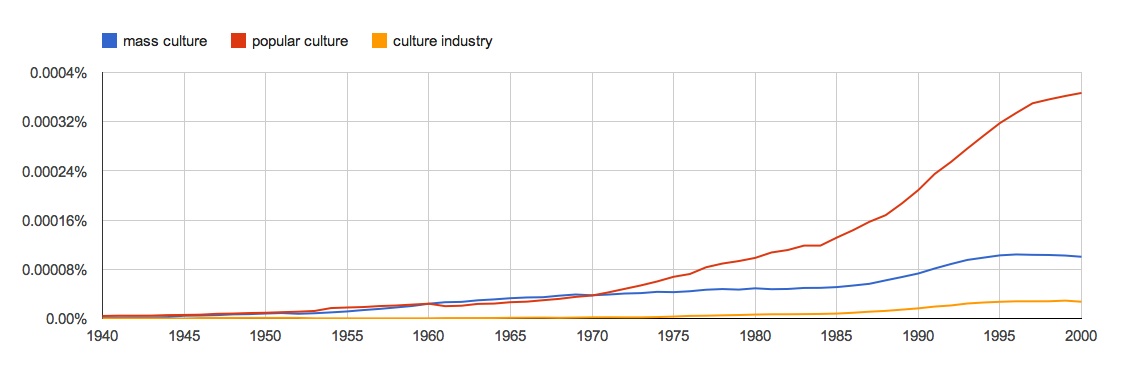
Before Horkheimer and Adorno released Kulturindustrie onto an unsuspecting world, Horkheimer had written an article that, bowing to the convention of his day, spoke of “mass culture” (see “Art and Mass Culture,” Studies in Philosophy and Social Science IX:2 (1941) 290–304). If you run an nGram for “mass culture,” “culture industry,” and “popular culture,” the results are about what you’d expect (but let’s do it anyway, if only for the perverse pleasure of dropping an nGram into a discussion of Dialectic of Enlightenment):

MC, PD, CINo one should be surprised that “popular culture” — so inoffensive, so unthreatening, so affirmative, so unlikely to get anyone in any trouble or keep anyone from getting tenure, so warm and cuddly, so … so … so … popular — quickly established a commanding lead over “mass culture,” a word from the wrong side of the tracks. Predictably, Horkheimer and Adorno’s compound only begins to rise from obscurity at the moment when it turns into a sort of shibboleth by which those of us who fool ourselves into thinking that we understand Dialectic of Enlightenment recognize one another.

Horkheimer’s article was billed as having been “provoked” by Mortimer Adler’s Art and Prudence (Adler would go on to have a good run at provoking people during the decade that followed) but after a few paragraphs even Horkheimer became bored with the prospect of further engagement with Adler’s tedious tome and veered off into a series of reflections that served as a sort of dry run for the culture industry chapter. While Adorno was, as always, enthusiastic about Horkheimer’s article (boundless enthusiasm for Horkheimer’s productions was not a bad survival strategy at the cash-strapped Institute for Social Research), readers who come to the article after having wrestled with Dialectic of Enlightenment will likely be struck by the utter implausibility of what Horkheimer was arguing. If the chapter on the culture industry overwhelms the reader with an explosion of ideas that defy easy summary, “Art and Mass Culture” cobbles familiar arguments together to reach a conclusion that is all too transparent. Here’s the set up:

The omnipotence of technics, the increasing independence of production from its location, the transformation of the family, the socialization of existence, all these tendencies of modern society may enable men to create the conditions for eradicating the misery these processes have brought over the earth.

If the Marxian provenance of the argument isn’t clear enough, just keep repeating the mantra: capitalism unfetters the forces of production and lays the foundations for future human liberation. Dialectic of Enlightenment flirts with a similar argument (see the discussion on pp. 60-64 in Volume 5 of the Horkheimer Werke), though in a way that no one could possibly understand. What this means is that, when the proletariat finally wakes up to its world historical mission, it will find itself in the possession of the means to end human misery. So, the problem is to figure out why the proletariat is still slumbering.

Analyzing the “subjective” factors that had prevented the enlightenment of the proletariat had been a major concern of the Institute for Social Research ever since Horkheimer assumed the directorship. The sentence in which “Art and Mass Culture” explains what has gone awry follows on the heels of the passage just quoted:

Today, however, the substance of the individual remains locked up in himself. His intellectual acts are no longer intrinsically connected with his human essence. They take whatever course the situation may dictate. Popular judgment, whether true or false, is directed from above, like other social functions.

Stated this baldly, the argument looks just about as bad as Horkheimer and Adorno’s critics tend to think it is: the working class would appear to be cultural dopes who, instead of seizing control of the means of production, have been manipulated by their crafty masters into watching bad movies and listening to jazz (sadly, the one thing that everyone knows about Adorno is that he — or perhaps his rottweiler — wrote an article about “jazz”). Workers of the World Unite! You have nothing to lose but your Benny Goodman records!

Chapter One of Dialectic of Enlightenment closed with a similar gesture. On face value, it’s not a lot more convincing, but it is considerably more opaque:

Today, when Bacon’s utopia, in which “we should command nature in action,” has been fulfilled on a telluric scale, the essence of the compulsion which he ascribed to unmastered nature is becoming apparent. It was power itself. Knowledge, in which, for Bacon, “the sovereignty of man” unquestioningly lay hidden, can now devote itself to dissolving that power. But in the face of this possibility enlightenment, in the service of the present, is turning itself into a complete deception of the masses.

And with this, the first chapter of Dialectic of Enlightenment closes. The nod to Bacon recalls the opening of the chapter, while the invocation of an enlightenment that has become “a complete deception of the masses” points ahead to the subtitle of the chapter on the culture industry: “enlightenment as mass deception.” And having wrapped things up so nicely, the boys probably took a break and strolled down D’Este Drive to see what was up with Dieterle.

Horkheimer's Street

D”Este Drive, Pacific Pallisades

This, then, was the hand that Horkheimer dealt Adorno when he set him to work on the culture industry chapter (as I’ve discussed elsewhere, Horkheimer’s extensive correspondence with the New York branch of the Institute opens a window on how the writing of Dialectic of Enlightenment progressed): what the chapter Adorno was writing had to do was show how the promise of enlightenment (in brief, the creation of human beings who would finally be free from fear and from the insatiable desire to dominate that this fear incited) was frustrated by a collapse of enlightenment back into mythology.

Let’s indulge in a bit of scene setting: every day after completing his work with Horkheimer, Adorno gets in his car to drive back from Horkheimer’s spacious home on D’Este Drive to his own more modest quarters on Kentor Avenue (need a map?). The sun is shining, the sky is blue, there are palm trees everywhere, Hollywood is off in the distance (need help picturing this? there’s a useful resource here). And, in the evening, he and his faithful wife Gretel —who bore the burden of scribbling down and typing up the ideas that Max and Teddy were dictating — would go to movies that, as he would explain in Minima Moralia, always left him feeling stupider than when he entered.

Adorno's House

Adorno’s House

OK, reverie over: just what did Adorno do with the hand Horkheimer dealt him?

First, and most immediately, he had to fill out an account that had focused almost exclusively on developments in Nazi Germany with a discussion of the development of the culture industry in non-authoritarian societies (whatever difficulties Dieterle may have had with Jack Warner, even he would have conceded that it was better than working for Joseph Goebbels). Much of the material that Adorno needed was at his doorstep, which explains the chapter’s relentless name-dropping: tips of the hat to Greta Garbo, Bette Davis, Greer Garson, and Betty Boop, wags of the finger for Mickey Rooney and Victor Mature. The rest could be quarried from the pile of manuscripts that Adorno produced during his time working on Paul Lazarsfeld’s radio research project, which helps explain a chapter in which Toscanini and Guy Lombardo rub shoulders with the Budapest Quartet and Benny Goodman, with none of them coming off particularly well.

Second, Adorno introduced some new elements into the conceptual machinery that was driving the argument. While Horkheimer had long been convinced that the meditation between the individual and society was to be found in the family, Adorno tended to emphasize the role played by the commodity fetish. The working out of these two positions occupied a fair amount of the Institute’s attention during the late 1930s and early 1940s, as can be seen by the various discussion protocols collected in Volume XII of Horkheimer’s collected works (there’s fascinating stuff here — is anyone working on it?). With Adorno now in control of the chapter, “culture industry” began to play a role that went beyond the limited function assigned to “mass culture” in Horkheimer’s essay. Recall that, for Horkheimer, mass culture was a mechanism of deception that separated human beings from their “human essence.” In Adorno’s hands, “culture industry” became a mechanism for inclusion:it had something — and equally importantly — some place for everyone. In the circle in which Horkheimer and Adorno were moving, it may have seemed as if everyone was somehow employed in the culture industry — as Brecht sardonically put it — hopefully as a producer of lies, less happily as a consumer of them. That idea had, as they say, “legs.”

Which brings us to Adorno’s third innovation. The incorporation of individuals into this massive an enterprise implies something that goes well beyond the “mass deception” alluded to in the subtitle that the chapter continued to carry (and had to carry, lest the connection to the opening chapter vanish). Deception implies the possibility that those deceived might, one day, come to see that they had been deceived and, when sufficiently enlightened about their deception, seek remedies. Such hopes lie at the heart of the notion of ideology critique. But “ideology” implies, at a minimum, that there are “ideas” of some sort to criticize. What the culture industry was selling doesn’t rise to the level of “ideas” (perhaps it might be helpful to think of Harry Frankfurt’s distinction between lying and bullshitting?). The culture industry produces what conservative critics — who, at heart, tend to view ideas with suspicion — have always thought liberalism lacked: a unified style. It provides the members of a fractured society with a repertoire of gestures, a stock of catch-phrases, a set of cues about how to make it. The opening chapter of Dialectic of Enlightenment — the fruit of Horkheimer and Adorno’s most intense collaboration — argued that adaptation of this sort had been the task of mimesis, which means that what Adorno wound up writing was a chapter that might better have been subtitled “enlightenment as mass mimesis.”

The Kulturindustrie chapter ends with the sort of sentence that drives translators to despair. In German it reads:

Das ist der Triumph der Reklame in der Kulturindustrie, die zwangshafte Mimesis der Konsumenten an die zugleich durchschauten Kulturwaren.

John Cumming, the first to try his hand at untangling Horkheimer and Adorno’s riddles, offered this solution:

The triumph of advertising in the culture industry is that consumers feel compelled to buy and use its products even though they see through them.

With all respect to Cumming’s labors (without which, many of us would not have begun our struggles with this text) this doesn’t quite cut it. The phrase zwangshafte Mimesis [compulsive mimesis] — which is as essential to Adorno’s account of what enlightenment has become as selbstverschuldeten Unmündigkeit was to Kant’s account of what enlightenment is — drops from sight. Edmund Jephcott’s 2002 translation tries this:

That is the triumph of advertising in the culture industry: the compulsive imitation by consumers of cultural commodities which, at the same time, they recognize as false.

Jephcott gives us “compulsive imitation,” but we lose Cumming’s deft handling of durchschauten [to see through something]. To my ears, “recognizing as false” implies something different from “seeing through” something — I may be able to “see through” someone’s bullshit without ever recognizing it as false for the simple reason that the bullshitter and I inhabit a world that is situated well beyond the domain of truth and falsehood. I suppose there might be a compromise (and translation is always about compromises) that could somehow keep both phrases, but I’m not seeing it.

Adorno expanded the category of “cultural wares” far beyond movies and radio programs. The sentence that immediately precedes the closing one was concerned with the marketing of toothpaste. He was concerned with the vast domain of objects that appear before us as the constituent elements of our culture and was trying to tell us that, pace his later critics, it is not as if we are unaware that much of the stuff we consume does not do what we hope it will do for us, but rather that we see through the limitations of what we are given, but keep coming back for more. The problem may lie less with what we are consuming (e.g., Guy Lombardo) than with the way we tend to consume it: compulsively. The best of the stuff that the cultural industry serves up may — if only briefly — give us a sense of what it would be like not to want more. The closing measures of Das Lied von der Erde may lead us into imagining that the ewig is, indeed, going to go on forever, but the silence that follows does not — at least in my case — trigger a need for a consumption of more Mahler or, indeed, a desire to hear any more music at all. That final C-major chord, as Benjamin Britten wrote in a lovely letter to Henry Boys, seems to hang in the air forever — it has always been there, it will always be there. But a look at my iTunes library reminds me that I am hardly immune to the compulsive mimesis of cultural wares whose … falseness? … I have seen through. For what else explains the presence of twenty-seven different recordings of Das Lied von der Erde?

The problem is not with mimesis itself: what we have learned since 1947 about child development in general and mirror neurons in particular suggests that mimesis does indeed play a fundamental role in the process that makes us what we are. The rub lies with zwangshafte: a word that stands as a marker for whatever it is that, willy-nilly, makes sure that we keep coming back for more. The way I read it, the great, ugly, unreadable, and unfinished torso that is Dialectic of Enlightenment is a reminder that the peculiar burden of enlightenment is to find a way to lose the “nilly” and save the “willy.” This — of course — is no easy task.

In Philosophische Fragmente, the 1944 mimeograph version of Dialectic of Enlightenment, the chapter on the culture industry closed with a phrase that, in a desperate attempt to make this wreckage of a manuscript look like a finished product, was cut from the final published version:

(To be continued)

Indeed. With apologies to Andre Bretonenlightenment will be persistent or it will not be at all.

Posted in Uncategorized | Tagged , , , | 1 Comment

What, if anything, does Dialectic of Enlightenment have to do with the Enlightenment?

It’s hardly surprising that scholars working in the area of eighteenth-century studies tend not to be well-disposed towards Dialectik der Aufklärung. At best, anyone who enters Max Horkheimer and Theodor Adorno’s labyrinth hoping to learn something about “the Enlightenment” is bound to come away somewhat confused. Explicit discussions of eigh­teenth century figures are scarce (they are confined, for the most part, to the book’s discussion on Kant and Sade) and tend to be lost in a cast of characters that stretches from Oedipus and Odysseus through Francis Bacon, Friedrich Nietzsche, and Sigmund Freud, and onward to Greta Garbo, Donald Duck, and Adolf Hitler. Since I’m teaching the book again this term as part of a course on “Enlightenment and its Critics,” I thought it might make sense to consider some of the reasons why this peculiar book has managed to cause so much confusion, especially since those confusions have something to do with the conceptual history of the notion of “enlightenment” itself.

It hasn’t help matters that the Anglophone discussions of the book were, at least initially, not entirely clear as to how to deal with the title. Attempts to render it as Dialectic of the Enlightenment were not uncommon (see, for example, Dick Howard, “A Politics in Search of the Political,” Theory and Society 1:3 (1974) 279). But confusions about what the book is doing are hardly confined to Anglophone readers. Concluding that something must have gone terribly wrong with the book’s treatment of the concept of “enlightenment,” Norbert Hinske bemoaned the “blindness of the authors towards all problems of conceptual history” and chastised Horkheimer and Adorno for their projection of “enlightenment” – a concept that “is originally bound to a specific epoch” – back onto earlier periods (see his “Einleitung,” in Was ist Aufklärung? Beiträge aus der Berlinischen Monatsschrift (Darmstadt: Wissenschaftliche Buchgesellschaft, 1981) xiv and his further thoughts in the afterward for the second edition, 553-558).

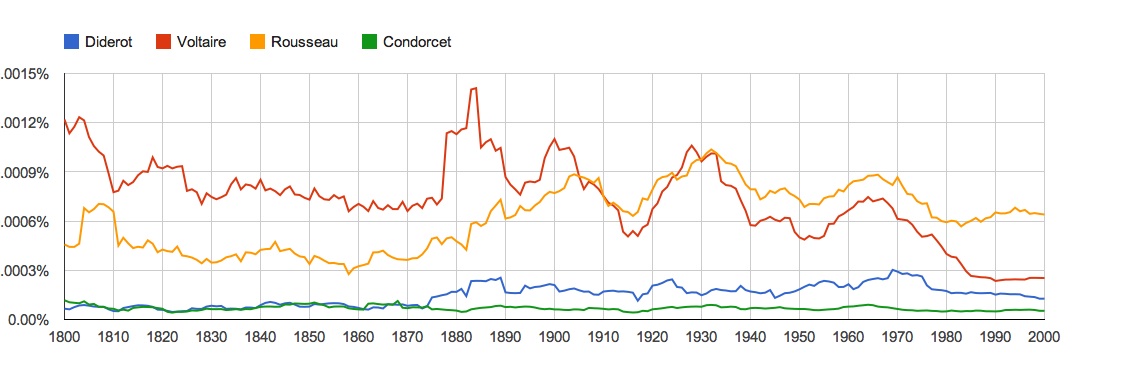
It turns out that complaints of this sort have accompanied the book from the start. In one of the few initial reviews of the work, the Stuttgart philosopher Max Bense (“Hegel und die kalifornische Emigration,” Merkur IV:1 (1950) 118-125) observed that the book had ignored the contributions of Diderot and Condorcet and went on to criticize its authors for their use of a “one-sided” conception of enlightenment that had been chiefly derived from Francis Bacon, whose presence loomed large in the book’s opening pages. But Bense differed from later critics in one important respect. As he saw it, the problem with Dialectic of Enlightenment was not that its concept of enlightenment was too expansive; he thought that it was not expansive enough. Because they constructed their concept around the notions of “fear,” “domination,” and “totalitarianism,” Horkheimer and Adorno were guilty in his eyes of employing an essentially “feudalistic” notion of enlightenment. As a result, they could not appreciate the extent to which enlightenment was a concept that transcended historical periods: it is a notion that “is defined in other terms in the eighteenth, nineteenth, and twentieth centuries than it is in the sixteenth and seventeenth century.”

Bense’s review suggests that Hinske’s understanding of the conceptual history of the concept of enlightenment is not without its blind spots. For though Bense may have had reservations about the particular way in which Horkheimer and Adorno framed their concept of enlightenment, he found nothing objectionable about their use of the term to designate a process that reached back into Greek antiquity. Indeed, the discussion of the “transition from mythology to enlightenment” in Dialektik der Aufklärung reminded him of two other recent studies: Wilhelm Nestle’s Vom Mythos zum Logos (1940) and Bruno Snell’s Die Entdeckung des Geistes (1946). What Horkheimer and Adorno were doing struck him as an attempt to bring a “sociological” analysis to bear on a question that Nestle had approached from the perspective of a “philosophy of history” and Snell had analyzed from the standpoint of the “history of language.”

Of the two other studies Bense cited, Vom Mythos zum Logos was the more ambitious in seeking to draw analogies between the eighteenth century and classical antiquity. Indeed, in sketching the broad outlines of the trajectory that his book intended to trace, Nestle turned to Kant’s essay “What is Enlightenment?” and drew a parallel between path from mythos to logos that his book proposed to trace and the passage from “immaturity to maturity” that, for Kant, had been the hallmark of enlightenment (Nestle 6) Analogies of this sort had long figured in Nestle’s work. He had opened his 1901 study Euripides, Poet of the Greek Enlightenment with the observation that, while there were a number of “excellent presentations of Greek philosophy,” a “history of the Greek enlightenment” was lacking (6). For the rest of his career, he worked at providing one. A 1909 article argued that, just as “the ideas of enlightenment” associated with Montesquieu, Voltaire, Rousseau, and Diderot paved the way for the French Revolution, so too the “age of Greek enlightenment” in the second half of the fifth century provided support for a revolution, albeit a revolution that proceeded not “from below” but rather “from above, in a reaction in aristocratic intellectual circles against the degenerate democracy” (“Politik und Aufklärung in Griechland im Ausgang des V. Jahrhunderts v. Chr.,” Neue Jahrbücher für das klassische Alterum, Geschichte, und Deutsches Literatur 1:1 (1909) 1-22). In an article published the next year, Nestle characterized Sophocles as standing in “fundamental and violent opposition against everything that is called enlightenment” (“Sophokles und die Sophistik,” Classical Philology V:2 (1910) 135-6).

But for all its confidence in the progress of human reason, Nestle’s book would up offering a chilling confirmation of the intertwining of myth and enlightenment that Horkheimer and Adorno were trying to comprehend. A passage in which Nestle invoked Kant’s answer to the question “What is enlightenment?” takes a sinister turn:

To go on this path from Mythos to Logos, to grow up from immaturity to maturity of spirit, seems to have been reserved for the Aryan peoples as the most talented race, and among these there is in turn no other people in whom this development can be traced so clearly as among the ancient Greeks. (6)

Nestle had remained in Germany during the war and made his peace with new regime. He had been a regular contributor to National Socialist journals since 1930 and participated in discussions on the implementation of National Socialist ideology into the classical curriculum. While the bulk of Vom Mythos zum Logos drew on work that had been completed long before the establishment of the National Socialist state, he inserted a few lines at the start of the book in which he expressed the hope that his study might have something to contribute to the struggles of the current day (vi).

It is far from clear what exactly Nestle thought his work could offer to a movement whose leading ideologist – the party hack Alfred Rosenberg –invoked “the Mythus of the blood” and “the Mythus of that new life-feeling” as a way to gain “the strength to overthrow the presumptuous domination of sub-humans and to create a unique civilization which will penetrate into all areas of life.” It is possible that, like Martin Heidegger, Nestle was under the illusion that he might provide the movement with a more subtle understanding of its world-historical mission than the obscure bluster that filled works like Rosenberg’s. Or, like many other German academics, he said what he thought he needed to say in the hopes of finding a way to survive. Whatever the explanation, the comments he added to his text in hopes of providing it with contemporary relevance are hard to reconcile with the contrast between mythos and logos that animated the other parts of his study. He now appeared less concerned with arguing that there was a steady progress from mythos to logos than with insisting that – while mythos and logos might appear to be “enemy brothers” – they were, in fact, “children of the same Hellenic spirit,” and that an understanding of the history of their kinship had something to teach the present (20).

While Nestle was producing drivel like this in Germany, Horkheimer and Adorno were working — under sunny California skies — on one of the bleakest of accounts of the vicissitudes of enlightenment. Central to its argument was the notion that mythos and logos — Nestle’s Hellenic children — had turned into evil twins.

Posted in Uncategorized | Tagged , , , | 3 Comments

John Quincy Adams, Translator and Anti-Jacobin (Another Presidents’ Day Special)

Were there, in fact, a holiday called “Presidents’ Day” (for a discussion of why there isn’t, see my previous post) the existence of John Quincy Adams, sixth President of the United States, would be enough to justify it. Like his father before him, he held the Presidency for only four years (one might have hoped that this would be enough to persuade future sons of Presidents, especially those bearing the first name of their fathers, to consider other careers). But, again like his father before him, his time in the Presidency was dwarfed by his other services to the republic. Not least among his father’s achievements had been the drafting of the Constitution of Massachusetts, the world’s oldest functioning written constitution. Not least among his were his defense of the enslaved Africans who reclaimed their liberties aboard the slave ship Amistad and his extended service (after his Presidency) in Congress, where he waged a long and ultimately successful fight to end the “gag rule” that had barred discussion of the evil that had haunted the republic from its creation.

There are others better equipped to take full the measure of the younger Adams. My concern here will be limited to his translation of Friedrich von Gentz’s Origins and Principles of the American Revolution, Compared with the Origin and Principles of the French Revolution (1800). It is, to be sure, one of his lesser achievements, but it is not an insignificant one for those of us who have tried our hand at putting German into English. And it has particular relevance for the concerns of this blog.

The “German Burke”

It has been Gentz’s fate to be classified as a “German Burkean” or, indeed, as “the German Burkeand his service as Metternich’s secretary during the Congress of Vienna sealed his reputation. But, as Fred Beiser notes, Gentz was very much a child of the Berlin Enlightenment and even went so far as to pen a 1791 defense of the Declaration of the Rights of Man and Citizen for the Berlinische Monatsschrift. Like other friends of enlightenment, his view of the Revolution began to change in the wake of the September Massacres and the trial of the King. By the autumn of 1792 he was at work on a translation of Burke’s Reflections on the Revolution in France (see Frederick C. Beiser, Enlightenment, Revolution, & Romanticism (Cambridge, 1992) 317-326).

The Origins and Principles of the American Revolution, Compared with the Origin and Principles of the French Revolution debuted as a two-part article in the Historische Journal (Vol. 5, May and June, 1800), the journal he edited and, for the most part, wrote. Though considerably less influential than Burke’s Reflections, it is in some ways a better work. For one thing, Gentz was writing at a time when the Revolution had managed to confirm Burke’s worst fears, which meant that, unlike the Irish Burke, the German one did not need to work himself into a frenzy at the thought of Marie Antoinette having been roused from her bed chamber and — shivering in her nightgown, etc., — forced to move from Versailles to Paris. Gentz could confront actual atrocities, rather than imagined ones. Perhaps because Gentz had, by 1800, already dealt with the French Revolution, The Origins and Principles devoted most of its attention to the American rather than the French side of ledger, offering an account of the actions and misunderstandings in England and in the colonies that led to the break. The result was a sort of “Atlantic history” avant le lettre. It may also have helped matters that the book was not burdened by the tiresome bile that Burke directed at Richard Price. Gentz treated Price with what almost passes for respect and focused his fire on Tom Paine (see the long footnote on pp. 72-73 of the recent Liberty Fund edition). And unlike Burke he found no need to draw on “proselyting tales and imaginary cabals of the illuminati,” but instead found evidence enough for why the Revolution descended into terror in the writings of the revolutionaries themselves. Finally, his thoroughness in working his way through the documents he had on hand meant that Burke’s habit of getting around difficulties by turning up the rhetoric was not always an option for him. Having insisted again and again that, in contrast to the French, the Americans were staging a “defensive revolution” aimed to protecting the rights that they already possessed as English subjects, rather than attempting to invent new ones, he eventually came to see that he needed to do something about the difficulties that the Declaration of Independence and the new state constitutions (whose bills of rights were being eagerly read by the representatives of the Third Estate assembled at Versailles) posed for his argument. Burke was a skilled enough politician to know how to overlook details like this and plow ahead; Gentz was an honest enough historian to realize that he had a problem. His attempt to get around it isn’t pretty, but at least he didn’t shirk the task:

True it is, that the declaration of independence published by the congress, in the name of the colonies, is preceded by an introduction, in which the natural and unalienable rights of mankind are considered as the foundation of all government; that after this assertion, so indefinite, and so exposed to the greatest misconstructions, follow certain principles, no less indefinite, no less liable to be abused, from which an inference might be drawn of the unlimited right of the people to change their form of government, and what in the new revolutionary language, is called their sovereignty. It is likewise true, that most of the constitutions of the United States, are preceded by those on idle declaration of rights, so dangerous in their application, from which so much misery as a later period derived upon France, and the whole civilized world. Much, however, as it were to be wished, that the legislatures of America have disdained this empty pomp of words, that they had exclusively confined themselves within the clear and lawful motives of their resistance; their resistance at first constitutional, and afterwards necessary, and within the limits of their uncontrovertible rights, yet it cannot escape the observation of those, who attentively study the history of the revolution, that they allowed to these speculative ideas, no visible influence upon their practical measures and resolves — They erroneously believed to them necessary to justify their first steps; but here the dominion of empty speculation, was forever abandoned— Never, in the whole course of the American Revolution, were the rights of man, appealed to, for the destruction of the rights of a citizen …. (Gentz 70-71)

Finally, Gentz’s little pamphlet reads better than Burke’s windy polemic. But the thanks for that probably belongs to John Quincy Adams.

John Quincy Adams, the Germanist

Adams’ translation of Gentz has had a long and somewhat peculiar history. It was one of a number of translations — including a rendering of Wieland’s Oberon — that Adams undertook while stationed in Berlin as the American minister to Prussia. It was first published in Philadelphia by Asbury Dickens in 1800. It was republished in 1959 by conservative Chicago publisher Henry Regnery in a volume entitled Three Revolutions: Gentz took care of the French and American ones, while the cold warrior Stephan Possony dealt with the Russians. Happily, the new Liberty Fund edition opts to drop Possony’s contribution (though I suppose we are ultimately indebted to Mikhail Gorbachev for that). Less happily, the Liberty Fund entrusted the editorial labors to Peter Koslowski, an economist and philosopher trained in Tübingen and Munich, whose ideas about what needs to be done in editorial footnotes are —shall we say? — somewhat peculiar. It is far from clear what sort of reader Koslowski had in mind when he opted to begin his notes with a sprawling explanation of the events to which the term “American Revolution” refers (see 98-99).

Koslowski based his discussion of the circumstances surrounding the publication of the book on the letters available in Worthington Chauncey Ford’s 1913 edition of John Quincy Adams’ writings. In trying to make sense of the context of Adams’ labors, I had the benefit of a contact at the Adams Papers Editorial Project at the Massachusetts Historical Society (thanks, Sara!). The letters between Gentz and Adams held by the Adams Papers indicate that it was Gentz who initiated contact with a letter to Adams on June 15, 1800 that included both parts of the article. Adams responded on the 16th, informing Gentz that he was already familiar with article and “as an American citizen” felt himself “highly obliged to you, for the consideration you have bestowed upon the subject, as well as for the honorable manner in which you have borne testimony to the purity of principle upon which the revolution of my country was founded ….” He closed by assuring Gentz that he would “take much satisfaction in transmitting and making known the treatise to persons in the United States capable of estimating its merits” [this letter, included in Ford’s edition, is reprinted in the Liberty Fund edition]. Adams would seem to have either already decided that his “transmitting” of Gentz’s treatise would consist of a full translation or settled on this course of action soon afterwards: his diaries (which, since he favored single line entries for most days, make perfect tweets: the great man can be followed at @JQADAMS_MHS) record that he had completed the translation by June 28. He first met Gentz face to face on November 9, at the home of Lord and Lady Carysfort (John Joshua Proby, then English ambassador at Berlin, and his 2d wife, Elizabeth Grenville). They remained in contact until the next spring, when Adams left Berlin.

Adams’ biographers have tended to attribute his translation of Gentz to his desire to improve his German (he had already been engaged in the more demanding task of translating Wieland’s Oberon, only to find that another translator had published one). But it would seem that he had additional and perhaps more compelling reasons to find Gentz’s work intriguing. First, this extended a treatment of the American Revolution would have had obvious interest to a member of the American legation in Berlin. And Gentz’s having included Adams’ father — along with John Dickenson, John Jay, and Benjamin Franklin — in the list of “great authorities of the American revolution” who would hardly have supported the revolutionary cause as it was advanced in Paine’s “contemptible” pamphlet Common Sense (72, footnote) would also have been relevant, as would his praise of the “glorious impartiality” with which the Americans conducted the trial of the British soldiers involved in the Boston Massacre (though Gentz did not mention the senior Adams’ labors as attorney for the soldiers).

Adams’ interests were, however, not limited to American matters. In a 1974 contribution to the Proceedings of the American Philosophical Society (118:4, August 1974), Walter Morris provided list of the German books that Adams collected during this travels in Germany, which began with his 1781 journey from Cologne to Königsberg and continuing during his time in Berlin in 1800-1801. The list includes some intriguing items. In addition to works by both Kant (a second edition of the Critique of Pure Reason) and Mendelssohn (copies of Jerusalem, Phädon, and the Philosophische Schriften), Adams owned a copy of Briefe über Schleisen, a 1792-93 work by Johann Friedrich Zöllner, the Berlin clergyman responsible for launching the discussion of the question What is enlightenment? He also owned a copy of Johann Georg Zimmerman’s Fragmente über Friedrich der Grossen, a work whose analysis of the Berlin enlightenment I’ve discussed in a previous post. Finally, he picked up multiple volumes of Johann Wilhelm Archenholtz’s Minerva, one of the most important German sources for information about the French Revolution (I’ve discussed its significant for Hegel elsewhere). What this suggests is that — assuming John Quincy Adams actually read the books he’d collected (and, after all, there’s every reason for a serious book collector not to do so) his understanding of the French Revolution would have more or less resembled that of any number of those figures associated with the Berlin enlightenment who were beginning to have reservations about what the French were up to. Hence an additional reason why Gentz’s work might have appealed to him: it fit right in with what Adams was already reading. (An alternative hypothesis might also be worth considering: conceivably, Adams’ collecting might, at least in part, have been informed by recommendations from Gentz: these were, after all, books that a veteran of the Berlinische Monatsschrift would know about).

John Quincy Adams, an Anti-Jacobin?

Nor should we ignore the immediate political context. By the time Adams left Berlin in 1801, Thomas Jefferson was President. The election had been a bitter (and notoriously convoluted) one and there was no love lost between the Adams family and Jefferson. As Linda K. Kerber and Walter John Morris noted in a 1966 article in The William and Mary Quarterly [Third Series, 23:3 (1966) 450-476, in 1802 John Quincy Adams penned an adaptation of Horace’s Ode to Xanthia Phoceus that, taking aim Jefferson’s liaison with Sally Hemmings , included the lines “Dear Thomas, deem it no disgrace/With slaves to mend thy breed.”

There had been much anxiety in anti-Jacobin circles about the prospect of Jefferson winning the Presidency. Relaying the news of Jefferson’s victory to its readers, the Anti-Jacobin Review (VII, p. xi) predicted,

The success of the Jacobins will inevitably tend to encrease the animosity of both parties, and, in all probability, to produce a dissolution of the Federal Government. If the new President who will enter upon his office, at the beginning of March, act in conformity with his know principles, he will immediately form a close alliance with Buonaparte —par nobile fratrum! —and, by that means, give disgust to every friend of the existing Constitution, and occasion a separation of the now United States.

I don’t know whether Adams was a reader of the Anti-Jacobin Review, but he does seem to have been versed in the argot that anti-Jacobins used to discuss the forces they saw as threatening them. Consider this passage from the brief introduction that he wrote for his translation of Gentz:

A modern philosopher may contend that the sheriff, who executes a criminal, and the highway man, who murders a traveler, act on the same principles; the plain sense of mankind will still see the difference between them, that is here proved between the American and French revolutions. — The difference between right and wrong.

The crucial term to note is “modern philosopher.”

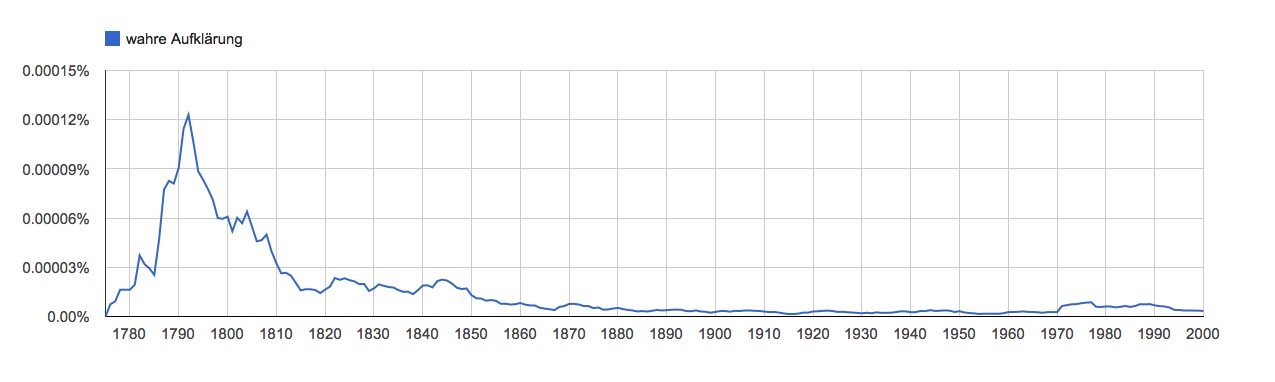
In my earlier discussion of Jefferson, I observed that the history of usage of “true enlightenment” does not track the history of the German “wahre Aufklärung.”

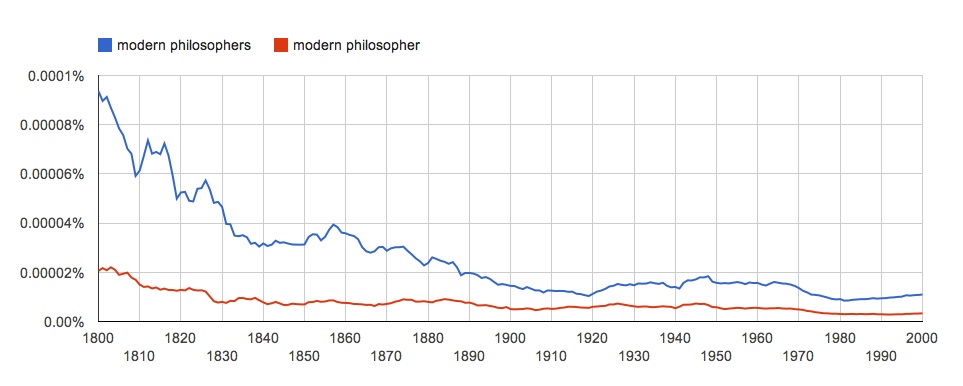
Wahre AufklärungBut “modern philosophers” (in the plural rather the singular) does much better:

modern philosopher(s)A glance at the samples nGrams provides confirms that, in these texts, “modern” does not have the same sense that it has today when we offer courses in “modern philosophy” or discuss the work of “modern” as opposed to “ancient” or “post-modern” philosophers. Like philosophism and philosophist it is a term with a distinct political edge: it designates those engaged in the spreading of false and dangerous doctrines, doctrines that are akin to the example offered by Adams in his introduction to Gentz. As such, it is a term that, like wahre Aufklärung, has a use only for as long as there is a battle to be fought. When defenders of wahre Aufklärung surrender the term Aufklärung to their opponents, wahre Aufklärung slips from usage. In the same way, when the anti-Jacobins conclude that the fires ignited in Paris are not going to engulf the entire world, “modern philosophers” begins to lose its purpose. If we think of words as rhetorical weapons, their becoming anachronisms marks the moment when they begin to be pounded into plowshares.

One-time enemies sometimes become friends: witness the remarkable correspondence conducted by Jefferson and the elder Adams over the last decade of their lives. Old enemies are sometimes are replaced by newer, more serious ones: John Quincy Adams won his glory not in his squabbles with “modern philosophers,” but rather in his long struggle against slavery.

Massachusetts celebrates something called “Presidents Day” on May 29 in honor of our four Presidents: John Adams, John Quincy Adams, Calvin Coolidge, and John F. Kennedy. Not a bad list, especially if you stick to the Johns.

Posted in Uncategorized | Tagged , , , | 3 Comments

Jefferson, an Epicurean? (Presidents’ Day Special, Part 1)

Readers outside the United States are likely not aware that, while tomorrow is officially “Washington’s Birthday” (a national holiday celebrated on the third Monday in February, a day on which George Washington’s actual birthday — February 22 (new style) — cannot ever fall), it now tends to be known as “Presidents’ Day.” Those puzzled by the ambiguity of what Americans are supposed to be celebrating this Monday (a group that likely includes a large number of Americans) can learn more than anyone needs to know from the article on the topic available in Prologue, the journal of the National Archives.

Had I attempted my own explanation, it would likely have veered off into a discussion of the continuing resistance in the legislatures of certain states — which once voted reliably Democratic, but now vote reliably Republican — to celebrating the birthday of the savior of the Union and first Republican President, Abraham Lincoln (whose birthday falls on February 12; another date which will occur on the third Monday in February). At first glance, the bargain that seems to have been struck is that we get to honor Lincoln with a national holiday only as part of a package deal that includes such decidedly lesser lights as Warren G. Harding, Millard Filmore, James Buchanan, Andrew Johnson, etc. (the list stretches onward and onward, reminding us that the principi who have guided this republic include a staggering number of mediocrities). C&C But, of course, whatever bargains there are to be found on Presidents’ Day lie in the sphere of commerce, rather than civic life, confirming once again the explanatory power of the graffiti at the right, from the 2007 Venice Biennalle. Suffice it to say that the true meaning of Presidents’ Birthday lies in its seeming to be the day when advertisers are convinced that Americans are eager to buy automobiles.

But I can still pretend that Presidents’ Day has something to do with Presidents and mark the occasion with two separate posts: this one is devoted to the aspiring philosophe Thomas Jefferson. The next one will honor the only American President to struggle with the task of rendering German texts into English: John Quincy Adams.

Jefferson Among the Antients

A recent episode of the BBC podcast In Our Time opened with Melvyn Bragg quoting Jefferson’s characterization of “the genuine (not the imputed) doctrines of Epicurus” as having contained “every thing rational in moral philosophy which Greece & Rome have left us.” These lines appear in Jefferson’s letter to William Short of October 31, 1819, a text that reminds us, once again, of the gulf between Jefferson’s understanding of “antient” philosophy and the way we now teach the canon (why is it that, whenever I hear the word “canon,” I think about buying a revolver?).

Jefferson’s praise of Epicurean doctrines move on to a defense of Epicurus against those who maligned him before indulging in a bit of Plato bashing, reminding us that despite Jefferson’s many failings as man and thinker, he had good taste in philosophy.

Epictetus indeed has given us what was good of the Stoics; all beyond, of their doctrines dogmas, being hypocrisy and grimace. Their great crime was in their calumnies of Epicurus and misrepresentations of his doctrines in which we lament to see the candid character of Cicero engaging as an accomplice. The merit of his philosophy is in the beauties of his style. Diffuse, vapid, rhetorical, but enchanting. His prototype Plato eloquent as himself, dealing out mysticisms, uncomprehensible to the human mind, has been deified by certain sects usurping the name of Christians; because in his foggy conceptions, they found a basis of impenetrable darkness whereon to rear fabrications as delirious, of their own invention. These they furthered blasphemously on him whom they claimed as their founder, but who would disarm them, with the indignation which their caricatures of his religion so justly excite. Of Socrates we have nothing genuine but on the Memorabilia of Xenophon. For Plato makes him one of his Collocurtors merely to cover his own whimsies under the mantle of his name; a liberty of which we are told Socrates honestly complained.

He grants that Seneca “is indeed a fine moralist,” but notes that though Seneca offers “on the whole a great deal of sound and practical morality,” even he winds up “disfiguring his work at times with some Stoicisms and affecting too much of antithesis and point.”

Jefferson’s affection for Epicurus was long-standing. The letter to Short includes a “syllabus” of Epicurus’ principal doctrines that Jefferson had written some two decades earlier. If the Google’s Ngram can be trusted (and, when we’re dealing with texts from this period, there is every reason not to trust it), Jefferson drew up the syllabus in the wake of a sudden Epicurean sell-off:Epicurus
But latter-day friends of Epicurus are used to sailing into the wind: attacks of the sort that Jefferson mounted against Epicurus’ calumniators are a standard trope in the literature. For one example, see Tobias Smollet’s comments in a review of Enfield’s History of Philosophy in the Critical Review for 1792 (pp. 146-150).

It is, as always, worth remembering that, since the nGram presents with a very small number of cases, the massive drop in references to Epicurus likely amount to little more than a minor swerve. That Epicurus has long played a secondary role in what would become “the tradition” becomes obvious once we expand the company of ancients to include the two big boys.

E,P,A

But why stop with Plato and Aristotle? There is one other name that looms large in Jefferson’s letter to Short, a figure who, some may recall, was also cited by the nation’s 43rd President (and third “George”) as his “favorite philosopher”:

Jesus added

While Jefferson found it necessary to defend Epicurus from his enemies, he was convinced that Jesus required rescue from his false friends.

But the greatest of all the Reformers of the depraved religion of his own country, was Jesus of Nazareth. Abstracting what is really his from the rubbish in which it is buried, easily distinguished by it’s [sic] lustre from the dross of his biographers, and as separable from that as the diamond from the dung hill, we have the outlines of a system of the most sublime morality which has ever fallen from the lips of man’s [sic] outlines which it is lamentable he had not live to fill up. Epictetus & Epricurus give us laws for governing ourselves, Jesus a supplement of the duties & charities we owe to others. The establishment of the innocent and genuine character of this good benevolent moralist, and the rescuing it from the imputation of imposture, which has resulted from misconstructions of his words by his pretended votaries artificial systems*, invented by Ultra-Christian sects, unauthorised by a single word ever uttered by him is a most desirable object, and one to which Priestly has successfully devoted his labors and learning, it would in times it is to be hoped effect a quiet euthanasia of the heretics of bigotry and fanaticism which have so long triumphed over human reason and so generally & deeply afflicted mankind. But this work is to be begun by winnowing the grain from the chaff of the historians of his life.

_______________________________

*e.g. the immaculate conception of Jesus, his deification, the creation of the world by him, his miraculous powers, his resurrection & visible ascension, his corporeal presence in the Eucharist, the Trinity, original sin, atonement, regeneration, election orders of Hierarchy etc.

Jefferson, a Christian?

However unlikely it might seem, the coupling of Epicurus and Jesus was also a long-standing feature of Jefferson’s moral philosophy. It turns up in his letter to Benjamin Rush of April 21, 1803, a letter which was accompanied by yet another “syllabus,” this one summarizing the views of ancient philosophers, Jewish moral teachings, and Jesus. The syllabus’s discussion of Jesus laments the fact that, unlike Socrates and Epictetus, he lacked “a Xenophon or an Arrian to write for him” and proceeds to explain that this fact, when coupled with Jesus’s early death, meant that the “doctrines which he really delivered were defective as a whole, and fragments only of what he did deliver have come to us mutilated, misstated, & often unintelligible” (not the least of Jefferson’s quirks as a Christologist is his view of the crucifixion as an unfortunate interruption of Jesus’ promising early work in the area of moral philosophy).

None of this, of course, has prevented the pious and careless from attempting to claim Jefferson as one of their own. A case in point is the evangelical minister David Barton, whose book on Jefferson was withdrawn by its publisher last year after it was determined that it took liberties with facts that, even in these factually-challenged times, went too far. In any case, ventures like Barton’s face a tough climb: the quotations that are most useful for the cause of the faithful typically lie in the middle of mine fields. Consider this passage from Jefferson’s letter to Rush:

To the corruptions of Christianity I am indeed opposed; but not to the genuine precepts of Jesus himself. I am a Christian, in the only sense he wished any one to be; sincerely attached to his doctrines, in preference to all others; ascribing to himself every human excellence; & believing he never claimed any other.

As the footnote in the letter to Short suggests, what Jefferson understood as the “genuine precepts of Jesus” diverged as markedly from what most Christians would understand as Christianity as what Gotthold Ephraim Lessing characterized as the “religion of Christ” different from what he called the “Christian religion.”

But Jefferson’s dogged persistence in constructing these peculiar syllabi in which Jesus fills out the lacunae in Epicurus’s system also presents a few stumbling blocks for those who are inclined to see the sage of Monticello as a card-carrying member of the Party of Humanity (though, granted, his ownership of enslaved Africans ought to have caused even greater problems). It is as if his career was an attempt to confirm Louis de Bonald’s definition of a deist as “a man who has not had time to become an atheist.” If only Jefferson had stopped with those syllabi — perhaps then he’d have had the time?

What makes Jefferson’s scribblings on moral philosophy valuable for students of the Enlightenment is that they remind us how various “enlightenment” was in the decades on either side of 1800. As I’ve suggested in earlier posts, because the concept remained in play it was still possible to find thinkers who some might be inclined to see as members of the “counter-Enlightenment” who continue to see themselves as defenders of “true enlightenment.” Jefferson reminds us that this works the other way as well: a fair number of the thinkers who we are inclined to recruit into the ranks of “the Enlightenment” remained wedded to launching excursions into territory that we now see as irredeemably “religious.” After a certain point, the lines would harden and the positions became more clearly defined: the enlightened would beat a retreat from religion (but got to keep Epicurus); in return, the religious stopped talking about “true enlightenment” (and took exclusive possession of Jesus).

An imperfect, but suggestive, indicator of what was happening can be seen by tracing the fate of the phrase “wahre Aufklärung [true Enlightenment]”:

Wahre Aufklärung

I’m skeptical as to what precisely the Ngram is picking up (though a sampling of the texts from around 1790 suggests that it may be grabbing precisely what I’m expecting it to) and I would feel a lot more comfortable if I could replicate these results with “true Enlightenment” (or, for that matter, “true enlightenment?) — as we will see in the case of John Quincy Adams, the terminology tends to differ in English. But, if nothing else, possible explanations for what would seem to be the long decline of wahre Aufklärung might be worth pondering — if only as a diversion while shopping for a new car. As for me, I plan to spend the day thinking about that strange and wonderful man John Quincy Adams.

Posted in Uncategorized | Tagged , , , | 1 Comment

Further Thoughts on “the Enlightenment,” the OED, the History of Concepts

Last week’s post ended with some misgivings about the distinction Koselleck drew between the “history of concepts” and the “history of words.” Admittedly, the distinction seems plausible enough: since concepts can be designated by a number of different words (e.g., “liberty” and “freedom” refer to more or less the same thing) there’s not a lot of point in getting hung up on the history of particular words. That history is the business of etymologists; historians of concepts have other fish to fry. But, on the other hand, the history of certain concepts sometimes exhibits periods when writers display an acute sense that other people are using words in the wrong way and that their misuse of these words may even have something sinister about it. To counter these perceived abuses, they produce texts that veer off into discussions that look, for all the world, like a sort of proto-Begriffsgeschichte. Moments like this abound in late eighteenth- and early nineteenth-century treaments of the family of terms we associate with the concept “Enlightenment.”  It is (with apologies to Carl Becker) as if every man has become his own historian of concepts.

I first encountered this sort of thing while reading Thomas Carlyle’s copy of Johann Georg von Zimmerman’s Fragmente über Friedrich den Grossen zur Geschichte seines Lebens, seiner Regierung, und seines Charakters (1790) in the Houghton Library at Harvard (to give credit where it might be due, it’s possible that I was pointed to the text by the entry on Aufklärung in Geschichtliche Grundbegriffe). In the decade that has passed since this encounter the text has been swept up in the gaping maw of Google’s scanners and is now freely available, minus the peculiar aura attached to pawing through Carlyle’s copy (the age of digital reproducibility has been even harder on the aura than the age of mechanical reproducibility).

Since I’ve discussed the context of Zimmerman’s complaint elsewhere, I’ll limit myself to focuing on the moment when he finds it necessary to trace the terms that Berlin enlighteners are tossing around back to their alleged French roots:

The entire initiative in Berlin is now called Aufklärung (Illuminatisme); the members of the synagogue are called Aufklärer (Illuminants); and Aufgeklärte (Illuminés) are the blind slaves of this sect. Of the true enlightenment (progrès des lumières) nothing is spoken in the clique of Berlin enlighteners.

Zimmerman’s concerns are hardly unique: they are but one example among many. In such texts, a fair amount of work is done by attaching modifiers (the most popular being “true” and “false”) to the term being contested. It is as if all the contestants are trying to keep hold of a term or set of terms that they fear might be slipping away from them into the hands of the enemy.

Here’s another example, from a 1792 article by Friedrich Karl von Moser that I included in my collection of texts on the question “What is enlightenment?” without entirely fathoming what was going on in it:

All enlightenment that is not grounded in and supported by religion, all enlightenment that does not grow out of the dependence of the created on its Creator and on the goodness and care of the Creator for His human creations, all enlightenment that draws back from the duties of love, reverence, gratitude, and obedience to His will, His commandments, and the institutions of His great world government, all enlightenment that leaves man to his own willfulness, vanity, and passions and inspires him with Lucifer’s pride to see himself as his sole, independent, ruler and to make his own arbitrary natural law — all such enlightenment is not only the way to destruction, immorality, and depravity, but also to the dissolution and ruin of all civil society, and to a war of the human race within itself, that begins with philosophy and ends with scalping and cannibalism.

It may be significant that, although Moser was desperately trying to save “true enlightenment” from the hands of its falsifiers, he had convinced that another term had already been lost. At the start of the essay, he defines enlightenment as the intellectual power that “progresses in equal proportion to the oppression of a people” and serves as a counter-weight to the “arts of seduction and delusion” by which despots maintain their power. He then goes on to observe that, rather than using “enlightenment” to denote this force, he “would have liked to use the word philosophy instead, if she were still the pure, chaste daughter of the heavens, come from the hand of the Creator through the godly gift of reason.“ Moser, in other words, was convinced that by 1792 ”philosophy“ had fallen into the hands of the French cannibals. So he fell back and tried to defend ”enlightenment” from their assault.

That defense stretches on for longer than we tend to realize. Among the tidbits swept up in Google’s scanning initiative is a translation of Gotthold Salomon’s Twelve Sermons Delivered in the New Temple of the Israelites, done by Anna Maria Goldsmid in 1849 and published in London. The first of the sermons dates from 1820 and takes its point of departure from Isaiah II.5: “House of Jacob, come, let us walk in the light of the Lord.” Very quickly, Salomon finds himself attempting to untangle the sort of conceptual confusions that Moser was wrestling with three decades earlier:

To walk in the light of the Lord, to use our reason and the examination of His word, we term Enlightenment—religious enlightenment. Doubtless, my friends, you have often heard religious Enlightenment lauded by some of our co-religionists as the greatest blessing to man; and we have all in truth ourselves experienced the good and cheering results which his heavenly gift has produced. But are you not aware that others of our brethren, shudder and recoil at the mention of its name? Are you not aware that this portion of our community regard enlightenment as a disturber of peace; as the deadly foe of religion? Whence does it arise that one and the same thing can be so differently judged and treated? that one sees light or another beholds not but darkness, which is to him, as to the lisping child, an object of terror? Whence does it arise my brethren, that one feels the blessing of heaven, were the other fears the curse of hell? Whence does it arise that one considers this enlightenment as the herald of evil, another, good?

At this point he proposes to “examine more closely the meaning of the word Enlightenment, and over the next paragraph proceeds to lay out the various ways in which the word had been employed:

This word, my friends, applied first objects in the material world, is now adapted to abstract ideas. It signifies a clearing up of our sight and our sense of that which was previously obscure and confused. When the dark clouds part, and the blue firmament is no longer hidden from our site, we say the sky clears up. The human being whose inward heaven is obscured and overcast, in whose mind confusion prevails, in whose intellect false and true notions are mingled, and who was subsequently enabled by means of wise instruction to separate the true from the false, gradually ceases to be enveloped in the mists of error—that man is enlightened. Heaven has opened upon him the portals of day, and light and heat pervade the previous domain of night, at the call of reason:– Let there be light—Light was!

Salomon was a representative of what David Sorkin has called the “religious enlightenment.” Early in his career he came into contact with such luminaries of the Haskalah as David Friedländer and he spent some time in Berlin before moving on to his post in Hamburg, where he produced one of the many tributes to Moses Mendelssohn that marked the centennial of his birth in 1829.

But if Salomon is part of what we would now see as the “enlightenment” version of “religious enlightenment,” it is worth remembering that what some might be inclined to call a “counter-enlightenment” interpretation of “religious enlightenment” also proliferated well into the nineteenth century (let us postpone, for another time, a discussion of why the notion of “counter-enlightenment” really needs to be put to sleep). The persistence of such arguments has been ably traced by Richard Schaefer in a recent article in The Catholic Historical Review.

Looking through this literature, we occasionally can find examples of individuals who have concluded that the battle just isn’t worth fighting any longer. One example, which I’ve discussed in the same article where I discuss Zimmerman, can be found in Paul Leopold Haffner’s book on the German Enlightenment. Haffner, who would go on to become Archbishop of Mainz, began his account by feigning some confusion as to what it meant to write a history of “enlightenment”:

Enlightenment is a sublime word, if one goes back to its meaning; it means illumination of the spirit through truth, liberation from the shadows of error, or uncertainty, of doubt. Enlightenment is, in its deepest meaning, the transfiguration [Verklärung] of reason.

But, rather quickly, he drops the pretense: he is, he concedes, “too much a child of the nineteenth century” to pursue a history that would depart so violently from what he now sees as the established convention of usage. Resigning himself to speaking the degraded language of his day, “which exchanges the meaning of light and darkness,” which produces a literature that regards “the light of Christian centuries as dark gloom,” and which “greets the shadows of doubt and the progress of religious barbarity as light,” he opts to recount the history of an enlightenment that has little to do with God. To speak of enlightenment in the middle of the nineteenth century is to use a concept that is “purely negative, destructive, empty; it has no positive content and no productive principle.” In order to be counted among the truly enlightened, one must “know nothing.”

Ngrams: Spikey, Not Smoothed

One of the dangers of the ease with which Ngram is that it tends to cover up battles like the ones in which Haffner and Salomon are engaged. Consider my previous Ngram tracing the steady rise of “Enlightenment” in English.

Aufklärung,Ill, and Enl

While I was heartened to see that uses of “the Enlightenment” prior to the publication of John Grier Hibben’s Philosophy of the Enlightenment, I’d assumed that it would also pick up some uses of “the Illumination” or even, in English texts from the period, the contiued use of the German Aufklärung. After all, that was the way that James Hutchison Stirling talked and, as I noted in the previous post, I could do a pretty fair imitation of a Hegel-besotted Scot. But, on further reflection, it makes sense that I’m not seeing those words on my Ngram. First of all, the further back in time that Ngrams stretch, the slimmer the pickings. And, more importantly, since the uses of such terms are so few and far between, they will tend to drop from sight:  the Ngram turns them into little ripples.

But what Google takes away, it also gives back: the family’s digital consoliere advised me that, from time to time, it pays to turn off the Ngram’s default smoothing and have my Ngrams spikey, not smoothed.unsmoothed

With the smoothing turned off it becomes a little clearer that the long flat plane during the first half of the nineteenth century is marked by a few isolated spikes, followed by a few more aftershocks that stretch down to the middel of the century. Something is happening down there, though it’s not clear what it is. Google makes it easy enough to find out what’s going on: taking a closer look at those peaks and checking out the texts that turn up reveals not only some examples of bad metadata (e.g., the misdating of Eucken’s history of philosophy that I mentioned in my previous post) but also some texts I’d never seen before (hello there, Rabbi Salomon!).

The problem isn’t that Ngrams doesn’t play nicely with the sort of conceptual history that Koselleck and his colleagues were doing: it is that, in some cases, Ngrams are all too amiable a playmate. To the jaded, Geschichtliche Grundbegriffe might be seen as the sort of offspring one would expect from a marriage between a certain sort of Begriffgeschichte and a version of social history that privileges a familiar narrative about the transition from traditional society to modernity. Most of the action is shunted off into the so-called Sattelzeit, the period when concepts undergo marked transformations.  The locus classicus for this might be the transformation of the concept of bürgerliche Gesellschaft that Otto Brunner sketched in his classic studies of treatises on householding and Manfred Riedel elaborated in the context of making sense of what Hegel was doing with the notion in the Rechtsphilosophie. Since it makes a great deal of sense to understand the transition to modern society as having a lot to do with the rise of a domain of economic relationships that are distinct from both the household (or, as Hegel now dubbed it, “the family”) and the state, it makes sense that the traditional conceptual opposition between oikos and polis, between domestic and civil society, might have needed refurbishing.

Smoothed Ngrams of the sort that I used above have a tendency to seduce us into seeing the rise of “the Enlightenment” as something that resembles the progress of other markers associated with the march into modernity: the line for “the Enlightenment” looks like a line tracking the percentage of the world’s population living in cities or the amount of carbon being pumped into the atmosphere. While turning off the smoothing doesn’t entirely banish that impression, it helps. Gazing at those tiny spikes and the silences in between them (what I really need here is a bar graph; I’d like to see nothing in the spaces in between) calls to mind other analogies of how things change: popcorn starting up or winding down, the early stages of a pandemic, or — for those of us who think about the history of concepts in the way that Quentin Skinner appears to have been thinking about it at that unexpected moment in Volume 1 of Visions of Politics when he suddenly began to channel Michel Foucault — “the distant roar of battles.” Those little spikes are testimonies to a series of discrete engagements, some of which eventually had weightier implications and some of which did not.

Towards a History of Contingently Contested Concepts

Like everyone else who works on the Enlightenment, I complained about the old OED definition of Enlightenment; but I secretly liked it. I used to begin my course on the European Enlightenment by showing a slide with the definition (accompanied by the famous picture of James Murray, in his library, with a beard that made him look like he could have joined up with these guys). I’d come back to it at the end of the course, right before plunging into a discussion of the “better” answers that could be found to the question “What is Enlightenment?” in Kant and Mendelssohn. This is the world we have lost: a world in which the Enlightenment might, somehow, seem dangerous. But now the OED, like Father Haffner before, has resigned itself to living in the modern world. The battle against the OED’s definition, begun back in the early 1950s by the young Peter Gay, is over. And it is as if the victors were given the final edit on the definition.

The OED’s definition of “the Enlightenment” now conforms to the way in which we talk about it today. Though we can still hear traces of the old Illuminati, Freemason, philosophe conspiracy dialect in accounts of the period that turn up from time to time, mainstream conservative pundits (e.g., David Brooks) have learned to follow the lead of Gertude Himmelfarb and play the good, English enlightenment off against that crazy French one (and, predictably, after the nod to Himmelfarb, Brooks moves on to juxtapose the wise Edmund Burke to that hothead Thomas Paine — plus ça change, indeed).

One reason for caring about getting the history of a concept like enlightenment right is that it might restore a sense of contingency to this process and allow us to catch echoes of the distant roar of battles in places like David Brooks’ column (which might, at the very least, make them slightly interesting).  At about the same time as philosophers were arguing that all three words in Walter Bryce Gallie’s notion of “essentially contested concepts” were somewhat problematic, William Connolly ported the notion over into political philosophy, where it appeared to make a bit more sense. But while it might be useful to think of the history of political thought as a long series of struggles with notions on which both reasonable and unreasonable people are bound to differ, it is also worth recognizing that, more often than not, the history of concepts involves the tracing of “contingently contested concepts.” The history of concepts needn’t be restricted to an account of titanic battles involving Big Notions that eventually gave birth to The Modern World. It might also be worth viewing it as an attempt to write the history of a series of bar fights, a few of which eventually blossomed into something bigger.

Posted in Uncategorized | Tagged , , , | Leave a comment

The Enlightenment, the OED, and the History of Concepts, with Ngrams

In the fall of 2010, the online Oxford English Dictionary revised its entry for “Enlightenment.” Since 1891 the definition had read as follows:

1. The action of enlightening; the state of being enlightened …. [I]mparting or receiving mental or spiritual light.

2. Sometimes used [after Ger. Aufklärung, Aufklärerei] to designate the spirit and aims of the French philosophers of the 18th c., or of others whom it is intended to associate with them in the implied charge of shallow and pretentious intellectualism, unreasonable contempt for tradition and authority, etc.

For quite some time, admirers of the Enlightenment have had problems with the OED’s definition. As Peter Gay noted, it has the dubious distinction of collecting “most current prejudices in one convenient place” [Peter Gay, The Party of Humanity (Princeton, 1959) 263].

In contrast, the treatment of the Enlightenment in the OED’s new definition is quite well-behaved:

The dominant European intellectual culture in the 18th cent. which typically emphasized freedom of thought and action without reference to religious and other traditional authority, proposed a deistic understanding of the universe, insisted on a rationalist and scientific approach to the understanding of human society, the law, education, the economy, etc., and had as an important aim the development of new theoretical methods and practical reforms for these areas; (also) the period of time during which this climate of thought was dominant.

I had, as they say, a dog in this fight — admittedly, it was a little, yappy one, but a dog nevertheless: back in 2003 I published an article in the Journal of the History of Ideas examining some of the peculiarities in the OED’s definition and trying to figure out how it got to be the way it was (there’s an open access copy here). The article argued that not only was the definition rather flaky, it had also misquoted one of the three source quotes and misinterpreted another. It got the third quote right, but while a .333 batting average is respectable in baseball, one hopes for something better in a dictionary. In addition to addressing most of my gripes, the revised definition in the online OED is kind enough to refer readers curious about the history of the earlier definition to my JHI article (which means that, at least until the next OED revision, my place in History is secure).

The point of this post is not to gloat (well, not just to gloat) but (1) to say a few things about the new definition, (2) to discuss how much easier it is today to do what I was attempting to do back in 2003 (i.e., seven years before the arrival of the Ngram), and (3) to explore some of the implications of my adventures with the OED for the enterprise known as “the history of concepts.” This post will focus mainly on point 2 and offer a few thoughts on point 3. A sequel will address point 1 and have something more on point 3.

Learning to Write Like a Scottish Hegelian

Looking back on how I wound up writing the JHI article in the first place, what strikes me now is how unsystematic I was. While it had been clear for quite some time that a lot was wrong with the OED’s definition, I’d assumed—as I suspect most other readers of the OED assumed — that the definition offered an accurate, if lamentable, reflection of the way in which “enlightenment” was used by its critics during the nineteenth century. Since I was (and remain) interested in eighteenth-century discussions of the question “What is enlightenment?” and their later implications (this blog is an attempt at working through this obsession), I figured that the OED definition might provide some hints on how these discussions might have made their jump from German into English. And because I knew that Hegel was quite interested in these discussions (he’d copied Moses Mendelssohn’s answer to the question into a notebook he kept while in high school and he carried this notebook with him throughout his life), it was encouraging to see that two of the three sources quotes in the OED came from James Hutchison Stirling’s The Secret of Hegel (1865), the first book on Hegel to appear in English —or, at least, as close to English as a Hegel-smitten Scot could produce.

I’d already done some preliminary searching on WordCat and other places, trying to determine when “the Enlightenment” first began to turn up in book titles. The earliest seemed to be  John Grier Hibben’s The Philosophy of the Enlightenment (1910) and its opening pages betrayed what struck me as a good deal of insecurity over whether his readers would be familiar with term he’d used in his title. Within the space of two pages he referred to the period as “the Enlightenment, or Aufklärung,” as the “philosophical century,” as “the age of illumination, or enlightenment,” and, finally,“the age of reason.”  Clearly, here we had a man who was trying to cover all the bases.

Hibben, like Striling, was a Hegelian. He taught at Princeton and went on to become its President (right after Woodrow Wilson) and Princeton had his papers. I spent a couple of hours rummaging through them, which included some of his correspondence with his publisher, hoping to turn up some deep thoughts on the title he had chosen, or at least some indication that initial drafts or proposals might have employed a different title. No such luck. Having struck out with Hibben, I resigned myself to reading Stirling’s Secret of Hegel (and here is the place to say that this is not something I’d recommend).  When I did, I was surprised to see that the quotes the OED extracted from the book weren’t doing what the OED said they were doing. He used “enlightenment” not to refer to a particular historical period (i.e., the second of the old OED’s two definitions) but, instead, in something close to the OED’s first definition. Odder still, when he wanted to talk about what we would call “the Enlightenment,” he either retained the German Aufklärung or, in a few cases, employed the term “Illumination.”

At this point, I settled on something approximating a plan of attack:  to figure out when the English stopped using Aufklärung to refer to “the Enlightenment” and shifted over to using “the Enlightenment,” what I needed to find was a place where an English speaker would be forced to produce a word that did what Germans did when they used Aufklärung in the way that Hegel had started using it in his Berlin lectures on the philosophy of history and the history of philosophy (for any Hegel fans out there, I don’t think the section in the Phenomenology on die Aufklärung is about “the Enlightenment,” but let’s leave that for another time). I figured that the most obvious places to find this would be in translations of works by Hegel and histories of German philosophy. Fortunately, there weren’t that many of them and it was simple enough to figure out where the German term would appear in the text that was being translated.  It was while attempting to track down early English translations of German philosophical texts, that I became aware of the existence of the German Museum, a short-lived British periodical that translated a remarkable amount of late eighteenth-century Enlightenment texts from German into English, among them, a translation of Moses Mendelssohn’s answer to the question “What is enlightenment?”.  Fortunately, the rare book room at Harvard owned one of the few surviving copies of the journal and working my way through the journal confirmed my growing  suspicion that the preferred translation for Aufklärung appeared to be “mental illumination.” The subsequent fleshing out of my argument was greatly aided by David Armitage’s suggestion that I might want to spend some time poking around in the Anti-Jacobin Review to see what terms were being thrown around there and by Darrin McMahon’s lesson on the jargon used by French anti-philosophes.

It was on the basis of this shaky foundation that I wrote an article maintaining that it was not until sometime around the close of the nineteenth century that the term “Enlightenment” came into use in English as a way of referring to a discrete historical period. I figured that if I was wrong, someone would let me know and I consoled myself with the thought that I was doing what Karl Popper said we ought to do: make bold conjectures and see if anyone shoots them down.  So I shipped the article off to the JHI, waited a year or so while they reviewed it and, after they’d signed off on it, I forwarded a copy of it to the OED.  I eventually received an email letting me know that they were on the case.

Enter the Ngram

Ten years later all of this would have been so much easier. For one thing, Google’s long march through the libraries means that a host of nineteenth-century texts, including the German Museum were now available online, which means that I can now read this strange periodical on my iPad while commuting into my office.  (Pause for a moment to reflect on how strange and wonderful this is).  And then, in the winter of 2011, Google said “let there be Ngrams!” and, behold, there were Ngrams. And they were good — or at least good enough to do a job like the one I was trying to do … and do it very quickly.

Thanks to the happy accident that English, unlike German, does not necessarily precede its nouns with articles and gives writers the option of capitalizing or not capitalizing those nouns, all I would have needed to do is plug “the Enlightenment,” “the Illumination,” and (since Stirling credited himself with having introduced a German term into English) “Aufklärung” into the search fields and hit the search button. Out would pop things like this:

Aufklärung,Ill, and Enl

The Ngram seems to lend support to my rash conjecture. There are very few uses of “the Enlightenment” until after the turn of the twentieth century (note the little bump that coincides with the publication of Hibbins’ book),  And then the ascent begins. The flat lines for “the Illumination” is a bit more surprising: I would have expected it would be popping up more often than it does (the sequel to this post will explain why that expectation is silly). Probing inside the results led me, momentarily, to think that I’d manage to refute my own thesis: the Ngram gives a link to an 1822 translation of Eucken’s history of philosophy, which used “the Enlightenment” in precisely the way that I insisted it wouldn’t be used until the twentieth century. But it turns out that Google’s metadata was faulty: the publication date was, in fact, 1922. Faulty metadata also accounts for some of the scattered appearances of Aufklärung that the Ngram picks up: it appears that Google classified certain German publications as “English books.”

The History of Concepts in the Age of Digital Reproducibility

So (with apologies to Walter Benjamin), what are the implications of my adventures for work on the “history of concepts” in the age of digital reproducibility?

First, and, most obviously, things have gotten a lot easier.  Imperfect though the Ngram may be, it would be crazy not to run a few of them before setting out on the sort of research that I did.

Second, the ease with which Ngram can be thrown together forces some reflection on  what the “history of concepts” allegedly involves. Reinhart Koselleck once insisted that a “history of concepts” should not be confused with a “history of words,” since a concept can be designated by any number of different words [see Koselleck, Futures Past 85-6]. For example, the entry on “Aufklärung” in Geschichtliche Grundbegriffe deals with “Age of Reason” as well as “Enlightenment.”  Koselleck might want to argue that while the OED got the history of the word “enlightenment” wrong, this error is of little importance for the historian of concepts (though it surely did matter to the OED, which is very much in the business of tracing the history of words). Koselleck might go on to argue that, while Stirling did not use the word “enlightenment” to designate the concept that we have come to designate as “the Enlightenment,” he had another word that did more or less the same job: “illumination.” Once we make the necessary translations, it should be clear enough what Stirling was up to.

My difficulties with this argument center on the “more or less.” For, in an important way, this interpretation fails to capture what Stirling was doing: it pays insufficient attention to the degree to which the choice of one word rather than another sometimes matters. Quentin Skinner has rightly (at least in my view) emphasized that the best evidence that “a group or society has entered into the self-conscious possession of a new concept is that a corresponding vocabulary has been developed, a vocabulary that can then be used to pick out and discuss the concept in question with consistency” [see Skinner, Visions of Politics I:160]. I suspect that the reverse might also be the case. The plethora of alternative terms (“Aufklärung,” “Illumination,” “Age of Reason”) that Stirling and others employed to designate what we now call “the Enlightenment” suggests that he might not have understood the period in the quite the same way as we do. And his vacillation about what to call this thing that had happened (or might still be happening) is very much in keeping with the patterns of usage that prevailed during the period whose grip he was hoping to escape. Late eighteenth-century texts manifest an obsessive concern that certain terms have been misused, a conviction that certain words can no longer be employed in the way in which the authors of theses texts would like to use them, and a zeal for tracing connections between the different words that are in play. It is as if an entire vocabulary has become suspect.

More on the implications of such suspicions next time.

Posted in Uncategorized | Tagged , , , , | 7 Comments

Diderot to the Pantheon, Diderot in the Times

Nine months before Denis Diderot’s body is scheduled to make its rendezvous with those of Voltaire, Rousseau, and Condorcet in the Pantheon, his name has made its first appearance on the op-ed pages of the New York Times in a concise and informed assessment by Andrew S. Curran burdened with the title (for which, odds are, Curran is not to blame) “Diderot, an American Exemplar? Bien Sûr!”

Curran sees Diderot as the champion of a conception of liberty that, in contrast to “today’s hackneyed understanding of freedom” was animated by a restless quest for an “intellectual emancipation from received authorities — be they religious, political or societal — and always in the interest of the common good.” He characterizes Diderot as an advocate of an enlightenment that was “progressive” and “secular,” which makes him “the precise type of secular Enlightenment thinker that some members of the Texas State Board of Education have attempted to write out of their high school curriculum” (let’s not even try to guess what sort of Enlightenment thinker would past muster with these Texas guardians of public virtue). It is “Diderot’s willingness to confront both the unconscionable and the uncomfortable, often embracing subject matter that his contemporaries fled” that warrants his place in the Panthéon and justifies seeing his entry as “a collective acknowledgment that part of what makes an artist great is having the courage to provoke and challenge.” While the collectivity in question is, of course, French, Curran insists that Americans have a stake in this as well:

The message ought to resonate on this side of the Atlantic, too. While it’s sometimes easy for Americans to forget, thumbing one’s nose at the establishment has been central to our own cultural and political traditions since, well, Diderot’s time. After all, that’s how we became Americans in the first place.

And it is here where the doubts begin, even for those who share Curran’s affection for le bon Denis (since Hume gets to be “le bon David,” let’s do the same something similar for Diderot — Twitter hashtag, anyone?).

The “ought” in Curran’s closing paragraph suggests a “hasn’t.” We can grant that Diderot’s message ought to resonate over here, but the suspicion that it hasn’t begins to arise after a few minutes of playing around with that bluntest of instruments: the nGram. Diderot English CitesComparing appearances of “Diderot” to the names of other three Pantheonized philosophes, we find Diderot running neck and neck with Condorcet (who really deserves better) for third place until around 1875, when Diderot establishes a modest lead. Meanwhile, in the battle for first place, Rousseau is making a steady climb and, sometime in the early 1930s, surpasses Voltaire (caveat lector: Jean-Jacques’ numbers may be helped at bit by Henri’s).

A trip to the Proquest Historical Newspaper’s NYTimes Historical Database (I suspect there should be a trademark symbol somewhere in there) indicates that the most recent previous appearance of Diderot’s name in the Times was November 2008 (NB: since the Proquest database cuts off at 2009, there is a four-year gap). He makes a walk-on in Caroline Weber’s review of Susan Pinkard’s A Revolution in Tastes: 1650–1800 in the Sunday Book Review, which is far and away the most common place where those Americans who read the New York Times are likely to encounter Diderot’s name.  A few months earlier, Chistopher Hitchens went so far as to quote him in a review of a book by Bernard-Henry Lévy and earlier in the year, Lewis Hyde, in a review of Richard Sennett’s Craftsmen, alluded to the role that interviews with artisans played in the writing of the Encyclopédie.

Readers of still earlier issues of the Sunday Book Review would have encountered him in Mark Lilla’s lament that, a the start of the nineteenth century, Russians lost interest in Locke, Voltaire, Diderot, and D’Alembert (a quartet of names that dances of the keyboard almost as easily as John, Paul, George, and Ringo) and became, well, Russians (July 29, 2007, G15). And Diderot, of course, looms large in a review of Malcolm Bradbury’s To the Hermitage (April 1, 2001 BR11), a novel in which he steals the show: aside from academics, does anyone remember the academics in the novel? Plunging further back into days when college professors owned summer homes, drank cocktails, and pulled in salaries that weren’t all that much lower than bankers, Albert Guerard was properly impressed by the first volume of Arthur Wilson’s great Diderot biography (May 26, 1957 BR4). Guerard’s account of the virtues of le bon Denis (sounds good doesn’t it?) prefigures Curran’s:

In Diderot, we feel a power which even now we cannot fully comprehend. In this he resembles a man who seems to be his very antithesis, Pascal. Neither is a blank-eyed Olympian, an academic ”immortal“ …. Diderot, moving spirit of the Encyclopédie, but also Grub Street drudge, playwright, musical theorist, art critic, author of disreputable tales, still baffles classification.

Appearances of “Diderot” outside the upscale neighborhood of the Sunday Book Review are rarer, but they provide some clues on his presence in American intellectual life (perhaps this is as good a place as any to note that Roland Mortier’s massive Diderot in Deutschland, 1750–1850 has been with us since 1967 and to wonder whether it is too much to hope that someone might try churning out an article on Diderot in America?). Movie goers could catch sight of him in A. O. Scott’s review of Barbet Schroeder’s documentary Terror’s Advocate, when the film’s subject — the lawyer Jacques Vergés (a.k.a. the “luminous bastard“) — gives this explanation for his joining up with de Gaulle during the Occupation:

France was Montaigne, Diderot, the Revolution, and it was intolerable to me that that could disappear.

Vergés might have sported a creepy list of clients, but I suppose there are worse definitions of What France Means.

Diderot actually made it onto the front page at least twice. In 1986, his name appears in a review of an exhibition at the Orsay;  the title of the article — “The Orsay, An Encyclopedia of a Museum” — makes it obvious why he’s there (December 4, 1986, A1). Moving backwards, he turns up again on July 31, 1977, in an article on those wild and zany guys, the Nouveaux Philosophes (remember them? no? never mind). Readers of the Times were treated to this summary of Bernard-Henri Lévi’s take on the origins of totalitarianism:

Mr. Lévy … roots the evil of modern oppression and repression in the 18th-century French philosophers, Voltaire, Diderot and other Encyclopedists, for spawning the belief that some people —the intellectuals —know the secret of remaking the world and have the mission of enlightening what they consider to be the brutish or insufficiently conscious masses.

Why anyone ever found BHL’s recycling of talking points from the Mémoires pour servir à l’histoire du Jacobinisme or The Anti-Jacobin Review worthy of attention might be explained, in part, by the photo of BHL and his sidekick Andre Glucksmann that graces the story.  What they lacked as historians of philosophy they made up for in style — let’s face it: they looked good in leather jackets (though nowhere near as good as this guy).   Sadly (or happily, depending on one’s resentement quota) the current Wikipedia photo of BHL serves as an object lesson on why men of a certain age — even those with recent wax jobs — ought to keep their shirts buttoned.

Pressing further back in time, we can pause briefly at a March 27, 1952 article on the promotion of Herbert Dieckmann to full professor at Harvard (who knew the Times used to cover such things?), which recounts how he found Diderot’s manuscripts in “an old castle in Normandy” (note to self: add “find some old manuscripts @old castle” to my RTM account) and then move on to an article from November 28, 1944: “Langres a Mecca for War Pioneers; Its Charm Draws Others, Too.”  The article is evidence of why, despite its awful interface, the Times Historical Database is well worth having. “Few towns in France,” we are told, “attract more sentimental Americans” than Diderot’s birthplace. But we arrive at Diderot’s name only after several paragraphs on the town’s role as the site of the first tank school of World War I, the recent establishment of a Red Cross club in the town, and a discussion of its amenities for tourists.

Struggling to make sense of why the Times would be offering tips for visits to France in the fall of 1944, I downloaded the entire page and was reminded again of what we are losing with the move from paper to digital newspapers.  The story about Langres is surrounded by accounts of the Third Army’s advance into “the Reich,” by news of the trench network that “snarls” the First Army, and by two massive maps with topographical details, twisting frontlines, arrows showing the lines of advance, railway connections, and so on. Finally, at the bottom of the page, the reader finds the following item:

Orders captured from a Panzer grenadier division have disclosed that the German High Command is placing a heavy penalty on ‘shirkers’ in the front line who deliberately break their false teeth or their glass eyes to avoid combat. ‘False teeth may not be taken out except for cleaning purposes,’ the order said.

The article about Langres is not unaware of the world that surrounds it, and this is where Diderot comes in:

The impact of the present has not shattered Langres physically, but naturally its serene aloofness is gone for the present. The statue of Diderot still dominates the central square and the splendid cathedral pokes its eminence into the lowering fog. And over all there rises, to greet anyone who has loved the little town, the realization that it will again be as lovely as it was.

So, “We’ll always have Langres.”

***

But back to the Times of January 25, 2013 and to Curran’s suggestion that Diderot ought to matter to Americans since his stance towards “the establishment” has something to do with “how we became Americans in the first place.” It is here that the strains in the argument start to show, and not just because because Curran’s characterization of Les Bijoux indiscrets — one of the strangest books in a century that was not sparing with them — as “a forerunner to The Vagina Monologues” doesn’t quite work. A play in which women talk about vaginas is one thing. A book in which vaginas talk (and always in Italian, which Diderot seems to have regarded as the lingua franca of the lascivious) is something quite different.  The larger problem is that the only history in which Diderot has much to do with America is an aspirational one: a story about an America which we might want to inhabit, rather than the one we’ve wound up with.

What is it, then, that drives Americans of a certain political disposition and a certain level of education (in other words, “us”) to see the American Founding as a partially-owned subsidiary of The Enlightenment Project, Inc.? It might have something to do with the reasonable desire to push back against the proliferation of junk histories that assure our fellow citizens that the Founders were good Christians and ours was, from the very start, a Christian nation. And it may, in part, be a consequence of the undeniable fact that enlightenment ideas were available during the Founding period, that it is possible to find participants at a Massachusetts town meeting speaking a dialect that sounds like Locke (or, more likely, Cato’s Letters), and that men like Franklin and texts like the final clause of Article Six of the Constitution thrilled enlightened Europeans. But what did Americans actually know about Diderot, aside from the role he had, along with D’Alembert (who inevitably tags along, playing McCartney to Diderot’s Lennon), in producing the Encyclopédie?

The evidence from a man who was in a position to know more about Diderot than most Americans is not exactly encouraging. In his letter to John Adams of April 8, 1816, Thomas Jefferson explains that he’d always supposed that Friedrich Melchoir Grimm was part of “the school of Diderot, d’Alembert, D’Holbach.” But Jefferson immediately undermines his status as a Paris insider by crediting Diderot, rather than D’Holbach, with having written Le Bon Sens. In any case, just what could the American Founders have known about what Diderot was writing?  Most of the staggeringly inventive works that Curran mentions remained, of course, in Diderot’s desk. I’d like to think that Franklin owned a copy of Les Bijoux indiscrets, but since Malcolm Bradbury is no longer with us, we’ll have to imagine that happy prospect on our own.

So the gap remains between the title of Curran’s article and its argument. Diderot as an exemplar of what America might become? Bien Sûr!   Diderot as an exemplar of the attitudes that made us “Americans in the first place”? Sadly, mais non.

Posted in Uncategorized | Tagged | 1 Comment

Sapere Aude: Incipe!

cropped-minervahead3.jpgTo begin, let’s go back to Kant again.

If there’s ever a second edition of What is Enlightenment?: Eighteenth-Century Answers and Twentieth-Century Questions (University of California Press, 1996), I’d like to make two changes in my translation of Kant’s answer to the question What is Enlightenment? The first is simple enough: my boneheaded use of “free reign” on p. 60 when I ought to have written “free rein.” The second is more interesting. Kant may have thought that he could gloss Horace’s Sapere Aude! as “Have the courage to make use of your own understanding.” But as Sean Goodlett was kind enough to point out in an email several years ago, what Horace was saying in Epistles I;ii wasn’t (as I have it in footnote 2 on p. 64) “Dare to know!” It was “Dare to be wise!”

The passage Kant was quoting goes like this:

Sapere aude: incipe!
qui recte vivendi prorogat horam,
rusticus exspectat dum defluat amnis;
at ille labitur et labetur in omne volubilis aevum.

The words are addressed to Lollius Maximus, a young man beginning studies in rhetoric in Rome. Horace compares an individual who postpones the “hour of right living” to a rustic bumpkin who waits for a river to run out — “yet on it flows, and on it will flow, rolling its flood forever.” Hence Horace’s advice: stop hesitating: “Dare to be wise: begin!’

Kant appears to have been fond of the passage in question. A year before his essay in response to the question “What is Enlightenment?”, he’d used the last two lines of the passage in the Preface to his Prolegomena to Any Future Metaphysics, arguing that there no reason to put off a “radical reform” of metaphysics any longer. And, as Franco Venturi noted, the Horace quote had turned up a year earlier in the prize question posed by the Munich Academy of Science (and who among us does not love those eighteenth-century prize questions?): “How should the motto of Horace: Sapere aude be brought into practice, so that not only the well-being of individual men, but rather the well-being of the entire state, would arise from it?” The popularity of the phrase stretches back at least as far as the 1736 medal adorning this blog, struck under the direction of Ernst Christoph von Manteuffel, the driving force behind the “Société des Aléthophiles” — “The Society of the Friends of Truth” — a Berlin society of churchmen, lawyers, and civil servants dedicated to the dissemination of truth in general and the philosophy of Leibniz and Wolff in particular (more on them in a later post).

It’s possible that Kant was doing nothing more than repeating a catch-phrase (his friend Hamann liked to close letters with it). But, then again, the connection it suggests between wisdom and moral reform has an affinity with Kant’s conception of enlightenment as a “reform of a way of thinking [Denkungsart].” In both cases, insight is married to moral regeneration. I’d missed that connection when translating the essay because the importance of the role of the concept of Denkungsart for Kant didn’t become clear to me until I read Felicitas Munzel remarkable Kant’s Conception of Moral Character (University of Chicago Press, 1999), which provides an exhaustive reconstruction of the role of the notion in Kant’s moral philosophy. Particularly important is her discussion of the sudden “crystalization” of moral character that Kant associates with a transformation of one’s Denkungsart (287).

What is peculiar here is how this way of using Horace’s motto cuts against the idea that wisdom is the result of a laborious process of study that must foreever be extended (one can never be rich enough, thin enough, wise enough). For Kant and Horace, wisdom ultimately involves a sort of leap: there’s no point in waiting for a better moment to begin to be wise — the river will never stop flowing. So, Sapere aude: incipe!

Tagged , | 11 Comments