Periods and Plots: A Postscript to Bentham’s Critique of the Declaration of Independence

Shortly after uploading Jeremy Bentham’s critique of the Declaration of Independence, I got around to reading the discussion in the New York Times of Danielle Allen’s questioning of the period that appears immediately after the words “life, liberty, and the pursuit of happiness” in the official transcript of the Declaration of Independence in the National Archives. According to the Times, she sees this “errant spot of ink” as leading to a “routine but serious misunderstanding” of the Declaration. Here’s how the Times summarizes her argument (a draft of her paper can be downloaded here):

The period creates the impression that the list of self-evident truths ends with the right to “life, liberty and the pursuit of happiness,” she says. But as intended by Thomas Jefferson, she argues, what comes next is just as important: the essential role of governments — “instituted among men, deriving their just powers from the consent of the governed” — in securing those rights. “The logic of the sentence moves from the value of individual rights to the importance of government as a tool for protecting those rights,” Ms. Allen said. “You lose that connection when the period gets added.”

The Times quotes Jack Rakove (whose volume Declaring Rights is worth consulting for those interested in how declarations of rights were framed in run-up to the only declaration of rights that Americans now bother to read) as pointing out that Allen’s work raises a significant issue about how to interpret the text:

“Are the parts about the importance of government part of one cumulative argument, or — as Americans have tended to read the document — subordinate to ‘life, liberty and the pursuit of happiness’?” said Jack Rakove, a historian at Stanford and a member of the National Archives’ Founding Fathers Advisory Committee. “You could make the argument without the punctuation, but clarifying it would help.”

At this point I suspect that readers of this blog are probably asking themselves, “what implications does this have for Jeremy Bentham’s attack on the Declaration of Independence?” Good question!

Bentham Vindicated

It strikes me that Allen’s discovery could perhaps be seen as lending further support to Bentham’s claim that the Declaration’s famous discussion of “unalienable rights” is inherently incoherent. Let’s take a look at (and, much as it might pain us, as patriotic Americans, admire the elegance of) what I take to be Bentham’s central point:

The rights of “life, liberty, and the pursuit of happiness” — by Jeremy_Bentham_by_Henry_William_Pickersgill_detailwhich, if they mean any thing, they must mean the right to enjoy life, to enjoy liberty, and to pursue happiness — they ” hold to be unalienable.” This they “hold to be among truths self-evident.” At the same time, to secure there rights, they are content that Governments should be instituted. They perceive not, or will not seem to perceive, that nothing which can be called Government ever was, or ever could be, in any instance, exercised, but at the expence of one or other of those rights. — That, consequently, in as many instances as Government is ever exercised, some one or other of these rights, pretended to be unalienable, is actually alienated.

His point would seem to go like this:

  1. The Declaration maintains that there are certain rights (including, but not limited to, “life, liberty, and the pursuit of happiness”) that ought not, under any circumstances, be alienated.
  2. It further argues that governments are established to secure these rights.
  3. But the establishment of a government necessarily involves the alienation of rights.
  4. Among the rights that must be alienated in #3 are certain of the rights that have been characterized as “unalienable” in #1.

As far as I can tell, the presence of the (potentially) spurious period matters not a bit to Bentham’s argument since his interpretation of the passage confirms Rakove’s point: even with the period after “the pursuit of happiness,” it was still obvious to him that the Declaration viewed the establishment of governments as essential to the securing of those rights. From this, he went on to argue that the argument advanced in the Declaration is fundamentally incoherent: government can’t secure those unalienable rights without requiring the alienation of certain of these allegedly unalienable rights. In other words, Bentham did not assume that the period ended the thought.

Though Bentham believed that it was clearly bonkers to assume that “Nature or Nature’s God” bestowed rights, he was willing to tolerate that claim, provided — of course — that those who talk this way could come up with some evidence:

If to what they now demand they were entitled by any law of God, they had only to produce that law, and all controversy was at an end.

He was, of course, not particularly pleased that, in response, all that the representatives of the American Congress offered was an invocation of “self-evident truths.” But what seems to have been the place where the Congress’ case tips over into what he would, in another context, characterize as “bawling on paper” was the self-contradictory claim that — period or not period — the whole purpose of establishing governments was to secure the list of “unalienable rights” compiled by the sage of Monticello.  For, in Bentham’s eyes, that list was so broad as to rule out the possibility of creating any government that would not, of necessity, infringe on certain of these allegedly “unalienable rights.”

Let’s Blame Locke

Not to drag things out (after all, it’s a national holiday in the country where I reside and we have rituals we need to perform: having been born in New Jersey, I am obligated to spend the rest of the day listening to every recording of Bruce Springteen’s “Sandy” in my iTunes library), but there’s one other part of Bentham’s argument that struck me as relevant to these troubled times.

Trying to make sense of the list of grievances compiled in the Declaration, Bentham observes,

For what, according to their own shewing, what was their original their only original grievance? That they were actually taxed more than they could bear? No; but that they were liable to be so taxed. What is the amount of all the subsequent grievances they alledge? That they were actually oppressed by Government? That Government has actually misused its power? No; but that it was possible that they might be oppressed; possible that Government might misuse its powers. Is there any where, can there be imagined any where, that Government, where subjects are not liable to taxed more than they can bear? where it is not possible that subjects may be oppressed, not possible that Government may misuse its powers?

What he is pointing out here was nicely captured in a famous sentence from the Declaration that he did not discuss:

But when a long train of abuses and usurpations, pursuing invariably the same Object evinces a design to reduce them under absolute Despotism, it is their right, it is their duty, to throw off such Government, and to provide new Guards for their future security.

The sentence (which reads slightly differently in Jefferson’s original draft) recalls an earlier one (the emphasis here is mine):

revolutions happen not upon every little mismanagement in public affairs. Great mistakes in the ruling part, many wrong and inconvenient laws, and all the slips of human frailty, will be born by the people without mutiny or murmur. But if a long train of abuses, prevarications and artifices, all tending the same way, make the design visible to the people, and they cannot but feel what they lie under, and see whither they are going; it is not to be wondered, that they should then rouze themselves, and endeavour to put the rule into such hands which may secure to them the ends for which government was at first erected; and without which, ancient names, and specious forms, are so far from being better, that they are much worse, than the state of nature, or pure anarchy; the inconveniencies being all as great and as near, but the remedy farther off and more difficult.

JohnLockeThe author of that passage is, of course, John Locke (Second Treatise § 225).  Jefferson — perhaps recalling Locke and certainly aided by Franklin’s substitution of “absolute Depotism” for Jefferson’s “arbitrary power” — conceded that governments were not to be dissolved for what he termed “light and transient causes.” Instead, what was required was evidence of a concerted effort to revoke those “unalienable rights” that governments were supposed to secure. What he might have found in Locke (and, if he didn’t find it there, could have found in any number of latter day English libertarians) was a way of making the case of dissolving a government. Central to that case was the idea of a concerted plot against liberties.

What Bentham might have found toxic here was the combination of (1) a conception of the relationship between rights and government that is inherently contradictory and (2) a case for dissolving governments that focuses not on actual actions done by governments but instead on the potential implications of these current actions for future actions that this government might take. To sum up:  since (according to Bentham) governments must, inevitably, infringe on certain of the allegedly “unalienable rights” that individuals possess as a gift from “Nature or Nature’s God,” it is all too easy for these infringements to be read by those persuaded that they are, indeed, the carriers of “unalienable rights”) as part of a master plot against liberty itself.  By now, we should be all too familiar where this sort of argument tends to lead.

So, happy Independence Day, fellow citizens. And, to my friends from the Garden State:  may the “the Aurora” keep rising behind you.

[Updated with minor corrections and clarifications, July 6, 2014].


Posted in Uncategorized | Tagged , , , | 5 Comments

Of Rights and Witches: Bentham’s Critique of the Declaration of Independence

It is not surprising that friends of the Enlightenment tend to assume that the Enlightenment was generally friendly towards the American Revolution. Richard Price had, after all, been an energetic supporter of the Colonial cause and, like Joseph Priestley, saw it as a link in the chain of “glorious revolutions” that stretched from 1688, through 1776, to 1789. Pierre-Augustin Caron de Beaumarchais spent several crucial years figuring out ways of getting weapons to the American revolutionaries. There was also considerable interest in the revolution in German-speaking Europe. The Basel Aufklärer Isaak Iselin translated the Declaration of Independence for the October 1776 issue of his journal Ephemeriden der Menschheit (a translation of a text by John Adams followed in a later issue). And, between 1787 and 1788 the Berlinische Monatsschrift devoted three articles to the recently enacted Virginia Statute for Religious Freedom.

There were, however, a few enlighteners who were not quite so enthusiastic. The Berlin radical enlightener Andreas Riem attributed the founding of the American republic to acts of deception by American colonists and by their British governors:

If the ministers of Great Britain had known the truth about the situation in its colonies, they would indisputably have acted differently. If the colonies had acted without deception, they would not now be a sort of anarchic state that maintains itself through weak bonds without any majesty, a state whose constitution is without true inner greatness and without the force that a well-ordered state ruled by a sovereign must have. Every province is sovereign, and so every province is by itself powerless! There is no spirit of harmonious unity, and everywhere there are false concepts of freedom!

And while the German Kantian turned Burkean Friedrich von Gentz, drawing up a comparison between the American and the French Revolutions, labored long and hard to emphasize how much more moderate and reasonable the Americans had been, he had some difficulties with the Declaration of Independence’s invocation of abstract rights to “life, liberty, and the pursuit of happiness.”

But the most relentless critique of the American declaration came from a thinker with impecable creditials as a radical enlightener: the great Jeremy Bentham. That Bentham’s critique is not as familiar as it deserves to be (and here I should record my profound thanks to David Armitage for calling it to my attention) stems from its having appeared not under Bentham’s own name but, instead, as the final chapter of John Lind’s Answer to the Declaration of the American Congress (1776).

In a better ordered world, John Lind (1737-1781) would have been the subject of a BBC miniseries: his life appears to have been considerably more interesting than that of the dim-wits who populate Downton Abbey (in what follows I lean rather heavily on H. L. A Hart’s “Bentham and the United States of America,” Journal of Law and Economics 19:3 (1976): 547–67). He first enters the historical record as the Anglican chaplain in the British legation at Constantinople. But, after becoming “too agreeable” with the Ambassador’s mistress, he was sacked and, leaving the clergy (after all, isn’t the opportunity for “familiarity” with superiors’ mistresses one of the perks of the job?), he returned to London, and began a career as a lawyer and pamphleteer. As the situation with the colonies worsened, the British government made increasing demands on his skills as a propagandist: between 1775 and 1766 he turned out a series of small books attacking the actions of the colonists.

Lind was also a friend of the young Jeremy Bentham, who lived in Lind’s house at the time of the composition of Lind’s Answer and was recruited into writing the book’s final chapter. While the rest of Lind’s Answer — which marched, article by article, through the Declaration — probably deserves more attention than it gets, Bentham’s concluding summary is in a class by itself: sardonic, ruthless, and unfailingly adept at finding the weakest points in the colonial case (though, unlike other critics, Bentham was curiously silent here on the great hypocrisy of the Declaration: a document signed by slaveholders that protests their potential enslavement by the home government).

In the transcription that follows (which, I fear, probably contains a few errors that, I trust, readers will point out) I have made a few minor changes in the use of commas but retained Bentham’s sometimes peculiar sentence structure and flamboyant use of emphasis. All of the footnotes (which, for the most part, refer to the particular grievances voiced by the American rebels and discussed, at length, by Lind in the earlier part of the book) are Bentham’s.  I’ve indicated, in parentheses, where the page breaks fall.
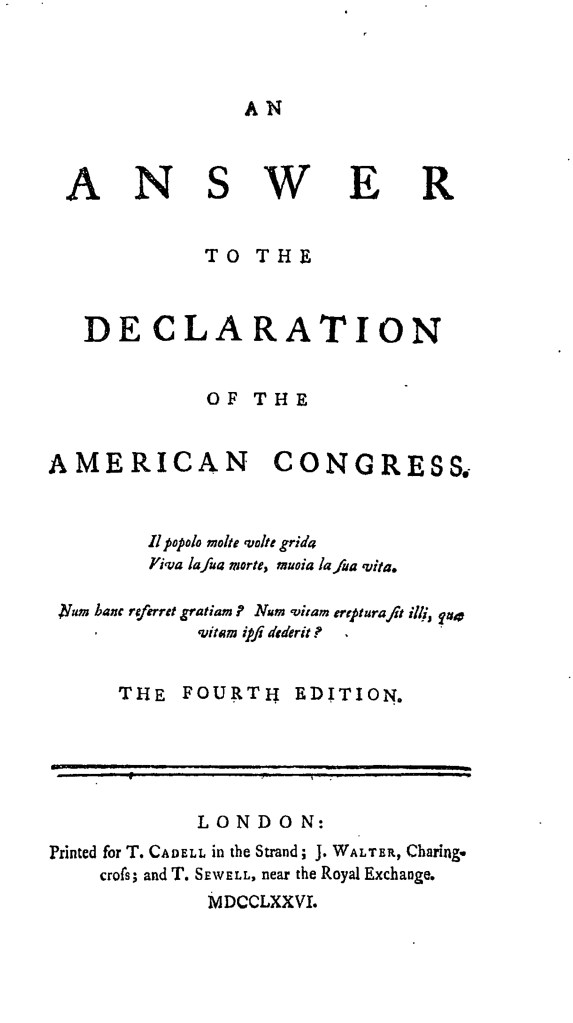
Lind Titlepage

SHORT REVIEW OF THE DECLARATION

IN examining this singular Declaration, I have hitherto confined myself to what are given as facts, and alleged against his Majesty and his Parliament, in support of the charge of tyranny and usurpation. Of the preamble I have taken little or no notice. The truth is, little or none does it deserve. The opinions of the modern Americans on Government, like those of their good ancestors on witchcraft, would be too ridiculous to deserve any notice, if like them too, contemptible and extravagant as they be, they had not led to the most serious evils.

In this preamble however it is, that they attempt to establish a theory of Government; a theory, as absurd and visionary, as the system of conduct in defence of which it is established is nefarious. Here it is, that maxims are advanced in justification of their enterprises against the British Government. To these maxims, adduced for this purpose, it would be sufficient to say, that they are repugnant to the British Constitution. But beyond this they are subversive of every actual or imaginable kind of Government.

They are about “to assume,” as they tell us, “among the powers of the earth, that equal and separate ( 120 ) station to which” — they have lately discovered — “the laws of Nature, and of Nature’s God entitle them.” What difference these acute legislators suppose between the laws of Nature and of Nature’s God, is more than I can take upon me to determine, or even to guess. If to what they now demand they were entitled by any law of God, they had only to produce that law, and all controversy was at an end. Instead of this, what do they produce? What they call sell-evident truths. “All men,” they tell us, “are created equal.” This rarity is a new discovery; now, for the first time, we learn, that a child, at the moment of his birth, has the same quantity of natural power as the parent, the same quantity of political power as the magistrate.

The rights of “life, liberty, and the pursuit of happiness” — by which, if they mean any thing, they must mean the right to enjoy life, to enjoy liberty, and to pursue happiness — they ” hold to be unalienable.” This they “hold to be among truths self-evident.” At the same time, to secure these rights, they are content that Governments should be instituted. They perceive not, or will not seem to perceive, that nothing which can be called Government ever was, or ever could be, in any instance, exercised, but at the expence of one or other of those rights. — That, consequently, in as many instances as Government is ever exercised, some one or other of these rights, pretended to be unalienable, is actually alienated.

That men who are engaged in the design of subverting a lawful Government, should endeavour by a cloud of words, to throw a veil over their design; that they should endeavour to beat down the criteria between tyranny and lawful government, is not at all (121) surprising. But rather surprising it must certainly appear, that they should advance maxims so incompatible with their own present conduct. If the right of enjoying life be unalienable, whence came their invasion of his Majesty’s province of Canada? Whence the unprovoked destruction of so many lives of the inhabitants of that province? If the right of enjoying liberty be unalienable, whence came so many of his Majesty’s peaceable subjects among them, without any offence, without so much as a pretended offence, merely for being suspected not to wish well to their enormities, to be held by them in durance? If the right of pursuing happiness be unalienable, how is it that so many others of their fellow-citizens are by the same injustice and violence made miserable, their fortunes ruined, their persons banished and driven from their friends and families? Or would they have it believed, that there is in their selves some superior sanctity, some peculiar privilege, by which those things are lawful to them, which are unlawful to all the world besides? Or is it, that among acts of coercion, acts by which life or liberty are taken away, and the pursuit of happiness restrained, those only are unlawful, which their delinquency has brought upon them, and which are exercised by regular, long established, accustomed governments?

In these tenets they have outdone the utmost extravagance of all former fanatics. The German Anabaptists indeed went so far as to speak of the right of enjoying life as a right unalienable. To take away life, even in the Magistrate, they held to be unlawful. But they went no farther, it was reserved for an American Congress, to add to the number of unalienable rights, that of enjoying liberty, and pursuing happiness; (122) — that is,— if they mean any thing, —pursuing it wherever a man thinks he can see it, and by whatever means he thinks he can attain it: — That is, that all penal laws — those made by their selves among others—which affect life or liberty, are contrary to the law of God, and the unalienable rights of mankind: — That is, that thieves are not to be restrained from theft, murderers from murder, rebels from rebellion.

Here then they have put the axe to the root of all Government; and yet, in the same breath, they talk of “Governments,” of Governments “long established.” To these last, they attribute same kind of respect; they vouchsafe even to go so far as to admit, that “Governments, long established, should not be “changed for light or transient reasons.”

Yet they are about to change a Government, a Government whose establishment is coeval with their own existence as a Community. What causes do they assign? Circumstances which have always subsisted, which must continue to subsist, wherever Government has subsisted, or can subsist.

For what, according to their own shewing, what was their original their only original grievance? That they were actually taxed more than they could bear? No; but that they were liable to be so taxed. What is the amount of all the subsequent grievances they alledge? That they were actually oppressed by Government? That Government has actually misused its power? No; but that it was possible that they might be oppressed; possible that Government might misuse its powers. Is there any where, can there be imagined any where, that Government, where subjects are not liable to taxed more than they can bear? (123) where it is not possible that subjects may be oppressed, not possible that Government may misuse its powers?

This I say, is the amount, the whole sum and substance of all their grievances. For in taking a general review of the charges brought against his Majesty, and his Parliament, we may observe that there is a studied confusion in the arrangement of them. It may therefore be worth while to reduce them to the several distinct heads, under which I should have classed them at the first, had not the order of the Answer been necessarily prescribed by the order — or rather the disorder, of the Declaration.

The first head consists of Acts of Government, charged as so many acts of incroachment, so many usurpations upon the present King and his Parliaments exclusively, which had been constantly exercised by his Predecessors and their Parliaments.1

In all the articles comprised in this head, is there a single power alleged to have been exercised during the present reign, which had not been constantly exercised by preceding Kings, and preceding Parliaments? Read only the commission and instruction for the Council of Trade, drawn up in the 9th of King William III addressed to Mr. Locke, and others.2 See there what (124) powers were exercised by the King and Parliament over the Colonies. Certainly the Commissioners were directed to inquire into, and make their reports concerning those matters only, in which the King and Parliament had a power of controlling the Colonies. Now the Commissioners are instructed to inquire — into the condition of the Plantations, “as well with regard to the administration of Government and Justice, as in relation to the commerce thereof;”–into the means of making “them most beneficial and useful to England; — “into the staples and manufactures, which may be encouraged there;” — “into the trades that are taken up and exercised there, which may prove prejudicial to England;” — “into the means of diverting them from such trades.” Farther, they are instructed “to examine into, and weigh the Acts of the Assemblies of the Plantations;” — “to set down the usefulness or mischief to the Crown, to the Kingdom, or to the Plantations their selves.” — And farther still, they are instructed “to require an account of all the monies given for public uses by the assemblies of the Plantations, and how the same are, or have been expended, or laid out.” Is there now a single Act of the present reign which does not fall under one or other of these instructions?

The powers then, of which the several articles now before us complain, are supported by usage; were conceived to be so supported then, just after the Revolution, at the time these instructions were given; and were they to be supported only upon this foot of usage, still that usage being coeval with the Colonies, their tacit consent and approbation, through all the successive periods in which that usage has prevailed, would be implied; — even then the legality of those powers would stand upon the same foot as most of the prerogatives (125) of the Crown, most of the rights of the people, — even then the exercise of those powers could in no wise be deemed usurpations or encroachments.

But the truth is, to the exercise of these powers, on many occasions the Colonies have not tacitly, but expressly, consented; as expressly as any subject of Great Britain ever consented to Acts of the British Parliament. Consult the Journals of either House of Parliament; consult the proceedings of their own Assemblies; and innumerable will be the occasions, on which the legality of these powers will be found to be expressly recognised by Acts of the Colonial Assemblies. For in preceding reigns, the petitions from these Assemblies were couched in a language, very different from that which they have assumed under the present reign. In praying for the non-exercise of these powers, in particular instances, they acknowledged their legality; the right in general was recognised; the exercise of it, in particular instances, was prayed to be suspended on the sole ground of inexpedience.

The less reason can the Americans have to complain against the exercise of these powers, as it was under the constant exercise of the self-same powers, that they have grown up with a vigour and rapidity unexampled : That within a period, in which other communities have scarcely had time to take root, they have shot forth exuberant branches. So flourishing is their agriculture, that — we are told — “besides feeding plentifully their own growing multitudes, their annual exports have exceeded a million;” So flourishing is their trade, that — we are told — “it has increased far beyond the speculations of the most (126) sanguine imagination.”3 So powerful are they in arms, that we see them defy the united force of that nation, which, but a little century ago, called them into being; which, but a few years ago, in their defence, encountered and subdued almost the united force of Europe.

If the exercise of powers, thus established by usage, thus recognised by express declarations, thus sanctified by their beneficial effects, can justify rebellion, there is not that subject in the world, but who has, ever has had, and ever must have, reason sufficient to rebel: There never was, never can he, established, any government upon earth.

The second head consists of Acts, whose professed object was either the maintenance, or the amendment of their Constitution. These Acts were passed with the view either of freeing from impediments the course of their commercial transactions,4 or of facilitating the administration of justice,5 or of poising more equally the different powers in their Constitution;6 or of preventing the establishing of Courts, inconsistent with the spirit of the Constitution.7

To state the object of these Acts, is to justify them. Acts of tyranny they cannot be: Acts of usurpation they are not; because no new power is assumed. By former Parliaments, in former reigns, officers of customs had been sent to America: Courts of Admiralty had been established there. The increase (127) of trade and population induced the Parliaments, under the present reign, for the convenience of the Colonists, and to obviate their own objections of delays arising from appeals to England, to establish a Board of Customs, and an Admiralty Court of Appeal. Strange indeed is it to hear the establishment of this Board, and these Courts, alleged as proofs of usurpation; and in the same paper, in the same breath, to hear it urged as a head of complaint, that his Majesty refused his assent to a much greater exertion of power: —to an exertion of power, which might be dangerous; the establishment of new Courts of Judicature. What in one instance he might have done, to have done in another, cannot be unconstitutional. In former reigns, charters had been altered; in the present reign, the constitution of one charter, having been found inconsistent with the ends of good order and government, was amended.

The third head consists of temporary Acts, passed pro re notá, the object of each of which was to remedy some temporary evil, and the duration of which was restrained to the duration of the evil itself.8

Neither in these Acts was any new power affirmed; in some instances only, the objects upon which that power was exercised, were new. Nothing was done but what former Kings and former Parliaments have shewn their selves ready to do, had the same circumstances subsisted. The same circumstances never did subsist before, because, till the present reign, the (128) Colonies never dared to call in question the supreme authority of Parliament.

No charge, classed under this head, can be called a grievance. Then only is the subject aggrieved, when, paying due obedience to the established Laws of his country, he is not protected in his established rights. From the moment he withholds obedience, he forfeits his right to protection. Nor can the means, employed to bring him back to obedience, however severe, be called grievances; especially if those means be to cease the very moment that the end is obtained.

The last head consists of Acts of self-defence, exercised in consequence of resistance already shewn but represented in the Declaration as Acts of oppression, tending to provoke resistance.9 Has his Majesty cut off their trade with all parts of the world? They first attempted to cut off the trade of Great Britain. Has his Majesty ordered their vessels to be seized ? They first burnt the vessels of the King. Has his Majesty sent troops to chastise them? They first took up arms against the authority of the King. Has his Majesty engaged the Indians against them? They first engaged Indians against the troops of the King. Has his Majesty commanded their captives to serve on board his fleet? He has only saved them from the gallows.

(129) By some, these acts have been improperly called “Acts of punishment.” And we are then asked, with an air of insult, “What! will you punish without a trial, without a hearing?” And no doubt punishment, whether ordinary or extraordinary; whether by indictment, impeachment, or bill of attainder, should be preceded by judicial examination. But, the acts comprised under this head are not acts of punishment; they are, as we have called them, this of self-defence. And these are not, cannot be, preceded by any judicial examination. An example or two will serve to place the difference between acts of punishment and acts of self-defence in a stronger light, than any definition we can give. It has happened, that bodies of manufacturers have risen, and armed, in order to compel their masters to increase their wages: It has happened, that bodies of peasants have risen, and armed, in order to compel the farmer to sell at a lower price. It has happened, that the civil magistrate, unable to reduce the insurgents to their duty, has called the military to his aid. But did ever any man imagine, that the military were sent to punish the insurgents? It has happened, that the insurgents have resisted the military, as they had resisted the civil magistrate: It has happened, that, in consequence of this resistance, some of the insurgents have been killed: — But did ever any man imagine that those who were thus killed, were therefore punished? No more can they be said to be punished, than could the incendiary, who should be buried beneath the ruins of the house, which he had feloniously set on fire. Take an example yet nearer to the present case. When the Duke of Cumberland led the armies of the king, foreign and domestic, against the Rebels in Scotland, did any man conceive that he was (130) sent to punish the Rebels? — Clearly not. — He was sent to protect dutiful and loyal subjects, who remained in the peace of the King, against the outrages of Rebels, who had broken the peace of the King. — Does any man speak of those who fell at the battle of Culloden, as of men that were punished? Would that man have been thought in his senses, who should have urged, that the armies of the King should not have been sent against these Rebels in Scotland, till those very Rebels had been judicially heard, and judicially convicted? Does not every man feel that the fact, the only fact, necessary to be known, in order to justify these acts of self-defence, is simply this: — Are men in arms against the authority of the King? — Who does not feel, that to authenticate this fact, demands no judicial inquiry? If when his Royal Highness had led the army under his command into Scotland, there had been no body of men in arms; if, terrified at his approach, they had either laid down their arms and submitted, or had dispersed and retired quietly, each to his own home, what would have been the consequence? The civil magistrate would have searched for and seized upon those who had been in arms would have brought them to a court of justice. That court would have proceeded to examine, and to condemn or to acquit, as evidence was, or was not, given of the guilt of the respective culprits. The Rebels did not submit, they did not lay down their arms, they did not disperse; they resisted the Duke: a battle ensued: some of the Rebels fled, others were slain, others taken. It is upon those only of the last class, who were brought before and condemned by Courts of justice, that punishment was inflicted. By what kind of logic then are these acts ranked in the class of grievances?

(131) These are the Acts — these are the exertions of constitutional, and hitherto, undisputed powers, for which, in the audacious paper, a patriot King is traduced — as “a Prince, whose character is marked by every Act “which may define a tyrant;” as “unfit to be the ruler of a free people.” These are the Acts, these exertions of constitutional, and, hitherto, undisputed powers, by which the Members of the Congress declare their selves and their constituents to be “absolved from all allegiance to the British Crown” pronounce “all political connection between Great Britain and America to be totally dissolved.” With that hypocrisy which pervades the whole of the Declaration, they pretend indeed, that this event is not of their seeking; that it is forced upon them; that they only “acquiesce in the necessity which denounces their separation from us:” which compels them hereafter to hold us, as they hold the rest of mankind; enemies in war; in peace, friends.”

How this Declaration may strike others, I know not. To me, I own, it appears that it cannot fail — to use the words of a great Orator— “of doing us Knight’s service.”10 The mouth of faction, we may reasonably presume, will be closed; the eyes of those who saw not, or would not see, that the Americans were long since aspiring at independence, will be opened; the nation will unite as one man, and teach this rebellious people, that it is one thing for them to say, the connection, which bound them to us, is dissolved, another to dissolve it; that to accomplish their independence is not quite so easy as to declare it: that there is no (132) peace with them, but the peace of the King: no war with them, but that war, which offended justice wages against criminals. — We too, I hope, shall acquiesce in the necessity of submitting to whatever burdens, of making whatever efforts may be necessary, to bring this ungrateful and rebellious people back to that allegiance they have long had it in contemplation to renounce, and have now at last so daringly renounced.

  1. Under this head are comprised articles I. II. so far as they are true, III. VII. IX. so far as the last relates to the tenure of the Judges’ offices. XI. XII. XIII. XIV. XVII. XVIII. so far as the last relates to the Declaration of the power of Parliament to make laws for the Colonies binding in all cases whatsoever.
  2. See Com. Journ. vol. xii. , p. 70, 71, 72.
  3. See Mr. Burke’s speeches. [Bentham’s reference is to Burke’s speech in Parliament of April 19, 1774 on a proposal to repeal the tea duty.  The speech had been published as early as 1775 by J. Dodsley.  It also appears to have been available bound in a volume containing other speeches (though editions in this form seem to be rare), which may explain Bentham’s use of the plural)].     
  4. Article X.
  5. Article XVIII, so far as it relates to the multiplication of the Courts of Admiralty.
  6. Article XXI
  7. Article VIII.
  8. Under this head may be classed Articles IV., V. VI. IX. so far as the last relates to the payment of the Judges by the Crown. XV. XXII so far as the latter relates to the suspension of their legislatures.
  9. Under this head may be classed Articles XVI.,XXIII, XXIV, XXV, XXVI, XXVII. Two other Acts there are, not comprised with any of the four heads, the XX and XXVIII. The former of there relates to the government of Quebec., with which the revolted Colonies have no more to do, than with the government of Russia: The latter relates to the humble petitions they pretend to have presented “in every stage,” as they style it, “of the oppressions,” under which they pretend to labour. This we have seen to be false. Not one one humble petition; no one decent representation, have they offered,
  10. Mr. Burke’s speech. [Bentham is again referring to Burke’s speech of April 19, 1774 and draws a parallel to Parliament’s repeal of the Stamp Act and the present discussion of the tea levy.   The relevant passage reads, “Sir, a partial repeal, or, as the bon ton of the court then was, a modification, would have satisfied a timid, unsystematic, procrastinating Ministry, as such a measure has since done such a Ministry. A modificatio [sic] is the constant resource of weak, undeciding minds. To repeal by the denial of our right to tax in the preamble, (and this too did not want advisers,) would have cut, in the heroic style, the Gordian knot with a sword. Either measure would have cost no more than a day’s debate. But when the total repeal was adopted; and adopted on principles of policy, of equity, and of commerce; this plan made it necessary to enter into many and difficult measures. It became necessary to open a very large field of evidence commensurate to these extensive views. But then this labour did knight’s service. It opened the eyes of several to the true state of the American affairs; it enlarged their ideas; it removed prejudices; and it conciliated the opinions and affections of men.”  E. J. Payne’s editorial note suggests a possible allusion here to Shakespeare’s use of  “yeoman’s service”  in Hamlet V:2, though this strikes me as a bit of stretch].
Posted in Uncategorized | Tagged , , | 18 Comments

Foucault, the “History of Thought,” and the Question of Enlightenment

My previous post examined how, during the last eighteen months of his life, Foucault repeatedly drew a distinction between the “history of thought” in which he was engaged and more conventional (though, in his view, “entirely legitimate“) approaches employed within the “history of ideas.” This distinction was related to his emphasis on what he called “problematization”: the process by which “a group of obstacles and difficulties” come to be seen as problems that prompt a range of possible responses. As he explained to Paul Rabinow in one of his final interviews,

The work of philosophical and historical reflection is put back into the field of the work of thought only on condition that one clearly grasps problematization not as an arrangement of representations but as a work of thought.1

This post will attempt to draw out some of the implications of Foucault’s distinction by exploring his discussions of a text that has been significant both for work in “history of ideas” and for Foucault’s discussion of the “history of thought”: Immanuel Kant’s 1784 answer to the question “What is Enlightenment?”

Enlightenment as Concept and Context

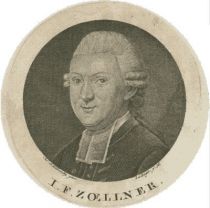
As I’ve discussed elsewhere, there is a long-standing tendency —both among historians of ideas and others — to use Kant’s essay to clarify the aims of the historical period that we call “the Enlightenment.”2 This tendency has been aided and abetted by Kant’s having closed his attempt to answer the question posed by Johann Friedrich Zöllner in the Berlinische Monatsschrift by asking and answering a question about the attributes of his age:

If it is asked: “Do we now live in an enlightened age?” the answer is: “No, but we do live in an age of enlightenment.”

While it is understandable that readers might be tempted to understand Kant’s phrase “Zeitalter der Aufklärung” as referring to what we have learned to call “the Age of the Enlightenment,” it is important (or so I’ve argued) to recognize that Kant and his contemporaries understood “enlightenment” as an activity or process in which one was engaged rather than a period to which one belonged. While they might — at their most optimistic — have argued that theirs was an age that was notable in its vigorous pursuit of this process, they were clear that there had been ages of enlightenment prior to theirs. It also bears remembering that, in the various discussions that led up to the posing of Zöllner’s question, there had been an extended discussion within the Wednesday Society (a secret society of “friends of enlightenment” whose members included, in addition to Zöllner and Moses Mendelssohn, the editors of the Berlinische Monatsschrift) of why, despite the concerted efforts of various enlighteners, enlightenment had made so little progress in Prussia.3

“Enlightenment” occupies a prominent, albeit somewhat peculiar, place in the history of ideas. For the most part, it tends to be used here in much the same way as it is used elsewhere: as a term that refers to a particular historical period. In that sense it functions less as a concept whose history is traced than as a historical context in which certain other ideas (e.g., “progress,” “death”, or “religion”) occur.4 It is, however, a context of a rather peculiar sort. In some cases, it serves simply a way of setting temporal boundaries and, in that usage, is roughly equivalent to “the eighteenth century” or the “long eighteenth century.” But since the eighteenth century (in either its regular or elongated forms) contained much that was not particularly “enlightened”, the term can also be used to denote a particular, temporally bounded, intellectual context. Understood in that way, historians of ideas have gone on to divide their time between explorations of the history of particular ideas within the broader context of “Enlightenment thought” and offering general discussions of the characteristics that define that peculiar entity known as “the Enlightenment.” The last several decades have also seen a variety of attempts to trace the history of the concepts of “enlightenment” and “the Enlightenment.” Much of what I’ve written might be understood as a contribution to that particular effort.

Foucault’s work has had a wide-ranging, but somewhat ambiguous, relationship to the history of ideas in general and to work on the Enlightenment in particular. The ambiguity can, in part, be attributed to the general skepticism with which an earlier generation of dix-huitiémistes received his work (see, for example, G. S. Rousseau’s dismissive review of the translation of Les Mots et le Choses in Eighteenth-Century Studies5) and to misgivings about what was viewed as Foucault’s general antipathy towards the ideals of the Enlightenment. The field of eighteenth-century studies was, as Leo Damrosch aptly put it, “born defensive” and its practitioners sometimes do not take kindly to critiques of the objects of its affection.6 And, finally, Foucault’s work was sometimes regarded as not sufficiently serious: in 1989, one of the readers’ reports I received when I submitted my article on discussions of the question “What is enlightenment?” to the Journal of the History of Ideas (while generally favorable) wondered whether my citation of Foucault’s discussion of Kant’s response might be too “trendy.”7

Times have changed: at this point references to Foucault’s discussion of Kant are hardly unusual. But while his work has had a pervasive influence on the history of ideas, the contrast he drew between his “history of thought” and conventional approaches in the “history of ideas” remains largely unexplored (at least by historians of ideas). In this post I will explore whether his (no longer trendy) discussion of Kant’s response to the question “What is enlightenment?” might be as good a place as any to attempt to remedy that.

Problematizing the Enlightenment?

In his Berkeley lecture, Foucault argued that Kant’s 1784 essay in the Berlinische Monatsschrift marked

the discreet entrance into the history of thought [emphasis mine] of a question that modern philosophy has not been capable of answering, but that it has never managed to get rid of, either. … From Hegel through Nietzsche or Max Weber to Horkheimer or Habermas, hardly any philosophy has failed to confront this same question, directly or indirectly. What, then, is this event that is called the Aufklärung and that has determined, at least in part, what we are, what we think, and what we do today?8

At the close of the lecture, he went on to suggest that the question Kant was attempting to answer opened up the possibility of a series of “historico-critical investigations” that

are quite specific in the sense that they always bear upon a material, an epoch, a body of determined practices and discourses. And yet, at least at the level of the Western societies from which we derive, they have their generality, in the sense that they have continued to recur up to our time: for example, the problem of the relationship between sanity and insanity, or sickness and health, or crime and the law; the problem of the role of sexual relations; and so on (49).

He stressed that he was neither imputing a “metahistorical continuity” to these problems nor suggesting that it would be necessary to trace all their variations. But he did stress that

What must be grasped is the extent to which what we know of it, the forms of power that are exercised in it, and the experience that we have in it of ourselves constitute nothing but determined historical figures, through a certain form of problematization that defines objects, rules of action, modes of relation to oneself. The study of modes of problematization [emphasis mine] (that is, of what is neither an anthropological constant nor a chronological variation) is thus the way to analyze questions of general import in their historically unique form (49).

When read in the context of Foucault’s 1983 discussions of the aims of his “history of thought” it is clear that he seemed to have seen a particular affinity between Kant’s response to the question “What is Enlightenment?” and his own work. Kant was regarded as making a contribution to the “history of thought” and one of the implications of his work was a concern with “modes of problematization.” In this light, it may be worth recalling that Foucault had begun his 1983 lectures at the Collège de France by confessing that Kant’s essay on enlightenment was “something of a b1azon, a fetish for me” and that it “bears some relation to what I am talking about.”9

But the relationship between this opening invocation of Kant’s essay and the discussion of the “government of self and others” that followed is far from clear. Kant returns briefly in the February 23 lecture, in the context of a discussion of Diogenes and Plato (292). An echo of this discussion returns in his Berkeley lecture when Foucault suggests that Kant was proposing something along the lines of a parrēsic contract to Frederick the Great (i.e., if you let us argue, we promise to obey).10

We can get a somewhat clearer sense of what Foucault seems to have found appealing in his final discussions of Kant’s essay if we contrast Foucault’s 1983 discussions with his 1978 lecture to the Société française de Philosophie “What is Critique?” There, Foucault associated the emergence of what he termed the “critical attitude” with the question of “how not to be governed” — a question that, as he immediately stressed, was not equivalent the demand not to be governed “at all,” but instead had to be understood in the context of efforts to question

How not to be governed like that, by that, in the name of these principles, in view of such objectives and by the means of such methods, not like that, not for that, not by them ….”11

What we find here reads like a preliminary formulation of what he would later characterize as the work of “problematization”: the attempt to govern in a certain way is met with a response that insists on not being governed in that specific way (while leaving open the prospect of other forms of governance).

In a discussion of Foucault 1983 lectures, Frédéric Gros summarized their relationship to the 1978 lecture this way:

In 1978 Kant’s text was situated in the perspective of a “critical attitude” that Foucault dates from the beginning of the modern age and in opposition to the requirements of a pastoral governmentality (directing individuals’ conduct by the truth). Posing the question of Enlightenment involved rediscovering the question: how not to be governed in that way? The problem posed was that of a “desubjectification” in the framework of a “politics of truth.” Modernity was then defined as a privileged historical period for studying the subjecting/subjectifying forms of knowledge-power. In 1983 the question of Enlightenment will be thought of as the reinvestment of a requirement of truth-telling, of a courageous I speaking the truth that appeared in the Greeks, and as giving rise to a different question: What government of self should be posited as both the foundation and limit of the government of others? The meaning of “modernity” also changes: it becomes a meta-historical attitude of thought itself 12

While Gros does an excellent job of capturing the main differences between the two discussions, I have a few minor reservations about his account.

The first has to do with the question of which of “Kant’s texts” is actually central to this account. Though Foucault somewhat coyly delays invoking the title of Kant’s little essay until the close of his 1978 lecture, for the most part this earlier discussion attempts to work out the parallels between the various contexts in which objections to governance emerge and the concerns of Kant’s three critiques. In contrast, his 1983 discussions of Kant emphasize the difference between Kant’s critical philosophy and more historical focus of Kant’s essay on enlightenment. My second reservation concerns Gros’ characterization of “modernity” as a “meta-historical attitude.” How can we to reconcile this with Foucault’s stress, in his 1983 Berkeley lecture, that the inquiries prompted by Kant’s essay need not be concerned with tracing a “metahistorical continuity over time,” but instead should focus on particular “modes of problematization”? My final question has to do with what, exactly, is supposed to be “problematized” by the question “What is enlightenment?”

For my immediate purposes, this final question is of greater import than the first two reservations, since it may help to clarify the differences between analyses of Kant’s essay that take their bearings from conventional approaches in the history of ideas and the approach of Foucault’s proposed “history of thought.” But we still have one earlier text to talk about in which Foucault distinguished the “history of thought” from the “history of ideas.”

Foucault on Cassirer and Hazard

As I noted in an earlier post, one of Foucault’s more interesting discussions of the Enlightenment has been routinely ignored: his 1966 review of the French translation of Ernst Cassirer’s Philosophie der Aufklärung. Contrasting Cassirer’s approach to Paul Hazard’s Crise de la conscience européenne, Foucault argues that Hazard tended to assume that “an ‘age’ (siècle) has, like everything else, consciousness, opinions, anxieties, aspirations ….” Cassirer, in contrast, dispensed with the discussion of individual motivations, biographical accidents, and minor thinkers and also avoided the analysis of economic and social determinants. Instead, he concentrated on the “inextricable web of discourse and thought, of concepts and words, of énoncés and affirmations,” which he proceeded to analyze “in its own configuration.” The result, Foucault argued, was a study that explored an “autonomous universe of ‘discours-pensée‘” that “isolates from all other histories the autonomous space of ‘the theoretical’.”

My earlier discussion had been content to note the parallel between Foucault’s description of what he saw Cassirer as doing and his own procedure in the Archaeology of Knowledge, but overlooked a few lines near the end, whose significance should now be a good deal clearer. Here Foucault noted that Cassirer’s account was not without its shortcomings: it gave philosophy in general and “reflection” in particular an unwarranted primacy. Foucault went on to argue,

Without a doubt it will be necessary — it will be our task — to free ourselves from these limits which are still disturbingly reminiscent of the traditional history of ideas.

But, reversing course, he ended by praising Cassirer for not limiting the Enlightenment, as had been customary, to England and France and for refusing to “play the game of looking for missing pieces and warning signs for the future.” He argued that, at the very moment when National Socialism were reviving a virulent form of German nationalism, Cassirer revealed “the calm, irresistible, enveloping force of the theoretical universe.” The result was a book that “founded the possibility of a new history of thought[emphasis mine]” — a possibility that Foucault viewed as a point from which “we others can take our departure.”

At the risk of reading too much into what might, after all, simply be a turn of phrase, the appearance, at this early date, of “history of thought” is worth noting, especially since Foucault contrasts it with approaches (both in Hazard and in Cassirer’s weaker moments) that remain tied to the conventions of the history of ideas. And, of courses, it is also significant that this contrast occurs in the context of a study of the Enlightenment.

What is most striking here are the differences between Foucault’s 1966 and his 1983 accounts of the “history of thought”. In 1966 he countered approaches like those of Hazard with an approach that would explore an “autonomous universe of ‘discourse-thought” [discours-pensée].” But in 1983, the aim of the “history of thought” was to explore those moments when individuals

step back from this way of acting or reacting, to present it to oneself as an object of thought and to question it as to its meaning, its conditions, and its goals.13

The contrast becomes a bit clearer if we note that there remains, despite these changes, a continued emphasis on emphasis on the function of “archaeology.”

In my last post, I noted that one of occasions on which Foucault invoked the idea of “history of thought” was a discussion with members of the Berkeley history department. In response to the suggestion that “archaeology” might be seen as emphasizing “discontinuities” while genealogy stressed continuities, he responded:

No: the general theme of my research is the history of thought. How could we make the history of thought? I think that thought cannot be disassociated from discourses and we can’t have any access to thought, either to our own present thought, or our contemporaries’ thought, or of course thought of people of previous periods, but through discourses. And that is the necessity of the archeological consideration. And that has nothing to do with continuity or discontinuity. You can find either continuity or discontinuity in those discourses.

This may help to clarify the differences between the treatment of the “history of thought” in Foucault’s review of Cassirer and the way in which he presented it at the close of his life. What remains constant is the role of discourses, which serve as the sole access we have to “thought.” It is this that renders the consideration of “archeology” necessary. What changes is the emphasis in his later work on the particular ways in which systems of thought become problematic.

Against the tendency to assume that systems of discourse were some inherently “discontinuous”, he stressed the way in which it was possible to trace the emergence, at certain particular sites of contestation, of problems that persist for shorter or longer periods of time. Understood in that way, the “history of thought” might be understood as

the history of the way people begin to take care of something, of the way they became anxious about this or that – for example, about madness, about crime, about sex, about themselves, or about truth.14

Would it, perhaps, be possible to add one further term to the list of things that, at particular historical moments, people begin to care about: namely, “enlightenment”?

What Was — and What Still Might Be — Problematic About Enlightenment?

One of the things that initially puzzled me about Foucault’s discussion of Kant’s answer to the question “What is enlightenment?” was his lack of interest in either the context in which the question arose or the answers that others offered (he mentions Mendelssohn’s response briefly in his Berkeley lecture, but has little to say about it). Granted, he had other concerns and it is possible that, had he been granted more time, he might have had more to say about an essay that clearly mattered a good deal to him. Then again, it may be that my problems with Foucault’s treatment of Kant’s answer are the result of expecting a “historian of thought” to do the sort of work that is normally done by “historians of ideas.”

As a historian of ideas who (I hope) has learned something from Foucault’s “history of thought,” what interests me about the question Kant was answering (and it is worth noting that this not the same thing as being particularly interested in Kant’s answer) was how — in the space of a year — a question about the advisability of clerical participation in marriage ceremonies turned into a wide-ranging discussion of the limits of civil and ecclesiastical power, the relationship of writing and thought, the obligations of citizens to their rulers, and so on. Could we see this, perhaps, as an example of “problematization” with a vengeance?

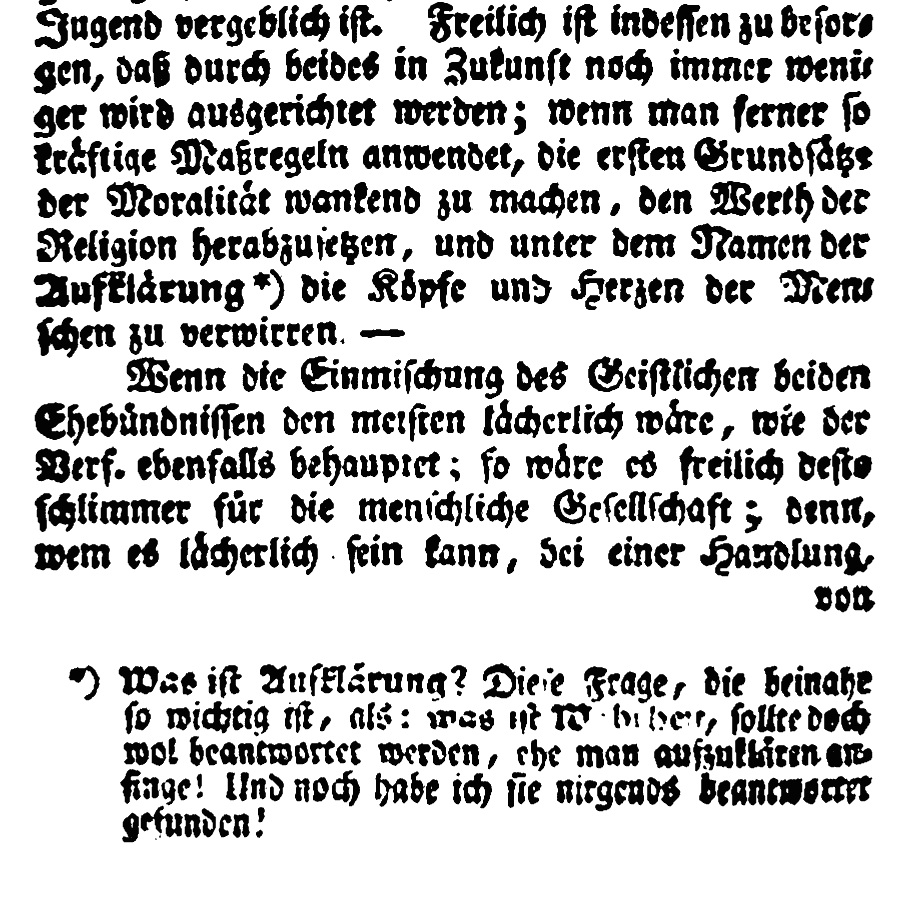
Foucault’s approach to these matters was, in one sense, quite traditional: he privileged Kant’s response and took little notice of the various lesser thinkers who sought to answer Zöllner’s question. Further, his exclusive focus on Kant’s answer prevented him from seeing that, at the origins of these arguments, there lay a set of concerns that ought to have interested him: the role of ecclesiastical and civil authorities in the administration of marriage, the potentially corrosive effects of discourse on obedience, and (particularly in the case of Mendelssohn’s response) the conflict between different regimes of knowledge. Finally, in his influential little footnote Zöllner had suggested that the question “what is enlightenment?” was “almost as important” as the question “what is truth?” — a suggestion that might have been of considerable interest for a thinker who was skilled in the art of exploring the complex rules that govern games of truth and power.

Foucault, however, regarded Kant’s essay as a “blazon, a sort of fetish,” which may explain why he was reluctant to subject it to the cold, merciless, and endlessly provocative analysis that characterized the best of his work.

Sun

  1. Foucault, “Polemics, Politics, and Problematizations,” in Ethics: Subjectivity and Truth, ed. Paul Rabinow, trans. Robert Hurley (New York: New Press, 1997) 119.
  2. See James Schmidt, “Misunderstanding the Question: ‘What Is Enlightenment?’: Venturi, Habermas, and Foucault,” History of European Ideas 37:1 (2011): 43–52 and “Enlightenment as Concept and Concept,” forthcoming in Journal of the History of Ideas — until publication, a preprint is available at https://www.academia.edu/4177077/Enlightenment_as_Concept_and_Context. 
  3. I’ve discussed these points at length in my introduction to James Schmidt, ed., What Is Enlightenment?: Eighteenth-Century Answers and Twentieth-Century Questions (Berkeley: University of California Press, 1996). 
  4. For example, Charles Frankel, The Faith of Reason; the Idea of Progress in the French Enlightenment (New York: King’s Crown Press, 1948),  John McManners, Death and the Enlightenment : Changing Attitudes to Death among Christians and Unbelievers in Eighteenth-Century France (Oxford: Clarendon Press ; New York, 1981), and Peter Harrison, “Religion” and the Religions in the English Enlightenment (Cambridge England ; New York: Cambridge University Press, 1990). 
  5. G. S. Rousseau, “Whose Enlightenment? Not Man’s: The Case of Michel Foucault,” Eighteenth-Century Studies 6:2 (1972): 238–56.
  6. This view of Foucault continues to turn up from time to time: for example, see Jonathan Israel, Democratic Enlightenment: Philosophy, Revolution, and Human Rights 1750-1790 (Oxford, 2011) 23-24. 
  7. James Schmidt, “The Question of Enlightenment: Kant, Mendelssohn, and the Mittwochsgesellschaft,” Journal of the History of Ideas 50:2 (1989): 269–91.
  8. Foucault, “What is Enlightenment?” in Paul Rabinow, ed., The Foucault Reader (New York: Pantheon, 1984) 32.
  9. Michel Foucault, The Government of Self and Others: Lectures at the College de France, 1982-1983, ed. François Ewald and Alessandro Fontana, trans. Graham Burchell (Palgrave Macmillan, 2010) 6-7.
  10. I’ve discussed this point in “Misunderstanding the Question” 50-51.
  11. Foucault, “What is Critique?” in James Schmidt, ed., What Is Enlightenment?: Eighteenth-Century Answers and Twentieth-Century Questions (Berkeley: University of California Press, 1996) 384.
  12. Michel Foucault, The Government of Self and Others: Lectures at the College de France, 1982-1983, ed. François Ewald and Alessandro Fontana, trans. Graham Burchell (Palgrave Macmillan, 2010) 378-379.
  13. Foucault, “Polemics, Politics, and Problematizations,” 117.
  14. Michel Foucault, Fearless Speech, ed. Joseph Pearson (Semiotext(e), 2001) 74.
Posted in Uncategorized | Tagged , , , , | 1 Comment

“The Radical Enlightenment” – Diametros Volume 40

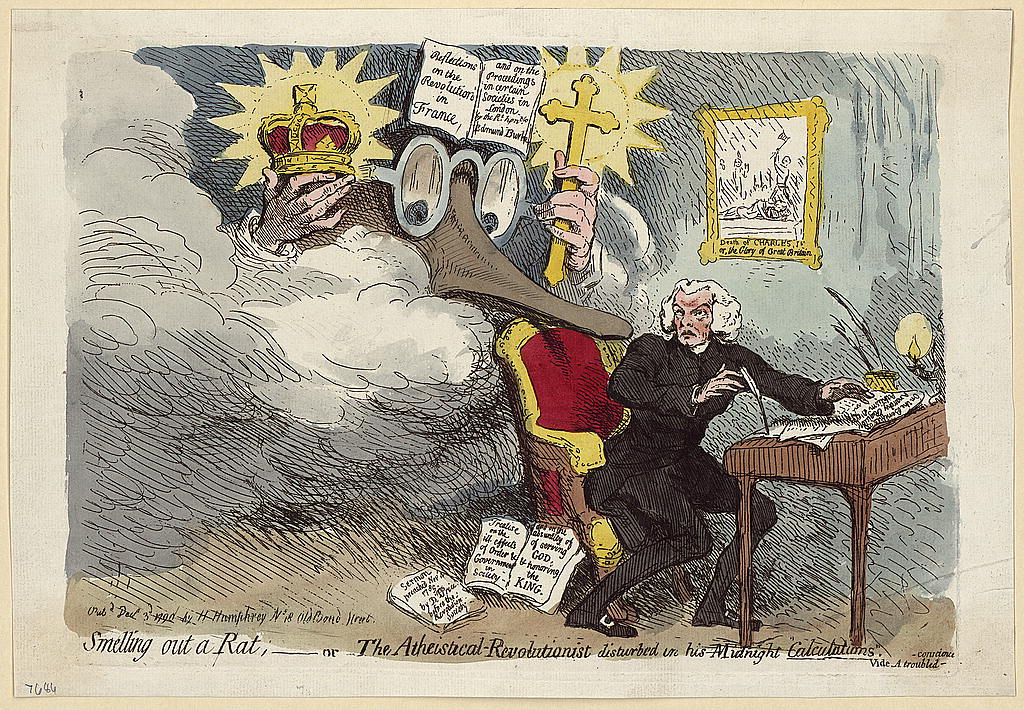
Volume 40 of the online philosophy journal Diametros (available here) focuses on “The Radical Enlightenment.”  The main event is the latest in the ongoing series of exchanges between Jonathan Israel and Margaret C. Jacob, along with discussions of Israel’s work by Sebastian Gardner and Przemysław Gut.  The issue also includes articles by Eric Schliesser on Toland and Smith, Bert van Roermund on the Code Civil, Zbigniew Drozdowicz on Voltaire, a discussion of the role of rights, responsibilities, and republicanism in the Enlightenment by Kenneth Westphal, and my thoughts on Burke and Gillray (at least some of which may already be familiar to readers of this blog).


Posted in Uncategorized | Leave a comment

On Michel Foucault’s Distinction between the “History of Ideas” and the “History of Thought”

In a May 1984 interview with Paul Rabinow, Michel Foucault characterized his general approach as follows:

For a long time, I have been trying to see if it would be possible to describe the history of thought as distinct both from the history of ideas (by which I mean the analysis of systems of representation) and from the history of mentalities (by which I mean the analysis of attitudes and types of action [schémas de comportement]. It seemed to me there was one element that was capable of describing the history of thought — this was what one could call the element of problems or, more exactly, problematizations. What distinguishes thought is that it is something quite different from the set of representations that underlies a certain behavior; it is also quite different from the domain of attitudes that can determine this behavior. Thought is not what inhabits a certain conduct and gives it its meaning; rather, it is what allows one to step back from this way of acting or reacting, to present it to oneself as an object of thought and to question it as to its meaning, its conditions, and its goals. Thought is freedom in relation to what one does, the motion by which one detaches from it, establishes it as an object, and reflects on it as a problem.1

It is not entirely surprising that the phrase “history of thought” turns up quite a bit in Foucault’s writings: after all, he held a chair at the Collège de France on the “history of systems of thought.” But, unless I’m mistaken (and the point of this post is, in part, to see if I am) there have been few discussions in the secondary literature of the way Foucault attempted to distinguish his proposed “history of thought” from more familiar approaches in the area of intellectual or cultural history.

A cursory search led me to M. Lane Bruner’s 2006 article “Rationality, Reason and the History of Thought” in Argumentation, which begins by quoting another of Foucault’s late invocations of the term (188) and goes on to explore possible parallels between Foucault’s use of the concept, Hegel’s notion of the cunning of reason, and my colleague Neta Crawford’s work on the history of arguments about slavery and forced labor.2 I also came across Bregham Dalgliesh’s discussion in a recent issue of Parrhesia of the relationship of Foucault’s approach to that of Kant and Nietzsche.3 But while Bruner and Dalgliesh discuss the distinction that Foucault draws between his proposed “history of thought” and the approaches of the “history of ideas” and the “history of mentalities,” their concern tends to lie with Foucault’s relationship with his philosophical predecessors, rather than with the implicit contrast he was making between his own inquiries and the sort of work in which historians of ideas see themselves as engaged.

While there is much to be gained by examining Foucault’s debts to Nietzsche, Kant, and others, what interests me is the way in which Foucault sought to differentiate his work from that of his contemporaries in the fields of intellectual or cultural history. As a test case, I’d like to explore how his account of Kant’s response to the question “What is Enlightenment?” differs from accounts of the essay that have been offered by those of us who, for better or worse, see ourselves as engaged in one or another of the various enterprises that cluster under the heading “intellectual history.” This post will take a closer look at the way in which Foucault distinguished the “history of thought” from “the history of ideas.” Its sequel will attempt to apply this distinction to discussions of Kant’s famous little essay.

Characterizing the “History of Thought”

The phrase “history of thought” turns up quite frequently in Foucault’s final writings, most notably in the context of a series of 1983 discussions of his work on the concept of parrēsia. While there are a few earlier uses of the phrase (one of which I’ll discuss next time), it appears that it was only in the end of his life that the term began to function as a way of characterizing his own particular approach.

He began his January 5, 1983 lecture at the Collège de France by attempting to summarize his work “over the last years, even over the ten or maybe twelve years I have been teaching here” as follows:

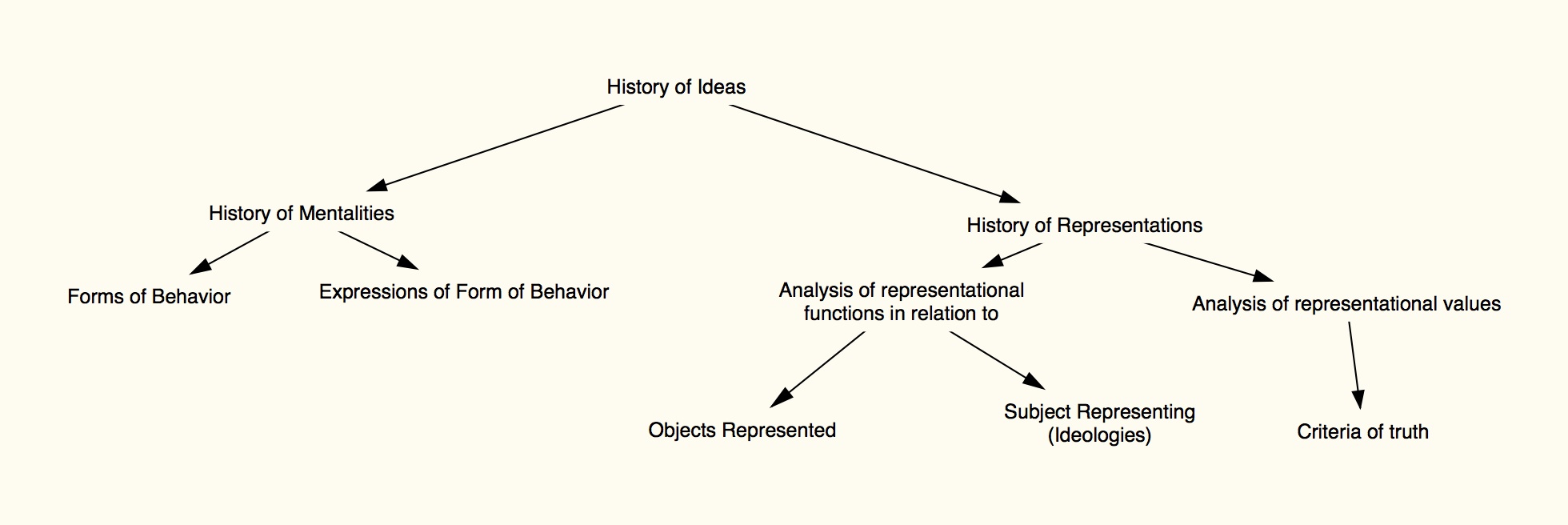
In this general project, which goes under the sign, if not the title, “the history of thought,” my problem has been to do something rather different from the quite legitimate activity of most historians of ideas. In any case, I wanted to differentiate myself from two entirely legitimate methods. I wanted to differentiate myself first of all from what we may call, and is called, the history of mentalities, which, to characterize it completely schematically be a history situated on an axis going from the analysis of actual forms of behavior to the possible accompanying expressions which may precede them, follow them, translate them, prescribe them, disguise them, or justify them, and so forth. On the other hand, I also wanted to differentiate myself from what could be called a history of representations or of representational systems, that is to say, a history which would have, could have, or may have two objectives. One would be the analysis of representational functions. By “the analysis of representational functions” I mean the analysis of the possible role played by representations either in relation to the object represented, or in relation to the subject who represents them to him or herself — let’s say an analysis of ideologies. And then I think the other pole of a possible analysis of representations is the analysis of the representational values of a system of representations, that is to say, the analysis of representations in terms of a knowledge (connaissance) — of a content of knowledge, or of a rule, or a form of knowledge — which is taken to be a criterion of truth, or at any rate a truth-reference point in relation to which one can determine the representational value of this or that system of thought understood as a system of representations of a given object.4

The phrase turns up again in an April 1983 discussion at the History department at Berkeley, where — in response to a question about the relationship between archaeology and genealogy that suggested that while the former emphasized discontinuities, the latter might be seen as stressing continuities — Foucault stated:

No: the general theme of my research is the history of thought. How could we make the history of thought? I think that thought cannot be disassociated from discourses and we can’t have any access to thought, either to our own present thought, or our contemporaries’ thought, or of course thought of people of previous periods, but through discourses. And that is the necessity of the archeological consideration. And that has nothing to do with continuity or discontinuity. You can find either continuity or discontinuity in those discourses.

Finally, he closed the second of the four lectures he gave at Berkley in the fall of 1983 on the notion of parrēsia by posing the distinction in this way:

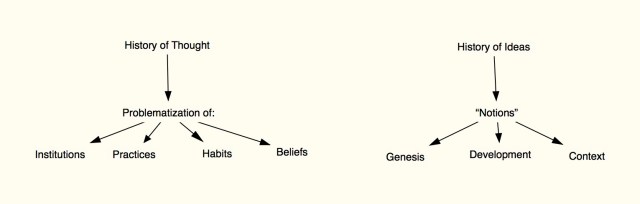
I would like to distinguish between the “history of ideas” and the “history of thought”. Most of the time a historian of ideas tries to determine when a specific concept appears, and this moment is often identified by the appearance of a new word. But what I am attempting to do as a historian of thought is something different. I am trying to analyze the way institutions, practices, habits, and behavior become a problem for people who behave in specific sorts of ways, who have certain types of habits, who engage in certain kinds of practices, and who put to work specific kinds of institutions. The history of ideas involves the analysis of a notion from its birth, through its development, and in the setting of other ideas which constitute its context. The history of thought is the analysis of the way an unproblematic field of experience, or a set of practices which were accepted without question, which were familiar and out of discussion, becomes a problem, raises discussion and debate, incites new reactions, and induces a crisis in the previously silent behavior, habits, practices, and institutions. The history of thought, understood in this way, is the history of the way people begin to take care of something, of the way they became anxious about this or that – for example, about madness, about crime, about sex, about themselves, or about truth.5

There are, no doubt, any number of other places where he used the phrase (I trust that readers will point out others), but this may be enough to begin to give us a sense of how Foucault proposed to use the term.

The most obvious points would seem to be the following:

  1. The term “history of thought” functions principally as a way to contrast what he is doing to the approaches of something called “the history of ideas.”
  2. In the January Collège de France lecture the “history of ideas” is further subdivided into two different “entirely legitimate methods”: (a) the “history of mentalities” — which ranges from “the analysis of actual forms of behavior to the possible accompanying expressions which may precede them, follow them, translate them, prescribe them, disguise them, or justify them, and so forth” — and (b) the “history of representations or of representational systems” — which is concerned with either “the analysis of representational functions” or with “the representational values of a system of representations.”
  3. The Berkeley lecture offers a somewhat different characterization of the concerns of the history of ideas: “a historian of ideas tries to determine when a specific concept appears, and this moment is often identified by the appearance of a new word.”
  4. The defining feature of the “history of thought” would appear to be that it is concerned with “the analysis of the way an unproblematic field of experience, or a set of practices which were accepted without question, which were familiar and out of discussion, becomes a problem, raises discussion and debate, incites new reactions, and induces a crisis in the previously silent behavior, habits, practices, and institutions.” In short, the focus of “the history of thought” falls on what Foucault calls the process of “problematization.”

The term “problematization” also turns up quite a bit in Foucault’s work from the 1980s, often in the context of his discussions of the concerns of his proposed “history of thought.” For example, the May 1984 interview with Paul Rabinow that I quoted at the start of this discussion continues

the work of a history of thought would be to rediscover at the root of these diverse solutions the general form of problematization that has made them possible — even in their very opposition; or what has made possible the transformation of the difficulties and obstacles of a practice into a general problem for which one proposes diverse practical solutions. It is problematization that responds to these difficulties, but by doing something quite other than expressing them or manifesting them: in connection with them, it develops the conditions in which possible responses can be given; it defines the elements that will constitute what the different solutions attempt to respond to. This development of a given into a question, this transformation of a group of obstacles and difficulties into problems to which the diverse solutions will attempt to produce a response, this is what constitutes the point of problematization and the specific work of thought (118).

At this point, Foucault emphasizes that what he is proposing is quite different from “an analysis in terms of deconstruction (any confusion between the two methods would be unwise).”

Rather it is a question of a movement of critical analysis in which one tries to see how the different solutions to a problem have been constructed; but also how these different solutions result from a specific form of problematization. And it then appears that any new solution which might be added to the others would arise from current problematization, modifying only several of the postulates or principles on which one bases the responses that one gives. The work of philosophical and historical reflection is put back into the field of the work of thought only on condition that one clearly grasps problematization not as an arrangement of representations but as a work of thought (119).

As a result, it might make sense to add a fifth point to our list:

5.  The “history of thought” is concerned, not with the functioning of systems of representation but rather with the “work of thought,” which begins at the moment when prevailing systems of representations and practices become problematic.

While there is more to be said about how Foucault goes about defining the “history of thought” (I’ve found Dalgliesh’s discussion particularly helpful), this may suffice to give a general sense of the way in which he proposes to distinguish what he is doing from the so-called “history of ideas.” The question I’d like to explore here is whether this distinction actually holds up.

Foucault’s Two Accounts of the “History of Ideas”

Understandably, Foucault is more interested in clarifying what the “history of thought” involves than he is in laying out the various practices in which historians of ideas might be engaged. In all of his discussions of the “history of thought” the “history of ideas” functions chiefly as a way of designating what it is that Foucault sees himself as not doing.  But if we compare the characterization of the “history of ideas” that he offers in his Collège de France lecture with the characterization that we find in his Berkeley lecture on parrēsia, we find two somewhat different accounts.

The Collège de France discussion is by far the most complicated, distinguishing between two different branches (the history of mentalities and the history of representations) which are subject to further subdivisions. The following might suffice as a rough sketch of Foucault’s account:

Collège de France Discussion

In contrast, the Berkeley discussion gives us a much simpler presentation of the concerns of the history of ideas. The focus now falls exclusively on “notions” and the task of the historian of ideas is confined to determining when (and, I suppose, how) these notions emerge, how they develop, and how their emergence and development might be contextualized.

Berkeley Discussion

The difference between the two accounts may amount to nothing more than the particular contexts of the two presentations:  the discussion at the Collège de France occurs at the start of what will a semester of lectures, while the discussion at Berkeley is sandwiched into the end of the second of four lectures. Obviously, Foucault had a good deal more time to draw distinctions in the earlier discussion than he did in the latter.  But as the characterization of the tasks of the “history of ideas” became simpler, the contrast to what Foucault’s “history of thought” became sharper: the former confines itself to tracing the history of concepts, whereas the latter focuses on the ways in which a wide range of beliefs and practices become subject to reflection and revision. When the “history of ideas” has been reduced to an examination of the history of “notions” — as opposed to an account of cultural practices (i.e., “mentalities”) and systems of representation — it is easier to see it as different from the type of inquiry in which Foucault sees himself as engaged.

This distinction is more difficult to draw in the case of the initial characterization of the scope of the “history of ideas”, which could be seen as expansive enough scope to include at least some of Foucault’s own earlier work. For example, in what sense is Les Mots et les Choses not an attempt at writing a history of the rise and fall of the various systems of representation in the human sciences? Or, couldn’t Surveiller et Punir be read, among other things, as the history of the emergence of those disciplinary practices served as the rationale for the modern prison? Much of the force of Foucault’s initial discussion of the distinction between the “history of ideas” and the “history of thought” stems from the way in which it suggests that these earlier works, which at one point might have been read as contributions to an enterprise (which, for want of a better term, could be called the “history of ideas”) that was expansive enough to cover the study of various cultural practices and representational systems were, in fact, pursuing a somewhat different research program. As his particular research program became clearer, it became possible to operate with a sharper contrast between it and a drastically simplified “history of ideas.”

The articulation of the concept of “problematization” would appear to play a leading role in sharpening this contrast. It provided Foucault with a way for him to stress that certain of his earlier works — especially those that were read as “structuralist” forays into the study of representational systems — were, in fact, doing something quite different. And (at last for some of us) one of the more attractive features of his later work was that it focused on the ways in which the history of certain concepts (e.g., parrēsia or the idea of self-governance) were transformed in the face of particular challenges or changing historical contexts. But a problem still remains.

Once the demarcation between the “history of ideas” and the “history of thought” is defined by the latter’s concern with moments of “problematization,” it is hard to see why at least some of the work done by “historians of ideas” could not be characterized as contributions to the “history of thought” in Foucault’s particular sense of the term. For certainly one of the things that at least some historians of ideas have explored is the way in which concepts and practices become problematic and are subjected to rethinking and reinvention. To clarify this issue, it might be helpful to pick a particular case and see the ways in which Foucault’s discussion of it differs from accounts offered by “historians of ideas.” One case immediately comes to mind: his discussion of Kant’s response to the question “What is Enlightenment?” I’ll look at it in the sequel to this post.

  1. Foucault, “Polemics, Politics, and Problematizations,” in Ethics: Subjectivity and Truth, ed. Paul Rabinow, trans. Robert Hurley (New York: New Press, 1997) 117.
  2. M. Lane Bruner, “Rationality, Reason and the History of Thought,” Argumentation 20:2 (2006): 185–208.
  3. Bregham Dalgliesh, “Critical History:  Foucault After Kant and Nietzsche,” Parrhesia, no. 18 (2013): 68–84. See also his 2002 dissertation Enlightenment Contra Humanism: Michel Foucault’s Critical History of Thought (PhD Thesis, Department of Philosophy, University of Edinburgh, 2002) (http://hdl.handle.net/1842/1725).
  4. Michel Foucault, The Government of Self and Others: Lectures at the College de France, 1982-1983, ed. François Ewald and Alessandro Fontana, trans. Graham Burchell (Palgrave Macmillan, 2010) 2-3.
  5. Michel Foucault, Fearless Speech, ed. Joseph Pearson (Semiotext(e), 2001) 74.
Posted in Uncategorized | Tagged , , | 6 Comments

Foucault on “Enlightenment” in Discipline and Punish

Discussing Michel Foucault’s Discipline and Punish (or, to be more accurate, that portions of it that turn up in The Foucault Reader) in a seminar I taught this spring, I was struck, once again, by a sentence that reminded me why — prior to Foucault’s last discussions of Immanuel Kant’s answer to the question “What is Enlightenment?” — there was a tendency to see Foucault as one of the more effective (and intransigent) modern critics of the Enlightenment.

An Enemy of the Enlightenment?

The sentence comes towards the end of the discussion of “Panopticism”, at the point when Foucault considers the ways in which the “formation of the disciplinary society” was connected with “a number of broad historical processes — economic, juridical-political and, lastly, scientific …” Considering the second of these three processes, he reflects on the way in which the rise of the bourgeoisie to the status of the politically dominant class had been “masked by the establishment of an explicit, coded and formally egalitarian juridical framework, made possible by the organization of a parliamentarian, representative régime.”

In a gesture that echoes the moment in Capital when Marx bids farewell to the domain of “Freedom, Equality, Property, and Bentham” and descends into the darkness of the factory to see how the worker tans hides and gets his own hide tanned, Foucault observes that the system of law and political representation is supported by a network of “tiny, everyday, physical mechanisms, by all those systems of micro-power that are essentially non-egalitarian and asymmetrical.” These mechanisms (which he terms “disciplines”) constitute “the other, dark side” of the system of rights and liberties.

… although, in a formal way, the representative regime makes it possible, directly or indirectly, with or without relays, for the will of all to form the fundamental authority of sovereignty, the disciplines provide to, at the base, a guarantee of the submission of forces and bodies. The real, corporeal disciplines constituted the foundation of the formal, juridical liberties. The contract may have been regarded as the ideal foundation of law and political power; panopticism constituted the technique, universally widespread, of coercion. It continued to work in depth on the juridical structures of society, in order to make the effective mechanisms of power function in opposition to the formal framework that it had acquired. The “Enlightenment”, which discovered the liberties, also invented the disciplines (222).

That last sentence seemed tailor-made to take its place — alongside Horkheimer and Adorno’s infamous judgment “Enlightenment is totalitarian” — on the list of the most famous attacks on the Enlightenment. His point, it would appear, is that the Enlightenment was playing a double game: on the surface, a world of rights, liberties, representation, but beneath the surface, a world of coercion and inequality. That the Panopticon served as the reigning image for the world of disciplinary practices added a final bit of spice to the account: the light that was supposed to liberate was even more efficient as a means of bondage.

Panopticon

Tallying “Enlightenment”

But having been recently cautioned by Stuart Edlen’s analysis of some of the problems that haunt the English translation of Surveiller et Punir, I thought it might make sense to take a look at the sentence in the original French. And, having done that, I became curious as to what the other invocations of “the Enlightenment” and “enlightenment” in the English translation were translating. Here, then, is an inventory of the five occurrences of these terms in English and the corresponding French passages that they are translating:

  1. The Enlightenment was soon to condemn public torture and execution as an ‘atrocity’. (Discipline and Punish 55)
    Les Lumiéres ne tarderont pas a disqualififier les supplices en leur reprochant leur ‘atrocité. (Surveiller et Punir 59)
  2. But at the time of the Enlightenment, it was not a theme of positive knowledge that man was opposed to the barbarity of public executions, but as a legal limit … . (Discipline and Punish 74)
    Mais en cette époque des Lumières, ce n’est point comme thème d’un savoir positif que l’homme est objecté à la barbarie des supplices, mais comme limite de droit. Surveiller et Punir 76)
  3. One should not forget that, generally speaking, the Roman model, at the Enlightenment, played a dual role: in its republican aspect, it was the very embodiment of liberty; in its military aspect, it was the ideal schema of discipline. (Discipline and Punish 146)
    Ne pas oublier que d’une façon générale le modèle romain, à l’époque des Lumières, a joué un double rôle; sous son visage républicain, c’était l’institution même de la liberté; sous son visage militaire, c’était le schéma idéal de la discipline. (Surveiller et Punir 148)
  4. The ‘Enlightenment’, which discovered the liberties, also invented the disciplines. (Discipline and Punish 222)
    Les ‘Lumiéres’ qui ont découvert les libertés ont aussi inventé les disciplines. ( Surveiller et Punir 224)
  5. (Quoting an 1847 ordinance): “The moral enlightenment of the inmates requires innumerable cooperators.” (Discipline and Punish 248).
    “La moralisation des détenus exige de nombreux coopérateurs.” (Surveiller et Punir 251-252).

Summing Up

What, then, are we to make of this list? Perhaps not all that much, but having gone to the trouble of looking up the various places where “enlightenment” appears in the English translation and comparing them with the French original, a few points might be worth noting.

First, we can throw out the phrase “moral enlightenment” in the fifth occurrence: the French is simply “moralisation”, which suggests that the English translation ought to follow suit and render it as “moral education” (or, if we want to exploit a possible ambiguity, “moralization”).

Second, we can note the not entirely surprising fact that, when Foucault finds the need to refer to the general period we call “the Enlightenment” (as he does in the second and third occurrences), he used the equivalent French phrase “époque des Lumières,” which is a minor variation on the eighteenth-century phrase that passed into general usage among French scholars of the Enlightenment as a way to refer to the period: “le siècle des lumières.” There are three reasons why this usage is worth noting:

  1. Both “époque des lumières” and “siècle des lumières” define an age by referring to the figures who defined it (“les lumières”), a gesture that — in the eighteenth century — made an implicit contrast to an earlier way of defining epochs: by referring to the name of the monarchs who defined them. For one famous example of this, it suffices to note a work by one of the “lumières”: Voltaire’s Le Siècle de Louis XIV.
  2. Defining a period in this way assumes that a group of individuals (les lumières) have enough in common to allow them to serve as a stand-in for a monarch who — though perhaps possessing two bodies — has (one hopes) a single identity. But when contrasted with terms like “the Enlightenment” or “die Aufklärung”, the French phrase seems to allow for a certain pluralism (perhaps a native French speaker could correct me on this). Were we to talk about “the age of the enlighteners”, instead of “the Enlightenment,” Anglophone scholars might be forced to think about the possible differences between the various thinkers they group together under the rubric “the Enlightenment.” Some of us think that might be a good thing (as we will see in a moment, this may also have implications for what Foucault may be doing in the other two occurrences).
  3. Finally, it should be noted that Foucault does not employ the German term Aufklärung, a term that turns up quite a bit in his work, and not just in the context of discussions of Kant’s famous essay on the subject. Should anyone care, here is a more or less complete list of Foucault’s use of the German term:Dits et Ecrits Vol 1: 76, 120, 545-546, 549.Dits et Ecrits Vol 3: 431-433, 479, 783.Dits et Ecrits Vol 4, 36-37, 73, 225, 231, 438, 440, 448, 562-568, 571-573, 577, 679-682, 685-687, 765-768.Histoire de la folie: 174.

    La naissance Naissance de la clinique, 51, 126.

    L’Herméneutique du sujet: 297, 467.

    There is more to be said about Foucault’s use of the term Aufklärung (I’ve said a bit about it in an earlier post), but, for now, we can simply pass on to the final to occurrences one and four.


Occurrences one and four strike me as even more problematic than the addition of “enlightenment” in fifth occurrence since they distort the text in a subtle, but significant way. They turn a claim about what certain individuals did into something that is accomplished by a historical period itself.

This is probably less of a problem in the first occurrence since, if there was anything on which the lumières could agree, it was that public tortures and executions were atrocious. But the fourth occurrence — which in English amounts to a sardonic takedown of the pretensions of “the Enlightenment” — reads somewhat differently in French, which would seem to be suggesting more that those Lumières, who were so concerned about discovering rights, were also engaged in the process of inventing the disciplines (I take Foucault’s use of scare quotes around Lumières to be an attempt to reinforce this point, but I’d be interested in alternative readings). While still nicely snarky, the French formulation carries an implicit burden with it: someone who makes a claim like this should be able to provide the names of a few lumières who were engaged in this sort of double game.

Jeremy_Bentham_by_Henry_William_Pickersgill_detailSince the passage occurs in a discussion of Panopticism, it is tempting to think of Bentham
as a possible example. He was, after all, about as close to being a philosophe as an English philosopher could come: he wrote in French, and he created a method of discipline that made use of light. There’s one problem, though: he didn’t think much of the idea of “rights”.

Posted in Uncategorized | Tagged , | 2 Comments

Zöllner on Prejudices and Superstitions: An Article from the German Museum

Introduction to Zöllner, “On Prejudices and Superstitions”

While Johann Friedrich Zöllner (1753-1804) is hardly a major thinker he deserves a bit more attention than he’s gotten in the Anglophone world. He was, after all, the person who asked the question that Moses Mendelssohn and Immanuel Kant were attempting to answer when they wrote their essays on the question “What is enlightenment?”

ZöllnerThe English-language scholarship has managed to obscure his contribution until relatively recently. The first two editions of Dorinda Outram’s fine survey of the Enlightenment began by informing readers that “in 1783 the Berlinische Monatsscrift set up a prize competition for the best answer to the question ‘What is Enlightenment?’”. But, while the Berlin Academy sponsored any number of significant prize contests, the Berlinische Monatsscrift didn’t; I suspect Outram (and others) was misled by Michel Foucault’s lecture on the question “What is Enlightenment?,” which begins by musing on how eighteenth-century newspapers liked to ask questions to their readers.1 The French aren’t that much better: Louis Dupré began The Enlightenment and the Intellectual Foundations of the Modern Age by observing, “In 1783 the writer of the article ‘Was ist Aufklärung?’ … confessed himself unable to answer the question he had raised.”2 But Zöllner’s article was not entitled “Was ist Aufklärung?” — its title was “Is it Advisable Not to Further Sanctify the Bonds of Marriage through Religion.” Further, Zöllner was not attempting to answer the question of what enlightenment might be; he was laying down a challenge to those who kept using the term to explain what they meant by it. Samuel Fleischacker’s What is Enlightenment? gets the basic history right, but part of the cost of his study’s appearing in a series entitled “Kant’s Questions” (and, let’s face it, a book entitled “Zöllner’s Question” would have a limited audience) is that, for the rest of the book, he treats the question “What is Enlightenment?” as if was a question that (like the famous quartet of questions Kant asked in his Logic: What can I know?, What ought I to do?, What can I hope for?, and What is man?) Kant had posed to himself.3

Though I’ve written an article complaining about this sort of thing, I haven’t treated Zöllner any better. In putting together my collection of German texts on the question, I decided against translating Zöllner’s essay because it would have necessitated also translating the essay by Johann Erich Beister to which Zöllner was responding, an essay that advocated removing clergy from wedding ceremonies. I figured that this would strain the reader’s patience and, besides, back in 1996 arguments about the role of clergy in wedding ceremonies didn’t seem nearly as interesting as they would be seven years later.4

It’s not as if Zöllner was all that famous in the eighteenth century. He had some success with his Reader for All Classes, a collection of essays on various disciplines that sought to introduce a diverse audience to some of the central ideas that we now associate with the Enlightenment (the young Hegel was familiar with the collection). His sermons at the Marienkirche in Berlin — where he served as deacon from 1782 onward —were unorthodox enough to unsettle Frederick William II when the new monarch attended services there shortly after his ascent to the throne in the summer of 1786. And like Biester, he was a Freemason in the Berlin lodge Zur Eintracht, a lodge whose members included Friedrich Gedike (the co-editor, with Biester of the Berlinische Monatsschrift) and the publisher Friedrich Nicolai. More relevant for the appearance of the article that ought to have made him more famous than he was, he, Gedike, Nicolai, and Biester were all members of the Berlin “Wednesday Society”, a secret organization of “Friends of Enlightenment” closely linked to the Berlinische Monatsschrift.5

But, as it turns out, one of Zöllner’s contributions to the Berlinische Monatsschrift was translated into English. The German Museum — that friend of all things having to do with the German enlightenment — translated Zöllner’s article “Etwas von Vorurtheilen und Aberglauben” (literally, “Something About Prejudices and Supersitions”) into English in 1800.6 So, in an attempt to make belated amends to the man whose simple question has kept me busy for several decades, I offer, as the second of my series of republications of essays from the German Museum, the only text by Johann Friedrich Zöllner that (at least as far as I have been able to determine) has ever been translated into English.7

  1. Dorinda Outram, The Enlightenment, 2nd ed., (Cambridge: Cambridge University Press, 2005), 1. The third edition of Outram’s book fixes this.
  2. Louis K. Dupré, The Enlightenment and the Intellectual Foundations of Modern Culture (New Haven: Yale University Press, 2004), 1
  3. Samuel Fleischacker, What Is Enlightenment? (London; New York: Routledge, 2012).
  4. See Goodridge v. Dept. of Public Health, 798 N.E.2d 941.
  5. I discuss most of this in my introduction to What Is Enlightenment?: Eighteenth-Century Answers and Twentieth-Century Questions (Berkeley: University of California Press, 1996).
  6. “On Prejudices and Superstitions,” The German Museum Vol. II (1800) pp. 320-323 . For the German original, see “Etwas von Vorurtheilen und Aberglauben,” Berlinische Monatsschrift1783 (1) 468-475.
  7. I have done minimal editing, retaining eighteenth-century spelling but altering the journal’s convention (which I’d not encountered before) of leaving the names of the days of the week in lower case. The one footnote in the essay was inserted by the anonymous translator.

thumb.php

ON PREJUDICES AND SUPERSTITIONS.

BY ZÖLLNER

EVERY friend of humanity feels it a sacred duty to contribute his utmost towards the extermination of prejudice and superstition. They are the offspring of the barbarism of ancient times, and are not only disgraceful to the understanding, but, as long as they retain their influence, become the foundation of infinite unseen evils. How many virtuous wives and mothers, instead of enjoying present happiness, indulge childish fears and absurd presentiments regarding the future? How many insignificant trifles fill their minds with alarms and terrors, while they not only devour, as it were, every remnant of the antiquated simplicity of old wives and grandmothers, but oppose the enjoyment of the most innocent gratifications? Thus Ariovistus neglected an excellent opportunity of giving the Romans battle, merely because some soothsaying formen, that accompanied his army, forbid his engaging till the new moon. And thus, alas, to this day, innumerable advantages are lost, or give place to incalculable evils, because some idle superstitious prejudice stands in their way. In Russia, inoculation was long rejected, because people of all conditions were firmly convinced, that the person from whom the matter was taken would inevitably die. But why should we look for examples in the north, since innumerable instances are daily occurring before our eves?

It is unfortunate, that the root of this evil is so difficult to be discovered. Opposed to sayings of deep and early impression, the authority of a doting nurse or grandmother, an old worm-eaten book of dreams or an almanack of the last century, and still more the pride of not confessing ourselves mistaken —opposed to these, the arms of sound reason are unavailing. Serious argument and ridicule, even the demonstration of their impossibility, are in vain. Of what use is reasoning with one who defends that which is incomprehensible, for no other reason than because he does not comprehend it?

The philosopher ought not to suffer himself to be discouraged from continuing his benevolent exertions by the small effects they produce. Every just idea that is disseminated among the people will take a deep and permanent root and draw to itself, as it grows up, the juices that have so long nourished weeds; and should it be impossible to eradicate these, where they have once obtained possession and been consecrated by time, yet his exertions afford hopes, that they will not encrease or again convert the once cultivated soil into an unproductive wilderness.

It sometimes happens, though rarely, indeed, by the force of reason, that persons who have grown old in the belief of superstition, renounce her faith. The prejudice against inoculation, was destroyed in Russia, for no other reason than that the empress determined to suffer the matter to be communicated from herself to several of her subjects. The empress lived, and the prejudice was banished by a single fact. But it is the privilege of the great alone thus, at once, to enlighten a whole nation by facts. Happy were it for nations if they made use of this privilege oftener. Others can rarely do good, but in the small circle of their acquaintance, though here their utility may be considerable. Every proselyte we make to sound reason, not only diminishes the number of the votaries of error, but will, perhaps, contribute to bring over other individuals to the side of truth.

Among my own acquaintance, whom I have often vainly endeavoured both to laugh and reason out of their prejudices, I have had recourse to facts with good effect: for example some of them believed, the weather, on Sunday, was the same as on Friday, agreeably to the old adage.

Der Donnerstag ist wunderlich,
Der Freitag ist absonderlich.
Wie das Wetter am Freitag,
So ist es am Sonntag.

Thursday is wonderful,
Friday is particular.
As the weather on Friday,
So is it on Sunday.

I began therefore, to make observations on the weather every Thursday, Friday, and Sunday, and got them signed. Thus, by a comparison, continued for several months, it appeared, that the weather, on Thursday and Monday, was as much like that of Sunday as that of Friday. The greatest inconvenience of this method is, that it often requires a collection of innumerable experiments, many of which may favor the rule superstition has formed, and these, like the game of loto, make us forget how unfavorable the chances of the game have hitherto proved.

Many prejudices may be overturned by discovering and pointing out their original source. But this is often impossible as for instance in the case of old adages and proverbs, of the origin of which all traces are lost. But where it can be discovered, we gain not only the advantage of driving superstition from her hiding places, but we often hit upon-some practical remark which amply compensates us for our researches, and which ought by no means to be confounded with the common mass of prejudices. Such ancient superstitious rules, however, are, not superstitious in respect to what they prescribe or forbid, but merely through the addition — “it is unlucky” to do so and so (es ist nicht gut,) or some similar absurdity. These additions, however, have either been made in later times, or were used by the first inventor of the rule to give it additional weight and influence.

I have from time to time collected a vast number of examples of this nature, which, should I render more complete, I may, perhaps, publish. At present, I shall content myself with a couple of instances, viz. “It is not lucky to send a child to school, for the first time, on Monday,” and “it is not lucky to leave the shells of boiled eggs whole.” Both these are prejudices, inasmuch as they are said to be unlucky, provided any thing supernatural or magical is thereby understood, but in themselves they are true maxims, particularly in the literal sense of the German phrase “It is not good.”

When a child, is sent to school for the first time on a Monday, he is constrained to do two irksome things he is not accustomed to during a whole week without intermission, namely, to sit still and to learn; from which, if he begin on a Friday, Saturday afternoon and Sunday will soon relieve him, and he feels a desire before Monday to return to school, because it is new to him, and because he has been absent a day and a half. Thus the first disagreeable impression is diminished, which is a great advantage gained; for it is of the utmost importance to discover the means of rendering study a pleasure.1 But the rule goes further and says, we ought not to begin any important undertaking on a Monday. I know, indeed, persons who always make a point of beginning every important affair with the week, and with them nothing succeeds — certainly, however, not because Monday is not an unlucky day, but because, by waiting for its arrival; they suffer the proper time to pass. I remember when I was young I was desirous of beginning every thing that appeared to me important with some new period of time, as with a new quarter, month, or week; and in some mean while some obstacle frequently arose, my inclination diminished, and my project was dropped, or I met with difficulties which would not have occurred had I set to work the moment I had resolved to do so. Surely Monday may frequently be the very day most convenient for our purpose but the inventor of this rule forgot this, or else relied on the chances which it is true are six to one in his favor.

The rule relative to egg shells is, “not to leave the shells of boiled eggs whole, because, if one who has a fever drink out of them, he who has eaten the egg will catch it.” This reason is without all doubt absurd. The rule, however, is good, because if the egg shells are thrown into a farm yard, or any place where poultry are kept, the cocks and still more the hens eat them. This, at length, becomes habitual, and they eat the eggs they lay. The man who first made this observation feared, perhaps, that the injury he thence suffered would not be a sufficient motive to induce his servants to break every egg shell in pieces, and, therefore, added this threat of catching a fever.

  1. For the same reason, children should be sent on the Friday afternoon to avoid the irksomeness of a whole day’s application at first; whereas, if they went first on Saturday morning, they would not have time to become acquainted with their school fellows, or form an attachment to their socicty. Editor.
Posted in Uncategorized | Tagged , | 3 Comments

Adorno on Kant and Enlightenment (in 1959)

Over the last decade or so, the publication and translation of Michel Foucault’s lectures at the Collège de France have led to a broader reconsideration of how his work ought to be understood. But, unless I’ve missed something, the publication and translation of Theodor Adorno’s lectures at the University for Frankfurt have generated considerably less interest.0804744262 In part, the difference is not entirely surprising. Foucault’s influence has, if anything, grown since his death, while Adorno’s work tends to be regarded with an ambivalence tempered by incomprehension. But the neglect of Adorno’s Frankfurt lecture is unfortunate, if only because (as is also the case with Foucault’s lectures) they sometimes help us to avoid misunderstanding what he was trying to accomplish in his published work. For example, consider his 1959 lectures on Kant’s Critique of Pure Reason and, in particular, the discussion of Kant’s relationship to the Enlightenment.1 What we find here helps to supplement his great, enigmatic, and (as least in some quarters) passionately disliked collaboration with Max Horkheimer, Dialectic of Enlightenment.

Dialectic of Enlightenment tends to be read (and not just by those who have not bothered read it) as maintaining that “the Enlightenment” was responsible for the legion of horrors that defined the twentieth century. The fact that the book’s actual discussion of Enlightenment thinkers is confined to an excursus on Sade and Kant tends to be overlooked, along with a passage from Minima Moralia that provides a concise summary of what he and Horkheimer were trying to do, in the infamous Sade chapter and elsewhere: “Not least among the tasks now confronting thought is that of placing all the reactionary arguments against Western culture in the service of progressive enlightenment.”2

Even Samuel Fleischacker’s recent discussion of the book, which distances itself from the tendency to see Horkheimer and Adorno as opposed to the Enlightenment “root and branch,” nevertheless maintains that they had significant reservations about Kant’s conception of enlightenment:

Horkheimer and Adorno saw fascism as but a symptom of a much wider social phenomenon, which included totalitarianism on the left and the right as well as the softer oppression of industrial capitalism and the mass media that works to promote consumption …. The root of the demonization they saw in all these evils was, they believed, a certain malformation of the Enlightenment: indeed quite specifically of the Enlightenment as Kant conceived it. They begin one of their chapters by quoting the opening of “What is Enlightenment?”, and go on to argue that the maturity, the independence of external guidance, that Kant lauds there is best exemplified by the amoral, egotistical characters in the works of the Marquis de Sade.3

Fleischacker sees their approach was “heavily influenced by Nietzsche, despite his politically right-wing, and sometimes anti-Semitic, proclivities” and, for that reason, can be seen as part of a “second wave of criticism explicitly directed at Kantian enlightenment.” This line of critique would be “further developed by the work of Michel Foucault, a left-wing thinker influenced by Heidegger, despite his right-wing proclivities, as well as by Nietzsche” (102).

This does not strike me as the most helpful way of approaching Dialectic of Enlightenment.4  To the extent that the book has much to say about Nietzsche, the discussion is confined to the excursus on Kant and Sade, and it is difficult (for me, anyway) to see Horkheimer (who bore the brunt of the responsibility for writing this chapter) as having been “heavily influenced” by Nietzsche (Schopenhauer, yes; Nietzsche, no). Nor is it clear that there is much in Dialectic of Enlightenment to suggest that Horkheimer or Adorno were particularly troubled by Kant’s account of enlightenment: for the most part, the discussion in chapter on Kant and Sade recycles Hegel’s critique of the alleged “empty formalism” of Kant’s ethics. While it is true that Kant’s definition of enlightenment is invoked in the opening sentence of the chapter, that is the last we hear of it. Indeed, the short shrift given to the essay in Dialectic of Enlightenment is one of the things that makes the discussion of Kant’s answer to question “What is enlightenment?” in Adorno’s Frankfurt lectures all the more significant: they help to clarify Adorno’s stance towards Kant’s conception of enlightenment and to the Enlightenment in general.

Situating Kant

That Adorno discusses Kant’s article on enlightenment at all is, in itself, intriguing. After all, the course in question was devoted to Kant’s first critique and its principal focus fell on Kant’s treatment of questions of epistemology and metaphysics. In contrast, while Adorno’s 1963 lectures on Problems of Moral Philosophy consider Kant’s moral philosophy, they have nothing to say about Kant’s stance towards the Enlightenment.

When read in the context of the lectures on the Critique of Pure Reason, Adorno’s discussion of Kant and the Enlightenment initially seems to be little more than a historical excursus. It begins:

Last time I told you something about Kant’s approach in the Critique of Pure Reason, focusing particularly on the problem of metaphysics, and I had reached the point of reading you the relevant passages in the text dealing with this problem and offering a brief interpretation of them. In the course of these passages in which Kant tells us about his intentions and about the meaning of the critique of reason there is a form of words that is extremely revealing about the problem I should like to discuss with you today. This concerns the relationship of the Critique of Pure Reason to the Enlightenment. He says there that in his book the answer of these metaphysical questions “has not been such as a dogmatic and visionary insistence upon knowledge might lead us to expect — that can be catered for only through magical devices, in which I am not adept” (57).

Suggesting that quotation from Preface to the first edition of the Critique should be read as an allusion to Swedenborg’s Dreams of a Spirit-Seer, he proceeds to quote the rest of it:

Such ways of answering them are, indeed, not within the intention of the natural constitution of our reason; and inasmuch as they have their source in misunderstanding, it is the duty of philosophy to counteract their deceptive influence, no matter what prized and cherished dreams have to be disowned (57, quoting Critique of Pure Reason A:xiii).

Adorno characterizes this a “an openly and explicitly enlightened statement” and goes on from here to discuss the “complex nature” of Kant’s relationship to the Enlightenment.

In order to appreciate what follows it helps to remember that, while we tend to see Kant’s relationship to the Enlightenment as anything but “complex”, the treatment of Kant as “an Enlightenment thinker” was hardly unproblematic in the tradition that Adorno sees himself as criticizing. Noting that the question of Kant’s relationship to the Enlightenment “has not escaped the attention of the traditional historians of philosophy,” he argues they have tended to deal with its complexity by deploying a cliché that he will sets out to “demolish” in the discussion that follows.

This cliché is the phrase that Kant was indeed the completer of the Enlightenment, but at the same time the Enlightenment was overcome in his philosophy. We shall shortly have more to say about what this ‘overcoming’ amounts to. First, however, we would do well to remind ourselves that the tradition of German thought and the German philosophy of which Kant was a part never achieved a full, authentic Enlightenment. It was once remarked — accurately, I believe — that there never was an Enlightenment in Germany, but only an enlightened theology (58).

In support of this claim he invokes the names of Leibniz and Lessing and “indeed, of Kant himself.” But arguing that his intent is not to provide “a historical introduction to the Critique of Pure Reason” but, instead, “an introduction to the substance of this book, that is, to the philosophical problems it raises,” he turns to a consideration of “how the problem of the Enlightenment appears to Kant.”

I have already told you that Kant is enlightened in the sense that he is a critic of dogmatism. It must be pointed out, however, that the concept of dogmatism undergoes a curious enlargement at his hands. Whereas the older Enlightenment and the Western Enlightenment mainly used the term to refer to theology proper, Kant uses the term, as I have already suggested, to apply also to metaphysics. This, too, is a feature that Kant shares with the mature Enlightenment. Those of you who have studied French will be aware that one of Voltaire’s chief works, certainly the book that is best known in Germany, is his Candide. Candide is an attempt to expose the dogmatic character not so much of theology as of German metaphysics, namely, Leibniz’s theodicy. To a degree, then, this critique of the dogmatic side of reason is to be found among the themes of the Critique of Pure Reason (58)

There is little in this account to suggest that Adorno has any particular problems with “Kantian Enlightenment” aside, perhaps, from a reluctance to draw a distinction between Kant’s conception of enlightenment and a “mature Enlightenment” that includes such figures as Voltaire.

What readers might overlook, however, is the difference between Adorno’s treatment of Kant and those earlier German histories of philosophy to which he refers at the start of his discussion. That tradition, which can be traced back at least to Hegel’s lectures on the history of philosophy, always saw Kant as a thinker who represented a break with the Enlightenment. This can be seen even in the case of historians who were at pains (as Hegel was in his Berlin lectures) to distinguish between a German Enlightenment (e.g., Mendelssohn, Nicolai, and other “popular philosophers”) and the French version. By treating Voltaire and Kant united in an attack on “dogmatic” approaches to metaphysics, Adorno advances an interpretation of the relationship between Kant and the Enlightenment that — like Ernst Cassirer’s account — stressed the extent to which the Enlightenment was a European movement and that German thinkers were a part of it. At a time when the faculties of German universities were still home to scholars who, during the period between 1933-1945 labored very hard to draw distinctions between the profound and German Kant and the superficialities of the French Enlightenment, the political stakes of the way in which Adorno situated Kant should not be minimized.

Having situated Kant squarely within the “mature Enlightenment,” Adorno concludes that The Critique of Pure Reason and Candide — two works that, on first glance, would seem to have very little in common — were united in a common endeavor.

It is this refusal to accept statements unquestioningly that marks the rather more incisive version of Enlightenment thought in Kant in which reason broadens its critical, anti-dogmatic activities to embrace everything that is not completely transparent and self-evident. I should like to say that the programme of Enlightenment shares this feature with the entire movement of modern Western thought (59).

And nowhere does Adorno see the modernity of this project more clearly articulated than in “an essay entitled ‘Answer to the Question: What is Enlightenment?’” (59).

Adorno on “What is Enlightenment?”

And so we arrive at the discussion of Kant’s response to the question “What is enlightenment?,” a discussion that occupies much of the remainder of the lecture. Perhaps the most surprising part of Adorno’s discussion comes at the very outset, when he explains to his students,

This essay is not very widely known, but it is very instructive. If you just taken an uninformed look at Kant’s own statements, you make some very striking and surprising discoveries. I should like to acquaint you with some of these statements, both for their own sake, and because of their value from the standpoint of method (59).

Because Kant’s essay is so familiar today, we tend to forget that this was not always so. As I noted in a previous post, as late as 1921 Gisbert Beyerhaus observed that the article had become a sort of step-child among Kant’s writings. While an Ngram for the phrase “selbstverschuldeten Unmündigkeit” (a phrase unlikely to be found anywhere other than quotations from or discussions of Kant’s essay) shows a steady increase from 1920 onward (with a significant uptick after 1945), the phrase was far less frequent at the time of Adorno’s lecture than it would be a decade or so later.

Kant BigramHence, Adorno may not have been mistaken in assuming that the essay he was about to discuss might not have been a text with which his students would have been familiar.

He begins by stressing that the “positive side” of Kant’s account of enlightenment is consistent with

the kernel of the Kantian method in the Critique of Pure Reason. That is to say, it consists essentially in the demand for the unfettered use of reason and the installation of reason as the supreme authority. The disputes in which reason becomes involved, including those disputes with itself, are to be seen as reason’s own life-blood (62).

But he also notes two significant shortcomings in Kant’s discussion.

On the negative side, however, a couple of points will no doubt have occurred to you. The first is that in Kant enlightenment always refers to thought that does not allow itself to be dictated to; you have to have the courage to think for yourself as far as possible according to the principle of autonomy, that is, the laws of thought. But enlightenment does not really mean to be critical of the structures of objective spirit, that is, to be critical of whatever is not thought. We may say, then, that the concept of enlightenment in Kant is subjectively restricted from the outset: it is restricted to the way the individual behaves within the world of his own thoughts. The question of the objectification of spirit and therewith the institutions and arrangements of the world is not really included in this definition of enlightenment (62).

In other words, the “motto” that Kant associates with the Enlightenment —   Sapere aude!, dare to be wise —  turns enlightenment into an individual decision: one summons the courage to make use of one’s own reason or one doesn’t. In doing so, he neglects to consider the domain of possible courses of action that individuals fail to undertake, not because they lack the courage to do so, but instead because they have not conceived of the possibility of their doing so. The account of the culture industry in Dialectic of Enlightenment might be seen as a variant on this general line of criticism. It is not a lack of courage that prevents the consumers of cultural products from acting differently. It is rather a lack of imagination: like Odysseus’ oarsmen, their ears have been blocked to the possibility that there could be an alternative.

Adorno suggests that this shortcoming is bound up with a second failing in Kant’s account: the lack of a “real connection between enlightenment and the concept of practice” (62). This problem can be seen most clearly in the distinction Kant draws between public and private uses of reason.

Here, then, you find the definition of enlightenment restricted in all innocence by that disastrous word ‘as’ that plays such a dubious role in our age too. You find it when people say in the course of a discussion, ‘As a German, I cannot accept that …’ or ‘As a Christian, I must react in such-and-such’ a way in this matter …’. This predicative use of ‘as’ signals a restricting of reason in line with the division of labour in which human beings find themselves involved; the restriction imposed on enlightenment here is in fact a matter of the division of labour. The purely theoretical human being – and that means quite concretely, the independent writer, in other words, the writer who is not paid for specific services and for propagating opinions that serve specific causes to a greater or lesser degree – the purely theoretical human being is free to be enlightened in a radical sense. The moment he has a particular function, the post of civil servant, for example, all reasoning is at an end. At that moment the unfettered use of reason becomes precisely what is concealed in the double meaning of ‘reasoning’, namely, a kind of unseemly grumbling, and hence to a kind of practical criticism of given institutions (63).

Adorno’s criticism goes to the heart of what Kant’s account of enlightenment but, pace Fleischacker, there is little here that can be viewed as particularly indebted to Nietzsche. Instead, the argument is recognizably Marxist in its provenance: because Kant simply takes the division of labor for granted, the critical use of reason is circumscribed to those who have the time and means to take up the position of “independent writers.”

It is possible to quibble with the way in which Adorno initially formulates the problem in his initial discussion of the “disastrous word ‘as’”: neither the use of reason that one might make “as a Christian” or “as a German” constitutes what Kant would see as a “private” use of reason. In Kant’s notoriously confusing account, the “private” use of reason is characterized as the “use which one makes of his reason in a certain civil post or office which is entrusted to him.” He then proceeds to explain

a certain mechanism is necessary in many affairs which are run in the interest of the commonwealth by means of which some members of the commonwealth must conduct themselves passively in order that the government may direct them, through an artificial unanimity, to public ends, or at least restrain them from the destruction of these ends. Here one is certainly not allowed to argue; rather, one must obey.5

Hence, a Lutheran clergyman (who would, in eighteenth-century Prussia, be viewed as the holder of what Kant characterizes as a “civil post”) would be required to speak — as Adorno would have it — “as a Lutheran.” Or, as Kant puts it,

what he teaches as a consequence of his office as an agent of his church, he presents as something about which he does not have free rein to teach according to his own discretion, but rather is engaged to expound according to another’s precept and in another’s name. He will say: our church teaches this or that; these are the arguments that it employs.

If we see Kant’s discussion of enlightenment as inspired primarily by the ongoing discussion of the role of religious oaths (a discussion in which Moses Mendelssohn had been engaged, which may help to explain the comment on Mendelssohn in the closing footnote of Kant’s article), there would seem to be little here that is particularly problematic: insofar as a Lutheran clergyman is discharging the obligations of his office, it would seem reasonable to expect him to transmit Lutheran doctrine and to restrict his own theological speculations to the “public” (i.e., “published”) use of reason in which he may be engaged when he is not in the pulpit.6

But things begin to fall apart when we move on to the cases of the soldier (who is supposed to dutifully obey orders by day and write critical articles by night) or the taxpayer (who is obligated to pay taxes, but free to criticize, in print, the uses to which they are put). The problems with this line of argument were apparent to Kant’s friend and critic Johann Georg Hamann (who, appropriately enough, held a civil post as a customs collector)

What good to me is the festive garment of freedom when I am in a slave’s smock at home? … the public use of reason & freedom is nothing but a dessert, a sumptuous dessert. The private use is the daily bread that we should give up for its sake.7

What Adorno find problematic, then, is Kant’s failure to reflect on the “genuine social situation” that this account presupposes.

On the one hand, the world with all the resources at its disposal is caught up in a constant process of rationalization: in the production process, in its shaping of individual human relations, in bourgeois society generally. It is permeated with science to a constantly increasing degree. At the same time, the irrationality of the whole, that is to say, the blindness of the forces at work, and with that the inability of the individual to determine his own life in accordance with reason, remains intact. This peculiar oscillation between rationality and irrationality characteristic of bourgeois society at its very core is reflected in the ambivalent attitude of philosophy, especially the great philosophy, towards reason (64).

Rescuing the Enlightenment with (and from) Kant

Where, then, does this leave Adorno vis a vis “enlightenment,” “Kantian enlightenment,” and “the Enlightenment”? With regard to the latter, his position could not be clearer:

In general, I believe that few concepts have been such a catastrophe for the history of German thought as the cliche that labels enlightenment ‘superficial’ or ‘facile’. It was perhaps the greatest curse of this development that the effect of the Romantic, and ultimately theological, belittling of enlightenment was to ensure that much of the enlightened thought that flourished in Germany actually assumed the shape imagined by the obscurantists (64).

And, he insists, it is in the context of this “European Enlightenment” that Kant’s Critique of Pure Reason must be understood (64). But, as he goes on to note,

I must point out that I am taking the liberty of using the term ‘enlightenment’ in the comprehensive meaning given to it in our Dialectic of Enlightenment. We use it there to describe the general trend of Western demythologization that may be said to have begun in Greek philosophy with the fragments of Xenophanes that have come down to us. The broad thrust of this process of demythologization is, as has frequently been shown, to demonstrate the presence of anthropomorphism. This refers to a practice in which objectivity, existence and absolute dignity have been ascribed to a whole series of assertions, doctrines, concepts and ideas of whatever kind, which in reality can be reduced to the products of human beings. In other words, they can be seen to be what the language of psychology would call mere projections, and since it is merely man that has produced these concepts from within himself they are not entitled to any absolute dignity (65).

This “comprehensive” sense of enlightenment — an enlightenment that, as the Dialectic of Enlightenment would have it, reaches back into Greek antiquity — provides the project that the Critique of Pure Reason allegedly carries forward

We could say, then, putting it rather freely and at a distance from Kant’s own words, that the metaphysical ideas whose absolute validity he is challenging are nothing more than hypostatizations of human beings as rational creatures; they are nothing other than attempts to translate the forms inherent in reason into absolutes without reference to anything that is not identical with or inherent in them. In this sense we may say that Kant’s supreme critical intention is in tune with that of the Enlightenment (65).

As Adorno sees it, Kant’s project rests on what might be regarded as a fundamental contradiction.

On the one hand, we think of the Critique of Pure Reason as a kind of identity-thinking, This means that it wishes to reduce the synthetic a priori judgements and ultimately all organized experience, all objectively valid experience, to an analysis of the consciousness of the subject. … On the other hand, however, this way of thinking desires to rid itself of mythology, of the illusion that man can make certain ideas absolute and hold them to be the whole truth simply because he happens to have them within himself. In this sense Kantian philosophy is one that enshrines the validity of the non-identical in the most emphatic way possible. It is a mode of thought that is not satisfied by reducing everything that exists to itself. Instead, it regards the idea that all knowledge is contained in mankind as a superstition and, in the spirit of the Enlightenment, it wishes to criticize it as it would criticize any superstition. It wishes to say that to make an absolute of everything human is not significantly different from endorsing the customs of shamans who regard their own rites as objectively valid, even though in reality they are no more than subjective abracadabra (66).

For Adorno, the significance of the Critique of Pure Reason lay with Kant’s willingness to accept this contradiction and maintain that, on the one hand, “we know absolutely nothing about things-in-themselves” and, on the other,

that our affections arise from things-in-themselves, for only in that way can his theory of knowledge introduce the element that is more than just mind or reason. For it is only in this way that this element of non-identity makes its appearance in his thought (67).

Working out the role of the “non-identical” provided Adorno with the guiding thread for the lectures that would follow. It would also be the great theme of Negative Dialectic, a work that might be read as his attempt to provide the sequel to Dialectic of Enlightenment that he and Horkheimer had hoped to complete: a work that would explain how it might be possible to rescue enlightenment from what it had become.

Sun

  1. See the Lecture of June 9 in Theodor Adorno, Kant’s “Critique of Pure Reason,” ed. Rolf Tiedemann, trans. Rodney Livingstone (Stanford: Stanford University Press, 2002).  
  2. Theodor W Adorno, Minima Moralia: Reflections from Damaged Life (London: Verso, 1978) # 122.
  3. Samuel Fleischacker, What Is Enlightenment? (London; New York: Routledge, 2012) 102.
  4. Nor may it give an adequate picture of Foucault’s stance toward Heidegger. On that point, see Hans Sluga, “Foucault’s Encounter with Heidegger and Nietzsche,” in Cambridge Companion to Foucault, ed. Gary Gutting, Second Edition (Cambridge: Cambridge University Press, 2006), 210–39.
  5. Kant, “An Answer to the Question:  What is Enlightenment?” in James Schmidt, ed., What Is Enlightenment?: Eighteenth-Century Answers and Twentieth-Century Questions (Berkeley: University of California Press, 1996) 60. 
  6. I’ve discussed this in one of my older articles, “The Question of Enlightenment: Kant, Mendelssohn, and the Mittwochsgesellschaft,” Journal of the History of Ideas 50, no. 2 (June 1989): 269–91.  Since then, a lot of work has been done on the question of the relationship of Kant’s text to ongoing disputes about religion.  Among the more important contributions are Ian Hunter, “Kant’s Religion and Prussian Religious Policy,” Modern Intellectual History 2:1 (2005): 1–27 and Michael J Sauter, Visions of the Enlightenment: The Edict on Religion of 1788 and the Politics of the Public Sphere in Eighteenth-Century Prussia (Leiden: Brill, 2009).
  7. Johann Georg Hamann, Letter to Christian Jacob Kraus, in Schmidt, What is Enlightenment? 148 (I’ve taken the liberty of cutting this passage rather drastically in the interest of making Hamann a bit clearer;  I may have betrayed him in the process). 
Posted in Uncategorized | Tagged , | 1 Comment

Light, Truth, and Caricature (without Consolation): Regarding James Gillray

A Peep into the Cave of Jacobinism — “Magna est Veritas Praevalebit” was the first work by the great eighteenth-century London caricaturist James Gillray to catch my attention.

Gillray Peep

As chance would have it, I encountered it in precisely the same way in which those who first saw it would have: by opening the first volume of the Anti-Jacobin Review and Magazine.

Looking back at the notes I took in the Houghton Library at Harvard on my old Handspring Visor, I see that I was confused as to who was the creator of the image that folded out (not unlike the collapsible Targus keyboard I’d attached to my Visor) from the pages from the journal.

KeyboardMy notes indicate that I initially confused the publisher of the Review with the creator of the print:

As frontispiece for the volume:  J. Wright — “A Peep into the cave of Jacobinism — “Magna est Veritas praevalebit” — shows truth bringing a light that illuminates monster of egalite and burns up books labelled atheism, ignorances, anarchy, sedition, libels, etc.

I went on to include a brief discussion of it in my article on the problems with the OED’s definition of “enlightenment,” which summed up what I thought the print suggested about the struggle over the concept of “enlightenment” at the close of the eighteenth century:

The image of the light of truth banishing the darkness of error was far too powerful a trope for opponents of the Revolution to surrender to their enemies. So they used it themselves. The frontispiece of the first volume of the Anti-Jacobin Review was an engraving by James Gillray entitled “A Peep into the Cave of Jacobinism.” It depicts a woman wearing a banner on which is inscribed the word “Truth.” Holding a torch in her hand, she enters the cave in which “Jacobinism”- a creature that is half-human and half-snake-sits surrounded by books bearing the titles “atheism,” “ignorances,” “anarchy,” “sedition,” and “libels.” The light from Truth’s torch not only frightens the creature in the cave (causing its mask to pop off, revealing the hideous face beneath); its rays also cause the equally monstrous books surrounding the creature to burst into flames. What is striking about the imagery employed in the engraving is how familiar it is. Change the name of the creature in the cave to “Jesuitism” and alter the titles on the books to “fanaticism,” “enthusiasm,” and “prejudices” and the frontispiece could have been used on any number of Enlightenment journals.1

By and large, this still seems right to me, though there is, of course, a lot more that could have been said about Gillray and — as my recent foray into Hans Blumenberg’s metaphorology has driven home — even more that could be said about the image of light and truth.  The various implications of the cave are as good a place as any.

Spelunking with Blumenberg

Any discussion of the metaphor of light as truth is, of course, going to wind up dealing with Plato at some point and, even more inevitably, any discussion of light and truth in Plato is going to spend a fair amount of time puzzling out the mysteries of the allegory of the cave. It is hardly surprising, then, that Blumenberg’s 1957 article on “Light as a Metaphor of Truth includes an excursus on “the Cave.”2

In the course of conversation last week, a colleague mentioned that whenever he read Blumenberg he got the impression that what he was seeing on the page consisted of a dumping of Blumenberg’s Zettelkasten out onto the printed page. I take his point, but I’m still impressed:  Blumenberg must have had a killer Zettelkasten. His survey
of caves visits Plato’s only briefly and spends most of the time showing how ubiquitous and various the image of the cave turns out to be (perhaps we can chalk this up to his admirable distaste for most things Heideggerian?).

His tour begins with the observation that,

The world of the cave is an “artificial,” indeed perfectly violent, underworld, relative to the sphere of natural light and natural dark: a region of screening-off and forgetting, a surrogate and derivative of Being (36)

We might expect, at this point, a descent into Plato’s cave. Instead, we get a comparison to Cicero’s:

The most important difference from the allegory of the cave in Book 7 of Plato’s Republic is that, in Cicero, the situation in the cave is merely a thought experiment for hypothetically reducing the factor of being accustomed. The normal situation … is outside the cave (37).

In Plato, the world beyond the cave was reserved for the initiates and the ascent to it is arduous, difficult, and dependent on an able guide. In contrast,

Cicero’s cave world is one of ‘urban’ luxury, a dazzlingly appointed sphere of culture, which captivates in virtue of its sheer attractiveness …. The realm of artificial light has nothing horrifying about it. Cicero has become familiar with the economy of the dark (37).

For Blumenberg, Cicero’s chief contribution lay in his stripping the cave of its “existential seriousness” (a phrase that appears — as might be expected — in scare quotes in Blumenberg’s text):

it becomes a hypothesis, a mental exercise. The contrasting background of obscuritas rerum, along with the internalization of  lumen naturae corresponding to it, have undermined the assumptions behind the image of the cave. From here on, radical reinterpretations of “cave” become possible (38).

The reinterpretations include the Neoplatonic extension of the metaphor of the cave to the entire cosmos, which, in turn, was given a further modification in Eastern Christian accounts of the Incarnation, which replace the stable with a cave.

The paideutic path no longer leads out of the cave; the gaze is directed into the dark, because in it the unbelievable — that light could appear here — has become believable. The Platonic opposition of the cave fire to the sun of the Good has been eliminated: the light in the cave is of one essence with its origin; it is its steward and guarantor, and not a deceitful source of shadows (38).

This “reassessment” of the inside of the cave brings with it a shift in the location where Truth is to be found:

As individualized caves, the small room and the monastic cell become … places where the truth is openly present, an indication that now everything can be expected from within (38).

This image would ultimately be subject to a further twist with Francis Bacon, for whom “leaving the cave is now longer the paideutic path of the wise individual into full light, but rather a method, a ‘technique’ for the production of a ‘greater common world’ for all” (38-39)

From this point on, the cave becomes the accepted metaphor in the philosophy of history for the point from which “progress” must begin. The problems of human socialization are exemplified by the hypothetical situation of leaving the primordial cave (where, quite fittingly, the relics of primordial man are also sought and found) (39).

There is much here that Blumenberg would revise and extend, most immediately in his Paradigms for a Metaphorology and, ultimately in his Work on Myth. But there is already enough here to begin to make sense of what is going on in Gillray’s “Peep into the Cave.”

Gillray’s Caves

I closed last week’s post by characterizing (without much in the way of explanation or justification) “A Peep into the Cave” as “one of the great James Gillray’s weaker efforts” — though I went on to add that “weak Gillray is better than practically anyone else.” I would not disagree that — as Lichanos (who has a good discussion the print on his blog) pointed out in a comment on last week’s post — there is quite a bit to admire in the Peep.  But it is somewhat difficult to square with the better-known works in Gillray’s portfolio. The explanation for that would seem to be simple enough.

Gillray had been courted for a number of years by George Canning, a member for Prime Minister William Pitt’s circle who had worked his way up to a position in the Foreign Office and would be instrumental in the founding of the  Anti-Jacobin, a journal covertly supported by the government with the aim of responding to what the government saw as the growing threat posed by British friends of the French Revolution. These efforts culminated late in 1797 with the awarding of a secret government pension of £200 a year to Gillray. With it came with the expectation that he would support the government line — both in his contributions to the  Anti-Jacobin and in the works he continued to produce for his publisher (as well as landlady and, until Gillrary got cold feet, prospective wife) Hannah Humphrey. Over the course of 1798 Gillray produced something on the order of one caricature a week, many of them single print caricatures that were displayed at Humphrey’s shop (frequently in front window) and, for those with the means, available for purchase.3

As part of this arrangement Gillray was expected to refrain from personal caricatures of government officials (though it is worth noting that Canning himself seems to have viewed his appearance in one of Gillray’s caricatures as a useful career move). This expectation was more easily enforced in the case of the prints that appeared in the The Anti-Jacobin and its successor, The Anti-Jacobin Review and Magazine, where it was possible to exert editorial control over Gillray’s work, than it was with the prints distributed via Humphrey’s shop where, as Ian Haywood notes in a helpful discussion of Gillray’s work during this period, Humphrey’s “commercial independence” provided Gillray with a certain amount of cover.4

This context helps to explain the difference in style between the Peep and a caricature from 1790 that is, in many respects, thematically similar: Smelling out a Rat,  Gillray’s famous homage to Edmund Burke’s Reflections on the Revolution in France.

Smelling Out a Rat

In both, a creature engaging in nefarious activities under the cloak of darkness is surprised by the sudden entry of a figure that casts light on its deeds. The Peep gives us a literal cave with a masked monster, while Smelling Out a Rat gives us a clergyman (the great political theorist, friend of the American Revolution, and actuary Richard Price) working away in his study.5 In both cases, the creatures that labor in darkness cannot abide the light: the monster’s mask pops off (unveiling its hideous face) and Price is gripped with horror at the entry of what looks to us to be a duckbill with glasses, but which would have been instantly recognized by eighteenth-century consumers of caricatures as nothing less than a caricature of a caricature of Burke.  It reduces him to nothing more than the two features on which his caricaturists had fastened: his nose (now grown to enormous size) and his spectacles.

Burke’s Reflections was treated rather roughly by other caricaturists. His long-time nemesis Frederick George Byron, focusing on the book’s somewhat lurid account of the events of October 6, 1789, when an “almost naked” Marie Antoinette was compelled (along with Louis XVI) to leave Versailles and take up residence in Paris and the lament for the demise of the “age of chivalry” that followed, fired off a series of prints — each one more outrageous than its predecessor — casting Burke in the role of Don Quixote, utterly smitten by his “Beautiful Vision.”  The final installment imagines the happy lovers reunited at last: Burke forswears his wife’s “eggs and bacon” in favor of the “delicious Dairy” of his “celestial Vision,” while an aroused Marie embraces her “God of Chivalry” and excitedly grasps for his “invincible Shillelee.”6

When compared to what Byron and others were producing, Smelling Out a Rat might be viewed as a defense of Burke’s book. But as a number of commentators have noted, if the content of the piece puts Price in a bad light, its form makes Burke look ridiculous or worse.7 In Peep into the Cave we see a monster illuminated by an idealized image of a human being. In contrast, Smelling Out a Rat shows us a clergyman attacked by a monstrous nose and glasses. It must have been difficult for at least some contemporary viewers not to sympathize with the alleged villain of this piece.

By the end of 1798, it seems that Canning as his associates were beginning to have doubts about the wisdom of their arrangement with Gillray.8 The December issue of the Anti-Jacobin Review included a “note to readers” reporting that the journal was reconsidering its policy of including “satyrical prints” on the grounds that at the might be regarded as “derogatory from the dignity of the Work” (739). Nevertheless, Gillray continued his relationship with the Anti-Jacobin Review (though he was later replaced by Thomas Rowlandson) and also accepted a commission to contribute prints to the Poetry of the Anti-Jacobin. But he resisted the demand from Canning and his colleagues that (in keeping with the new policy of laying aside sectarian politics in order to present a united front against France) he cease personal caricatures of opposition leaders. When Gillray refused to submit his drawings for review prior to publication, Canning observed to an associate that “the scoundrel” Gillray was “not so ready as you imagined to receive any instruction or correction.”9

Among the works intended for the Poetry of the Anti-Jacobin was yet another grotto scene, this one set in Hell. It depicts Voltaire instructing the monster child of Jacobinism.  The image, an oil sketch on paper, appeared in a 2004-2005 exhibit of Gillray’s work at the New York Public Library along with an oiled paper transfer, which would have been produced as part of the process of transferring the image to plates for printing. But no prints of Voltaire Instructing the Infant Jacobinism survive: either the they were never made or they were among the plates that Gillray, bowing to Canning’s demands, turned over for destruction when his collaboration with Poetry for the Anti-Jacobin ended.

Artificial Lighting

Assessing Augustine’s role in the metaphorics of light as truth, Blumenberg argued that,

In contrast to the Neoplatonists’ ecstatic concept of truth, in which the highest level of the disclosure of truth is seeing-into-the-light, Augustine returns to the classical form of the metaphor of seeing-in-the-light: we can recognize the light only by the certainty that it grants us in elucidated beings. … Light is always, so to speak, ‘behind us’ and that is true precisely for lux interior, which is responsible for things being laid plain to us. the “locus” of illuminatio is the “depths” of the soul, especially memoria‘s “ground” of inwardness (43).

What would have perplexed the Neoplatonists about this was the lack of any clarification of “the ‘direction’ from which illuminatio comes.”

To put it in the language of Plato’s allegory of the cave, the accent is on turning away from the shadows, or more narrowly and precisely, on breaking the chains that forced the gaze toward the shadows. Everything depends on something that, in Plato, the prisoners in the cave were not able to accomplish by themselves, although this is treated as incidental there and is given no importance in comparison with the path of paideia. At the start of the path of paideia, there is now an all-important condition, namely, the act of gratia, which can be grasped in the experience of conversio. Augrustine’s doctrine is a “metaphysics of conversion” (43-44).

Laying aside the question of whether Blumenberg’s account captures the complex relationship between Plato, Neoplatonism, and Augustine (a topic I am incompetent to address), it does seem to capture something of the peculiar quality of the light in the various frontispieces that I discussed in my previous post. The source of the light is always hidden: it streams from above, it illuminates the world, but — aside from the ridiculous smiling suns that pop up from time to time — its origin always lays somewhere “behind” or “above” us.

But this is clearly not the case in Gillray’s treatment of light: it has a clear source and, in most cases, that source has political connections that are as clear as day. Burke blasts into Price’s study bearing the Cross and the Crown. The figure of Truth in Peep into the Cave of Jacobinism is accompanied by cherubs carrying the Cross, the Crown, and the scales of justice. And in LIGHT expelling DARKNESS, – Evaporation of Stygian Exhalations, – or – The SUN of the CONSTITUTION, rising superior to the Clouds of OPPOSITION, a 1795 print published by Humphrey we see this:

Light Expelling Darkness (Wikimedia)


William Pitt appears here as Apollo (a role, it might be note, that had previously been played by Louis XIV), crossing the heavens in a chariot pulled by a lion (British, of course) and a white horse (Hanoverian — according to the New York Public Library’s explanation). Various “Foxite” Whigs (including Fox himself) flee in terror, while a Fury labelled “Whig Club” cowers to one side. Pitt’s chariot grinds its way over a scroll emblazoned with slogans that inventory the various Anti-Jacobin fears: “Plan for inflaming the Dissenters in Scotland,” “A scheme for raising the Catholicks in Ireland,” “Jacobin Prophecies for breeding Sedition in England.” The light that illuminates the scene is exactly where Blumenberg says it should be: behind Pitt. But it is clearly visible and labelled: on the face of the sun we see “Wisdom” (in Hebrew) and around it, those earthly arbiters of wisdom — Commons, King, and Lords. The whole scene is so ludicrously over the top is that it is hard to shake the suspicion that taking it seriously would reduce one to the level of those deeply confused individuals who have somehow managed to convince themselves that Stephen Colbert is actually a conservative.

A little over a month later, Gillray released Presages of the MILLENIUM:

Presages of the Millenium

Pitt returns as Death itself, riding a pale horse. Various Whig politicians are trampled underfoot, along with a herd of swine (obviously, an uncomfortably literal reference to Burke’s “swinish multitude”). But even a viewer unaware that the creature with the feathered crown busy kissing Pitt’s ass is the Prince of Wales (one might have thought it would be the other way around) cannot help but get the impression that Pitt comes off even worse than the Whigs. It probably matters that, as Robinson notes, Gillray was the son of an invalided soldier and, while he may have found the French Revolution and its British supporters appalling, he was no less appalled by the policies of Pitt and his ilk. Their only virtue would seem to be that they were willing to pay for his services.

Gillray’s ruthless exploration of the image of light and truth may well have reached its high point with the mind-bogglingly complex Democratic Transparency … with its Effect upon Patriotic Feelings: Representing, the Secret-Committee throwing a Light upon the Dark Sketches of a Revolution found among the Paper of the Jacobin-Societies lately apprehended, a print from April 1799, published by Humphrey and executed while Gillray was supposed to be towing the Pittite line.

Yale Center for British Art

Yale Center for British Art

There is much to sort out here and readers seeking a fuller account should consult Ian Haywood’s discussion of the print in his Romanticism and Caricatures.10 It helps to know that, in eighteenth-century London, a transparency was a popular form of street art, which involved illuminating pictures from behind. The pictures here illuminated are scenes from the report of a secret committee of the House of Commons investigating the activities of suspect groups in England and Ireland.

The report, which was released in March 1799 and published in the Anti-Jacobin Review, purported to have

found the clearest proofs of a systematic design, long since adopted and acted upon by France, in conjunction with domestic traitors, and pursued up to the present moment with unabated perseverance, to overturn the laws, constitution, and government, and every existing establishment civil or ecclesiastical, both in Great Britain and Ireland, as well as to dissolve the ties between the two kingdoms, so necessary to the security and prosperity to each (Anti-Jacobin Review Vol. II, January-April 1799, 413-414).

As Haywood explains,

four illuminated panels … form the centrepiece of Gillray’s Exhibition of a Democratic Transparency. The print claims to have based these ‘dark sketches of a revolution’ on material ‘found among the Papers of the Jacobin Societies lately apprehended’, but Gillray surely knew that none of the documents in the Appendix supported the report’s sensational insurrectionary narrative, and the ambiguously denoted ‘sketches’ could equally refer to the report’s transformation of obscure hints into full-blown tableaux.

Instead of exhibiting an actual Jacobin plot, the print shows that the insurrectionary narrative is actually the product of the report itself: by ‘throwing a light’ on these original documents, the report is likened to an illumination, a form of popular visual spectacle in which a powerful light magnified and projected an image painted on a transparent screen only by the assistance of artificially enhanced illumination (loyalist fantasy) that a small-scale, fragmented, group of radical political cells could be transformed into a vision of national revolution. The dazzling light of Gillray’s ‘democratic transparency’ connotes the hyperbolic luminosity of the loyalist imagination, not the penetrating beams of sublime Truth (67).

Haywood concludes that Gillray’s point was that “loyalist fantasies of Jacobin conspiracy have more in common with caricature than with the truth: politics and caricature have converged into an aesthetics of distortion, demonisation, defamation and violence” (67). But I wonder whether this interpretation — which turns Gillray into a covert operative that, even as he mouths the party line, finds ways to undermine it — captures what might be the truly unsettling force of Gillray’s work.

To say that Gillray’s Exhibition of a Democratic Transparency captures “the hyperbolic luminosity of the loyalist imagination” rather than “the penetrating beams of sublime Truth” rests on the presupposition that Gillray believed that there was a “Truth” unstained by the filth of party politics.  While Haywood and others are far more familiar with the Gillray’s work than I am, I wonder whether we might do better to expand Max Horkheimer’s roster of “dark writers of the bourgeoisie” to include at least one caricaturist. Perhaps Gillray’s free-ranging suspicion, like Nietzsche’s distrust of pity, “redeemed the unwavering trust in humanity which day to day is betrayed by consoling affirmation.”

  1. James Schmidt, “Inventing the Enlightenment: Anti-Jacobins, British Hegelians, and the ‘Oxford English Dictionary,’” Journal of the History of Ideas 64:3 (2003): 436.
  2. Hans Blumenberg, “Light as a Metaphor for Truth at the Preliminary Stage of Philosophical Concept Formation,” in Modernity and the Hegemony of Vision, ed. David Michael Levin (Berkeley: University of California Press, 1993), 36-40.
  3. The classic resource for information about Gillray is Draper Hill, Mr. Gillray the Caricaturist, a Biography (Greenwich, CT: Phaidon Publishers, 1965). For what was known about Gillray during his own time, see Christiane Banerji and Diana Donald, Gillray Observed : The Earliest Account of His Caricatures in London und Paris (Cambridge ; New York: Cambridge University Press, 1999).
  4. Ian Haywood, Romanticism and Caricature (Cambridge : Cambridge University Press, 2013) 60.
  5. Haywood notes that the image of Price parodied “traditional representations of holy anchorites such as Saint Jerome and Saint John the Evangelist “ 69.
  6. Robinson 143-144.
  7. Hall, 42; see also Haywood, 68.
  8. The New York Public Library’s Gillray site includes excerpts from a letter, dating from the end of 1797, in which Canning’s associate John Hookham Frere complains about Gillray’s failure to follow the instructions of his employers (see item 64 on http://web-static.nypl.org/exhibitions/gillray/part4.html )
  9. See item 69  at http://web-static.nypl.org/exhibitions/gillray/part4.html
  10. Haywood, Romanticism and Caricature Chapter 3;  Haywood has pursued this line of interpretation further in “The Transformation of Caricature: A Reading of Gillray’s The Liberty of the Subject,” Eighteenth-Century Studies 43:2 (2010): 223–42.
Posted in Uncategorized | Tagged , , | 4 Comments

Hans Blumenberg on Light & Truth, with Some Thoughts on Eighteenth-century Frontispieces

There’s no good reason why it took me so long to get around to reading Hans Blumenberg’s Paradigms for a Metaphorology — a 1960 contribution to the Archiv für Begriffsgeschichte that has been available in translation since 2010.1 I’d read around in (a euphemism for “never quite appreciated the significance of”) The Legitimacy of the Modern Age and Work on Myth when they were translated three decades ago and recall discussing Shipwreck with Spectator: Paradigm of a Metaphor for Existence as part of a rapidly defunct reading group of Boston area intellectual historians shortly after it appeared in translation in the late 1990s. But it was only recently, while revising a lecture that I’d given on images of light in Burke’s Reflections on the Revolution in France, that I got around to reading his 1957 article on “Light as a Metaphor of Truth.”2 It led me to Paradigms for a Metaphorology (and, at this point, I will resist the temptation to lie and write something like “which I’d been meaning to read for some time”) and realized that (1) it was quite wonderful and (2) it (shall we say?) “shed some light” on something that intrigued me about eighteenth-century frontispieces: the way in which they depict light.

Lucem Post Nubila Reddit

We can start with an old favorite: the frontispiece to Christian Wolff’s 1719 Vernünftige Gedanken von Gott, der Welt und der Seele des Menschen, auch allen Dingen überhaupt (Rational Thoughts on God, the World and the Human Soul, Along with a Lot of Other Stuff) a work that — since life it too short to write Vernünftige Gedanken von Gott, der Welt und der Seele des Menschen, auch allen Dingen überhaupt too many times — is better known as the German Metaphysics.metaphysics_wolff While I suspect the sum total of those now living who have read the entirety of the German Metaphysics can be counted on two hands, the frontispiece turns up quite a bit. Karl Barth began the discussion of eighteenth-century thought in his Protestant Theology in the Nineteenth Century with a paragraph on it, Jeffrey Kosky used it as the point of departure for his recent Arts of Wonder, a book that explores the intersection of religion and the visual arts, and — back in 1996 — thwarted in my efforts to track down an engraving of the medal minted by the “Society of the Friends of Truth” that proclaimed “Sapere Aude!”, I used it as the cover for my collection of articles on the question “What is enlightenment?”.3 The point of the frontispiece is (shall we say?) blindingly obvious: the ascending sun burns away the clouds and “brings back the light.” Kosky notes that the Latin motto is not without a certain ambiguity — the subject of the sentence is implied (though a glance at the frontispiece would appear to make that … well …  clear) — and discusses the connection between the motto’s reddit and the Leibniz-Wolff principium reddendae rationis (“principle of rendering reason”). While conceding that the smiling face of the sun is “so corny and silly as to seem unremarkable” he draws out what he sees as its implications for the (allegedly) secularized modern world:

… modern disenchantment does not mean the disappearance of God or the neutralization of theology. Indeed, there is a theology of modern disenchantment: divine is whatever holds the position of the sun in this picture, the smiling source of the light that illuminates a world in which objects appear at rest under the sun. God or reason — both make for a world that appears clearly and distinctly to the man who looks at it. It is as if a certain form of enlightenment (the principle of rendering reason) shared a common structure of bringing things to light with a certain form of religion (the God who shines a light on all things). This format or way of organizing our picture of the world is modern disenchantment (5).

But unlike Kosky, my interest in the frontispiece is historical, rather than theological (assuming, for the moment, that there’s a difference). And here is where Blumenberg enters the picture.

Clearing Things Up

One of the things that may have made Wolff’s frontispiece effective in its own day was that it draws on a variety of the implications of that protean German term aufklären.  The term was, and still is, used to denote the “clearing” of the skies after a storm as well as the return to consciousness after a period of sleep or unconsciousness. From here it is but a short step to using it as way of referring to the moment when matters that have been previously obscure sudden become become clear. The power of the image was such that, at the close of the century, the Polish-Prussian painter and engraver Daniel Chodowiecki noted that the highest achievements of reason still had no more “generally comprehensible allegorical symbol … than the rising sun.”4  Sadly, only rather poor reproductions of Chodowiecki’s own engraving Aufklärung are available online:

Aufklärung

One of the more important implications of the image of the rising sun is that it allows the process of enlightenment to appear inevitable and, conversely, makes the unenlightened seem, at best, remarkably dense (see the phrase “Light dawns on Marblehead,” a Boston-area euphemism for the moment when, at long last, someone finally gets a point that long ago should have been obvious) if not willfully stupid.

These connotations, however, stand in sharp opposition to the change that Blumenberg argues is taking place at this point.

With the emergence of the Enlightenment, “light” moves into the realm of that which is to be accomplished; truth loses the natural facilitas with which it asserted itself. … The truth does not reveal itself; it must be revealed. “Natural” luminosity cannot be relied on; on the contrary, truth is of a constitutionally weak nature and man must help it back on its feet by means of light-supplying therapy. … Phenomena no longer stand in the light; rather, they are subjected to the lights of an examination from a particular perspective.5

According to Blumenberg, this transformation — which might be crudely glossed as a shift from a world in which the truth was made manifest through divine revelation to a world where truth must be wrestled from a nature that gives up its secrets grudgingly — brought with it a handy way for the Enlightenment to explain the darkness that obscured the truth from earlier ages:

The ignorance of the Middle Ages must thus be attributed precisely to the illusion that the truth “reveals itself.” The truth does not reveal itself; it must be revealed. “Natural” luminosity cannot be relied on; on the contrary, truth is of a constitutionally weak nature and man must help it back on its feet by means of light-supplying therapy.” (52)

From the perspective of now-ascendent Enlightenment,

Phenomena no longer stand in the light; rather, they are subjected to the lights of an examination [Optik des Präparat] from a particular perspective.

As the translator’s note explains, in using the phrase Optik der Präparat, Blumenberg was attempting to capture is the way in which access to truth is achieved through various artificial “preparations” (e.g., experimental apparatuses) that place the truth in the proper light (perhaps Foucault’s account of the “clinical gaze” or his discussion of the relationship between disciplines, knowledge, and power might be relevant here). When viewed in this context, what is strange about the frontispiece of Wolff’s German Metaphysics is that it persists in using an allegory for enlightenment that Blumenberg sees as increasingly out of date. It continues to present what ought to be seen as the product of concerted human action as if it were the bestowal of a gift that demands nothing more from human beings than that they wait for a light that descends from above.

Lights from Above

Wolff’s frontispiece is hardly unique in this regard. Consider, for example, the frontispiece to Andrew Motte’s 1729 translation of Newton’s Principia:


MotteNewton


We see Newton seated in the midst of clouds, with a light streaming from behind him. Below him, the clouds are beginning to dissipate, revealing the planets moving around the sun (albeit in circles, rather than ellipses, reminding us that those responsible for frontispieces are likely not to have read the books they are illustrating). Newton would seem to be receiving his enlightenment from the naked woman on his left (an allegory for Truth?), who points at him with her right hand while holding calipers in her left hand.  What is perhaps most remarkable about the entire production is Newton’s relative passivity, which stands in sharp opposition to Alexander Pope’s famous couplet:

Nature and Nature’s laws lay hid in night. God said, “Let Newton be!” and all was light.

Newton appears here less as the bestower of light and truth than as its recipient. God not only has to make Newton. He also has to enlighten him.

We see something similar in the frontispiece to Voltaire’s Elements of the Philosophy of Newton (1738).  Light streams over his left shoulder from an opening in the clouds above and is reflected in mirror held by a woman (Truth, again, I suppose, though now in the more earthly guise of the brilliant mathematician Gabrille Emilie du Châtelet) down onto the writing table where an idealized image of Voltaire, her student and lover is hard at work.

Voltaire Newton


Newton now holds the calipers and does the pointing and it is possible that Truth (or the Madame du Châtelet) has her eyes fixed on him. But her main concern is with catching the heavenly light that has begun to break from behind the clouds at the proper angle so that her mirror can direct it down on the table so that the marble-headed Voltaire can scribble it all down (and claim credit for it as his own work).

Finally, and perhaps most famously, Charles-Nicolas Cochin’s frontispiece for Diderot and D’Alembert’s Encyclopédie serves up a riot of figures, clouds, and rays of light.

Encyclopedia

Diderot’s explanation of the allegory informs us that the veiled figure at the apex of the composition is Truth, while the figures lifting and pulling away the veil are Reason and Philosophy. As might be expected, Truth is “radiant with a light which parts the clouds and disperses them.” But to the right of Truth we see a separate shaft of light, descending from the clouds and illuminating the kneeling figure of Theology, who — as Diderot notes — “receives her light from on high.” So here we have two different sources of light: one radiates out from the figure of Truth at the top of the image to enlighten the various disciplines that behold her while another — more focused and discrete — provides a separate illumination for Theology (and is ignored by the figures that sit of her left, busy reading sacred texts and apparently oblivious to everything else that is going on).

False Light

The frontispiece to the Encyclopédie is one of the few eighteenth-century engravings where we are able to catch a glimpse of the contest — which I’ve discussed in a number of earlier posts — that was beginning between “true” and “false” enlightenment. I suspect this can be explained in part by the inherent limitations of the genre itself: it is far from obviously how one would go about representing a light that, rather than enlightening, only plunges us deeper into darkness. Claude-Marie Giraud’s Epistle of the Devil to Voltaire — allegedly, a collection of  Voltaire’s letters with the Prince of Darkness himself — has a wonderful craziness about it, but its charm rests more with the idea that the book was a product of “Beelzebub Press,” a publishing house with a branch at Voltaire’s château in Délices and a main office in Hell (presumably, all contracts with authors must be signed in blood) than with the image on the page itself.

Giraud

For the most part, friends and enemies of what we have come to call the Enlightenment were content to deploy the same set of visual tropes, while varying who was assigned the position of the bringer of light and who hid in the dark. For an example, consider one of the great James Gillray’s weaker efforts: A Peep into the Cave of Jacobinism, his frontispiece for the Anti-Jacobin Review.

Gillray Peep


“Truth” arrives, torch in hand and accompanied by cherubs bearing the Cross, the scales of justice, and the Crown. The rays of her torch shine into the cave in which Jacobinism hides, literally unmasking the Jacobin conspiracy and setting aflame the various writings through which its false enlightenment is spread.

While even weak Gillray is better than practically anyone else, there is a considerably more skilled use of some of these same tropes in Smelling Out a Rat, Gillray’s contribution to the war of prints that greeted Edmund Burke’s Reflections on the Revolution in France.

Smelling Out a Rat But since this post has gone on long enough, I’ll delay a consideration of the peculiar genius of Smelling out a Rat until another time.


  1. Hans Blumenberg, Paradigms for a Metaphorology, trans. Robert Savage (Ithaca, NY: Cornell University Press, 2010). 
  2. Hans Blumenberg, “Light as a Metaphor for Truth at the Preliminary Stage of Philosophical Concept Formation,” in Modernity and the Hegemony of Vision, ed. David Michael Levin (Berkeley: University of California Press, 1993), 30–62. 
  3. Karl Barth, Protestant Theology in the Nineteenth Century: Its Background & History (London: SCM Press, 1972);  Jeffrey L. Kosky, Arts of Wonder : Enchanting Secularity —Walter de Maria, Diller + Scofidio, James Turrell, Andy Goldsworthy, (Chicago: University of Chicago Press, 2013).
  4. Ulrich Im Hof, “Enlightenment – Lumieres – Illuminismo – Aufklaerung: Die ’Ausbreitung Eines Besseren Lichts Im Zeitalter Der Vernunft” , in “Und Es Ward Licht”: Zur Kulturgeschichte Des Lichts, Maja Svilar (ed.) Berlin Peter Lang, , 1983 115-116.
  5. Hans Blumenberg, “Light as a Metaphor for Truth at the Preliminary Stage of Philosophical Concept Formation,” 52-53.
Posted in Uncategorized | Tagged , , , , | 10 Comments