Fox News, the Enlightenment, and G. K. Chesterton

I’m about as familiar with the Fox News Channel as I am with golf: I know that people watch the former and I’m aware that people play the latter and when I go to the local YMCA I wind up in a locker room with people who do both. We all get along, because (1) we’re naked and (2) the Red Sox have stopped drinking beer and eating fried chicken in their locker room and are back to their usual trick of convincing us that This Might be the Year.

Given my limited contact with what goes on at Fox, it was with considerable trepidation that I clicked a link in an email from a fellow historian that took me to a “Fox & Friends” broadcast. The email read: “Thought you might be interested in this (rather bizarre) reinterpretation (???) of Dialectic of Enlightenment.”

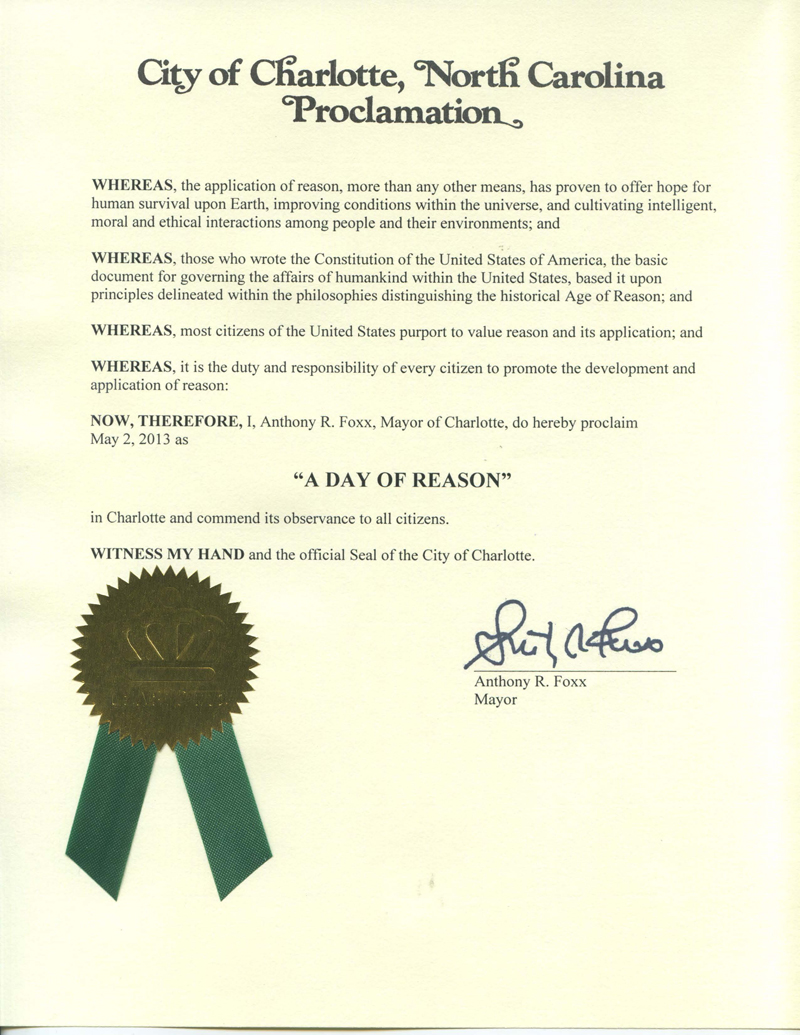
Happily, Fox wasn’t doing cruel things to the book that everyone loves to hate. Unhappily, the link took me to a clip of Steve Doocy interviewing a woman named Penny Nance about imagesthe decision by Anthony Foxx, the mayor of Charlotte, North Carolina, to issue proclamations making May 2 not only a “Day of Prayer” but also a “Day of Reason.” Doocy and Nance had no problems with the former proclamation, but were quite annoyed about the latter. fox_ff_nance_reason_130502i-615x345-1 Nance, it turns out, is “CEO and President” (there’s a difference?) of something called “Concerned Women of America,” an organization whose “Statement of Faith” goes a long way towards clarifying her reservations about the “Day of Reason”:

• We believe the Bible to be the verbally inspired, inerrant Word of God and the final authority on faith and practice.
• We believe Jesus Christ is the divine Son of God, was born of a virgin, lived a sinless life, died a sacrificial death, rose bodily from the dead on the third day and ascended into Heaven from where He will come again to receive all believers unto Himself.
• We believe all men are fallen creations of Adam’s race and in need of salvation by grace through personal faith in the Lord Jesus Christ
• We believe it is our duty to serve God to the best of our ability and to pray for a moral and spiritual revival that will return this nation to the traditional values upon which it was founded.

It turns out that point three is the important one for Ms Nance’s take on the Enlightenment (I have no idea which, if any, of these concerns matter to Mr. Doocy or, indeed, if Mr. Doocy has views on the Enlightenment’s relationship to the Holocaust).

Mayor Foxx’s rationale for proclaiming May 2 Charlotte’s “Day of Prayer” was that May 2 is the “National Day of Prayer” and, perhaps, he thought that the good citizens of Charlotte needed an additional reason for observing it. Among the reasons for the proclamation of a “Day of Reason” (which can be seen below) was the conviction that “The application of reason, more than any other means, has proven to offer hope for human survival on earth.” No one should be surprised that there is also a “National Day of Reason” that, even less surprisingly, also falls on May 2.

charlotte_2013Fox’s interest in Foxx’s proclamation (stuff like this is enough to make me wonder whether theologians overlooked the most compelling proof for the existence of God: the universe is ruled by an all-powerful intelligence with a wicked sense of humor) might seem momentarily puzzling. Why are these Foxites so worked up over this particular Foxx when there so many other foxes trying to sneak into the great national hen-house? But everything became perfectly clear to me once Mr. Doocy kindly explained that Mayor Foxx is President Obama’s pick to become Secretary of Transportation. Fox News, of course, is interested in everything that President Obama does — indeed, so insatiable is their interest in his doings that they sometimes have to make them up.

Had Mr. Doocy or Ms Nance recalled John Locke’s distinction between ecclesiastical and civil interests (after all, Ms Nancy is a graduate of Liberty University and perhaps the Letter Concerning Toleration is part of the curriculum; I have no idea what Doocy has read), they might have looked more kindly on Mayor Foxx’s double proclamation: those concerned with the care of their souls can pray in the manner they judge most efficacious for their salvation while those concerned with “life, liberty, health, and indolency of body” can spend the day reasoning. But Ms Nance was concerned that a pursuit of civil ends without the leavening of faith ends in disaster. This is where the Enlightenment comes in. Thus spake Ms Nance:

You know, the Age of Enlightenment and Reason gave way to moral relativism. And moral relativism is what led us all the way down the dark path to the Holocaust… Dark periods of history is what we arrive at when we leave God out of the equation.

I suspect that friends of the Enlightenment can take a little comfort in Ms Nance’s use of the phrase “gave way” rather than “gave rise.” But I’m afraid that what she really meant was “gave rise” (but was kind enough not to say it).

Either way, Ms Nance’s argument isn’t quite the same as Horkheimer and Adorno’s. For them, the problem was that enlightenment kept collapsing back into mythology. For her, what’s bad about the Enlightenment was that it greased the slippery slope that culminates in “moral relativism.” During her three minutes on Fox Ms Nance didn’t have time to explain whether she believed that Voltaire, Hume, Kant, Smith, and the rest were moral relativists or whether the problem is that their moral philosophies were so deeply flawed that they provided no viable alternative to it — perhaps she’ll clear this up by giving a talk at the next conference of the American Society for Eighteenth-Century Studies.

Nance’s point has more in common with the position staked out in 1940 by the historian Carlton J. H. Hayes than it does with Horkheimer and Adorno’s Dialectic of Enlightenment.  Hayes argued:

For two centuries some of the classes, especially intellectuals, have been repudiating our common religious heritage, but indifference or hostility of the masses towards it, of the rural as well as the urban masses, is a strictly contemporary phenomenon. How this has come about, I shall not here attempt to suggest. I merely remark the fact, which seems to me self-evident, and pass on to an important consequence. No man, whether he be Western or Eastern, lives by bread alone. Everybody must have faith, a faith in some mysterious power outside of one’s self, a faith attested by feelings of reverence and expressed in external acts and ceremonials. When a man loses faith in one religion, he naturally attaches himself consciously or unconsciously to another object of worship. It may be worship of Christ; it may be worship of totem or fetish; it may likewise be worship of science or humanity – provided these concepts are written in his mind with capital letters.1

Among the possible objects to which men turn, especially in an age of disruption, are authoritarian movements. Unfortunately, Hayes failed to spell the relationship between these “self-evident” facts and what was regarded by some as his cozy relationship with the Franco regime during his stint as FDR’s ambassador to Spain (as the moral philosopher Bob Dylan once observed, in what might serve as a fair summary of Professor Hayes’ argument: “you gotta serve somebody.”)

There was a rage for these sorts of explanations of fascism during the late 1930s and early 194s, presumably because the idea that the Enlightenment might, somehow or other, have paved the path that led to National Socialism is less obvious — and hence — more noteworthy than arguments that attributed fascism to German nationalism, the imperatives of monopoly capitalism, or anti-semitism, a.k.a. “the socialism of idiots.” In intellectual history as in competitive figure skating, the degree of difficulty counts for something.

In those days, what Ms Nance calls “moral relativism” was characterized as “nihilism” and Leo Strauss, recently arrived in America but not yet schooled in the subtle art of concealing his punch lines, gave a lecture that he probably wished he hadn’t given that explained at some length how the Enlightenment led to a nihilism that was so pervasive that even intelligent young Germans came to view National Socialism as a plausible remedy.2 I suspect that Ms Nance is probably not a Straussian (though it does seem that Strauss was, if only temporarily, some sort of fascist).

Having explained the relationship between the Enlightenment and the Holocaust, Ms Nance went to show that she was not someone to be underestimated by quoting a bit of G. K. Chesterton (was this, perhaps, the first G. K. Chesterton shout out in the history of Fox News?):

You know, G. K. Chesterton said that the Doctrine of Original Sin is the only one which we have 3,000 years of empirical evidence to back up. Clearly, we need faith as a component and it’s just silly for us to say otherwise.

As I was listening to Ms Nance explain this to me, I was struck by two things:

  1. She says “you know” a lot — perhaps she’s trying to be kind to those of us who are utterly clueless about the sorts of things she claims to be true.
  2. She probably doesn’t want to go around quoting Chesterton: he’s not a reliable friend — he’s more like a frenemy.

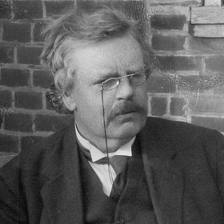
For example, a careless reader might think that the following passage from Chesterton’s images-1What I Saw in America provides some support the last of the four concerns on the Concerned Women of America’s statement of faith:

America is the only nation in the world that is founded on a creed. That creed is set forth with dogmatic and even theological lucidity in the Declaration of Independence; perhaps the only piece of practical politics that is also theoretical politics and also great literature. It enunciates that all men are equal in their claim to justice, that governments exist to give them that justice, and that their authority is for that reason just. It certainly does condemn anarchism, and it does also by inference condemn atheism, since it clearly names the Creator as the ultimate authority from whom these equal rights are derived. Nobody expects a modern political system to proceed logically in the application of such dogmas, and in the matter of God and Government it is naturally God whose claim is taken more lightly. The point is that there is a creed, if not about divine, at least about human things.

I can imagine that when Ms Nance read this (for, of course, we can be sure that she has her Chesterton down cold) she was nodding along right up to the part about the condemnation of atheism and the clear naming of “the Creator” and go so excited with this that she overlooked those last two sentences where Chesterton starts making things complicated again.

And I suspect that perhaps she was so taken with the idea that Chesterton saw original sin as an empirical fact that she missed this tough little nut from his Orthodoxy, which is not very gentle with those people that Fox & Friends like to call “job creators.”

If we wish to pull down the prosperous oppressor we cannot do it with the new doctrine of human perfectibility; we can do it with the old doctrine of Original Sin. If we want to uproot inherent cruelties or lift up lost populations we cannot do it with the scientific theory that matter precedes mind; we can do it with the supernatural theory that mind precedes matter. If we wish specially to awaken people to social vigilance and tireless pursuit of practise, we cannot help it much by insisting on the Immanent God and the Inner Light: for these are at best reasons for contentment; we can help it much by insisting on the transcendent God and the flying and escaping gleam; for that means divine discontent. If we wish particularly to assert the idea of a generous balance against that of a dreadful autocracy we shall instinctively be Trinitarian rather than Unitarian. If we desire European civilization to be a raid and a rescue, we shall insist rather that souls are in real peril than that their peril is ultimately unreal. And if we wish to exalt the outcast and the crucified, we shall rather wish to think that a veritable God was crucified, rather than a mere sage or hero. Above all, if we wish to protect the poor we shall be in favour of fixed rules and clear dogmas. The rules of a club are occasionally in favour of the poor member. The drift of a club is always in favour of the rich one.

Chesterton is just too complicated to be Fox’s kind of Christian. Which explains why we are treated to the spectacle of Ms Nance explaining the finer points of the doctrine of original sin to a less-than interested Mr. Doocy.

It’s not surprising that she simplifies the passage about original sin  that she pretends to have read. Here’s what Chesterton actually said in Orthodoxy:

Modern masters of science are much impressed with the need of beginning all inquiry with a fact.The ancient masters of religion were quite equally impressed with that necessity. They began with the fact of sin — a fact as practical as potatoes. Whether or not could be washed in miraculous waters, there was no doubt at any rate that he wanted washing. But certain religious leaders in London, not mere materialists, have begun in our day not to deny the highly disputable water, but to deny the indisputable dirt. Certain new theologians dispute original sin, which is the only part of Christian theology which can really be proved. … The strongest saints and the strongest sceptics alike took positive evil as the starting-point of their argument. …In this remarkable situation it is plainly not now possible (with any hope of a universal appeal) to start, as our fathers did, with the fact of sin. This very fact which was to them (and is to me) as plain as a pikestaff, is the very fact that has been specially diluted or denied. But though moderns deny the existence of sin, I do not think that they have yet denied the existence of a lunatic asylum. We all agree still that there is a collapse of the intellect as unmistakable as a falling house. … For the purpose of our primary argument the one may very well stand where the other stood. I mean that as all thoughts and theories were once judged by whether they tended to make a man lose his soul, so for our present purpose all modern thoughts and theories may be judged by whether they tend to make a man lose his wits.

J. G. A. Pocock argued that there was a “magisterial enlightenment” as well as a radical one. Passages like the one I just quoted from Chesterton make me think that this was a good thing: beginning with a shared conviction that, as Voltaire insisted, there was evil in the world, these two enlightenments could keep each other honest.

The National Day of Reason is every bit as idiotic as the National Day of Prayer and the republic would be much happier if its trustees would spend their time trying to remedy actual wrongs rather than telling the faithful to pray and the rational to reason and acting as if these are two separate interest groups with no overlap in membership. I hope that Mayor Foxx will soon be freed from the need to engage in nonsense of this sort and — once the now-obligatory hearings, holds, filibusters, and faux outrage on the Fox News Channel are over and done with — he can get to work on dealing with the legitimate “civil interest” of moving citizens from point A to point B without their killing each other or burning up the planet.

As for Fox, of course, there is no hope. Looking at Mr. Doocy and Ms Nance as they chatter at each other I am glad to follow Chesterton’s advice and refrain from speculating on the state of their souls. But, you know, they’re both nitwits.

  1. Carlton J. H. Hayes, “The Novelty of Totalitarianism in the History of Western Civilization,” Proceedings of the American Philosophical Society 82, no. 1 (February 23, 1940) 95.
  2. Leo Strauss, “German Nihilism,” ed. David Janssens and Daniel Tanguay, Interpretation 26, no. 3 (Spring 1999): 353-378
Posted in Uncategorized | Tagged | 1 Comment

Why It Wouldn’t Have Mattered if Isaiah Berlin used Ngrams

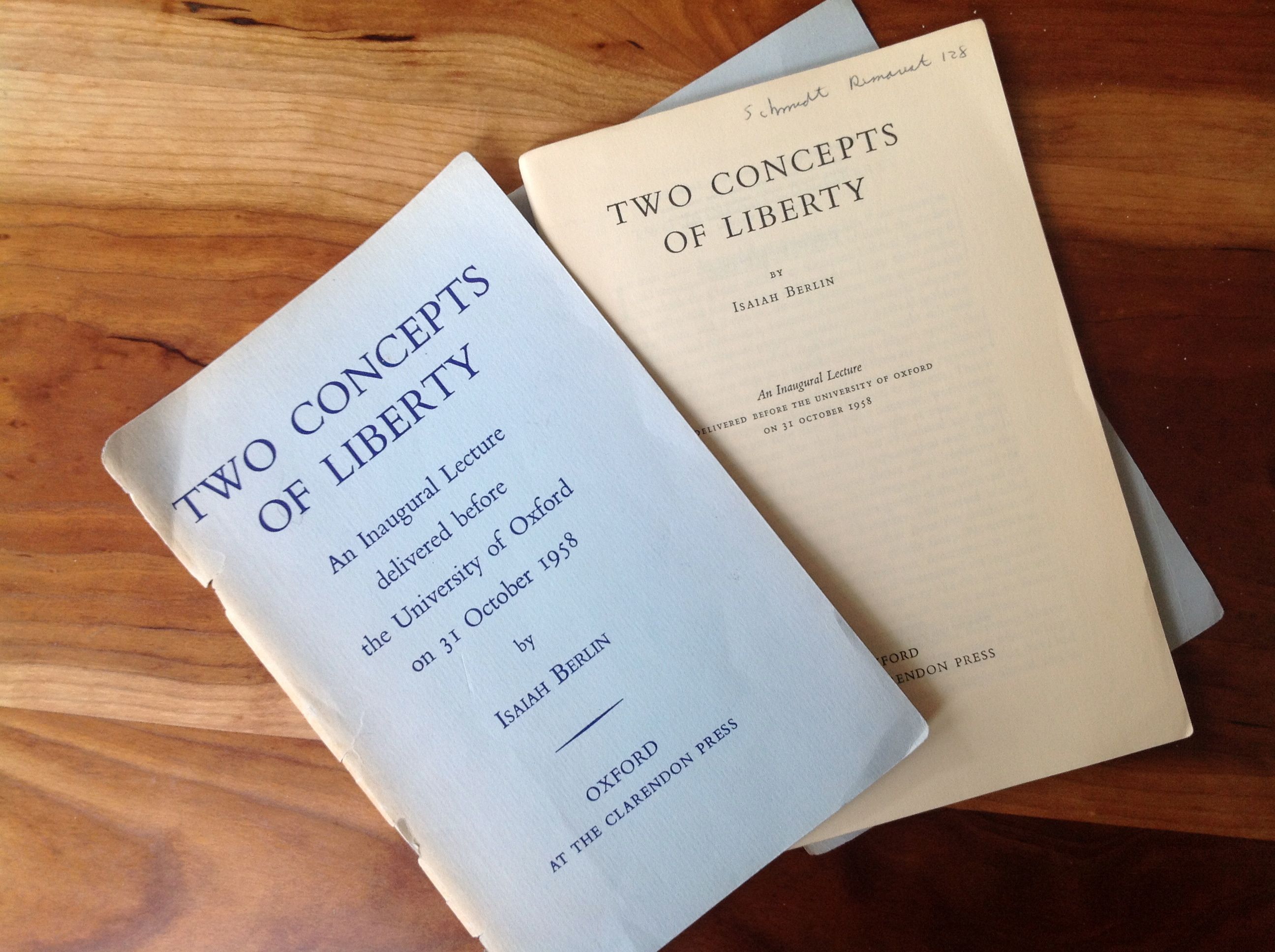
I’d been planning on posting the final part of my discussion of the exchange of letters between Isaiah Berlin and Karl Popper on liberty and enlightenment, but various commitments have conspired to delay my posting of that discussion until later in the week. But I’d been planning to say a few things about what we can — and mostly can’t — learn about the distinctions Berlin sought to draw by looking at the frequency of usage of the terms he was discussing. So now seems as good (or, as it turns out, as bad) a time as any to say it. Hence, here is a sort of “pre-postscript” to my posts on Berlin and Popper.

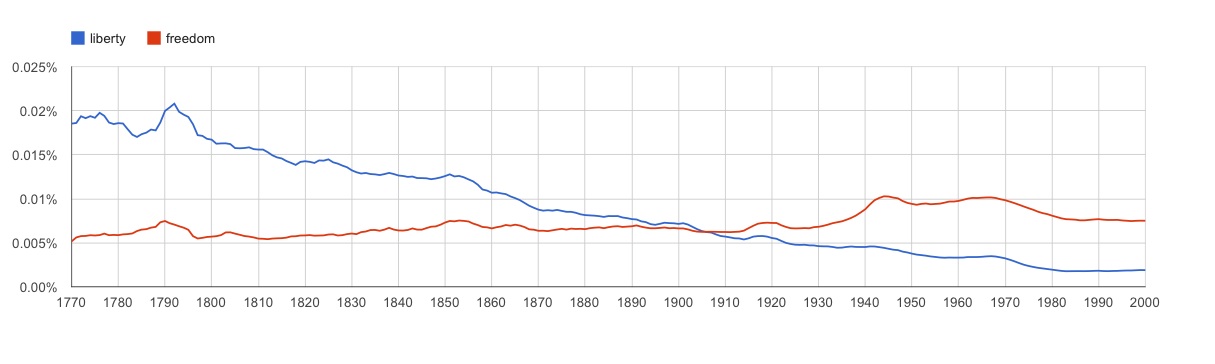
Earlier this term I discussed Berlin’s Two Concepts essay in my introductory political thought course and I thought it might be interesting to show the class (most of whom hadn’t heard about Ngram) how patterns in the use of “liberty” and “freedom” have changed over time. The results were more or less what I’d expected: “liberty” crests around 1790 and then begins a slow descent, “freedom” plays the tortoise to liberty’s hare and pulls ahead around 1905.

liberty&freedom

After constructing the Ngram it struck to me that I ought to push the end date up from Google’s default of 2000 to something closer to the present in order to see if there had been any uptick in uses of “freedom” in the wake of the September 2001 attacks (it certainly seemed as if “freedom” was being invoked quite a bit between 2001-2004, particularly by the man who just got his very own Presidential Library). Surprisingly, nothing seems to happen.

What I hadn’t thought to do at the time was to see if there was any way of seeing whether the nGram could tell us anything about shifts in the invocation of the concepts of positive and negative conceptions of liberty. But an attempt along these lines rather quickly brings us up against the difficulties of trying to pick up changes in the use of concepts by looking at changes in the use of words. For starters, an Ngram for uses of the phrases “positive liberty” and “negative liberty” tells us next to nothing. The reasons for this are easy enough to see: (1) these are technical terms that enjoy rather little usage outside of a specialized literature, so shifts in the frequency of their usage are small moves in a rather small sample and (2) they are terms that tend to be used together, as a way of drawing a distinction in philosophical discussions. As a result, all that such a search will pick up is how many articles are being published in any given year that are invoking the distinction that Isaiah Berlin made famous.

However, Berlin did employ, in passing, the circumlocution “liberty from” as a way of denoting “negative liberty,” a usage that echoes a distinction that Franklin Roosevelt had drawn in his list of the “Four Freedoms” between “freedom from” want and fear and “freedom of” speech and worship. And, much more emphatically, Erich Fromm’s Escape from Freedom (1941) had framed the distinction between “positive” and “negative” freedoms as the distinction between “freedom to” and “freedom from.” I’ve always found this way of explaining Berlin’s distinction more of a hindrance than a help: typically (and, I suspect, rightly) it tends to confuse students. They ask “Isn’t freedom from regulations that forbid something the same thing as freedom to do it?” and I say “Don’t pay attention to that” and point them to the way in which Berlin framed the distinction: negative liberty “is involved in the answer to the question ‘What is the area within which the subject — a person or group of persons — is or should be left to do or be what he wants to do or be, without interference by other persons?'” In contrast, positive liberty, “is involved in the answer to the question ‘What, or who, is the source of control or interference, that can determine someone to do, or be, one thing rather than another?'” But while the conceptual distinction between positive and negative liberty might better be grasped by focusing on the questions that Berlin posed, it is possible that tracking the use of the colloquial distinction between “freedom from” and “freedom to” might pick up something worthwhile.

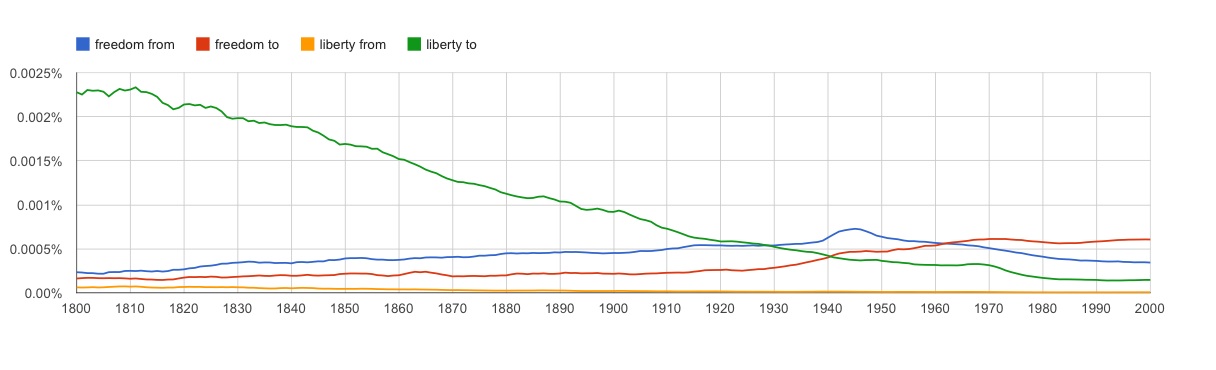
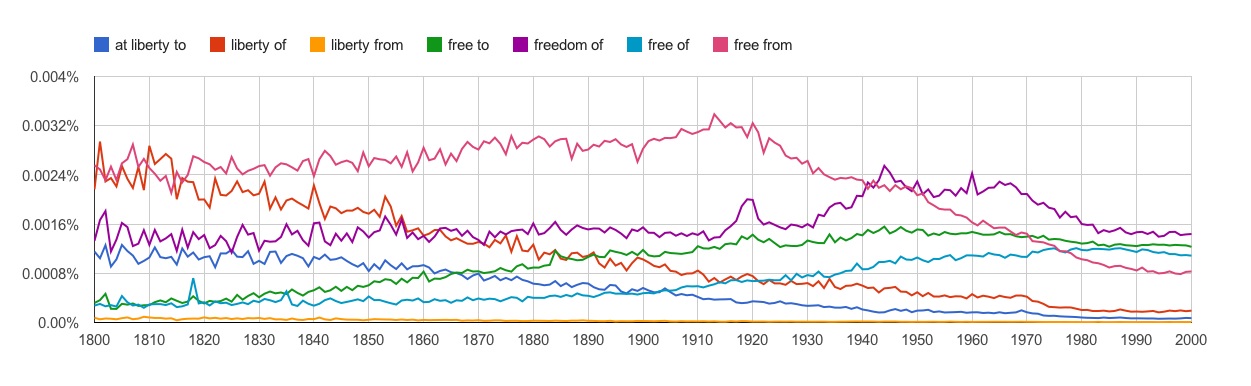
Let’s start with “freedom from,” “freedom to,” and, for the sake of completeness, “liberty from” and “liberty to” (it turns out that there is no need to worry about the capitalized form of the terms):

from&to

At first glance, what we have here seem quite peculiar: the most notable feature is the long decline of “liberty to.” But a moment’s reflection should be enough to remind us that this decline probably tells us more about the fading of the once-prevalent idiom “at liberty to do x” than it does about the distinction between “positive” and “negative” forms of freedom or liberty. The Ngram may also be reminding us of two other things: (1) there is no equivalent idiom “at liberty from x” and (2) there are different idioms in play for talking about “freedom”: namely, “free to” and “free from.”

On one of the more influential early critique of the Two Concepts lecture, the American political theorist Gerold MacCallum argued that instead of seeing disputes over the concept of liberty as involving a struggle between Berlin’s “liberal” notion of “negative liberty” and the “romantic” (and potentially totalitarian) concept of “positive liberty,” we would do better “to regard freedom as always one and the same triadic relation, but recognize that various contending parties disagree with each other in what they understand to be the ranges of the term variables.” [“Negative and Positive Freedom,” The Philosophical Review 76, no. 3 (July 1967): 312]. He proposed that

Whenever the freedom of some agent or agents is in question, it is always freedom from some constraint or restriction on, interference with, or barrier to doing, not doing, becoming, or not becoming something. Such freedom is thus always of something (an agent or agents), from something, to do, not do, become, or not become something; it is a triadic relation. Taking the format “x is (is not) free from (to do, not do, become, not become) z,” x ranges over agents, y ranges over such “preventing conditions” as constraints, restrictions, interferences, and barriers, and z ranges over actions or conditions of character or circumstance. [313]

MacCallum, it should be stressed, was proposing a conceptual distinction, but he argued that we could use the distinction could clarify how disputes involving freedom might be seen as:

a series of attempts by parties opposing each other on very many issues to capture for their own side the favorable attitudes attaching to the notion of freedom. [313]

If MacCallum’s conceptual distinction remotely corresponds to the way in which contesting parties talk about freedom, what we would expect to find, at any given moment, is a rough equivalence in uses of “free from,” “free to,” “freedom of” and the corresponding forms of liberty. But (and here I am tempted to add “of course”), we don’t:

BigMashUpThis is a really ugly Ngram (and not just because it would profit from a better contrast between its colors), but it may have something to tell us about the folly of trying to use an Ngram to frame a history of this sort of concept (I’d like to think that there are other concepts whose history might be tracked more effectively byNgrams — for instance, “enlightenment”). Here’s what I think I’ve learned from this (I’ll be interested in seeing what others make of it):

  1. What we’re seeing here is not what a straightforward translation of MacCallum’s conceptual distinction into word usage would have suggested. We do see movement in the different aspects of his “unitary” concept of freedom. While there may well be variation in the ways in which different parties fill out the different parts of his “unitary” notion, what we seem to see here is that, over time, there is a shift in the usage of “freedom of,” “free from,” “free to.”
  2. I suspect, however, that some of what we are seeing here can best be explained in the migration of certain circumlocutions from various specialized discourses into common usage (and, perhaps, the reverse). For example: “freedom of” sounds, at least to me, like a term that had been at home in legal discourse, but began to spread into other domains during the 1930s (this is the sort of change that Bookworm is tailor-made to pick up).
  3. Other changes (e.g., the decaying of “freedom of” and the rise of “free of”) might reflect nothing more significant than a preference for the shorter term “free” over the more technical sounding “freedom.”
  4. Finally, to give MacCallum his due, perhaps we can understand the convergence of “freedom of,” “free to,” “free of,” and “free from” as we near 2000 as evidence that those who are engaged in disputes about “freedom” are busily involved in defining the “freedom of” agents “from” certain impediments “to” do or be something or other.

But, in the end, I’m inclined to think that the exercise in which I’ve been engaged here really doesn’t have much to recommend it.

Posted in Uncategorized | Tagged , , , | 6 Comments

Isaiah Berlin & Karl Popper on Liberty & Enlightenment (Part II)

Last Sunday (which, for those of us who live in the Boston area, seems like the distant past), I began an examination of Karl Popper’s comments on Isaiah Berlin’s 1958 lecture “Two Concepts of Liberty” in his letter to Berlin of February 17, 1959.[1] Popper’s letter struck me as worth discussing for two reasons. First, Berlin’s Two Concepts is interesting in its own right: it is an influential — though at times quite puzzling — discussion of a central political concept and Popper’s letter allows us to see how one of Berlin’s contemporaries tried to make sense of its arguments. Second, the discussion between Berlin and Popper sheds some light on the diverging ways in which two self-described liberals, at the height of the Cold War, thought about the Enlightenment and its implications. In this post, I’ll finish the discussion of Popper’s letter by considering the second of the two points he raised. Next week, I’ll finish off the discussion by examining Berlin’s response.

A Kantian Case for Positive Liberty

Popper’s second point consists of a proposal and a question. The proposal takes the form of an alternative way of thinking about “positive” liberty. The question has to do with what strikes Popper as Berlin’s antipathy towards Horace’s phrase “sapere aude.” Our first task will be to figure out how the proposal (which is, I think, straightforward enough) is related to the question (which is, at first glance, a bit obscure).

Here is the relevant section of Popper’s letter (which consistently renders “sapere aude” as “sapere ande” — an error I have not transcribed here — and includes a minor typo that I’ve crossed out):

My second point is your picture of positive freedom. It is a marvelous elaboration of the idea of being one’s own master. But is there not a very different and very simple idea of positive freedom which may be complementary to negative freedom, and which does not need to clash with it? I mean, very simply, the idea to spend one’s own life as well as one can; experimenting, trying to realize in one’s own way, and with full respect to others (and their different valuations) what one values most? And may not be the search for truth — sapere aude — be part of a positive idea of self-liberation? What have you against sapere aude? No doubt, the idea that anybody is wise, is dangerous and repugnant. But why should sapere aude be interpreted as authoritarian? It is, I feel, anti-authoritarian. When Socrates said, in the Apology, that the search for truth through critical discussion was a way of life (in fact, the best way of life he knew of) — was there anything objectionable in this?

The connection that Popper seeks to draw here between the “very different and very simple” example of “positive freedom” that he offers and his defense of the “anti-authoritarian” implications of Horace’s sapere aude becomes somewhat clearer if we look at the lecture Popper had given (five years before Berlin delivered his inaugural lecture) on the BBC to mark the sesquicentennial of Immanuel Kant’s death.[2]

Popper began his homage to Kant by recalling the unexpectedly large crowds that gathered for the great philosopher’s funeral:

They came to show their gratitude to a teacher of the Rights of Man, of equality before the law, of world citizenship, of peace on earth, and, perhaps most important, of emancipation through knowledge (175).

Popper’s invocation of the idea of “emancipation through knowledge” sets the stage for a brief discussion of Kant’s response to the question “What is Enlightenment?” and a consideration of Kant’s role as the “last great defender” of the Enlightenment.[3] After quoting the opening paragraph of Kant’s answer, which culminates in Horace’s sapere aude, Popper provided the follow explanation:

Kant is saying something very personal here. It is part of his own history. Brought up in near poverty, in the narrow outlook of Pietism … his own life is a story of emancipation through knowledge. In later years he used to look back with horror to what he called “the slavery of childhood,” his period of tutelage. One might well say that the dominant theme of his whole life was the struggle for spiritual freedom.

With those last four words we arrive at the nub of Popper’s second comment on the Two Concepts. How can we to situate Kant’s “struggle for spiritual freedom” within Berlin’s distinction between “positive” and “negative” forms of liberty?

What is at stake in this struggle is not a question of the extent of the space in which an individual “is or should be left to do or be what he wants to do or be, without interference by other persons” (i.e., “negative” liberty). I can be “negatively” free to engage in any number of activities that I am “spiritually unfree” (e.g., because of fear or ignorance) to undertake. Kant characterizes enlightenment in terms of an escape from a state of “self-incurred tutelage [Unmündigkeit]” — a condition for which I am myself responsible. So the question of whether I am free or not turns on whether I am or am not exercising “mature autonomy” (one of a variety of terms that translators have used to try to capture the implications of the German Mündigkeit). What is involved, then, in the pursuit of enlightenment turns on considerations that were nicely captured by Berlin in his initial definition of “positive” liberty: “What, or who, is the source of control or interference, that can determine someone to do, or be, one thing rather than another?” Kant’s subsequent account of the differences between “public” and “private” uses of reason can, without too much difficulty, be understood as involving questions about the extent to which subjects are free, or not free, to articulate certain positions — i.e., with what Berlin characterizes as the “negative” concept of liberty. But Popper is not concerned with that discussion. What interests him, instead, are the broader implications of the motto that Kant took from Horace, a motto that Popper sees as summarizing the story of Kant’s life: “a story of emancipation through knowledge.” And this, of course, is a question about “positive,” rather than “negative,” liberty.

Berlin’s Case Against Positive Liberty

It would have been hard for Popper to overlook the degree to which Berlin’s critique of the concept of “positive” liberty represents a critique of the very idea that he had praised in his own discussion of Kant. Section IV of the Two Concepts lecture closed with a full-throated attack on what Berlin characterized as “the positive doctrine of liberation by reason,” which argued that,

Socialized forms of it, widely disparate and opposed to each other as they are, are at the heart of many of the nationalist, communist, authoritarian, and totalitarian creeds of our day. It may, in the course of its evolution, have wandered far from its rationalist moorings. Nevertheless, it is this freedom that, in democracies and in dictatorships, is argued about, and fought for, in many parts of the earth today.

Several pages later, in the sprawling second paragraph of Section V, he resumed his attack on the idea of “liberation through reason” by noting how it had figured in the work of such otherwise different thinkers as Spinoza, Locke, Montesquieu, Kant, and Burke and then went on to conclude,

The common assumption of these thinkers (and of many a schoolman before them and Jacobin and Communist after them) is that the rational ends of our ‘true’ natures must coincide, or be made to coincide, however violently our poor, ignorant, desire-ridden, passionate, empirical selves may cry out against this process. Freedom is not freedom to do what is irrational, or stupid, or wrong. To force empirical selves into the right pattern is no tyranny, but liberation.

But the passage in Berlin’s lecture that appears to have most concerned Popper was the opening paragraph of Section IV, where Berlin states that, when “free self-development” becomes the standard for determining whether one is truly free, individuals tend to view the various “obstacles which present themselves as so many lumps of external stuff” blocking the achievement of this goal. He continues,

That is the programme of enlightened rationalism from Spinoza to the latest (at times unconscious) disciples of Hegel. Sapere aude. What you know, that of which you understand the necessity — the rational necessity — you cannot, while remaining rational, want to he otherwise. For to want something to be other than what it must be is, given the premisses — the necessities that govern the world — to be pro tanto either ignorant or irrational. Passions, prejudices, fears, neuroses, spring from ignorance, and take the form of myths and illusions. To be ruled by myths, whether they spring from the vivid imaginations of unscrupulous charlatans who deceive us in order to exploit us, or from psychological or sociological causes, is a form of heteronomy, of being dominated by outside factors in a direction not necessarily willed by the agent. The scientific determinists of the eighteenth century supposed that the study of the sciences of nature, and the creation of sciences of society upon the same model, would make the operation of such causes transparently clear, and thus enable individuals to recognize their own part in the working of a rational world, frustrating only when misunderstood. Knowledge liberates by automatically eliminating irrational fears and desires.

There is more to say about what Berlin seems to be doing in this paragraph, but for now it may be enough to suggest that his use of the motto from Horace that had served as the touchstone for Popper’s encomium to Kant clarifies the context for the question that Popper posed to Berlin in his “second point”: “What have you against sapere aude”?

Histories, Individual and Collective

Popper had good reason to be puzzled by the link Berlin sought to establish between the “positive” conception of liberty and totalitarian forms of domination: the Two Concepts lecture was not entirely clear as to how this relationship was to be understood.

At the beginning of the discussion of “The Notion of Positive Liberty” (Section II of the lecture), Berlin explained that his intent was to show how the two concepts of liberty, which might initially seem to have been nothing more than two perspectives on the basic idea, had “diverged” over time. Here’s how he presents this in second paragraph of Section II:

The freedom which consists in being one’s own master, and the freedom which consists in not being prevented from choosing as I do by other men, may, on the face of it, seem concepts at no great logical distance from each other — no more than negative and positive ways of saying much the same thing. Yet the ‘positive’ and ‘negative’ notions of freedom historically developed in divergent directions until in the end, they came into direct conflict with each other.[4]

This suggestion that, while the “logical distance” between positive and negative conceptions of liberty may not be that great, their historical development proved to be quite different, would seem to be setting the stage for an historical account of how this divergence came about. But the lecture never quite provides one.

What Berlin offers, instead, is a condensed (albeit quite evocative) sketch of “the independent momentum which the metaphor of self-mastery acquired.” This sketch is notable for what it doesn’t contain: anything approaching an account of an historical transformation of a concept. Berlin starts with a passing reference to T. H. Green and then goes on to trace the “momentum” of the concept of self-mastery. Let’s look at the passage in question and then try to make sense of what is going on:

Have not men had the experience of liberating themselves from spiritual slavery, or slavery to nature, and do they not in the course of it become aware, on the one hand, of a self which dominates, and, on the other, of something in them which is brought to heel? This dominant self is then variously identified with reason, with my ‘higher nature’, with the self which calculates and aims at what will satisfy it in the long run, with my ‘real’, or ‘ideal’, or ‘autonomous’ self or with my self ‘at its best’; which is then contrasted with irrational impulse, uncontrolled desires, my ‘lower’ nature, the pursuit of immediate pleasures, my ’empirical’ or ‘heteronomous’ self, swept by every gust of desire and passion, needing to be rigidly disciplined if it is ever to rise to the full height of its ‘real’ nature. Presently the two selves may be represented as divided by an even larger gap: the real self may be conceived as something wider than the individual (as the term is normally understood), as a social ‘whole’ of which the individual is an element or aspect: a tribe, a race, a church, a state, the great society of the living and the dead and the yet unborn. This entity is then identified as being the ‘true’ self which, by imposing its collective, or ‘organic’, single will upon its recalcitrant ‘members’, achieves its own, and therefore their, ‘higher’ freedom. The perils of using organic metaphors to justify the coercion of some men by others in order to raise them to a ‘higher’ level of freedom have often been pointed out. But what gives such plausibility as it has to this kind of language is that we recognize that it is possible, and at times justifiable, to coerce men in the name of some goal (let us say, justice or public health) which they would, if they were more enlightened, themselves pursue, but do not, because they are blind or ignorant or corrupt. This renders it easy for me to conceive of myself as coercing others for their own sake, in their, not my, true interest.

What we seem to have here is a discussion of the dangers associated with the use of a metaphor: the metaphor of “self-mastery.” These dangers are illustrated by tracing a path that leads from an experience of liberation to a new form of slavery. To simplify (without, I hope, distorting Berlin’s argument ), the steps in the path might be summarized as follows:

  1. An experience of liberation from some form of “slavery”
  2. A subsequent interpretation of this experience in terms of a contrast between between two different “selves”
  3. The identification of one of these selves with a larger collectivity
  4. The exercising of coercion over the self that is not identified with the collectivity.

These steps are sufficiently abstract to allow them to be interpreted in a variety of ways. We might, for example, think of them as stages in the development of an individual. For example:

  1. After a youth spent in various pursuits, a young man experiences, for the first time, a sense of purpose and coherence in his life
  2. He identifies this new sense of coherence and purpose with the “new” (“truer” and “purer”) person he has become, a person that has overcome the temptations that dogged the “old” person that he was
  3. He finds a larger community (religious or political) that offers him a language in which he can articulate this experience, a language that carries on the interpretation that he has begun at step 2 by linking it to this larger community (e.g., as the distinction between those who have been “enlightened” vs those who remain in the “darkness”).
  4. As a member of this community the young man engages in aggressive efforts at recruitment and “conversion” (perhaps at the behest of his superiors) of others, in order to bring others (who remain in the darkness from which he has escaped) into “the light.”

While a narrative of this sort may have a certain plausibility — especially for those of us who spent Friday “sheltering in place” and watching more television than anyone should — we can, just as easily, imagine more benign versions. For example:

  1. a recent college graduate, having double majored in Economics and English, weighs the decision of whether to accept a promotion in the financial firm at which she is employed, but recognizes that accepting this position will mean increased demands on her time that will require her to abandon the writing she has been doing in her spare time. She concludes that the time has come to quit her job (which she finds rather tedious) and instead to pursue a career as a writer.
  2. Upon making this decision, she experiences a certain relief — indeed a “liberation” — in the realization that, all along, she had “really” been “a writer”, rather than an aspiring investment banker (this recognition may also help her to understand why she found work at the firm so tedious).
  3. She joins a group of writers in her city who get together from time to time to discuss their work and provide support to each other.
  4. The group she has joined also includes individuals who have yet to quit their day jobs and are, indeed, wrestling with the sort of decision that our recent college graduate has already made. She discusses the challenges and rewards of the path she has taken with those who are still trying to figure out what they should be doing.

Both of these narratives — and any number of other stories of this sort that we might want to construct — consist of a sequence of moves that, for all their apparent logic, are beset by any number of contingencies. The transition from step 1 to 2 may perhaps seem slightly less contingent than the other steps because we are familiar with the set of metaphors that both individuals are using to interpret their experience. But the interpretation of the experiences undergone at step 1 in terms of the metaphor employed in step 2 rests on the fact that the individuals in these stories being members of communities in which these sorts of metaphors have some currency. And, pushing on through the remainder of the steps, it is less than obvious that metaphors of this sort possess any sort of “independent momentum” that requires the individual who, at step 2, takes up the metaphor of “self-mastery,” to march onward through steps 3 and 4. Obviously, not all individuals who experience religious conversions wind up packing shrapnel into pressure cookers and not all accountants turned writers become members of writer support groups.

But while it may be appealing to read Berlin’s steps as describing a sort of personal history of the sort that I have constructed (at least it appeals to me, since it makes some sense of the process that he seems to be tracing), Berlin had something else in mind. He was attempting to trace the trajectory of an idea, not a life, which means that movement from step 1 through step 4 has to be reformulated as a sort of “biography of an idea” — i.e., as a history of the concept of “freedom,” cast in the form of a “history of ideas” written in the Great Books style: ideas are passed from thinker to thinker and reformulated along the way. But, while this sort of history lies at the heart of the transition that Berlin sketched at the start of Section II, this isn’t what he proceeds to offer in the remainder of the Two Concepts lecture. What we find instead is something that looks, at best, like an account of the implications of a metaphor and, at worst, like the “movement of the Concept.”

Berlin’s “Phenomenology of Freedom”: Self-Mastery, Self-Abnegation, and Self-Realization

So, let’s try again, this time talking about the history of a concept rather than the biography of an individual. Berlin’s account of the vicissitudes of the concept of “positive liberty” goes as follows.

  1. He begins with a brief discussion, in Section II, of the “desire to be self-directed” and then proceeds, in the next two sections, to explore the two directions that efforts to achieve such self-direction have taken.
  2. Section III (“The Retreat to the Inner Citadel”) considers the project of “self-abnegation,” i.e., the attempt to “strive for nothing that I cannot be sure to obtain.”
  3. Section IV (“Self-Realization”) focuses on a strategy of liberation that he sees as central to the project of “enlightened rationalism”: this project involves understanding what “rational necessity” demands and making this necessity into one’s own project.
  4. Finally, Section V (“The Temple of Sarasto”) examines how adepts at the project outlined in Section IV impose such projects on others in order to lead them (or, more bluntly, to force them) to “true” freedom.

These sections can, without too much difficulty, be mapped onto steps 2 through 4 of the sequence that I constructed above. Section III of the lecture generates a division between “rational” and “irrational” selves of the sort that can be found at step 2 of my earlier reconstruction. Section IV — with some difficulty (which can be clarified in a moment) — can be seen as a sort of merging of the “rational self” into a larger collectivity (e.g., one of Berlin’s favorite examples for this is a musician learning to play a composition and, in doing so, becoming “free” by subjecting himself or herself to the score). And Sarastro’s “enlightened despotism” in Section V is, quite transparently, an example of what Berlin sees at work in step 4.

As we make our way through these three sections we encounter many proper names (Kant, Spinoza, Montesquieu, Burke, Hegel etc.), but it is hard to get a grasp on how these names are supposed to be arranged into anything like a history of ideas (even in the Great Books style). While Berlin (like Popper) disliked Hegel intensely, the experience of reading these sections is not unlike the confusion that begins to settle over a reader of Hegel’s Phenomenology: concepts are on the move, changing their implications as they make their progress; glimpses of the development of these concepts can be seen in this or that thinker (though Hegel, unlike Berlin, is sparing in his use of proper names), but it is not always obvious how the discussion is supposed to line up with anything that resembles an actual history.

Kant’s name turns up quite a bit in Section III, where he serves as an illustration of how the breach between the “two selves” comes about. In Berlin’s account, the “retreat to the inner citadel” rests on the separating off of a “‘noumenal’ self” that remains free, even though the phenomenal self may be subject to external forces.

From this doctrine, as it applies to individuals, it is no very great distance to the conceptions of those who, like Kant, identify freedom not indeed with the elimination of desires, but with resistance to them, and control over them. I identify myself with the controller and escape the slavery of the controlled. I am free because, and in so far as, I am autonomous. I obey laws, but I have imposed them on, or found them in, my own uncoerced self. Freedom is obedience, but ‘obedience to a law which we prescribe to ourselves’ and no man can enslave himself.

From time to time, we find discussions in the Two Concepts lecture that provide something approximating an account of the development of metaphors and their appropriation by historical actors. For example, four paragraphs from the end of Section III, Berlin observes:

Kant’s free individual is a transcendent being, beyond the realm of natural causality. But in its empirical forms — in which the notion of man is that of ordinary life — this doctrine was the heart of liberal humanism, both moral and political, that was deeply influenced both by Kant and by Rousseau in the eighteenth century. In its a priori version, it is a form of secularized Protestant individualism, in which the place of God is taken by the conception of the rational life, and the place of the individual soul which strives towards union with Him is replaced by the conception of an individual, endowed with reason, straining to be governed by reason and reason alone and to depend upon nothing that might deflect or delude him by engaging his irrational nature. Autonomy, not heteronomy: act and not to be acted upon. The notion of slavery to the passions is — for those who think in these terms — more than a metaphor.

What Berlin might be suggesting here is that Kant provides a secularized form of Protestant theology and that — perhaps because his discussion of autonomy and heteronomy shared much with a more culturally pervasive appropriation of religious accounts of divisions within the soul — his particular way of framing these discussions went on to have a broad appeal to “liberal humanists” (e.g., liberals who were looking for non-religious ways of reframing the religious traditions from which they were coming?). An account of this sort might help clarify why the metaphor of self-mastery could take on a “momentum” that would allow it to complete the passage from step 1 to step 4. But it is hard to see how Berlin can characterize this “momentum” as in any sense “independent.” There is no logical explanation for the transition from step 1 to step 4 nor is it clear that the metaphor of “self-mastery” has any inherent relationship to the later discussions of “self-realization” or self-enslavement. If there is a connection here, it is an historical or cultural one. At the close of Section IV, Berlin is content to note that, in the account he has been offering, the idea of positive liberty has, “wandered far from its rationalist moorings.” Explaining that it is not his intent “to trace the historical evolution [emphasis mine] of this idea,” he proposes instead “to comment on some of its vicissitudes.” And, with that, we move on to the discussion of Sarastro’s Temple.

A Brief Consideration of the Flexner Lectures

Berlin had, however, attempted an account of the “historical evolution” of the idea of positive liberty some six years earlier as part of his Flexner Lectures at Bryn Mawr College. An adequate discussion of these lectures would drag this already lengthy set of posts out to an intolerable length. And, in any case, it would be folly for me to attempt such an account without having had the chance to read Joshua Cherniss’s recently published discussion of the development of Berlin’s thought, which draws on archival materials that I have not examined.[5] But, at the risk of having Cherniss’ book prove me wrong (and I’m enough of a Popperian not to get worked up about being proven wrong), here is my take on what is going on in the Flexner Lectures.

The history of ideas that Berlin offered at Bryn Mawr began by tracing the way in various Enlightenment thinkers (among them, Helvetius) advanced a concept of liberty that is grounded on the accumulation of natural scientific knowledge of the functioning of the world. This knowledge was seen as potentially liberating in two ways. In the case of the various illusions and prejudices that held sway over the human mind, a demonstration of their falsity was sufficient to break their hold. Further, human liberty could also be enhanced by an understanding of the actual constraints that nature places on human actions. In this case, emancipation took the form of the development of strategies that echoed Bacon’s idea that, in order to command nature, we must first learn how to obey her. It is important, I think, that there is no talk at this point about a division between “true” and “false” selves nor any suggestion that knowing how nature operates necessarily requires the leap that Berlin makes at the start of Section IV of the Two Concepts lecture when sapere aude is identified with a process in which individuals achieve liberty by subjecting their own ends to those of nature. Pangloss may do this, but Candide winds up learning that work (or, as Habermas would have it, “purposive-rational action”) is a reasonable alternative. And Voltaire, as we know, didn’t try to convince himself that torturing Huguenots was part of the “rational necessity” of the world.

In the Flexner Lectures, the discussion of these (“Enlightenment”) strategies for advancing human liberty is followed by an analysis of what he terms the “romantic conception” of liberty. As would be the case in the Two Concepts lecture, Kant’s role in this story lies in his distinction between two different “selves” (noumenal and phenomenal) (see pp. 147–148 and 173), which serves as the premise for Berlin’s discussion of the notion of “positive freedom” (166). The narrative that Berlin offered at Bryn Mawr associates “positive freedom” with what he terms the “romantic” rather than the “liberal” conception of liberty, and much of his discussion of it is accomplished in an extended account of Fichte (177–198). In Fichte, Berlin found a thinker who might be seen as tailor-made for demonstrating the dangerous “momentum” of the concept of “self-mastery”: the Wissenschaftslehre corresponds to the distinction between the “free” self and the “subject” one (step 2 in the sketch above), while The Addresses to the German Nation show how such a distinction might be transferred to a collectivity (step 3 above). But since Fichte is, in Berlin’s eyes, a “romantic” not an Aufklärer, a considerable reshuffling of labels is necessary in order to produce the account offered in the Two Concepts.

The label “romantic liberty” was jettisoned and the roots of “positive liberty” were seen as reaching back to (at least) the Enlightenment. This shift allowed Berlin, in the lectures, articles, and drafts that would follow in the wake of the Two Concepts, to bring the Romantics, along with that odd assortment of thinkers who make up the Counter-Enlightenment, onto the field as the opponents of what, in the Flexner lectures, had been characterized as the “Romantic conception” of liberty. It is possible that this may, in part, have provided a reason for avoiding an historical account of the transformation of the concept in the Two Lectures. Not only would it have been difficult to work such a discussion into the limited space permitted in his inaugural lecture, but it is also possible that Berlin was not, at least at this point, entirely settled on how such a history might be presented.

Popper on Positive Liberty as Self-Legislation

Had Popper been familiar with how Berlin’s argument had been developed in the Flexner Lectures, it would have done little to remove his reservations about Berlin’s attitude towards Horace’s “sapere aude.” Though Fichte might have shown how a thinker could run through the steps that culminated in subjection to the authority of the ”enlightened“ that had been previewed in the third paragraph of Section II and ultimately cashed out in the discussion of Saratro’s Temple in Section V, Popper would have had considerable difficulties in seeing Fichte as a legitimate heir of Kant. He had emphatically rejected that line of interpretation in his BBC lecture:

Kant believed in the Enlightenment. He was its last great defender. I realize that this is not the usual view. While I see Kant as the defender of the Enlightenment, he is more often taken as the founder of the school which destroyed it — of the Romantic School of Fichte, Schelling, and Hegel. I contend that these two interpretations are incompatible.[6]

What separates Berlin and Popper, then, are two rather different accounts of the relationship between “the Enlightenment” and “the Romantics.” These interpretations, to be sure, are creatures of a period in which the lines between enlightenment, idealism, and romanticism tended to be drawn more starkly than we might be inclined to draw them today. This difference in how Berlin and Popper situate Kant leaves us with two self-described liberals — both wary of the threat posed by a totalitarian enemy — who offer markedly diverging accounts as to how to trace the history of the ideas that laid the foundations for the enemy they both oppose.

But since the Two Concepts offered rather little of this history of ideas, their disagreement may not have been quite as significant for Popper as it might appear to those of us who can work our way through the Flexner Lectures and fill out the intellectual history that the Two Concepts lacked. Popper had the luxury of simply being puzzled by what Berlin was saying and could go on to read what Berlin was offering as an exercise in political philosophy that sought to distinguish two different concepts of liberty. What struck him as questionable in the lecture was its implication that positive liberty and negative liberty were ultimately incommensurable: a conjecture about the implications of a concept, rather than a history. And Popper, of all people, knew what to do with conjectures: try to come up with a refutation.

Popper’s second point, then, can be viewed as an attempt to refute Berlin’s claim that there is an inherent contradiction between positive and negative concepts of liberty by providing a “very simple idea of positive freedom which may be complementary to negative freedom, and which does not need to clash with it.” The example that he provides is — appropriately enough for a friend of Kant — cast in the form of a maxim:

search for truth — sapere aude

Popper prefaces this familiar quotation with the following maxim:

spend one’s own life as well as one can; experimenting, trying to realize in one’s own way, and with full respect to others (and their different valuations) what one values most …

However we understand what Kant was doing with the “motto” he took from Horace, Popper has captured something important about the form in which it is cast: it can only be interpreted as an example of “positive freedom.” In Berlin’s account, the adopting of a maxim (i.e., “search for the truth” or “think for oneself” rather than follow instructions that are given by others) is, and can only be classified as an example of positive, rather than negative, liberty since what is at issue here is a question of who is the source that is determining what I can be or do. Since “sapere aude” is a rule that I give to myself (as opposed to a command from a superior), it counts as an instance of “positive” freedom: it represents an act of self-legislation.

As I have suggested in an earlier post, this way of thinking about the phrase from Horace is not unique to Popper. When read in context, what Horace is advising his young friend Lollius Maximus to do is to adopt a rule for living properly. As my friend Manfred Kuehn has explained in a discussion of Kant’s lectures on anthropology, Kant held that

As free and rational beings, we can and must adopt principles according to which we live, and it is for that reason that character may “be defined also as the determination of the freedom (Willkür) of human beings by lasting and firmly established maxims.” Insofar as character is indeed the characteristic mark of human beings as free and rational beings, living by maxims makes us what we should be. … It is for this reason that he identifies character with our “way of thinking” (Denkungsart), which is opposed to the “way of sensing” (Sinnesart).[7]

This seems to have been the way in which Horace’s motto was understood by the “Society of the Friends of Truth,” that strange group of Epicurean champions of Leibniz and Wolff who were responsible for coining the medal that graces the right side of this page. They thought that the Horatian imperative could be reconciled with Leibniz’s principle of sufficient reason, hence the rule that they adopted for themselves: “Hold nothing as true, hold nothing as false, so long as you have been convinced of it by no sufficient reason.” Perhaps, a discussion of the difference between their use of Horace’s dictum and Kant’s might introduce some needed complexity into Berlin’s account of the relationship between “the Enlightenment” and the vicissitudes of the concept of positive liberty.

In his letter to Berlin, Popper emphasized the difference between claiming to be in possession of the truth, a claim that looms large in Berlin’s discussion of the dangers that haunt the concept of positive liberty, and the demand to seek the truth through a process of criticism (which Popper saw as the project pursued by Socrates). To quote the crucial passage once again,

No doubt, the idea that anybody is wise, is dangerous and repugnant. But why should sapere aude be interpreted as authoritarian? It is, I feel, anti-authoritarian. When Socrates said, in the Apology, that the search for truth through critical discussion was a way of life (in fact, the best way of life he knew of) — was there anything objectionable in this?

Popper, of course, could find nothing objectionable here. Next week we can see how Berlin responded.


  1. The letter can be found in Box 276, Folder 10 of the Karl Popper Papers at the Hoover Institution Archives and I quote from it here with the permission of the Karl Popper Library, Klagenfurt, Austria.
  2. Popper, “Immanuel Kant: Philosopher of the Enlightenment,” reprinted as “Kant’s Critique and Cosmoology” in Conjectures and Refutations (New York: Harper Torchbooks, 1963) 175–183.
  3. The discussion also features a footnote in which Popper takes aim at the OED’s infamous definition of “Enlightenment.”
  4. In the version of this passage in Four Essays on Liberty, the words “not always by logically reputable steps” are inserted immediately after the words “divergent directions.” I’ll have more to say about this, and other, changes in the text next week.
  5. Joshua Cherniss, A Mind and Its Time: The Development of Isaiah Berlin’s Political Thought (Oxford: Oxford University Press, 2013). The first chapter of the book is available as a free download from Oxford’s website.
  6. Popper, Conjectures and Refutations 176.
  7. Manfred Kuehn, Kant: A Biography (Cambridge: Cambridge University Press, 2002) 147.
Posted in Uncategorized | Tagged , , , | 8 Comments

Edes and Gill, the “Patriot Printers” & Locke’s Second Treatise

I published this post about three hours before the bombing in Boston as the second of two posts marking the Patriots’ Day holiday.  In the wake of the attacks, I pulled both posts off the site.  I’ve replaced the first post with a very different one.  This one, I think, can stand more or less as it was.

As Richard Sher and Michael Warner have reminded us, any discussion of an “American Enlightenment” had better pay attention to printers. And what better printers are there to attend to on “Patriots’ Day”  than the “Patriot Printers” Benjamin Edes and John Gill? Among their many other achievements, Edes and Gill were the publishers of the Boston Gazette, the newspaper that played a leading role in the anti-British agitation that culminated with the confrontation in Concord that citizens of the Commonwealth of Massachusetts celebrate today, among other ways, by gathering along the route of the Boston Marathon.

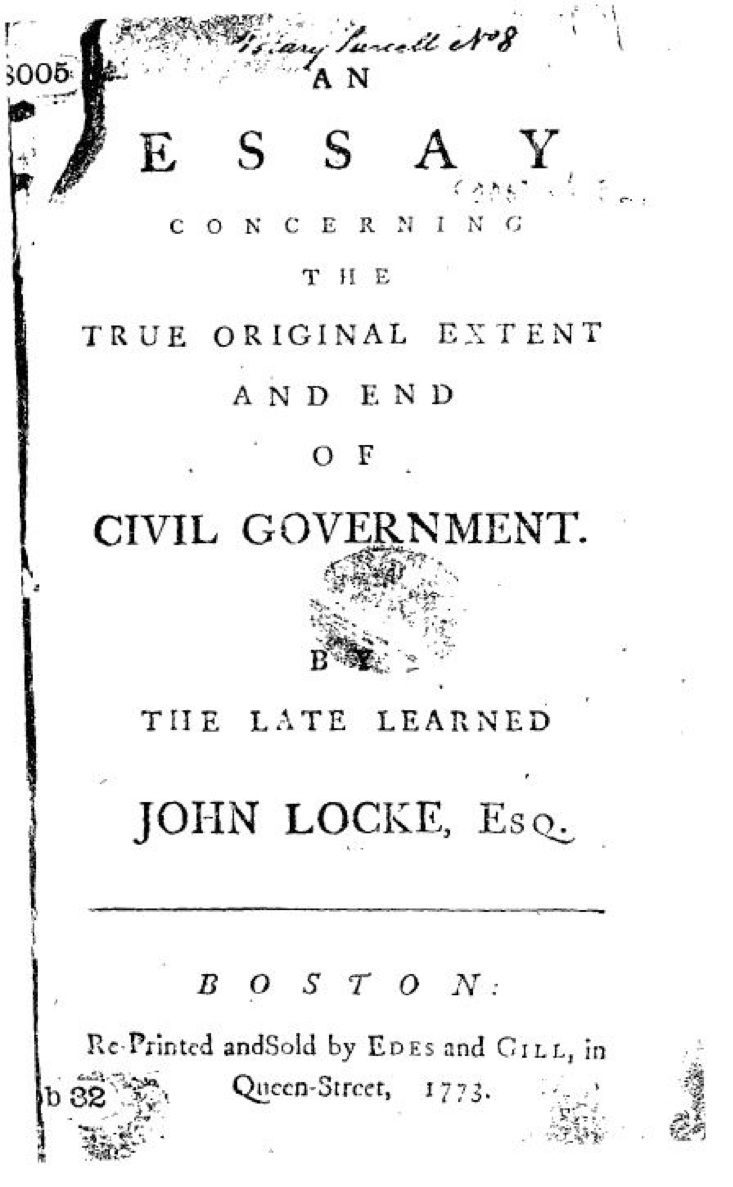
My interest in Edes and Gill is rather limited and focuses on their roleEdesGill in publishing the item on the right. Despite having lived in Boston, off and (mostly) on for almost four decades, my knowledge of eighteenth-century Boston is scandalous spotty. And, despite having taught John Locke’s Two Treatises more times than I would care to remember (it’s possible to teach introductory courses in political thought without teaching Locke, but why would anyone want to?), it was only recently that I became interested in when the practice of reading the Second and only the Second Treatise was established. Granted, there are good reasons why interest in the First Treatise was bound to fade once Sir Robert Filmer’s reputation began its decline (I’ve always savored the irony that Locke’s attack on Filmer in the First Treatise was so successful in driving Filmer from history that it also removed most of the reasons why anyone would want to read what Locke had to say about him — who wants to read an attack on a nobody?). But when did this shift in the sense of what mattered in Locke’s work begin to be reflected in editions of the Second Treatise that presented it as an independent text that could be read on its own?

The answer, it seems, is 1691, the date of the publication of a French translation by the Huguenot émigré David Mazzel (the title page says “a Londres,” but I assume Mazellthis was produced in Holland for smuggling into France). Mazzel’s translation eliminated the First Treatise and the opening chapter of the Second (which made it clear that it was a continuation of the argument begun there), and retitled the volume Du Gouvernment Civil. The work that resulted sported a table of contents that looks exactly like the current Hackett edition of the Second Treatise, the version that most undergraduates wind up reading.

Along with a variety of editions of the Two Treatises that were published in England over the course of the eighteenth century, WorldCat notes the appearance in London in 1753 of a work by Locke entitled Of Civil Polity. It describes itself in its Preface as having been “extracted from Mr. Locke’s Essay on Civil Government, with some Alterations and Additions”. A quick look at the copy available on ECCO reveals a very peculiar book: it eliminates quite a bit of the Second Treatise, including the important (and incendiary) chapter on the dissolution of government that concludes the work (and which is, after all, the point of the entire exercise) and patches in a discussion of “the establishment of religion” (a quick scanning of the chapter suggests that it may have been pulled from the Letter Concerning Toleration, though I’ve done no more than glance at the text). In contrast to the Mazzel translation, here is a book that provides scant evidence that what Locke had produced was a powerful argument for deposing a monarch. What we are presented with is a treatise on the nature of civil government that is capped, not by a discussion of the legitimate grounds for dissolving a government, but instead by a sketch of the differences between the ends of civil and ecclesiastical society.

It was not until the end of the eighteenth century that editions began to appear in the United Kingdom that follow the model provided by Mazzel. As a result, the 1773 edition produced by the patriot printers Edes and Gill would appear to have been the first edition anywhere in the world to do, in English, what Mazzel had done in French. Theirs would be the only edition of either of the two treatises to appear on the North American continent. It should come as no surprise that Edes and Gill, like Mazzel before them, included the chapter on the dissolution of government.

Posted in Uncategorized | Tagged , | Leave a comment

On the Boston Bombings

Yesterday morning, I published a post entitled “Liberty, Freedom, and nGrams! (A Patriots’ Day Special)” in which I explained that, though I try to limit my postings on this site to one a week, I’ve made exceptions to the rule: once to discuss some issues that had arisen regarding the Vienna Philharmonic’s dealings with its past (a topic on which I’ve written) and once again on the holiday popularly known as “Presidents’ Day” — when I offered a few thoughts on Thomas Jefferson as an Epicurean and John Quincy Adams’ translation of Friedrich von Gentz’s book on the American Revolution.

Since yesterday was “Patriots’ Day” — a holiday unique to Massachusetts and Maine — I used the holiday as an excuse for two posts: one tracing usages of the terms “freedom” and “liberty,” the other on the eighteenth-century “Patriot Printers” Benjamin Edes and John Gill. Yesterday was a beautiful April day in the Boston area (so, for that matter, is today), so I headed out for a long walk. When I arrived home around four in the afternoon, I learned of the bombings at the finish line of the Boston Marathon. Since my first post made passing mention of the Marathon (I’d suggested, tongue in cheek, that it was a contributing factor in preventing the commercialization of the holiday, since it makes it impossible for those of us who live here to cross Commonwealth Avenue for most of the day), I decided to take it, along with the other post, down.

This is a research blog that deals with “the Enlightenment as an historical period and continuing project.” While the events in downtown Boston today have little to do with the Enlightenment as an historical period, they are not without relevance for what I take to be the legacy that period has left us. My discussion of Edes and Gill, in a small way, had something to say about that legacy, so I thought that it might not be inappropriate to make it available again, with a brief preface. The situation with my discussion of “freedom” and “liberty” — which this post replaces — was somwhat more complicated: its main focus had to do with the difficulty in trying to pin down shifts in the usage of the terms “liberty” and “freedom” and was provoked in part by the opportunistic misuse of the latter term in American politics over the last decade or so. I think I can do it better if I drop the nGrams and simply say a few things about the Boston Marathon, about Patriots’ Day, and about the particular spot in the Boston where the first bomb exploded.

Johnny Kelly and the Boston Marathon

I live in Newton, a suburb outside the Boston city limits. The Marathon runs down Commonwealth Avenue, about a half mile from my house. I’ve spent a fair number of Patriots’ Days watching the stream of runners and wheelchair athletes as they begin their ascent up “Heartbreak Hill,” the last big climb before the long downhill stretch that leads down into Boston.

Newton is home to a statue honoring Johnny Kelly, who competed in 61 Boston Marathons, won two of them, placed second in 7, and finished in the top ten 18 times. He ran his final Marathon at the age of 84. In the last years of his life (he died in 2004 at the age of 97) he ran the last part of the race (about six miles or so — more than I can comfortably run), starting at the statue that had been erected to honor him, a statue that shows the young and the old Kelly running together, hands uplifted. The crowds that lined the way would always recognize him and cheer him on, as did his fellow runners.DSCF9420

Kelly was not a professional athlete and, until he retired at the age of 73, he continued to work as a maintenance man for Boston Edison. For much of the last century, the Boston Marathon was not an event for professional athletes, mainly because there weren’t such things as “professional runners.” It was a public event, open to anyone up to the challenge of running 26 miles. Even after it began to attract all the remarkable runners from other parts of the world who I’ve seen from my favored vantage point (for example, Uta Pippig), it remained — like most other marathons, I suppose — a competition that was open to the public. Yesterday’s bombs exploded well after the “elite” runners had finished the competition, which meant that those who were crossing the finish line and those who were gathered on the sidewalk to see them, were mostly amateur runners and their families, many from the Boston area.

What took place yesterday afternoon, then, was an attack both on the people who assembled to watch the end of the race in downtown Boston and on that strange but essential entity that we call “the public.” The reports in today’s newspapers have been explicit in describing what was only hinted at yesterday in the televised reports: many people have suffered horrible injuries as a result of bombs that, by accident or design, were positioned in a way that made them terribly effective at blowing off legs.

I stopped following the Twitter feed on the bombing after reading a tweet from a woman who — apparently having speculated in an earlier tweet that President Obama would, “once again,” fail to call this a “terrorist attack” — was outraged that, in his comments on the attacks, he failed to deploy the shibboleth for which she had been waiting. The public is under attack in a variety of different ways and we can leave it for a calmer moment to draw the subtle distinctions between someone walking into an elementary school with the sort of weaponry used by armies and slaughtering students and others placing the sorts of explosive devices used by other armies along a street filled with families watching a public event. Acts of both sorts strike at the heart of what republics require: public spaces where citizens can go about their lives. Yesterday evening, Boston Police Commissioner Edward Davis requested that people remain indoors, not congregate in large groups, and stay away from the immediate area of the bombings. In the short run, this is a reasonable request: the police have a crime scene to investigate. In the longer run, of course, it is the sort of request that is antithetical to what it means to be a citizen of a republic. But the fact that public officials are describing the area of the attack as a “crime scene” and that the use of “war zone” seems, thus far, to be limited to certain parts of the press is somewhat encouraging.

Patriots’ Day

I like Patriots’ Day quite a bit. In part, this has to do with local pride: it’s a holiday that is only celebrated by those of us who live in Massachusetts and Maine (a state that, long ago, was a part of Massachusetts). Prior to becoming a moveable holiday (it is now celebrated on the third Monday in April) it was observed on April 19, the anniversary of the battles at Lexington and Concord that began the American war of independence. I’ve been to Concord many times and like to take foreign visitors there. They are usually somewhat puzzled, especially when I insist on dragging them to the shabby building that housed the “Concord School of Philosophy” — a place where American Hegelians assembled in the nineteenth century. But they, like everybody else, seem to enjoy Walden Pond.

Sadly, over the last several decades, the holiday has been burdened with other associations. I was vacationing with my family in Florence on April 19, 1995, the date of the bombing of the Murrah Federal Building in Oklahoma City. I watched the scenes of the destruction on CNN with incomprehension and followed, with even greater incomprehension, the subsequent reporting on the militia groups from which the bomber had come. A few days later I was in the Sala della Pace of the Palazzo Pubblico in Siena gazing at the Lorenzetti frescoes. In 1995, “freedom” had not quite yet become what it would become in the wake of the 2001 attacks on the World Trade Center: a verbal tick, uttered by politicians in defense of increasingly questionable (but, unfortunately, not sufficiently questioned) ventures — a word intended to mark the true “patriots” off from the suspect parts of the population. But even then I was developing a preference for the Latin word that I saw on the shield on the balcony of the Palazzo and would see again, a few days later, on the walls of Lucca: Libertas.  It is a word that has always struck me as more complex in its implications than the word “freedom.”

768px-Ambrogio_Lorenzetti_-_Allegory_of_the_Good_Government_(detail)_-_WGA13487Among the lessons taught on the walls of the Sala della Pace is that the preservation of  liberty requires such things as concord, peace, fortitude, prudence, magnanimity, temperance, justice — especially justice (the inscription reads “Love Justice you who rule the earth”). At this hour, we do not know whether the bombings on Boylston Street were carried out by domestic or foreign enemies. But we should know by now that the only way in which republics can effectively respond to challenges like this is to call upon all of the capacities allegorized on the walls of the Sala della Pace. While the twittering woman was outraged (or feigning outrage — on Twitter there may not be a difference) that President Obama didn’t utter the word “terrorism,” I was gratified that he characterized Boston as “tough and resilient” — words that translate well into Latin as “fortitudo.” The reports in today’s newspapers also point to a considerable outpouring of magnanimity on the part of those who, in large and small ways, came to the aid of those whose live were disrupted, in ways minor and massive, by yesterday’s events. And the fact that the American war for independence began in a town called “Concord” ought to be enough to remind us that in a properly functioning republic citizens don’t need to be forever at the ready to topple their government.  They can put down their muskets, take up their pens, and make good use of the liberties that republics provide.

“The Safeguard of Order and Liberty”

A few years ago it struck me that, though I teach at Boston University, I wasn’t spending nearly enough time walking around the city of Boston itself.  I resolved that, rather than boarding the subway near my office for the ride back to Newton, I would instead walk the mile and a half into the city itself and get on the subway at the Copley Square stop, which stands across the street from the Boston Public Library. I subsequently realized that, though I was walking past the Boston Public Library quite a bit, I wasn’t spending nearly enough time in its g220px-Bates_Hall_Bostonorgeous main reading room. So, whenever I had an hour to spare, I went into the building and did my reading in the great vaulted hall. The first of yesterday’s bombs went off across from the new wing of the Library and, for the moment, the Copley Square station is closed as the investigation of the crime scene continues.

In the face of the pain and suffering that those most directly affected by the attacks have endured and will be enduring in the days to come it may be pointless to talk about walks in cities and reading rooms in libraries. An eight-year old child was the first confirmed death in the attacks and reports of the carnage filled the morning papers.  Families of children killed in the Sandy Hook shootings were among those on the stands erected at the finish and the streets across from the library were stained with the blood of the victims.

But there are two inscriptions on the outside of the library that strike me as worth recalling in the midst of these horrors. The first was composed by the board of trustees when they established what would be the first American public library: “The Commonwealth Requires the Education of the People as the Safeguard of Order and Liberty.” It might serve as a reminder that the things we need to do in order to protect the republic involve more than simply maintaining “homeland security.”  The other inscription, shorter and more direct, is on the keystone of the entrance. It speaks for itself: “Free to All.”

The doors of the Boston Public Library are, for obvious reasons, closed today.  But we can be certain that they will not remain closed.  And there is some comfort in that.

Posted in Uncategorized | Tagged , | Leave a comment

Karl Popper & Isaiah Berlin on Liberty & Enlightenment (Part I)

On October 31, 1958, Isaiah Berlin assumed the Chichele Chair of Social and Political Theory at Oxford and delivered his inaugural lecture, “Two Concepts of Liberty.” The lecture — which is now regarded as one of the more important contributions to twentieth century political thought —  played no small part in making the case for the importance of political philosophy at a time when the viability of the discipline was in question. And, if I am permitted to Two Conceptsinject a personal note (and one of the privileges — and risks — of blogging is that there is no one to stop me), it was also one of the first pieces of “contemporary” political theory that I read. The copy of the lecture that lies open on my desk as I write is the original Oxford University Press edition, the version that Gordon Schochet (a great and inspiring teacher to whom I am greatly indebted) assigned during my freshman year at Rutgers University. Though its cover long ago separated from the text and while the text itself has been defaced by the various implements — pencils, pens, and (foolish boy!) yellow highlighter — that I’ve used to attack texts over the years, it Cruelty to Booksis still the version that I prefer to read. Turning its pages is a sort of homecoming and, every once in a while, I can take some comfort when I notice that the awful yellow highlighting, splattered throughout the text during a frenzied reading many decades ago, actually marks an important passage. But, as we will see, my peculiar attachment to this version has something more than nostalgia to recommend it.

Karl Popper was among those to whom Berlin sent copies of the Two Concepts and, on February 17, 1959, he finally got around to acknowledging Berlin’s gift. Henry Hardy and Jennifer Holmes included brief extracts from his letter to Berlin in the second volume of Berlin’s correspondence.1 But these extracts are not enough to convey a sense of what Popper thought of the lecture, though Berlin’s response to them (which is published in full in the volume) does make it clear that Popper had some questions about what Berlin had written. Even after reading the full text of Popper’s letter — which the staff at the Hoover Institute Archives was kind enough to retrieve from Box 276, Folder 10 of the Karl Popper Papers and which I am able quote here with the permission of the Karl Popper Library, Klagenfurt, Austria — it is difficult to grasp the point of Popper’s comments without consulting Berlin’s text. But, fortunately, Popper was quite precise in his citations and, luckily, I kept my copy of the edition that he was citing (which offers yet another argument for the questionable practice of never getting rid of anything).

Popper’s letter falls into three parts. He begins by expressing his general agreement with the thrust of Berlin’s argument:

I have hardly ever read anything on the philosophy of politics with which I agreed so completely on all important issues — and the issues are very important indeed. I am delighted by your clear distinction between what you call negative and positive freedom; in your own confession of faith — even though it is only implicit, it is no less open and forceful — for negative freedom; for your exposition of the dangers of the ideology of positive freedom; your stand, on p. 57, against moral historism and historicism; your warnings against the assumption that social problems must be soluble in principle, and that (‘real’) goods must be compatible, and in harmony; and above all, your declaration on absolute human rights, on p. 51. On all these things, there is perfect agreement between us; and I believe that the way in which you have discussed and presented these ideas is admirable.

Praise completed, he goes on to observe, “Nevertheless I have some criticisms — in fact, a long list.”

In the letter Popper limits his discussion to “only two points.” The first has to do with Berlin’s characterization of “rationalism” and focuses, in particular, on the discussion that takes place in the last paragraph of Section V of the lecture, a section that — in an allusion to Mozart’s Magic Flute — carries the subtitle “The Temple of Sarasto.”2 The second consists of an alternative interpretation of the notion of “positive freedom,” an interpretation of the concept that Popper suggests might be “complementary to negative freedom.” His presentation of this alternative rather quickly leads to a somewhat enigmatic question to Berlin: “What have you against sapere aude?” What is at issue here was Berlin’s passing reference, at the start of Section IV of the lecture (which carries the title “Self-realization”), to Horace’s famous words, which Immanuel Kant had quoted at the start of his answer to the question “What is Enlightenment?”  Popper, as we shall see in the sequel to this post, found Berlin’s treatment of these famous words rather troubling.

What I will be arguing in the next few posts (there is a lot to cover here, so this is going to take a while) is that (1) Popper’s two points are intimately related and (2) taken together, they represent a significant challenge to Isaiah Berlin’s interpretation of the Enlightenment. Popper’s first point can be understood as an attempt to question the concept of “rationalism” that Berlin had seen as central to the Enlightenment by contrasting it with a markedly different understanding of the Enlightenment that Popper associated with his own project of “critical rationalism.” In his second point, Popper seeks to associate the phrase that Kant had characterized as the “motto of enlightenment” with a form of “positive liberty” that would not be plagued by the various pathologies that Berlin had discussed in the Two Concepts. As a result, spending some time working our way through Popper’s letter and Berlin’s subsequent response will help to clarify the differing ways in which Popper and Berlin understood the Enlightenment — both the period and its broader project.  Since such questions are the raison d’être for this blog, let’s get to work.

Point 1: Popper’s Reservations About Berlin’s “Four Premisses”

Popper’s first point is, as he explains, “connected with” Berlin’s “picture of rationalism.” Here is the relevant section of the letter:

On p. 39 you state the basic assumptions of a kind of rationalism. Now I am sure you will believe me when I say that I was never in my life tempted to accept any of those four assumptions — on the contrary, I should say that ever since I could understand them — say, from my seventeenth year on — I would have turned from them in horror. Moreover, when you say “Can it be that Hume is right, and Socrates mistaken” I am far from convinced that Socrates would have accepted your four basic assumptions, although I agree that Hume would have rejected them.

The passage to which Popper refers is the final paragraph of Section V of the lecture and the “four assumptions” discussed there loom large in Berlin’s discussions of the Enlightenment.

In the paragraph at issue, Berlin summarizes the account that he has been developing, over the course of the previous three sections, of how the notion of “positive liberty” has evolved into a doctrine that now lies “at the heart of many of the nationalist, communist, authoritarian, and totalitarian creeds of our day.”3 “Positive liberty,” as Berlin defines it, is a conception of liberty that assesses whether one is free or not by posing the question “What, or who, is the source of control or interference, that can determine someone to do, or be, one thing rather than another?” (there has been much written about the peculiarities of Berlin’s characterization of positive liberty but, at least for the present, I’d like to avoid opening that can of worms — perhaps I can discuss those issues in a later post). Here is the entirety of the last paragraph of Section V:

If this leads to despotism, albeit by the best or the wisest — to Sarastro’s temple in the Magic Flute — but still despotism, which turns out to be identical with freedom, can it be that there is something amiss in the premisses of the argument? that the basic assumptions are themselves somewhere at fault? Let me state them once more: first, that all men have one true purpose, and one only, that of rational self-direction; second, that the ends of all rational beings must of necessity fit into a single universal, harmonious pattern, which some men may be able to discern more clearly than others; third, that all conflict, and consequently all tragedy, is due solely to the clash of reason with the irrational or the insufficiently rational — immature and undeveloped elements in life — whether individual or communal, and that such clashes are, in principle, avoidable, and for wholly rational beings impossible; finally, that when all men have been made rational, they will obey the rational laws of their own natures, which are one and the same in them all, and so be at once wholly law-abiding and wholly free. Can it be that Hume is right and Socrates mistaken, that virtue is not knowledge, and freedom not identical with either? that despite the fact that it rules the lives of more men than ever before in its long history, not one of the basic assumptions of this famous view is demonstrable, or, perhaps, even true?

The four premisses that Berlin lays out here could profit from some cleaning up, especially since there seems to be some unnecessary repetition (it tends to be his style to repeat his points in a variety of ways and, though this is sometimes quite effective rhetorically, it may get in the way of understanding his argument). As a first stab, his “four premises” might, without too much violence to his presentation of them, be summarized as follows:

  1. “rational self-direction” is the sole “true purpose” of all human beings
  2. the ends of all rational beings fit into a coherent pattern, which some people are better at seeing than others
  3. while rational purposes never conflict with each other, irrational (or imperfectly rational) purposes do
  4. when human beings have been made fully rational, conflicts can be avoided without impinging on human freedom

I think that the argument might be a bit clearer if we reformulated these premisses as follows (readers should feel free to venture alternative formulations of Berlin’s argument in their comments — I need all the help I can get):

  1. “rational self-direction” is the sole “true purpose” of all human beings
  2.  while rational purposes never conflict with each other, irrational (or imperfectly rational) purposes do
  3. actions based on irrational (or imperfectly rational) projects can be restrained without impinging on actions based on projects involving “rational self-direction”
  4. Some people are better at understanding premises 1,2, and 3 than others.

Readers will note that two things are missing from my proposed reformulation: (a) any mention of “freedom” and (b) any talk about purposes filling together into a “single, harmonious pattern.” It is simple enough to get “freedom” back into the discussion if we realize that Berlin’s “positive freedom” is probably best glossed as “rational self-direction” (which, for those familiar with Kant’s terminology, translates into Wille) and that “non-rational” or “false” purposes might — somewhat more tentatively — be glossed as freedom in the “negative” sense (i.e., the freedom to choose one thing rather than another without interference: what Kant would term Willkür). So, let’s try another stab at reformulating Berlin’s point (I’m not entirely happy with what follows, but it may be adequate enough for now):

  1. “rational self-direction” (i.e., the “rational willing” that lies at the heart of “positive liberty”) is the sole “true purpose” of all human beings
  2. conflicts between human purposes are limited to “irrational” or “imperfectly rational” purposes
  3. actions based on “irrational” (or “imperfectly rational”) projects can be restrained (i.e. the “negative liberty” to perform them restricted) without impinging on actions based on projects involving “rational self-direction”
  4. Some people are better at understanding premisses 1,2, and 3 than others.

The business about the “ends of all rational beings” fitting together into a “single, harmonious pattern” is still absent, though I think it is implicit in premise #2 since a lack of conflict between the rational wills of agents is, by definition, a “harmonious pattern.” Nevertheless Berlin, as we shall see, may have other reasons for talking about a “harmonious pattern.”  But, for the moment, we can ignore them.

Finally, I should probably say something about what I am offering as premise #4, which  extends the scope of what, in Berlin’s original formulation, had been limited to the idea that some people see a “harmonious pattern” while others don’t.  It strikes me that this premise actually does a fair amount of work in the argument of the Two Concepts and, for that reason alone, deserves to be emphasized. All that the first three premisses offer is a conjecture about the ways in which differing human purposes might (or might not) fit together: while rational projects of self-direction do not clash with one another, irrational projects may sometimes conflict (e.g., your desire to drive through the streets of Boston while wearing a blindfold will conflict with my desire to walk down the middle of Beacon Street while reading a book). The mischief done by the fourth premise is that it helps to insulate this conjecture about the difference between rational and irrational projects from refutation by suggesting that some people aren’t that good at understanding the fact that rational projects always harmonize while irrational projects sometimes clash.

To drive this point home, all we need to do is replace “Some people” with the words “Rational people” and “others” with the words “irrational people.” And this should make it clearer why Popper might see this is a version of “rationalism” that he has long rejected: it is a formulation that is tailor-made to produce conjectures that can easily evade refutation (e.g., “Your resistance to my conjecture that your symptoms are the result of an unresolved Oedipal complex strikes me as evidence of your suffering from an unresolved Oedipal complex. Whoops, time’s up.  Let’s talk more about this at our next session”).

There is still one more significant, if obvious, point to note about what Berlin is doing here:  he has not desire to defend the plausibility of these premisses. Indeed, the whole point of the Two Concepts lecture is that these premisses, and the conception of liberty that he sees as derived (somehow or other) from them (i.e., “positive liberty”, a.k.a., “rational self-direction,” or — as he puts it in Section IV — “self-realization”) are deeply flawed, terribly misguided, and responsible for many of the miseries of the twentieth century.  Much of the mischief that concerns him is, I think, done by the claim that I have reformulated in premise #4, which can be read as a warrant that allows me to force you to be free (e.g., “Your irrational attachment to bourgeois values prevents you from recognizing your failings as a citizen of the Soviet state. Why don’t we discuss this further in one of the basement rooms at Lubyanka?”).  Nevertheless, Berlin does need to show that these premisses, or something like them, have enjoyed some measure of historical currency. Otherwise he runs the risk of knocking down a straw man.

Berlin makes some gestures in this direction in the Two Concepts lecture — see, for example, his references to British Hegelians such as Bradley, Bosanquet, and T. H. Green, along with Kant, Fichte, Hegel, and Rousseau. But since his chief interest is with the contrast between “negative” and “positive” forms of liberty, he confined most of his discussion of the premisses on which the notion of positive liberty rests to Sections IV and V of the lecture and focused the bulk of his attention on the disastrous political implications that flow from the concept of positive liberty. In making that point, what mattered most were the first and fourth premisses on my revised list: the first provides Berlin with the potentially dangerous concept of positive liberty and the fourth gives a warrant for exploiting these dangers. As he argues in the fourth paragraph of Section II (which begins the discussion of the notion of positive liberty):

This monstrous impersonation, which consists in equating what X would choose if he were something he is not, or at least not yet, with what X actually seeks and chooses, is at the heart of all political theories of self-realization.

That this “monstrous impersonation” is something more than a theoretical possibility is clear from the outset of the lecture, which argues that the question Berlin wants to explore — namely, “the permissible limits of coercion” — is a matter on which “opposed views are held in the world today, each claiming the allegiance of very large numbers of men.” And while many of those who embrace the “positive” conception reside on the eastern side of the line that divides Europe, others were closer to home. For the “strange reversal” that transformed Kant’s “severe individualism into something close to a pure totalitarian doctrine” — a reversal that, as Berlin cautions his listeners, “is not of merely historical interest” — can also be seen in the evolution of “not a few contemporary liberals.”4

Interlude:  “Three Legs Upon Which the Whole Western Civilization Rested”

The “picture of rationalism” Berlin offered at the end of Section V was intended as a summary of a longer discussion that takes place in the first two paragraphs of the section. These paragraphs (which, combined, sprawl over four pages of the version of the lecture Popper was reading) offer an extended discussion of the premisses that Berlin attempts to summarize at the close of the section. In this account Berlin places particular emphasis on a point that I have, somewhat rudely, kicked out of my reformulation of his four premisses: namely, further arguments in support of the idea that the rational purposes individuals pursue fit together into a “harmonious pattern.” In an effort to summarize the assumptions shared by such thinkers as Spinoza, Hegel, Marx, and (depending on how one understands the relationship between the first and second paragraphs of this section) Rousseau, Kant, and Fichte, Berlin offers the following:

Thinkers of this type argued that if moral and political problems were genuine — as surely they were —they must in principle be fully soluble;5 that is to say, there must exist one and only one true solution to any problem. All truths could in principle be discovered by any rational thinker, and demonstrated so clearly that all other rational men could not but accept them …. On this assumption, the problem of political liberty was soluble by establishing a just order that would give to each man all the freedom to which a rational being was entitled. My claim to unfettered freedom can prima facie at times not be reconciled with your equally unqualified claim; but the rational solution of one problem cannot collide with the equally true solution of another, for two truths cannot logically be incompatible; therefore a just order must in principle be discoverable — an order of which the rules make possible correct solutions to all possible problems that could arise in it.

While the premise that all “genuine” problems must be soluble may not have been necessary for the critique of positive liberty that Berlin was offering, it does play a role in the overall argument he is making by providing an account of the broader set of assumptions that disposed certain thinkers to set off on the dangerous path that led to the deeply flawed set of premisses that close Section V. What we have here, then, is further evidence that the version of positive liberty that Berlin is criticizing is something more than a straw man.

The passage that I’ve quoted above will, no doubt, be familiar to Berlin’s readers since versions of it can be found in both the works that he wrote in the wake of the Two Concepts and in those that preceded it. For example, in his 1965 Mellon lectures at the National Gallery of Art in Washington (which served as the framework for a series of subsequent lectures on the BBC), we find the following summary of the “three legs upon which the whole Western tradition rested”:

First, that all genuine questions can be answered, that if a question cannot be answered it is not a question. … The second proposition is that all these answers are knowable … The third proposition is that all the answers must be compatible with one another ….

Notice that, in this discussion, there is no talk of “liberty” or “rational purposes” at all.  We are presented with a set of assumptions that lie at a more fundamental level than arguments about liberty.  The Enlightenment, he goes on to argue, “offered a particular version of them, transformed them in a particular manner” (21) and it was against these three principles that the Romantics mounted their attack. A similar claim can be found, a few years later, in his entry on “The Counter-Enlightenment” in the Dictionary of the History of Ideas, where a version of these principles serves as a rough characterization of what it was that the “Counter-Enlightenment” was countering.6

Working backwards from the “Two Concepts,” we see a similar list in his 1952 Flexner Lectures at Bryn Mawr College — a first canvasing of the concerns that Berlin explore, in more detail, over the next several decades. Surveying the eighteenth century he states that

Where ever we look — from the deists and the believers in natural law and natural religion to the disciples of Quensay or Adam Smith, form the German metaphysicians to the atheistic materialists in France, from the neo-classical aesthetic theorists to chemists and mathematicians zoologists — we find the same common assumption: that the answers to all the great questions must of necessarily agree with one another; for they must correspond to reality, and reality is a harmonious whole. If this were not so, there is chaos at the heart of things: which is unthinkable…. No truly good thing can ever be finally incompatible with any other; indeed they virtually entail one another: men cannot be wise unless they are free, or free unless they are just, happy and so forth.7

Pushing further backwards, we see much the same claim in his 1950 Foreign Affairs article “Political Ideas in the Twentieth Century”:

European liberalism wears the appearance of a single coherent movement, little altered during almost three centuries, founded upon relatively simple intellectual foundations, laid by Locke or Grotius or even Spinoza; stretching back to Erasmus and Montaigne, the Italian Renaissance, Seneca and the Greeks. In this movement there is a rational answer to every question. Man is, in principle at least, everywhere and in every condition, able, if he wills it, to discover and apply rational solutions to his problems. And these solutions, because they are rational, cannot clash with one another, and will ultimately form a harmonious system in which the truth will prevail, and freedom, happiness and unlimited opportunity for untrammeled self-development will be open to all.8

And, finally, we can catch the first glimmerings of this idea in his earliest book, Karl Marx: His Life and Environment, which — from the first edition onward — included the following summary of the lessons that Marx inherited from the Enlightenment:

Reason is always right. To every question there is only one true answer which with sufficient assiduity can be infallibly discovered, and this applies no less to questions of ethics or politics, of personal and social life, than to the problems of physics or mathematics. Once found, the putting of the solution into practice is a matter of mere technical skill; but the traditional enemies of progress must first be removed, and men taught the importance of acting in all questions on the advice of disinterested scientific experts, whose knowledge is founded on reason and experience. Once this has been achieved, the path is clear to the millennium.9

In short, Berlin’s characterization of the fundamental principles on which “rationalism” in general and the Enlightenment in particular rested was not an idea that he cobbled together for the “Two Concepts” and then discarded, nor was it a formulation that was limited to a particular period in his career. It was fundamental to how he understood the Enlightenment and, if was are to hold him to his formulation in The Roots of Romanticism, central to his understanding of the foundations on which Western Civilization rested.  In other words, slippery slope that leads to totalitarianism is rather long.

Popper’s First Point Concluded: What “Reason” Means

For this reason Popper’s first point marks an important disagreement: what Berlin saw as central to a conception of “rationalism” (surely a misguided conception of rationalism, but a form of rationalism that was held by a number of significant thinkers — e.g., Kant) struck Popper, the self-professed “rationalist,” as nothing of the sort. That point was driven home by Popper in a succinct comment aimed at the lengthy footnote that Berlin placed at the end of the penultimate paragraph of Section V of the lecture. After noting that Kant, in his “Idea for a Universal History with a Cosmopolitan Intent” “came nearest” to articulating a “negative” conception of liberty, Berlin went on to argue:

Mill, and liberals in general, at their most consistent, want a situation in which as many individuals as possible can realize as many of their ends as possible, without assessment of the value of these ends as such, save in so far as they may frustrate the purposes of others. They wish the frontiers between individuals or groups of men to be drawn solely with a view to preventing collisions between human purposes, all of which must be considered to be equally ultimate, uncriticizable ends in themselves. Kant, and the rationalists of his type, do not regard all ends as of equal value. For them the limits of liberty are determined by applying the rules of ‘reason’, which is much more than the mere generality of rules us such, and is a faculty that creates or reveals a purpose identical in, and for, all men. In the name of reason anything that is non-rational may be condemned, so that the various personal aims which their individual imagination and idiosyncrasies lead men to pursue, — for example aesthetic and other non-rational kinds of self-fulfillment — may be ruthlessly suppressed to make way for the demands of reason. The authority of reason and of the duties it lays upon men is identified with individual freedom, on the assumption that only rational ends can be the ‘true’ objects of a ‘free’ man’s ‘real’ nature.

I have never, I must own, understood what ‘reason’ means in this context; and here merely wish to point out that the a priori assumptions of this philosophical psychology are not compatible with empiricism: that is to say, any doctrine founded on knowledge derived from experience of what men are and seek.

To this Popper replied,

On the bottom of p. 38 (note) you say: “I have never, I must own, understood what “reason” means in this context”. Nor have I. But does not this passage read like an anti-rationalist declaration? And is not anti-rationalism, or irrationalism, at least as great an enemy as an uncritical rationalism?

To sum up: Popper’s first problem with Berlin’s lecture involves a disagreement about the proper understanding of what constitutes “rationalism.” Popper regards the premisses of the “kind of rationalism” that Berlin sees as providing the foundation for the “positive” conception of liberty as something that he — a self-described “rationalist” — rejects.  This allows him to agree with Berlin’s view that the line of argument traced in the long footnote on p. 38 employs a notion of “reason” that is suspect. But, for  Popper, what Berlin presents as a form of “rationalism” that reaches back through the Enlightenment and constitutes a central pillar on which Western Civilization rests might better be understood as a serious misunderstanding of what “reason” involves and (as we shall see in the sequel to this post) a misunderstanding that the Enlightenment (and, especially Kant) sought to correct.

Popper’s immediate (and perhaps strategic) response is to explain to Berlin that, despite what he may think, Berlin is a “rationalist” as well (albeit in Popper’s  understanding of the term).

In my view, you yourself are a perfect example of a rationalist; for “rationality” means, for me, the readiness to pay attention to criticism an argument—to other people’s criticisms of what one thinks and says, and to be highly critical of one’s own views and predilections.

But this praise of Berlin, even if sincere, carries the implication that Berlin would be well-advised to alter his understanding of what constitutes “rationality’ and instead embrace Popper’s conception of “critical rationalism” (as we will see in a subsequent post, Popper seems to be engaged in an effort to recruit Berlin to his position).  Doing so would ultimately require Berlin to revise his judgment on Kant and, more generally, his evaluation of the Enlightenment.

Such a revision will also deprive Berlin’s attack on the concept of “positive” liberty of some of its force, since it is central to that argument that, once a distinction has been made between the “rational” (i.e., “autonomous”) self and the empirical self (mired in heteronomous projects), the path has been greased that leads, at a minimum, to the “benign despotism” of Sarastro and, more ominously, to Soviet-style totalitarianism. Popper’s second point proceeds to develop a remedy for that problem: a reconsideration of what counts as “positive” liberty.

(To Be Continued)

  1. Isaiah Berlin, Enlightening. Letters 1946-1960, ed. H. Hardy and J. Holmes (London: Chatto & Windus, 2009) 680-682
  2. Since Berlin’s lecture was published three times — first in the Oxford edition of the lecture itself, then as one his Four Essays on Liberty (Oxford:  Oxford University Press, 1969), and most recently as Liberty (Princeton: Oxford University Press,  2002)— and also exists in any number of anthologies, I will point readers to the passages I will am discussing by counting paragraphs within sections. There are some minor — but interesting — differences between the first edition and the version in Four Essays.  Since I already own two copies of the Two Concepts, I’ve opted not to purchase the most recent incarnation.
  3. Two Concepts 29 – this passage can be found in the last paragraph of Section IV
  4. Two Concepts 37.
  5. The version reprinted in Four Essays deletes the word “fully.”  I will have more to say about the revisions that Berlin made to this version in my next post.
  6. See Berlin, Against the Current ed. Henry Hardy (New York: Viking, 1980) 3-4,
  7. Berlin, Political Ideas in the Romantic Age,ed. Henry Hardy (Princeton: Princeton University Press, 2006 54-55.  The importance of these lectures for making sense of the development of Berlin’s argument cannot be stressed enough.
  8. Isaiah Berlin, “Political Ideas in the Twentieth Century,” Foreign Affairs 28, no. 3 (April 1950): 357.
  9. Berlin, Karl Marx; His Life and Environment (London: T. Butterworth ltd, 1939) 44.
Posted in Uncategorized | Tagged , , , | 3 Comments

Habermas on Publicity II (Re: Arendt, Koselleck, and Schmitt)

It is hardly surprising that Immanuel Kant plays a prominent role in Habermas’s discussion of the vicissitudes of what — for reasons that I’ve discussed in a previous post — might best be termed “bourgeois publicity.”  As Habermas notes at the outset of the section on Kant in Strukturwandel der Öffentlichkeit, Kant’s elaboration of the “principle of Publizität”  represented the elevation of the “idea of bourgeois publicity” to “its theoretically mature form.”[1]

The discussion of Kant plays a pivotal role in Habermas’s exploration of the way in which bourgeois publicity functions both as “ideology and more than ideology.” Perhaps that is why the discussion begins with a stock-taking of Habermas’s position vis a vis a few rival accounts.  What I’d like to do in this post is to focus on a series of statements that unfold over the course of the second paragraph of the section.[2]  Quite a bit happens in a rather short space.

The paragraph begins with a quick summary of the process that Kant was attempting to comprehend:

The critical process that private people engaged in rational-political debate brought to bear on absolutist rule interpreted itself as unpolitical:  public opinion aimed at rationalizing politics in the name of morality.

From here, Habermas goes on to offer a brief characterization of the transformation that he sees as having taken place in eighteenth-century discussions of political philosophy:

In the eighteenth century the Aristotelian tradition of a philosophy of politics was reduced in a telling matter to moral philosophy, whereby the “moral” (in any event thought as one with “nature” and “reason”) also encompassed the emerging sphere of the “social,” its connotation overlapping those of the word “social” given such peculiar emphasis at the time.

The paragraph closes with a brief summary of Kant’s argument in Perpetual Peace:

The juridical relationships, their authority grown absolute, originated in practical reason and were conceived as the possibility of a mutual constraint that, on the basis of general laws, harmonized with the freedom of every single person — the most extreme counterposition to the principle auctoritas non veritas facit legem.

Though it may not be immediately clear to the reader, besides offering a sketch of where the argument of Strukturwandel der Öffentlichkeit stands, each of these statements carries an echo of the work of other thinkers.

At the risk of belaboring the obvious, let’s spell out where these arguments are originating.  The first quote is a rather straightforward summary of the basic argument of Reinhart Koselleck’s Critique and Crisis.  The second alludes, first of all, to Wilhelm Hennis’s exploration (noted at the Habermas’s Preface to Strukturwandel der Öffentlichkeit) of the status of the “traditional science of ‘politics’” within the broader domain of “practical philosophy.”  But, looking beyond the immediate context of Hennis’s work,  Habermas is concerned, in particular,  with the challenge posed to this tradition with the “emergence” of the category of “society” over the course of the eighteenth century.  And this, of course, was a concern that loomed large in Hannah Arendt’s Human Condition, a work whose importance for the argument Strukturwandel der Öffentlichkeit has yet to be fully explored.   Finally, the last extract closes with a passage from the Latin translation of what is probably the greatest piece of political philosophy written in English:  Hobbes’s Leviathan.  But, more importantly for the matter at hand, this phrase had long served as a sort of talisman for the evil genius behind Critique and Crisis:  Carl Schmitt.

Arendt and the Concept of Society

The influence of Arendt’s Human Condition on the argument of Strukturwandel der Öffentlichkeit is pervasive, but also somewhat elusive.  Taken as whole, it is hard to read Habermas’s project as anything other than a critique of Arendt’s account of the implications of the triumph of “society” for the traditional understanding of politics.   For ArendtArendt, the concept of “society” served as a marker for the intrusion of concerns that the tradition descending from Aristotle had regarded as affairs of the household into what Arendt understood as the “public sphere.” The result was a blurring of “the old borderline between private and political” that altered the meaning of the distinction between the private and the political “almost beyond recognition.”

In The Human Condition, “society” marked the domain in which “the fact of mutual dependence for the sake of life and nothing else assumes public significance.”  For Arendt, the entry of such concerns into the public sphere marked a fundamental break:  the activities that had once been the concern of the household now flooded into a domain that — in her idealized account of the Greek public sphere — had previously been the site of activities that transcended the household’s concern with the production and preservation of physical life.  In the wake of the invasion of the public realm by “the social,” the classical understanding of the meaning of politics had been lost and, with it, the distinction between “action” — which, following Aristotle, she saw as possible only within a public space that was free from those concerns that now constituted “the social” — and what she termed “behavior.”  Because she held that “action” was distinguished by its unique capacity to bring something novel into the world,  the displacement of “action” by “behavior” had far-reaching implications. Among other things, it meant that any success that the social sciences might have in framing generalizations that satisfied the standards of the natural science represented a confirmation of the degree to which authentic (political) “action” had been replaced by predictable patterns of (social) “behavior.”[3]

It is possible that  a Verfallgeschichte of this sort might have had a lingering appeal to Habermas.  After all, as he later observed, he had begun his philosophical career as a “thoroughgoing Heideggerian”.[4]   But it is hard to see how a history of this sort could have been accepted by the author of Strukturwandel der Öffentlichkeit.  This, however, is not to say that it is an argument that Habermas seems to have had much interest in criticizing: the closest he came to a critique occurs in initial reference to Arendt’s work, which describes it as the most recent example of a tradition, reaching back to the Renaissance, that interpreted ancient forms of publicity through a “stylized Greek self-interpretation.”  He observes (somewhat laconically) that, like “everything else considered ‘classical’,” this model of publicity has retained “a peculiarly normative power” (4). But it is not the intent of Strukturwandel der Öffentlichkeit to use the image of the polis as the norm against which later manifestations of the public life were to be measured.  At this point in his career, such a norm would have to be extracted from the unfulfilled promise of bourgeois publicity, which — as he tells us time and again — was both “ideology and more than ideology.”

Habermas was considerably more attracted to the idea that something had been lost with the demise of what he would call “the classical doctrine of politics” in the lecture that he delivered in December 1961 as the final step in his protracted Habilitation process. But, in contrast Hennis, Arendt, Gadamer, and any number of others for whom Aristotelean practical philosophy seemed to offer an alternative to modern political science, he disavowed any interest in recovering a lost science of politics: the approaches on which “social philosophy” relied were, of necessity, broader than those of the traditional humanities.  Habermas’s attempt to clarify the peculiar relationship of critical social theory to the “hermeneutic” disciplines on the one hand and the “empirical analytic” sciences on the other would remain a sort of work in progress for the next several decades.

Koselleck and the Hypocritical Enlightenment

If the relationship of Strukturwandel der Öffentlichkeit to The Human Condition is somewhat ambiguous, its stance towards Reinhart Koselleck’s Critique and Crisis is, at least at first glance, much simpler:  Koselleck’s argument divereged markedly from Habermas.  But, as had been the case with its treatment of Arendt, Strukturwandel der Öffentlichkeit went about its business with little in the way of an acknowledgement that the account it was developing stood in starkest possible contrast to the one provided in Critique and Crises.  The book’s explicit discussions of Koselleck are Koselleckfew and far between.  Habermas began with a footnote expressing his indebtedness to Koselleck’s “exceptional investigation” for “many references” (see p. 267, footnote 2).  A few footnotes later he noted a “characteristic passage” from Turgot that Koselleck had cited (p. 269, footnote 25).  And finally, a few pages later, in the course of an account of the way in which Kant sought to bring about the reconciliation of politics and morality in the absence of the achievement of a “juridical condition” [Rechtszustand], Habermas observes that Kant

did not believe that he should expect any other beginning of the juridical condition than one achieved by political force.  The indirect assumption of power by private individuals assembled to constitute a public, however, was not seen as itself political; …. (108).

At the end of this passage Habermas places a footnote directing readers to the discussion of Kant in the section of Critique and Crisis that discusses “The Process of Critique.”[5]  It may be worth noting that the German — “Prozess der Kritik” — has juridical overtones (recall Kafka) that Koselleck cashes in by the end of the discussion:

With this the pro and con of criticism, which had followed its non-political course within the Republic of Letters, turned into a trial between the Règne de la Critique and the rule of the State.  In this trial the critic was simultaneously prosecutor, supreme judge and interested party (113).

Passages like this remind the reader that, whatever faults Koslleck’s book may have, a lack of style was not one of them — it is packed with zingers that must have made Carl Schmitt smile.

The way in which Habermas defined bourgeois publicity allowed him to follow Koselleck at least part of the way.  The concise definition of “bourgeois publicity” that opened Habermas’s “sketch” of its social structure characterized it as “ the sphere of private people come together as a public” [als die Sphäre der zum Publikum versammelten Privatleute].[6]  The designation “private people” meant, first of all, that those who constituted this new public did not hold public offices and, further, that they were individuals whose concerns were with such previously “private” matters as “commodity exchange and social labor,”  matters that had now become a matter for public deliberation.  To the extent that this deliberation was taking place in venues that were not the normal location for “political” discussions — e.g., in coffee houses, at the stock exchange, etc. — it was possible to describe it in the ways that Koselleck (following his mentor Carl Schmitt) would habitually describe it:  as “non-political” or as “indirectly political.”  But this is the step that Habermas could not take:  enforcing such a definition of what constitutes “the political” cuts against the broader trajectory of Habermas’s argument.[7]

Koselleck’s argument requires that he employ a distinction between “political” and “nonpolitical” that sticks, relentlessly, to an understanding of politics that, like Schmitt before him, he traced back to Hobbes.  This means that Koselleck has to regard those who assembled in coffee houses in precisely the same way as they were viewed during the time when the epithet “coffee-house politician” denoted an unjustified meddling of “private individuals” in what was properly the business of the state.  Remaining true to Hobbes means that he is also compelled to  view any disavowal of “politics” — e.g., the statement in the Constitutions of the Freemasons that Mason are “Resolved against All Politics” — as a hypocritical rejection of  “the political” that sets the stage for a duplicitous pursuit of politics by other means.

Reading such disavowals of “politics” (which, as Margaret Jacob has argued, may amount to less than Koselleck would like us to think) as rejections of “the political” tout court enables Koselleck to see those who engage in such disavowals as guilty of a fundamental hypocrisy:  they say they are not engaged in politics while, in fact, they are engaged in “indirect politics” — a power grab that dare not speak the truth about what it is doing.  As with Masons, so with the “process of criticism”:

Initially, criticism based itself on this dualism in order to launch its own political process of pro and con against religion. Later, it increasingly involved the state in this process, but at the same time intensified the dualism so as, ostensibly non-politically, to turn into political criticism. Finally, its reach was extended to the State and the legal difference between its own authority of judging and that of the State was negated.  … Criticism, via counter-criticism, arrived at super-criticism, before finally declining into hypocrisy. Hypocrisy was the veil which the Enlightenment continued to weave and carry and which it never managed to tear apart. (122)

It is hardly accidental (as they used to say in old German Democratic Republic and in points further east) that Koselleck’s account devotes considerable attention to the Illuminati:  their attempt at a long march through the institutions of the Absolutist state serves as a sort of model for what he sees at work everywhere during in the Enlightenment.  But if we take away the notion of “indirect politics,”  the charge of “hypocrisy” collapses.  And if we take away the charge of hypocrisy, Koselleck’s account of the “dialectic of enlightenment” (his choice for the title for his dissertation before he discovered it had been already taken) collapses as well.[8]

In contrast, Habermas’s discussion gave pride of place to coffee houses rather than the Illuminati.  In place of secret forces engaged in an indirect power grab we see the bourgeoisie, fueled by caffeine and newspapers,  chattering away about public affairs, embodying a sort of rough draft of what in later versions of Habermas’s theory will  become the regulative ideal of the ideal speech situation.  But though almost everything about the argument of Strukturwandel der Öffenlichkeit pointed in a rather different direction from Critique and Crisis,  Habermas was not inclined to point this out, at least not in the formal context of his Habilitation.  The settling of accounts would be reserved for a review article in Merkur entitled “Verrufener Fortschritt —Verkanntes Jahrhundert [Disreputable Progress — Misunderstood Century.][9]

The review included a discussion of both Critique and Crisis and Geschichtsphilosophie und Weltbürgertum, a book written by Koselleck’s friend Hanno Kesting that (as their mutual friend Nichlaus Sombart would later note) articulated, in less guarded form, most of the same concerns that animated Critique and Crisis.[10]  (It also dealt, though much more briefly, with Peter Drucker’s Landmarks of Tomorrow (1957), a work that provided Habermas with his first encounter with the notion of “post-modernism”).  The review  focused on what Habermas had avoided pointing out in Strukturwandel der Öffenlichkeit: the argument of Critique and Crisis presupposed a “political anthropology” that regarded “civil war” [Bürgerkrieg] — rather than international conflict — as the supreme evil that must, at all price, be avoided.  It was this assumption, Habermas noted, that had led Koselleck to insist that all efforts to engage in a critique of princely authority inevitably carried with it the “terror of civil war.”  But, in the absence of such an anthropology,  Koselleck’s thesis that “the power of indirectly political critique necessary culminates in crisis” remains “not entirely convincing,”

Schmitt on Authority and Truth

The anthropology Koselleck required could be found in Hobbes’ Leviathan, especially as was read by Carl Schmitt.   This brings us to the third of the passages I quoted at the start of this discussion.  In reading Kant as “the most extreme counter-position to the principle auctoritas non veritas facit legem,” Habermas was doing nothing more than reading Kant in the same way as Koselleck, following in the footsteps of Carl Schmitt, had read him.  The crucial difference was that Critique and Crisis took Hobbes’ principle as the fixed Schmittpoint of reference from which to trace the collapse of Europe in the catastrophe of the French Revolution and the “global civil war” that would rage on into the twentieth century. while Strukturwandel der Öffenlichkeit took its bearings from Kant.

Koselleck cited the Hobbes quote in the course of his opening sketch of Hobbes’ solution to the problem of how to put an end to religious conflict:

The public interest, about which the sovereign alone has the right to decide, no longer lies in the jurisdiction of conscience.  Conscience, which becomes alienated from the State, turns into private morality.  Auctoritas, non veritas facit legem — laws are made by authority, not by truth.  The prince is above the law and at the same time its source;  he is both law-maker and judge.  This law, as constitutional law, is no longer substantially tied to social interests and religious hopes; instead, it designates a formal domain of political decisions beyond any Church, estate, or party.  This domain can be occupied by this or that power, only  providing it has the authority required to protect the various individuals, irrespective of their interest and expectations.  The ruler’s political decision takes effect by virtue of that decision. (Critique and Crisis 31)

The line from Hobbes that Koselleck was quoting seems to have had a peculiar hold on Schmitt, who kept returning to it, again and again.  In Political Theology (1922) his discussion of it went as follows:

We can perhaps distinguish two types of juristic scientific thought according to whether an awareness of the normative character of the legal decision is or is not present. The classical representative of the decisionist type (if I may be permitted to coin this word) is Thomas Hobbes. The peculiar nature of this type explains why it, and not the other type, discovered the classic formulation of the antithesis: autoritas, non veritas facit legem (33).

In the Crisis of Parliamentary Democracy he explained it this way:

If only those regulations which have come into effect with the cooperation and participation of the popular assembly are called laws, then it is because the popular assembly, that is, the parliament, has taken its decisions according to a parliamentary method, considering arguments and counterarguments. As a consequence its decisions have a logically different character from that of commands which are only based on authority. This is expressed in the biting antitheses of Hobbes’s defInition of law: “Every man seem, that some lawes are addressed to all the subjects in generall, some to particular Provinces; some to particular Vocations; and some to particular Men.” To an absolutist it is obvious “that Law is not Counsell, but Command,” essentially authority and not, as in the rationalist conception of the law in Rechtstaat theories, truth and justice: Auctoritas, non Veritas facit Legem (43).

Finally, in The Leviathan in the State Theory of Thomas Hobbes (1938), he took stock of the then current state of the discussion:

Auctoritas (in the sense summa potestas),  non veritas. This sentence, often cited since 1922, as expressed by Hobbes, is anything but a slogan of irrational despotism. Nor should the expression be regarded as a kind of Credo quia absurdum, as it has so often been misunderstood.  What is significant in the statement is Hobbes’ conclusion that it is no longer valid to distinguish between auctoritas and potestas, making the summa potestas into summa auctoritas. The sentence thus becomes a simple, objective expression of value-and-truth-neutral, positivist-technical thinking that separates the religious and metaphysical standards of truth from standards of command and function and renders them autonomous (44-45).

What was new in the 1938 discussion was the subsequent account — in Chapter VI —of how the great leviathan was “destroyed from within.”  The explanation, in brief, was the same as the one that would be offered by Koselleck:  “the distinction between inner and outer became for the mortal god a sickness unto death” (65).  What had once been “private” now became “social” and

From the duality of state and state-free society arose a social pluralism in which ‘indirect powers’ could celebrate effortless triumphs. ‘Indirect’ used here means not at its own risk but —to cite the pertinent term of Jacob Burkhardt —‘by previously ill-treated and humiliated temporal powers (73-74).

In this context,

the appeal to justice and truth does not produce peace but instead leads to war ….Everyone claims, of course, that right and truth is on his side. But the assertion of being in the right does not lead to peace. Instead, it is designed to contravene the decisions of a well-functioning legal force that was created to end strife (45).

Here, in short, was the sketch that Koselleck proceeded to fill out — a task that, to be sure, was not a simple one and one which he executed with considerable flair.  But there was, as Habermas noted in the Merkur review but had avoided mentioning in Strukturwandel der Öffenlichkeit, something a bit strange — no matter how well it was done —about such an exercise.

The “grandiose project” in which Koselleck, Kesting, and (at least according to his account) an increasingly skeptical Sombart were engaged was the construction of an Archiv für Weltbürgerkrieg und Raumordnung — an attempt to trace the history of the world-wide civil war had broken out at the close of the eighteenth century in the final death spasms of Hobbes’ mortal god.  As conquered Germans they could see themselves as occupying a privileged spot from which to comprehend the new ordering of the world that had emerged in the wake of what they regarded as the latest fragile cease-fire in this war —  a cease-fire that had left American and Soviet troops facing each other across the borders of a divided Germany.  Even absent the particulars of Koselleck’s war time experiences — which avoiding the siege of Stalingrad only thanks to his foot being crushed by an artillery wagon, being captured late in the war by the Red Army and assigned the task of removing I. G. Farben equipment from Auschwitz for shipment to the Soviet Union, and avoiding the Gulag only through the intervention of a family friend — it is hardly surprising that the “apocalyptic sublime” might have had its appeal as a governing narrative trope. Depending on how one chooses to read Critique and Crisis (and in the various Prefaces he wrote, Koselleck lays out all the possible options) the book could be understood as an attempt to understand the “utopian self-exhaltation” that had given rise to the Third Reich (in other words, the ultimate origins of the “German catastrophe” could be traced to the Enlightenment) or the origins of the unfettered utopian politics that had given birth to the two super-powers (both of them, as Koselleck noted, children of the Enlightenment) that, armed to the teeth against each one another, stood face to face across a divided Europe, incapable of “simply recognizing each other as opponents”  (presumably, an airdrop of copies of The Concept of the Political on both sides of the cease-fire line would not have remedied their misunderstanding).  Either way, the Enlightenment functioned as “the antechamber to our present epoch”  (6).

Towards a “Philosophy of History with a Practical Intent”

Habermas was aware that Kant’s project of subjecting law to the principles of moral philosophy was not without its own presuppositions.  But, in contrast to the assumptions that fueled Koselleck’s argument, they were historical and social rather than anthropological.  During the period that separated Hobbes from Kant, “private people had … formed themselves into a public and endowed the sphere of their reasoning [Sphäre ihres Räsonnements] — namely, publicity — with the political function of mediating state and society.”  The ever-present threat of a war of all and against all had given way to a society in which the public were capable — in the words that Kant put in the mouth of Frederick the Great — of arguing, but still obeying.  Tracing how the change had taken place that allowed Kant to assume that the extreme remedy that Hobbes had prescribed was no longer necessary had been the burden of the first half of Strukturwandel der Öffenlichkeit, which is why it was possible to Habermas to draw on a few of Koselleck’s sources, but read them in a radically different way.   Habermas’s reading of Kant went on to trace how Kant’s writings on the philosophy of history might be seen as an attempt to grasp, as “principle,” the “structural transformation of publicity” that these opening chapters had sketched.  Habermas’s reading of Kant was not without its peculiarities, but their discussion will have to wait for another time.  What is perhaps of greater immediate relevance is what Habermas thought he found in Kant’s “Idea for a Universal History from a Cosmopolitan Point of View.”

He saw  the concept of publicity as playing two different roles in Kant’s philosophy of history.  In what Habermas terms the “official” version, a cosmopolitan political order emerges as a result “natural necessity alone”:   it is the product of mechanisms that produce the “pathologically compelled agreement” to enter into society.  Within such a society, “moral politics amounted to nothing more than legal conduct out of duty under positive laws” and the role of publicity is limited to providing a guarantee that the laws subjects are obligated to obey are ones that these subjects could have given to themselves.  Of greater interest for Habermas was the “unofficial” account, which envisions a cosmopolitan order that “issued from both natural necessity and moral politics (115).”  In this account, the articulation of the philosophy of history itself plays a role in reconciling natural necessity and moral politics.

As Kant explained in last proposition of his “Idea for a Universal History,” the attempt “to work out universal world history according to a plan of nature that aims at the perfect civil union of the human species” is not only “possible” but, indeed, is also capable of “furthering this aim of nature.”  By showing how the vicissitudes of history have nevertheless “always left over a germ of enlightenment that developed further through each revolution and prepared for a following stage of improvement” this account not only explained the past history of the species, but also provided an incentive for carrying this progress forward into the future.  For Habermas, this “remarkable self-implication of the philosophy of history” carves out a role for philosophy in facilitating the public’s critical reflections:  it becomes “a part of the Enlightenment diagnosed as history’s course (115-6).”

What Habermas found in Kant — or, as more skeptical readers might see it, what he read into him — was a vision of the relationship between theory and practice that had been a sort of guiding thread since his early review essay on literature on Marx and Marxism:  the concept of a “philosophy of history with a practical intent.”   The pursuit of that goal would ultimately lead him far from the sort of critique of ideology that he was practicing in Strukturwandel der Öffenlichkeit.  Eventually, it would lead him to question what sort of purchase a philosophy of history could have in the domain of political and moral philosophy. That it is difficult to find the author of Strukturwandel der Öffenlichkeit in the pages of Faktizität und Geltung is hardly a criticism of the latter book.  But those interested in trying the fathom the peculiar ways in which the concepts that have been used to understand the world sometimes help to shape might still find something of value in this peculiar early work of an enormously talented young thinker who was still in the process of figuring out just what sort of thinker he would become.


[1] See p. 102 of the English translation for a different handling of the passage in question.

[2] See pp. 102-103 of the English translation.

[3] On this point, see Arendt, Human Condition, 40, 42-3, 45-46.

[4] Habermas, Autonomy and Solidarity 147-8, 189.  Habermas’s writings prior to the publication of Strukturwandel der Öffentlichkeit remain terra incognita for most English commentators.  A notable, and extraordinarily helpful, exception is Dirk Moses’s discussion in German Intellectuals and the Nazi Past (Cambridge: Cambridge University Press, 2007).

[5] Unfortunately, I am not currently in possession of the first edition of Kritik und Krise, nor do the translators of Structural Transformation of the Public Sphere provide a citation to the English translation.  But what Habermas seems to have in mind is the account of Kant in Chapter III, section V of the German edition (pp. 81 ff in the Suhrkamp edition), which winds up as Chapter 8 of the English translation (pp. 98 ff).

[6] See p. 27 of the English version for a different translation.

[7] For a helpful attempt to work out the implications of Schmitt’s conception of “the political” for the Koselleck’s account, see Timo Pankakoski, “Conflict, Context, Concreteness: Koselleck and Schmitt on Concepts.” Political Theory 38:6 (2010): 749–779.

[8] For the choice of title (as well as an exhaustive exploration of the political subtext to Critique and Crisis), see the penetrating discussion in Franz Leander Fillafer, “The Enlightenment On Trial:  Reinhart Kosselleck’s Interpretation of Aufklärung.” In  …..Fillafer, Franz L., and Q. Edward Wang, eds., The Many Faces of Clio:  Cross-Cultural Approaches to Historiography, Essays in Honor of Georg G. Iggers, 322–345. Oxford: Berghahn Books, 2007.

[9] “Verrufener Fortschritt-verkanntes Jahrhundert,” Merkur 14, No. 147 (1960).  As I’ve suggested earlier, this is a text that would be worth having in English.

[10] For Sombart’s account of his relationship of Kesting and Koselleck in postwar Heidelbert, see Rendezvous mit Dem Weltgeist. Heidelberger Reminiszenzen 1945-1951. Fischer Frankfurt, 2000 — a heady dose of insider gossip on goings on in Heidelberg.

Posted in Uncategorized | Tagged , , , , , | 2 Comments

Publicity & the Public Sphere – Reading Habermas as a Historian of Concepts

As I was getting ready for a discussion of Jürgen Habermas’ Structural Transformation of the Public Sphere in a seminar that I’m teaching on Enlightenment and its Critics, I recalled an incident from the distant past. A colleague returned from a visit to Paris with the news that “Habermas has a new book out — and it’s about advertising!” This struck me as rather unlikely and, after further discussion, I realized that the book she’d seen must have Habermasbeen L’espace public: Archéologie de la publicité comme dimension constitutive de la société bourgeoise,” the French translation of Strukturwandel der Öffentlichkeit: Untersuchungen zu einer Kategorie der bürgerlichen Gesellschaft. The French title is not without its charms, and not just because Archéologie de la publicité manages to make it seem like Habermas and Foucault were, indeed, engaged in a similar project. I now believe that if the English translation had opted for something along the lines of “The Structural Transformation of Publicity, we might have been spared many misunderstandings about what Habermas was up to in what may well be his most audacious book.

Anyone who compares the English translation with the German original will discover that there have been some bumps along the way.  Fortunately, the “Translator’s Note” at the start (though, since two translators are credited, shouldn’t this have been a “Translators’ Note”?) alerts readers that Öffentlichkeit is not a term that goes easily into English. After noting that the word “may be rendered variously as ‘(the) public’, ‘public sphere,’ or ‘publicity’,” it offers the following solution: “Whenever the context makes more than one of these terms sensible, ‘public sphere’ was chosen as the preferred version.” And here the troubles begin.

As W. G. Runciman observed in a review of the German original, we once had an English word for the object of Habermas’s inquiry: “publicness.” The word, he noted, can be found in the OED, but it has passed from usage and with its passing “a useful abstract noun has been lost to the English-speaking writer.” An Ngram for “publicness” (you knew there would be an Ngram coming, right? — these damn things are a sort of catnip for intellectual historians) would seem to suggest that the rumors of term’s demise were greatly exaggerated:

PublicnessBut the scarcity of occurrences of “publicness” should be warning enough that what looks like a surge in usage may be less significant than it might appear. The easiest way to confirm that “publicness” is, indeed, dead (and may not ever have been all that lively) is to compare it to “public sphere”:

Publicness and PDAnd, while we’re at it, let’s turn this into a threesome:

threesome

Poking among the rare nineteenth-century appearances of “publicness” turns up appearances of the word in three translation dictionaries. Supporting Runciman’s suggestion, Nathan Bailey’s  English-German and German-English Dictionary (Leipzig and Jena: Friedrich Frommann, 1801) offers “publicness” as a translation for Öffentlichkeit.  George J. Adler’s monumental mid-nineteenth-century dictionary does the same, but adds “publicity” and “openness” as possible options. Finally, “publicness” can be found in the French-English dictionary put together by Thomas Nugent (who is probably best known as the first English translator of Montesquieu’s Spirit of the Laws): it is offered as a translation for the French Publicité.

The pickings in English are somewhat richer for “publicity” and a look at texts using the term in the first half of the nineteenth century turns up a fair amount of Jeremy Bentham, who used the term in ways that parallel the German Öffentlichkeit. Faced with a choice between a word we have lost (“publicness”) and a word that has taken on a different meaning  (“publicity”), the decision to translate Öffentlichkeit as “public space”might seem the best choice from a bad set of options.  But it comes at a cost. As Harold Mah has argued in an article that should be required reading for anyone interested in understanding (rather than merely citing) Habermas’s book, the decision to render Öffentlichkeit as “public sphere” inevitably fosters the impression that Habermas was concerned with something that functions like a physical space, “a domain that one can enter, occupy, and leave.” Now Habermas is interested in understanding the how the notion of Öffentlichkeit began to take on spatial connotations. But the decision to translate the German term as “public sphere” cannot help but deprive this crucial development of the attention it deserves by conveying the impression that the historical moment when Öffentlichkeit “presents itself as a sphere [selbst stellt sich als eine Sphäre dar]” was more or less preordained. Translating “Die Öffentlichkeit selbst stellt sich als eine Sphäre dar — dem privaten steht der öffentliche Bereich gegenüber” as “The public sphere itself appears as a specific domain — the public domain versus the private” [see Structural Transformation of the Public Sphere 2] turns what should be a novel development (i.e., just how did an attribute — namely, “publicness” — come to be associated with a distinctive social space — “the public sphere”?) into a foregone conclusion: why should we be surprised to see the “public sphere” presenting itself as a “sphere”?

The convention of translating Öffentlichkeit as “public sphere” also makes a complete nonsense of the distinction that Habermas proceeds to work out between the different dimensions in which Öffentlichkeit (see the diagram on p. 30 of the English translation). Habermas’s concise distinction between “politische Öffentlichkeit” and “literarische Öffentlichkeit” here becomes a cumbersome distinction between the “public sphere in the political realm” and “pubic sphere in the world of letters” (sphere? realm? world? huh?).  One of the rules that translators would be well advised to follow is that when the text begins to bury you, stop digging. But having decided that, whenever possible, Öffentlichkeit is going to turned into “public sphere,” the translation grinds on, page after mind-numbing page, turning a book that is not without a certain flair (granted, as a writer, Habermas is no Adorno, but he’s better than this translation) into something that reads like a sociology textbook.

Sadly,  clumsiness is not the least of the problems plaguing the translation. As Mah goes on to point out, once Öffentlichkeit has been “spatialized,” the stage was set for critics to fault the book for its failure to explore the mechanisms of exclusion that had been at work in the creation of the “bourgeois public sphere,” its lack of attention to the existence of other, non-bourgeois public spheres, and its tendency to overlook the less than rational features of what now came to be called “the eighteenth-century public sphere.” Such concerns would have merit if, in fact, Habermas was using the term Öffentlichkeit to denote a space into which groups moved or were barred from entering. But while bürgerliche Öffentlichkeit may “present itself” as a space, it is central to Habermas’s argument that its success in Coffeepresenting itself in this way was grounded in a “fiction”: namely, the fiction that “property owners” are the same things as “the human beings pure and simple.” It is only thanks to this fiction that certain physical spaces (e.g., everyone’s favorite part of “the Enlightenment public sphere,” the coffee-house) could come to be seen as part of that more expansive network of institutions that make up “the public.”

Habermas’s lack of interest in other possible “publics” or his failure to examine the way in which certain groups or forms of political activity are excluded from the “bourgeois public sphere” are less a failing on Habermas’s part than a consequence of the way this fiction functions. Defending Strukturwandel der Öffentlichkeit against its critics (which now seem to include Habermas himself, who would later take this line of criticism more seriously than it deserves), Mah emphazies that it is misguided to think of Öffentlichkeit is some sort of magical “space” that automatically grants “recognition and a measure of political power” to those who succeed in entering it. Instead, the agents who participate in the fiction of inclusiveness that the concept invokes are able to do so only to the extent that they “appear in a certain form” — namely, that peculiar fusion of “bourgeois property owner” and “human being” that looms so large in Habermas’s account. The denizens of coffee houses shape themselves into a “public” only to the extent that they take on the particular demeanor and embrace the general norms associated with the concept of “bürgerliche Öffentlichkeit.” (If there is a criticism of Habermas’s treatment of institutions like the coffee house it would be that, in tending to treat Addison and Steele’s writings as descriptions of coffee house life rather than as efforts to reform the conduct of those who gathered in them, Habermas tended to downplay just how much effort was required to teach the bourgeois how to act like a “human being,” a point that has been nicely developed by Lawrence E. Klein).

At the risk of pursuing this point further than Mah might be willing to push it, what his argument suggests to me is that — despite its accounts of coffeehouses, salons, table societies, Masonic lodges, and the Tattler — Habermas’s book ought to be read as something other than a social history of the rise and fall of the “eighteenth-century public sphere.” What the book was attempting to do was to trace the fate of a concept: as the subtitle tells us, the book is an inquiry into a “category of bourgeois society” known as Öffentlichkeit. By the opening decades of the nineteenth century, this concept had been inscribed into constitutional arrangements that conceived of legislation as something that was produced through a process of public debate. As a result, law became something other than the expression of a sovereign will (pace Hobbes, it is not the case that Auctoritas, non veritas facit legem). Instead, it was seen as deriving its force from the agreement of parties who have engaged in a process of public deliberation. Once we begin to think about the book in this way it becomes clearer that Habermas was less interested in the various forms of association that defined what we — thanks, in large part, to the opening chapters of his book — have come to call “the Enlightenment public sphere,” than he was with tracing the trajectory of the concept of Öffentlichkeit. In other words, what he was doing is a odd sort of conceptual history: a history in which the concept, at a key moment, had a crucial role in structuring political life.

In this light, it might be useful to consider how Habermas’s Begriffsgeschichte of Öffentlichkeit differs from that other discussion of the “eighteenth-century public sphere” that has haunted Habermas’s book (first in German and then in English) like a sort of evil twin: Reinhart Koselleck’s Critique and Crisis. In 1954, Koselleck had submitted the manuscript, which would appear in book form in 1959, as his Habilitationsschrift. Strukturwandel der Öffentlichkeit was Habermas’ Habilitationsschrift, begun in 1959 and completed by the summer of 1960. The second edition of Habermas’ book included a footnote that expressed his indebtedness to the Koselleck’s “exceptional [ausgezeichneten] contribution … for many references.” But while Habermas may have been indebted to the “references” he gleaned from Critique and Crisis, he had little use for its overall argument.  That much should be clear from his critique of Koselleck’s book in the review that appeared in Merkur shortly before the appearance of Strukturwandel der Öffentlichkeit (it would be good to have the review translated,  preferably the original Merkur version, rather than the somewhat abbreviated version that Habermas included in his collection Kultur und Kritik).

That Habermas was troubled by the political subtext of Koselleck’s work is hardly surprising. The books come from different universes: Kritik und Krise extended Carl Schmitt’s interpretation of Hobbes’ Leviathan into the eighteenth century, while Strukturwandel der Öffentlichkeit drew out the political implications that Horkheimer and Adorno were never able to incorporate into their account of the dialectic of enlightenment. A fuller discussion of the ideological chasm separating these two books will have to wait for a later post. For now, it might be enough to contrast the way in which Koselleck and Habermas think about the relationship of concepts and history.

One of the least convincing features of Koselleck’s account is the book’s assumption that Hobbes’ account of absolutism has some sort of purchase on the actual structures of political life in late seventeenth-century Europe. Taking Leviathan as a sociological sketch of the relationship between the public and the private in early modern Europe turns Hobbes’ theory of sovereignty from an aspirational project to an empirical description. In their dreams, monarchs may well have imagined themselves as powerful as Moby Dick; but the more realistic ones were probably more concerned with avoiding the fate of Ahab. In contrast, Habermas’ account was on somewhat firmer ground in that, insofar as Öffentlichkeit became an actual constitutional principle, it could play a role in structuring the nineteenth-century liberal state. His point, repeated again and again throughout the book, was that Öffentlichkeit was “both ideology and more than ideology.”

That phrase might be read in two ways. First, and perhaps most obviously, though Öffentlichkeit might ultimately rest on a fiction (i.e., the male property holder is not identical with the human being as such), it nevertheless expressed an ideal that transcended the divisions of class society: a form of rule based on a rational consensus achieved through free and open discussion. In other words, it was both ideology and utopia.  Second, and perhaps more central to the immediate concerns of Habermas’ study, while the concept of Öffentlichkeit was a “category of bourgeois society,” it would nevertheless become something “more and other than a mere scrap of liberal ideology that social democracy could discard without harm” (4).  It came to perform a constitutional function whose significance cannot be underestimated. There two connotations of the phrase merge in the succinct statement of the general argument of the book that can be found at the midpoint of the book (a fact that, I suppose, would delight a hard-core, line-counting disciple of Leo Strauss — in the unlikely event that one of these odd creatures happened to read Habermas’s book).  Here’s the German:

Öffentlichkeit scheint in dem Masse Kraft ihres Prinzips, kritische Publizität, zu verlieren, in dem sie sich als Sphäre ausdehnt und noch den privaten Bereich aushöhlt.

While the argument is straightforward enough in German, the English is somewhat more opaque:

The principle of the public sphere, that is, critical publicity, seemed to lose its strength in the measure that it expanded as a sphere and even undermined the private realm.

Once again we see the price of a translation binds itself to the mast of translating every possible appearance of Öffentlichkeit as “public sphere,” even at the price of producing a sentence where a “sphere” somehow gets to have a “principle”.  So, let’s unpack what the German text is saying:

  1. The fullest development of the “principle” of Öffentlichkeit can be found in the notion of “critical Publizität” that Habermas discusses in §13 (”Publicity as the Principle of Mediation of Politics and Morality”), which deals with the role played by the concept in Kant’s writings of enlightenment, law, and history.
  2. To the extent that, at the start of the nineteenth century, the concept of Öffentlichkeit came to be applied not simply to the bourgeois property owner (who in the fiction on which the concept rests, is identified with human beings in general) but to other human beings who lacked the economic and the educational resources on which the property owner can draw,  we now have a “public” that includes more than just the bourgeoisie.
  3. But, as Öffentlichkeit expands as a sphere to include previously excluded groups, the principle on which it had rested (i.e., that process of critical deliberation that Kant associated with the “public use of reason”) must be supplanted with procedures that do not measure up to the rigorous standards of critical deliberation (e.g., political bargaining and compromises replace critical deliberation) .
  4. Pushed far enough, this process not only undercut the utopian hopes that Kant and others had once associated with the “public realm,” but also undermines the “private sphere” associated with the bourgeois family.

What Habermas is saying here might well be bad history (caveat:  I’m not a nineteenth-century political historian), but getting rid of the infelicities of the English translation at least provides us with a coherent and perhaps suggestive way of thinking about what is taking place in early nineteenth-century Europe. The burden of the second half of the book (which is a part that most of us who work in the area of eighteenth-century studies rarely read and almost never remember) winds up deploying a fair number of the arguments that the earlier generation of Frankfurt School theorists had developed in the 1930s and 1940s (e.g., the interpretation of the transition from “liberal” to “monopoly” forms of capitalism, the replacement of the indirect form of socialization of children via the mechanism of the Oedipal crisis with direct socialization via mass media, and the growing importance of the “culture industry’). To bring their work up to date, Habermas drew on more recent work by American sociologists and cultural critics (e.g., William H. Whyte and David Riesman). But above all else looms the figure of Theodor Adorno.

Nowhere is Habermas’s debt to Adorno clearer than in a rather dense discussion of the ways in which the products of the culture industry (a term that Habermas explicitly invokes) deaden the capacities of those who consume them, a discussion that also manages to work in a reference to Kant’s answer to the question “What is Enlightenment?”:

They draw the public as listeners and viewers under their spell, taking away the distance of ‘autonomy’ [Mündigkeit], namely the chance to be able to speak and to disagree” [“Sie ziehen das publikum als Hörende und Sehende in ihren Bann, nehmen ihm aber zugleich die Distanz der »Mündigkeit«, die Chance namlich, sprechen und widersprechen zu konnen.” — see p. 171 of the English translation for a different take on the passage].

Like his mentor, Habermas had an ear for the violence that had been inflicted on words. There is a striking passage (inevitably blunted in translation) on p. 213 of the German edition in which the English term “publicity” begins to crop up, like an unwelcome weed, choking off whatever meaning once adhered to the Kantian notion of Publizität:

Publizität once meant the exposure of political domination before the public use of reason; publicity [English in original] now adds up the reactions of an uncommitted friendly disposition. In the measure that bourgeois Öffentlichkeit is shaped by public relations [English in original], it again takes on feudal features. The “suppliers” display a showy pomp before customers ready to follow. Publizität imitates the kind of aura proper to the personal prestige and supernatural authority once bestowed by representative Öffentlichkeit” [cf. English translation 195].

In the face of a paragraph like this, a translator can only despair: its impact rests on the way it which it enacts a washing away of meaning, a replacement of terms that once held the promise of something better with terms that serve the aims of the bad present.

Passages like this make me wonder whether the best strategy for translating Öffentlichkeit might involve resigning ourselves to using a word that is all too current — “publicity” — rather than attempting to breathe new life into the word we have lost — “publicness.” Readers might well be discomforted by the sight of a word now associated with the deceptive trade of advertising in a discussion of a period that hoped, through the public use of reason, to make a better world. But perhaps a reminder that “publicity” harbored loftier aims might not be the worst way of remaining loyal to the hopes of past.

To be continued ….

Posted in Uncategorized | Tagged , , | 12 Comments

Deeper into the “Shallow Enlightenment” (Ludwig Tieck, George J. Adler, and Herman Meville)

Before resuming last week’s exploration of the “shallow Enlightenment,” we should take stock of where things stand.

What we saw last week was that “shallow” was but one of a number of pejoratives that have been marshaled against the Enlightenment. It bears remembering that, when viewed in the context of the other terms that could be used, “shallow” is probably one of the gentler characterizations of the Enlightenment’s failings.  After all, a “shallow enlightenment” is not an enlightenment that is likely to set the world on fire. It is not something that inevitably inaugurates an era of revolutions, nor does it threaten to culminate in a nihilism that eradicates all values. Indeed, friends of enlightenment are  quite capable of accusing each other of periodic lapses into “shallowness” or “superficiality.”  One of the many things that the notion that there was something called “the counter-Enlightenment” tends to obscure is that criticisms of what we now call “the Enlightenment” came in a number of forms and from a variety of parties.  In order to make sense of the history of the concept of “enlightenment,”  we need to recover the language used to criticize it.

My point of departure last week had been the assumption that, as Ernst Cassirer implied in the Preface to his Philosophy of the Enlightenment, this particular pejorative was a term that could be traced back to the Romantic tradition. This origin might help explain why this phrase turns up both in German critiques of the Enlightenment and in a number of English criticisms, including James Hutchison Stirling’s  The Secret Of Hegel, which served as one of the source quotes used by the Oxford English Dictionary in its lamentable, but now happily revised, definition of the Enlightenment.  There is, however, one problem with the OED’s quote from Stirling: when he spoke of a “shallow enlightenment” he was referring to the limited degree of enlightenment achieved by an individual — namely, Thomas Buckle — rather than the failings of an historical period.

On Errors, Forced and Unforced

In my article on the OED’s definition I was inclined to view this misreading simply as the sort of mistake that was inevitable in producing  a complex lexicon like the OED at a time when the resources on which we can now draw were not available. But in doing this, I may have overlooked an interesting question: just why would an editor, looking at a slip of paper containing a quotation from a mid-nineteenth century book, be inclined to read the phrase “shallow enlightenment” as referring to the shallowness of an historical period, rather than the shallowness of an individual? In sports (and in politics, assuming there’s a difference) we talk about “forced” and “unforced errors.” Perhaps as historians of concepts and ideas, we might want to do the same. If the OED’s error was “forced,” just what was doing the forcing? In other words, what might have lead those who were inserting these source quotes into the OED to assume that there was nothing peculiar about a passage that described an entire tradition of thought as “shallow”?

One conjecture might go like this:  by the close of the nineteenth century, when the entry was being edited, the convention of seeing “enlightenment thought” as “shallow” had become so well-established that it was only natural for an editor to read Stirling’s characterization of the shallowness of an individual as a description of the shallowness of an epoch. And, if Cassirer was right in viewing the German pejorative “flachen Aufklärung” as the verdict of the “romantic tradition,” then the explanation for the OED’s forced error might go like this: by the close of the nineteenth century, the convention of viewing “enlightenment” as “shallow” had completed its migration from German romanticism into English literature. Since an explanation of this sort is consistent with the Ngram that I posted last week, it would make sense to take a look at some of the examples that Google provides and see just how this transmission might have taken place.

English Romantics with Germans Weapons

In a study dating from 1887 Alois Brandl observed that Coleridge and Carlyle “fought against shallow enlightenment, conscious calculations and narrow-minded materialism, and both fetched their weapons by preference from Germany” (Samuel Taylor Coleridge and the English Romantic School   370). It is not clear, however, that the phrase “shallow enlightenment” itself was one of the “weapons” that Coleridge and Carlyle picked up in Germany. A quick search for the phrase “shallow enlightenment” in texts by Coleridge and Carlyle available online turns up nothing. But, searching beyond the works of Coleridge and Carlyle, the phrase can be found in a number of nineteenth-century Anglophone accounts of German Romanticism, including discussions of a German romantic whose path had crossed that of both Coleridge and Carlyle: Ludwig Tieck.

Coleridge met Tieck in Rome in 1806 and the two men met again during Tieck’s visit to England in the spring and summer of 1817. But Edwin Hermann Zeydel’s Ludwig Tieck and England (1931) maintains that their contacts were, at best, “casual” (91). He grants that Carlyle’s involvement with Tieck might have gone a bit further. Carlyle translated a collection of Tieck’s shorter works in 1825, but does not seem to have been much impressed by them. Zeydel argues that Carlyle was “out of sympathy with the undertaking” (he regarded it, at best, as a way to make some money) and sees his introduction to the volume as betraying “a poorly disguised indifference to Tieck’s work and no unusual liking for his fiction” (116). But Carlyle later provided a somewhat more sympathetic account of Tieck’s longer works in his 1827 German Romance (a collection of translations with introductions), which offered some measured praise for Tieck’s fairy tales, particularly his dramatized version of Puss in Boots, Der gestiefelte Kater.   In this work Carlyle maintains that Tieck

laughed with his whole heart, in the true Aristophonic vein, at the actual aspect of literature; and without mingling his satire with personalities, or any other false ingredient, and drained it like a quiet shower of volcanic ashes on the cant of Illumination, the cant of Sensibility, the cant of Criticism, and the many other cants of that shallow time, till the gumflower products of the poetic garden hung draggled and black under their unkindly coating.

In seeing Tieck as taking aim at the “cant of Illumination,” Carlyle was employing the favored term that English critics used in speaking of the movement we call “the Enlightenment.”  But, while we are close to our quarry, we still haven’t found a use of the phrase “shallow enlightenment.”

George J. Adler, Lexicographer

There is, however, another English discussion of Tieck’s Puss and Boots and it contains the phrase “shallow enlightenment” along with a good deal more. The text in question is the Handbook of German Literature, an anthology of German texts with English introductions compiled by George J. Adler (New York, D. Appleton & Co. 1854). The collection includes, in addition to Tieck, not only the expected texts from Schiller and Goethe, but also extracts from Johann Georg Hamann (though one can only guess at what a student of German might have made of them). The introduction to Puss and Boots (or, as Adler would have it, The Booted Puss), explains that Tieck was born in Berlin and that

A certain tone of omniscience, which according to the author’s account was at that time particularly prevalent in the city, was as offensive to him as it was odious to foreigners. A certain shallow enlightenment, which pronounced a sentence of condemnation on everything, that would not submit to the metewand of its artificial standard, had become the fashion of the day.

Unable and unwilling itself to comprehend the profounder verities of art, of philosophy and of religion it yet arrainged them all before the forum of its superficial common sense. This jejune illuminatism, while it successfully exposed to merited ridicule and contempt many a remaining vestige of superstition or of obscurantisitic abuses, assumed itself the intolerant attitude of the parties supplanted and condescended even to inquisitorial heretifications and to a malignant persecution of all, who ventured to dissent from its infallible decisions.” (321–322)

The “Berlin Monthly magazine,” Adler goes on to note, “was the oracle and organ” of this general attitude.

Here, as long last, we find the phrase “shallow enlightenment” used in the context of a discussion of a German romantic.  It occurs not in a text written by an English romantic but rather in the work of what would appear to be an unknown American.  But Adler was, in fact, neither American nor entirely unknown.

An article in the November 1934 issue of The German Quarterly informs us that Adler was born in Leipzig in 1821, came to America in 1833, and graduated as valedictorian  from Columbia University (then known as the University of the City of New York) in 1840. He completed his most significant contribution at the tender age of 28: his massive Dictionary of the German and English Languages, published in 1849. The dictionary is available online and the epigram from Coleridge that stands at the outset suggests that Adler’s approach shares some of the concerns of today’s historians of concepts: “Language is the armory of the human mind, containing at once the trophies of its past, and the weapons for its future conquests.”

Adler’s definition of Aufklärung rounds up a fair number of the weapons that had been deployed against the Enlightenment:

Adler Aufklärung

Here, in sum, was a man who seemed to know a great deal about the intellectual life of Berlin in the mid–1780s and about the terms that had been used to criticize the Enlightenment. How did he know this?

His account of Tieck’s life drew rather heavily on Tieck’s own Preface to the republication of his early epistolary novel William Lovell. While Tieck’s description resembles what we see in Adler’s summary (for instance, it characterizes the Berlinische Monatsschrift as the “main carrier and advocate” of the general attitude he associated with the Aufklärung) the word that Tieck uses to describe the failings of this Aufklärung was “Seichtigkeit” rather than “flache.” But since both words can be translated into English as “shallow,” this is a distinction without difference. The adjective flache seems to be used a bit more often than the adjectival form of Seichtigkeit:

adjective contrast

But occurrences of flache Aufklärung are somewhat more common than references to seichte Aufklärung (though neither of these terms is all that popular, especially when compared with the other alternatives):

flache v seichte

Like his familiarity with eighteenth-century Berlin, Adler’s grasp of German pejoratives for Aufklärung has a simple explanation: anyone working on a German-English dictionary would likely have consulted the relevant German dictionaries. We need only compare the entry for Aufklärung in Campe’s 1806 dictionary to Adler’s in order to see what he might have taken from earlier German ventures:

Campe Wörterbuch Aufklärung

And this, perhaps, sheds some light on what the German term Aufklärerei is doing in the OED’s old definition: is it unreasonable to think that, when dealing with a term whose provenance —according to the source quotes that they were using —would have appeared to be German, the editors might have consulted the leading German-English dictionary of the day (even if it was written by a German-American)?

Adler at Sea

Adler’s crowning scholarly achievement came at a terrible personal cost. Among the works by him that can be found online is a self-published text entitled “Letters of a Lunatic: A Brief Exposition of My University Life During the Years 1853–54” (1854). This sad little book consists of  letters and documents he assembled in an effort to respond to the various conspiracies that he saw as having been mounted against him by his immediate superiors at New York University. He reports on voices that he has heard outside his office, taunting him.  He includes the letter that his Dean wrote to Adler’s friends and colleagues advising them of Adler’s difficulties and goes on to couple it with own lengthy response, disputing various points (but usually in a form that leaves one wondering whether his Dean’s assessment of his state might have been correct).  And he provides his readers with a copy of the letter that he wrote to the mayor of New York, protesting his confinement in the Bloomingdale Asylum, a place where he would reside, off and on, until his death in 1868. The book closes with a brief summary of “The Law of Intellectual Freedom” — extracted from Spinoza — to which Adler added a note explaining what he felt was at stake:

I emphasize this important clause for the particular benefit of those who in my personal history have had the absurd expectation that I should continue to entertain a respectful deference to a certain phase of religionism, which upon a careful and rational examination I found to be worthless and which is repugnant to my taste and better judgment, and of others who with equal absurdity are in the habit of exacting ecclesiastical tests (I will not say religious, for such men show by their very conduct that their enlightenment in matters of the religion of the heart is very imperfect) for academic appointments;—as if the science and the culture of the nineteenth century were still to be the handmaid of the church, as they were in the Middle Ages; as if Philosophy and the Liberal Arts could ever thrive and flourish in the suffocating atmosphere of the idols of the cave, the idols of the tribe, and the idols of the marketplace!

It appears that Adler’s difficulties date from the fall of 1849 and began while he labored to complete his great dictionary. Seeking respite from the demons that were troubling him, he boarded a ship for England and during the voyage spent quite a bit of time with a shipmate whose most famous novel (still, at this point, unwritten) would begin with some reflections on the curative effects of sea voyages on troubled spirits: Herman Melville. While Adler may be unknown in most parts of the academy, he looms large in the Melville literature.

It is clear from his journals that Melville was impressed by Adler. His journal entry for October 12 reports:

He is the author of a formidable lexicon, (German & English); in compiling which he almost ruined his health. He was almost crazy, he tells me, for a time. He is full of the German metaphysics, & discourses of Kant, Swedenborg & c. He has been my principal companion thus far.

The next day he wrote:

Last evening was very pleasant. Walked the deck with the German, Mr. Adler to a late hour, talking of “Fixed Fate, Free-will, foreknowledge absolute” &c. His philosophy is Coleredegian: he accepts the Scriptures as divine, & yet leaves himself free to inquire into Nature.

The entry for October 22 reports that, over “whiskey punches,” Melville and another companion had a discussion with Adler that lasted “until two in the morning”:

We talked metaphysics continually, & Hegel, Schlegel, Kant &c were discussed under the influence of the whiskey. I shall not forget Adler’s look when he quoted La Place the French astronomer—“It is not necessary, gentlemen, to account for these worlds by the hypothesis” &c.

Five days later, shifting from whiskey punches to mulled wine, the three voyagers were “riding on the German horse” until around three in the morning. After landing in London, Melville and Adler kept in contact, wandering through the city and visiting museums and churches before proceeding on to Paris, where they eventually parted company.  They never met again, though Melville was one of the few mourners who attended Adler’s funeral.

In the literature on Melville (I’ve appended a brief bibliography for those who might be curious as to what our colleagues in the Melville industry have turned up), Adler figures both as possible inspiration for his fellow madmen Pierre, Ahab, and Bartleby and as Melville’s guide into the world of German idealism. The latter role may have been more important than the former. For madness was something with which Melville was all too familiar before setting off on his voyage to England. But it is easy to see how his contact with this troubled lexicographer could have served as the catalyst for a book that included both a chapter on the “etymology” of whales — allegedly supplied by a “late consumptive usher to a grammar school” who “loved to dust his old grammars” as a way to remind himself (“mildly”) “of his mortality” — and a chapter on the attribute of “whiteness” that sails fearlessly into the heavy seas of metaphysics.

The quotation from Coleridge on words as weapons was but the first of the three epigrams that launched Adler’s dictionary. The third, and no less significant epigram, came from Jean Paul Richter:

It seems to me that — just as the speechless animal swims in the outer world as in a dark benumbing sea —man would likewise lose himself in the star-filled heaven of outer phenomena if he did not through language divide the confused shining lights into star-maps and, by means of these, break the whole into parts for his consciousness. Only language illuminates the broad single-colored world-map.

This struggle to overcome the confusion of the world by means of the light that language provides is surely one of the things at stake in the project of enlightenment.

A Short Bibliography on Adler and Melville

Bradley, Lyman R. “George J. Adler, 1821-1868.” The German Quarterly 7, no. 4 (November 1, 1934): 152–156.  [A survey of his career, including a discussion of his contact with Melville]

Lee, Dwight A., Lee Ash, Lawrence S. Thompson, and Rigby Graham. “Melville and George J. Adler.” American Notes & Queries 12, no. 9/10 (May 1974): 138 [an early mapping of the relationship].

Marovitz, Sanford E. “More Chartless Voyaging: Melville and Adler at Sea.” Studies in the American Renaissance (January 1, 1986): 373–384 [this article, along with its sequel from two decades later, provide the most thorough discussion of the impact of Adler on Melville’s work].

Marovitz, Sanford E. “Correspondences:  Paranoiac Lexicographers and Melvillean Heroes.” In Ungraspable Phantom: Essays on Moby-Dick, 100–113. Kent State University Press, 2006.

Parker, Hershel, Herman Melville : A Biography. 2 vols. Baltimore: Johns Hopkins University Press, 1996, [Vol 1:  661-687, provides a detailed account of Melville’s journey to England and the Continent and his contact with Adler].

Posted in Uncategorized | Tagged , , , , , , | 2 Comments

Pursuing the “Shallow Enlightenment” (Part I: Nineteenth-Century Trash-Talk)

In my efforts to make sense of the various pejoratives hurled at the Enlightenment, the one whose depths I’ve yet to plumb is (oddly enough) “shallow.” The term surfaces in a number of places and there’s a lot to be untangled here. But I thought it might be time to make a first stab at tracing the history of the term’s usage, if only because we will wind up encountering some interesting characters and stumbling into an area of research that is far removed from the normal concerns of this blog.  So, let’s cast off for the deep waters.

Professor Stirling, Meet Professor Cassirer

One of the more infamous appearances of “shallow Enlightenment” occurs in the flawed source quote from Stirling’s Secret of Hegel that the OED used as an example of its now-revised definition of “Enlightenment”:

Shallow Enlightenment, supported on such semi-information, on such weak personal vanity, etc.

As I argued in my article on the problems with the OED’s definition, the broader context from which the quote was extracted makes it clear that Stirling was criticizing the shallowness of the “enlightenment” achieved by Henry Thomas Buckle, rather than the shallowness of the historical period known as “the Enlightenment.” This means that what the OED presented as an example of second sense of the term (i.e., a reference to the views of certain French philosophers of the eighteenth-century) was, in fact, yet another example of the first sense (i.e., “imparting or receiving mental or spiritual light”).

But the phrase turns up in another important place: the translation of Ernst Cassirer’s Philosophy of the Enlightenment. It can be found towards the close of the Preface to the work, which dates from October 1932 (i.e., a few months before Hitler’s seizure of power). There Cassirer calls for a revision of the “verdict of the Romantic Movement on the Enlightenment.” The 1952 translation renders the passage as follows:

This verdict is still accepted by many without criticism, and the slogan of the “shallow Enlightenment” [flachen Aufklärung] is still in vogue. A major objective of this study would be achieved if it succeeded in silencing that slogan.

Now, of course, the slogan Cassirer saw himself as battling was “flachen Aufklärung”, not “shallow Enlightenment;” but the fact that his translators opted for “shallow” rather than one or another of the possible options (e.g., my big Langenscheidt suggests “superficial” or “vapid”) raises the possibility that the “flachen Aufklärung” Cassirer was hoping to silence may have had something to do with the usage of the phrase “shallow Enlightenment” that the OED (wrongly) thought it had discovered in Stirling’s 1865 study of Hegel. This would suggest that, though the OED might have been wrong about the particular citation from Stirling, the catch-phrase “shallow Enlightenment” might have been employed by other nineteenth-century English writers who had taken it over from the same place where Cassirer thought it had originated: in the “verdict of the Romantic Movement on the Enlightenment.” Were this the case, it might also help to explain why the OED’s old definition offered, as precedents for the use of “Enlightenment” to refer to an historical period, not only the normal German term Aufklärung but also the pejorative Aufklärerei.

Running a few Ngrams and then looking at a few of the sources suggests that there might, indeed, be something more connecting Cassirer’s “flachen Aufklärung” and the OED’s “shallow Enlightenment” than the obvious fact that “shallow” is not that bad translation for “flachen.” From what I’ve been able to work out — and I hasten to add that all of this is rather tentative — (1) both “shallow Enlightenment” and “flachen Aufklärung” enjoy a modest currency in the nineteenth century, (2) the terms seems to have migrated from German into English, and (3) the vehicle for this transmission consisted of Anglophone admirers of German Romantics. Making things even more interesting is that fact that there is also a madman in the mix, along with an ocean voyage that left its mark on American literature.  We’ll get to the really interesting stuff next week;  today’s assignment is to look at some of the nineteenth-century trash-talk that was used to refer to the Enlightenment.

Some Bad Words for the Enlightenment

Let’s start by comparing the German and English terms:

Shallow v Flache

The first thing to notice is that we are dealing with pathetically small numbers of occurrences (so I’ve turned off the smoothing entirely). But the results do lend some support to the suspicion that the phrase “shallow enlightenment” originated in German and then migrated over to English and that its heyday was the period between 1830 and 1900.  A quick look at the samples suggests that most of the action in German after 1945 consists of quotations from nineteenth century texts or characterizations of how critics of the Enlightenment allegedly talked about it. The lack of appearances of flache Aufklärung before 1830 is, however, somewhat puzzling: if the term is something that the Romantics were using, Google should be picking it up. But there’s nothing there.

It is always difficult to explain why something isn’t occurring, but it is possible that the absence of appearances of flache Aufklärung may have something to do with the presence of other, more popular pejoratives that were deployed against the Enlightenment. So, let’s see how the phrase fares against some competing terms.

German Neg TermsThis Ngram presents a rogues’ gallery of pejoratives: false enlightenment, shallow enlightenment, and the untranslatable Aufklärerei, which was an attempt to create a word for enlightenment that is modeled on the word that enlighteners use to characterize certain forms of religious fanaticism (Schwärmerei). There are probably a few other terms that could be thrown into the mix (suggestions anyone?), but this will do for now.

We can safely ignore just about everything after 1900:  appearances of these terms (with the possible exception of flache Aufklärung) will likely be occurring in new editions of earlier texts, quotations from earlier texts, and discussions of the way in which Aufklärung was treated in the previous century (for example, if the Ngram is doing its job, it should pick up Cassirer’s use of flachen Aufklärung in 1932).  It’s possible that some of the usages of these terms between 1932 and 1945 come from National Socialist denunciations of Aufklärung, but a quick poking around in the examples from that period didn’t bear out that suspicion and, in any case, it is unlikely that there would be many National Socialist texts in American libraries for Google to scan (and with this we stumble into a broader bias in the corpus that I’m working from:  what’s being searched here aren’t “German texts” but, instead, a particular subset of German texts:  the ones that Google managed to scan). And, finally, don’t trust the flat line before 1790:  the terms are there, but Google isn’t turning them up either because the books are not sitting on the shelves to be scanned (for an explanation of where they might be, consult this discussion) or the OCR software is having difficulties with old German fonts.

The Waning of the Trash-Talk

But, if we are willing to live with these reservations about what the Ngram is showing us, what, if anything, does it suggest about the transformation of arguments over the concept of enlightenment during century between 1790 and 1890?  When I look at the Ngram (caveat:  your mileage may vary), I don’t see anything here that raises problems for my general take on the conceptual history of Aufklärung during this period:  falsche Aufklärung (false enlightenment) can survive only as long as there is a wahre Aufklärung (true enlightenment) that can be marshaled against it.  It is the creature of a world in which all parties want to defend what they take to be “enlightenment,” but the notion of “enlightenment” is still capacious enough to encompass much of what will later be slotted (anachronistically and unhelpfully) into the misleading concept of “counter-enlightenment” (in a subsequent post I will try to explain it is a very bad concept that needs to be sent to its room without dinner).  The appearance of Aufklärerei marks a stepping up in the intensity of the debate:  it’s a term of ridicule that, at least initially, still functions as part of an opposition to Aufklärung, properly understood, but which eventually functioned as an abusive term for Aufklärung in general.  Hence, it has a longer tail than “false enlightenment.”  It stretches into the last decades of the century when, at long last, the term Aufklärung will be employed, sometimes pejoratively, sometimes affirmatively, and sometime neutrally:  everyone is now generally clear on what “the Enlightenment” designates, even though they differ on how it is to be evaluated.  What’s a bit puzzling here is how few instances of “shallow enlightenment” are turning up.  Looking at the samples, a fair number of them seem to be in the context of the loss of religious sentiments during the eighteenth century, but there’s the risk of reading too much into the limited sample I’ve looked at (after all, this is a blog post, not an article — it’s a preliminary formulation to be scrutinized and criticized).

We are still no clearer on two points than we were before we started this voyage:  (1) why the OED (or, more specifically, the extractor of the quote from Stirling) was so eager to read Stirling’s critique of Buckle’s “shallow enlightenment” as an accusation that the Enlightenment itself was shallow and (2) what the German pejorative Aufklärerei was doing in the OED’s definition.    The answers to those questions turn out to be lurking down in the troubled waters of Google’s samples.  We will descend further into those depths in next week’s post and, when we plumb them, we will encounter an American writer, a very disturbed college professor, and the whitest of all white things.

Posted in Uncategorized | Tagged , , , , , | 1 Comment