Fabricating the “Counter-Enlightenment” — Part II: German Uses 1875 – 1925

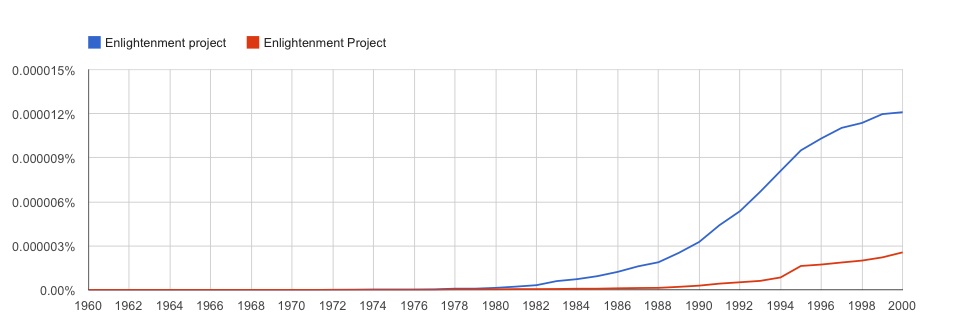
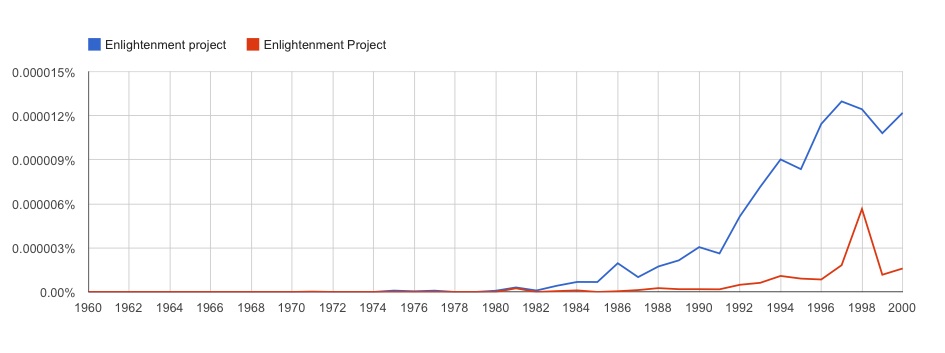
The first post in this series examined Zeev Sternhell’s claim that Nietzsche “probably invented” the term Gegenaufklärung and noted that (1) Nietzsche’s one use of the term is difficult to reconcile with the subsequent usage of the term that we now associate with Isaiah Berlin and (2) the term had been used by others before Nietzsche, though — once again — in ways that diverge markedly from the current meaning of the term. This post is concerned with Sternhell’s claim that the term “was in common usage in Germany at the turn of the twentieth century.”1  Once again, evidence in support of Sternhell’s claim turns out to be surprisingly elusive. An Ngram of occurrences of the term between 1880 and 2000 indicates that occurrences of the term in the Ngram database are quite rare prior to the 1920s and it is only after the 1960s that the term began to enjoy what little currency it seems to have (it is worth stressing that, even at its peak of popularity, this is hardly a frequently-used term).

Gegenaufklärung

Extending the search to include the phrase “gegen Aufklärung” (“against Enlightenment”) turns up a few earlier occurrences of the phrase (which is hardly surprising), but does little to alter the general picture.2   

It might, of course, be argued that the problem lies, not with Sternhell’s assertion, but rather with the corpus of texts searched by the Ngram Viewer.  It is possible that Gegenaufklärung was a commonplace in works that, for one reason or another, did not wind up in library collections and, hence, were not part of the corpus of texts searched by the Ngram. It is also conceivable that, while the term entered into common usage during the last decades of the nineteenth century, this was not immediately reflected in printed works. There are, however,  reasons to be skeptical about both of these arguments. To understand why, we need to consider two questions that, by assuming that the term was in “common usage”, Sternhell does not seem to have addressed: just who might have been using this term? And how would they have been using it?

What Gegenaufklärer?  Whose Gegenaufklärung?

Since its been a while since my last post on this issue (the delay can be partly attributed to my not appreciating just how puzzling the German usage of the term seems to be), let us review what Sternhell has to say about the term:

The term Gegen-Aufklärung was probably invented by Nietzsche, and was in common usage in Germany at the turn of the twentieth century. It was no accident that Nietzsche invented this term in order to define the thought of Arthur Schopenhauer and Richard Wagner, for its creation reflected not only his understanding of the intellectual trends of his time but also the fact that it was in the “Nietzsche years” that the Anti-Enlightenment gained momentum and became a veritable intellectual torrent. It was at that time that the antirationalist and antiuniversalist revolution of the end of the eighteenth century came down into the street, adapted to the needs of a society that within a few decades had changed as never before(The Anti-Enlightenment Tradition 3)

Two different claims are run together here: the first involves the history of the term Gegenaufklärung while the second is concerned with the history of “intellectual trends” at the close of the nineteenth century and their impact on the politics of the period. Sternhell would appear to take it for granted that the alleged “intellectual torrent” of “antirationalist and antiuniversalist” thought was responsible for the alleged (albeit, it would seem, undetectable) popularity of the term Gegenaufklärung. But just how  was this supposed to happen?

One conjecture would be that the denizens of the European “street” took up the term as a way of characterizing their “antirationalist and antiuniversalist” program and, since they employed this term in broadsheets, political pamphlets, and other documents that were never archived in libraries, this sudden upsurge in the use of the term was never recorded by Google’s scanners. It only but a moment’s reflection to see that this story is somewhat implausible. Google has, in fact, scanned a fair number of German periodicals and, even if we assume that all of the texts written by our self-described Gegenaufklärer somehow vanished, it is difficult to see how this “intellectual torrent” could have passed unnoticed (and unmentioned). Further,  even if we cling to the unlikely assumption that this Gegenaufklärung occurred without anyone recording it, Sternhell’s account is still plagued by the difficulty of explaining what any of this has to do with Nietzsche. For Nietzsche, after all, was hardly a friend of “the street”: he dedicated the first edition of Human, All Too Human  to Voltaire in an attempt to play off an “aristocratic enlightenment” against the “democratic enlightenment” that he associated with Rousseau and the French Revolution.3   So, in the lack of evidence to the contrary, it would seem unlikely that the term Gegenaufklärung was being used at this point by individuals as a way of characterizing their own beliefs.

As an alternative hypothesis we might conjecture that Gegenaufklärung was used, not as a self-description, but instead as a term employed by third parties to designate (a) the “antirationalist and antiuniversalist” beliefs that flooded “the European street,” (b) the more pervasive anti-Enlightenment temper of the times, or (c) anti-Enlightenment sentiments associated with other periods (i.e., the way in which Isaiah Berlin used the term). This account, while somewhat more plausible than the first, still faces the nagging difficulty of explaining why so few examples of this usage are being recorded on the Ngram. We could try to save the hypothesis by conjecturing that there was a lag between the appearance of this “torrent” of anti-Enlightenment thought and the use of the term Gegenaufklärung to designate this general movement. But while this may rescue the hypothesis, it requires us to abandon Sternhell’s claim that Gegenaufklärung was in “common usage” by the close of the nineteenth century. And, of course, this revised version of our alternative hypothesis is hard to reconcile with a lag in the usage of the term Gegenaufklärung that stretches into the 1960s: we would need to see some at least some examples of the term being used in the last couple of decades of the nineteenth century or the first decades of the twentieth and that these usages anticipate the connotations that the term later took on.   A search that is restricted to the period between 1875-1926 Google turns up a mere seventeen uses of the term Gegenaufklärung.  While this helps answer the question of who was using the term — namely, next to nobody — it still leaves our second question unanswered: how was the term being used?  Fortunately, since there are only seventeen uses, it is easy enough to look at them and see what we can find.  Unfortunately, what we find is rather rather confusing.

Misplaced Citations

Poking around in the texts that Google links to the Ngram results yields at least one surprise: two of the examples turn out to fall outside the period that we are searching.

In the first case, the passage in question, though published in an 1878 issue of the Zeitschrift für das Privat- und öffentliche Recht der Gegenwart, turns out to be a quotation from 1841 text.4 Hiller The focus here would appear to be on the rules for determining criminal intent (though I should caution that I am no expert of nineteenth-century German jurisprudence) and, in this context, Gegenaufklärung might best be translated as “counter explanation” (cf. similar usage of the term, in the previous post in this series, in connection with a rejoinder to an article about customs involving bell-ringing).

The other misplaced text appears in what Google alleges to be an 1890 issue of the Neue Rundschau.  All Google lets us see is the following snippet (and, why, you might well ask, is Google only letting us see a snippet from a text that dates from 1890? —  therein lies a tale …): Neue Rundschau

Though it is difficult to grasp what the author is arguing from the small portion available, the usage appears quite similar to the way in which the term is used today: “Counter-Enlightenment declares itself Enlightenment” — sounds surprisingly current.  There’s a good reason for that:  Google’s metadata is faulty.  Though Google would have us believe that the text dates from 1890, what we in fact are seeing in the snippet is a 1988 article by the Adorno scholar Hauke Brunkhorst.5  There were no issues of the Neue Rundschau published in 1890:  at that point the journal was still calling itself the  Freie Bühne für modernes Leben.  I suspect Google’s error might be traced to the Neue Rundschau’s practice of listing the date of its founding — or rather, the date of the founding of the  Freie Bühne — on its front cover; that date seems to have made its way into Google’s cataloging.

Unexpected Usages

Having eliminated two of our seventeen examples, we can move on to only actual nineteenth-century example contained in our sample: Wilhelm von Scherff’s Die Lehre von Krieg: auf der Grundlage seiner neuzeitlichen Erscheinungsformen (1897):

von Scherff

What is being discussed here has nothing to do with what we would call “counter-Enlightenment” but rather with what those schooled in the military arts term “counter-intelligence.”6

It is only when we move into the twentieth century that we begin to pick up usages that look more like what we would expect to be finding. But there are also quite a few usages that are likely to trip up the casual reader (and this, in part, explains why it has taken so long to get this post finished: these examples are far more puzzling than I’d suspected).

For a prime example, consider the following usage in the journal Hochland in 1906 (to provide some context, I’ve inserted a selection that runs from pp. 230-231 of  the journal — I’ll summarize what seems to be going on below).

Hochland 230 p. 231 HochlandThe Munich journal Hochland  is the sort of place where one might find the counter-Enlighteners that Sternhell expects us to be seeing using the term Gegenaufklärung as a way of announcing their opposition to the Enlightenment. Established in 1903 by the Catholic publicist Carl Muth as a vehicle for an revitalized form Catholicism that — breaking with what Muth saw as the inward piety of ultramontanism — championed a vision of “positive Christianity” that was cross-confessional in its aspirations and wide-ranging in its concerns.  Contributors to the journal included such figures as Max Scheler, Theodor Haecker, Sigrid Unset, and Carl Schmitt.  The journal would later gain fame for its criticisms (which, understandably, tended to be somewhat covert) of the Nazi regime (it was eventually banned in 1940) and because of Muth’s relationship with Hans and Sophie Scholl and others in the White Rose resistance.  But during the teens and twenties it was aggressively nationalist and frequently anti-Semetic  — praise for the work of Arthur de Gobineau and Houston Stewart Chamberlain can be found side by side with woodcuts of robust country folk engaged in healthy activities.7

While it would make sense to characterize Hochland (at least at certain points in its history) as embracing a program that was opposed to the ideals of the Enlightenment, the  one use of the term Gegenaufklärung that Google finds in the journal confounds our expectations.  The extracts reproduced above are from an unsigned article on the “dogmatism of free-thinking” that takes aim at Ernst Haeckel’s theories of  evolution. Arguing that this demonstrates how “free-thinking” has degenerated into a new form of “dogmatism,” the article suggests that Haeckel’s work is an example of “counter-Enlightenment” thinking.   As I noted in an earlier post, this sort of move is not uncommon in nineteenth-century religious critiques of Darwin by Anglophone writers,  though their preferred term to describe what Darwin was peddling was “scientism” rather than “counter-Enlightenment” (though, as we shall see in the next post, the two terms turn out to be connected).

We see a similar use of the term in another Catholic journal, the Historisch-politische Blätter für das katholische Deutschland (1912), though without the complete text it is soemwhat hard to tell what is going on:

Katholische Deutschland

So, at long last, we seem to have located some actual Gegenaufklärer, but they none of them seem to be using the term Gegenaufklärung as a way of characterizing their own position. Following the paradigm that was established at the close of the eighteenth century, the present themselves as  friends of “true enlightenment.”

Finally, Google provides two snippets from the 1917 issue of Deutschlands Erneuerung, the journal of the Pan-German League, a group whose nationalist, imperialist, expansionist, and anti-Semitic policies are precisely what Sternhell might have had in mind when he assumed that Gegenaufklärung had entered into common usage by the close of the century. Once again, it is difficult to be sure what is going on in the snippets Google provides (and I have trouble lining them up with scans of the journal that area available online, which makes me suspect that Google’s metadata may, once again, be misleading):

Deutschlands ErneuerungMy best guess (and I’d be grateful to anyone who wants to offer an alternative reading) is that Gegenaufklärung figures here not as a description of the cause that the League embraces but, rather, as a way of characterizing the program of Wirtschaftliche Aufklärung (“economic enlightenment — or, perhaps, “economic education”?) that it opposes: bourgeois liberties amount to a Gegenaufklärung. The mind boggles: if any journal could be seen as exemplifying the aims of the Gegenaufklärung it would be Deutschlands Erneuerung, but it employs the term, not as a badge of honor, but rather as a pejorative for the positions that others hold.

The Delayed Arrival of the Gegenaufklärung as We Now Know It

It is not until the 1920s that we begin to find uses of Gegenaufklärung that employ the term in the context of discussions of the legacy of eighteenth-century thought.  And they tend to use the term for scholarly, rather than polemical, purposes.  For example, Google offers the following snippet from Franz Oppenheimer and Bertha Spinder-Gysin’s 1922 System der Soziologie :

Oppenheimer Four years later we find the following in the journal Logos: Logos The author’s “if I might say” suggests that the term still has a certain novelty about it, which means that we have probably still not arrived at the point where the term is in “general usage,” but we finally seem to be approaching a point where the term refers to an intellectual movement that is opposed to what we would recognize as “the Enlightenment.” But we are still four decades away from the uptick in usage that we can see in the Ngram that opened this post.

That uptick would seem to be driven by German discussions of Berlin’s work and by Herman Lübbe’s Hochschulreform und Gegenaufklärung, a polemic against the German student movement that argued that the students were engaged in an attempt at “counter-Enlightenment.” I would be inclined to maintain that it is only at this point — some eighty years later than Sternhell suggests — that the term Gegenaufklärung entered into common German usage.

What took it so long? The belated popularity of the term might be explained, in part, by the fact that there was no need for it. Prior to 1965 there were other ways of referring to enemies or the opponents, the simplest of which was just to call them “enemies” or “opponents”:

Enemies and Opponents to 1965

It is not until 1955 that we begin to see Gegenaufklärung consistently supplanting these more familiar phrases (the brief upsurge of Gegenaufklärung around 1945 seems to be driven, in part, by discussions of the need for “counter-education” in postwar Germany) and, over the course of the next decade, it becomes the preferred term for referring, collectively, to the Enlightenment’s enemies.

What, then, are we to make of this substitution? While it may well amount to little more than a distinction without a difference, invoking the existence of something called a “counter-Enlightenment” would appear to imply something more than the trivial observation that the Enlightenment had enemies and opponents. It suggests that these enemies and opponents were engaged in a common cause, that all of them were making arguments that had, at a minimum, some sort of family resemblance. This, after all, is what Sternhell is attempting to argue: not just that the Enlightenment had enemies, but that these enemies are part of a coherent tradition.

On the other hand, the term “counter-Enlightenment” can also serve as a way of designating the historical period that followed in wake of “the Enlightenment.”  We begin to find examples of that usage, in German, in historical studies during the 1920s, when the term begins to be used as a synonym for “Romanticism.” But this less ambitious use of the term does not appear to have caught on. After all, there was already a term that does that particular job quite effectively: namely, “Romanticism” itself. Once again, the only advantage that “counter-Enlightenment” would seem to offer is that it assembles all the opponents of the Enlightenment under a single label.  For reasons that remain to be explored, it was not until the 1960s that a significant number of people seemed to have felt the need to do this.

To be continued

  1. Zeev Sternhell, The Anti-Enlightenment Tradition (New Haven: Yale University Press, 2010) 3.
  2. Beginning the search at 1800 produces a spike for the phrase gegen Aufklärung between 1800-1820, which makes a certain amount of sense but which might also be an artifact of the small number of books from that period that would have been scanned and available for searching.
  3. See Graeme Garrard, “Nietzsche For and Against the Enlightenment.” The Review of Politics 70:4 (2008): 595–608.
  4. Karl Hiller, Zur Versuchslehre des österreichischen Strafrechts,” Zeitschrift für das Privat- und öffentliche Recht der Gegenwart V (1878) : 657-718
  5. Hauke Brunkhorst, ” Die Unverzichtbarkeit der Utopie. Zur Rolle der Intellektuellen in dern Kulturellen Wenden der westdeutschen Republik,” Neue Rundschau, 99:1 (1988) 140-156.  The full quotation reads, “Währed dessen begnügen sich die konservativen Theoretiker der Regierung mit der Theoretisierung der eingenen Theorielosigkeit,(151) indem die zu begründen versuchen, warum Theorien, aslo Erklärunggen und Begründungen, unnütz und schädlich sind. Sie propagieren die allgemeine Abschaffung des Allgemeinen, arbeiten theoretisch am Verfall von Theorie und denken das Denkverbot. Gegenaufklärung verkünden sie als Aufklärung, dem Affekt gegen die Intellektuellen geben sie intellektuelles Gewicht.” 
  6. Wilhelm von Scherff, Die Lehre vom Kriege: auf der Grundlage seiner neuzeitlichen Erscheinnungsformen (Berlin: Ernst Siegfried Mittler und Sohn, 1897).
  7. For a discussion of the journal’s early history and its relationship to broader tendencies in Bavarian Catholicism, see Derek Hastings, Catholicism and the Roots of Nazism : Religious Identity and National Socialism (Oxford ; New York: Oxford University Press, 2010) 31-32, 39-44.
Posted in Uncategorized | Tagged , , | 4 Comments

Kant on “Paradoxical Thinking”

Various  commitments have conspired to delay the next installment of my discussion of the history of the notion of “counter-enlightenment.”  But in the course of my reading, I came across a quote from Kant’s lectures on anthropology that casts a somewhat different light on the idea of “daring to know.”  So, I thought I’d share it:

Paradoxical cognitions are the ones that make errors suspect; these cognitions appear strange. Hence, if one judges him, one can learn something new from an author who is paradoxical, because he deviates from the old path and chooses a new one. However, according to reason, such an author is a daredevil, and he exposes himself both to winning and to losing. If he succeeds, he gains the advantage therefrom, if he fails he still deserves credit for that reason, because he had this much daring to take a risk. Someone else, who is not so daring, holds to common opinion in order not to fail.The French are very fond of daring in thinking, as they take a risk and thereby leave themselves open to praise or blame. That is a narrow-minded person who, in an unfinished book containing errors, does not nevertheless see the idea of genius which dared, after all, to say such a thing. One must read such authors who are paradoxical because one finds much that is new in them. [Akademie Ausgabe 25:484-485; trans. by Felicitas Munzel, Lectures on Anthropology (Cambridge 2012) p. 59].

I hope to be back to tracking down later nineteenth-century and early twentieth-century uses of Gegenaufklärung shortly.

Posted in Uncategorized | 2 Comments

The Fading of “True Enlightenment” (Another Wildcard Search)

Apologies for the uncharacteristic flurry of activity on this blog, but Google’s addition of wildcard searches to the Ngram (and some tweaks in how it displays the data) has allowed me to take a quick look at a few issues I’ve explored in earlier posts.

Since wildcard searches can be limited by parts of speech, it is simple enough to collect the various adjectives that have preceded Aufklärung.  Here are the results for the period from 1770-1870 (I suspect that none of the data for the eighteenth century should be trusted, but I figured it wouldn’t hurt to include it.  Again, there’s not a lot that is unexpected here, though dragging the cursor backwards over the Ngram provides an easy way of seeing how the ranking of adjectives change over time.  Our old favorite “wahre Aufklärung” (i.e., an enlightenment grounded in religion as opposed to a “false enlightenment” resting on unaided human reason) ranks at the top until 1870, when “weitere Aufklärung” (“further enlightenment”) catches it.

Then, for contrast, look at the results for the period from 1870 to 1920.  “Weitere Aufklärung” is still at the top of the list in 1920, but over the course of the half century it is replaced, momentarily by “deutschen Aufklärung” (in the late 1870s) and “sexuelle Aufklärung” in 1907.  The former reflects the impact of German unification, the later — of course — is the result of Freud’s Zur sexuellen Aufklärung der Kinder.  Note, more generally, that at this point we begin to pick up the differentiation between a “German” and a “French” Enlightenment (a distinction that Hegel drew in the 1820s and, perhaps, is now making its way into general usage.

Finally, let’s look at the period from 1920 to 2000.  “Weitere” is still chugging along, but greatly diminished, the distinction between German and French enlightenments has now become canonical, with the German one taking the lead (in German texts, of course).  Perhaps the most interesting new addition here is Niklas Luhmann’s formulation “Soziologische Aufklärung” (the fact that the adjective is capitalized suggests that there are references to the title of Luhmann’s book) which takes off a bit before 1980 and leads the pack in 2000.

I should point out that, in all these examples, I’ve turned smoothing off:  since we are dealing with very small numbers, I didn’t see the point of making any of these trends look less eccentric than they seem to be.

Posted in Uncategorized | 2 Comments

Enlightenment and Ngram Wild Card Searches

A link on my Twitter feed this morning alerted me to Ben Zimmer’s article in the Atlantic on a new (and welcome) feature that Google has added to the Ngram:  wild card searches.

Naturally, I thought I’d try it out with “Enlightenment” and “enlightenment”.  Here are the results:

EnlightenmentWild

To appreciate what is going on here, it makes more sense to open the Ngram itself in a separate window.  In addition to providing a larger image of the Ngram, working from the actual Ngram allows you to take advantage of the new features than Google has added, including the ability to highlight the graph for the individual words by mousing (or, in the case of trackpad users, “tracking”?) over the list of words on the right ride.

While there’s nothing here that alters the general point that I’ve been emphasizing here and elsewhere — namely, that “the Enlightenment” was not a formulation that enjoyed much currency until the post-World War II period (and, at some point, we need to consider alternative ways of designating this period:  “Cold War” anyone?).  But what is somewhat more unexpected is the ranking of frequency of the various wildcards that precede “Enlightenment.”  For example,  I would not have thought that “of Enlightenment” beat out “of enlightenment” at some point during the 1990s. Might this be the result of a tendency to turn “Enlightenment” into a general designator for all the mischief allegedly done by “the Enlightenment Project”?

It is also possible to select different names and display only their plots.  Clicking on “Scottish Enlightenment” and “French Enlightenment” helps to clarify when it was that the former became more frequent than the latter (early 1980s, it appears).  It’s also interesting to click on the least frequently appearing phrases on the list, if only to see how formulations such as “his enlightenment” or “general enlightenment”  have been hanging on, at the bottom of the Ngram, since the 1840s (could this be artifact of the continued republication of nineteenth-century novels?).  Finally, highlighting “European Enlightenment” suggests that it was not until the 1980s that those working on the Enlightenment of the eighteenth century found it necessary to distinguish their enlightenment from the Buddhist one.

Posted in Uncategorized | Tagged , , | 3 Comments

Fabricating the “Counter-Enlightenment” — Part 1: Nietzsche’s Role

When asked “Who invented the word ‘counter-Enlightenment?” Isaiah Berlin replied

I don’t know who invented the concept …. Someone must have said it. Could it be myself? I should be somewhat surprised. Perhaps I did. I really have no idea.1

In the quarter century since this 1988 interview, it has become clearer that the concept Berlin popularized enjoyed a limited usage prior to the publication of his influential 1973 article on the subject in the Dictionary of the History of Ideas.2 But almost everything else about the term remains puzzling.

17pocock

J. G. A. Pocock

Among the larger puzzles is just what it is supposed to designate, a problem nicely captured by J. G. A. Pocock when he asked whether it was intended to refer to “one brand of Enlightenment in opposition to another, or a fixed antipathy to Enlightenment in some final sense of the term?”3 But there are also smaller, and no less puzzling questions, as to how Berlin came to use the term in the first place and what, if anything, his use of the term might have had to do with these earlier uses.4 While Pocock’s reservations about the concept (which I share) raise what are, by far, the most significant set of issues, my concern in this and the posts to follow will be with less weighty, but somewhat more easily resolvable, problems involving the history of the term itself.  I hope that exploring them may lend further support to Pocock’s suspicions about the utility of this confused and confusing concept.

My plan, then, is to devote a few posts to an examination of earlier uses of the term, both in English and in German, and see how these earlier uses may have influenced Berlin. In the end, we will still be left with a number of mysteries about the term (which, it turns out, has been kicking around longer than I suspected) but one thing seems reasonably certain: the account that Zeev Sternhell offers of the history of the term at the start of his Anti-Enlightenment Tradition gets much of the earlier history of the term wrong. Since his account repeats much of what has become the conventional wisdom about the history of the concept, it seems as good a place as any start. While understanding where and why Sternell’s account goes wrong will not, in itself, explain what led Berlin to use the term, it does help to clarify some of the problems that plague the concept itself.

Sternhell’s History of the Term

Zeev Sternhell’s discussion of what he characterizes as the “anti-Enlightenment tradition” begins with a short account of the history of the term “Counter-Enlightenment.” Drawing, for the most part, on earlier studies he argues:

The term Gegen-Aufklärung was probably invented by Nietzsche, and was in common usage in Germany at the turn of the twentieth century. It was no accident that Nietzsche invented this term in order to define the thought of Arthur Schopenhauer and Richard Wagner, for its creation reflected not only his understanding of the intellectual trends of his time but also the fact that it was in the “Nietzsche years” that the Anti-Enlightenment gained momentum and became a veritable intellectual torrent. It was at that time that the antirationalist and antiuniversalist revolution of the end of the eighteenth century came down into the street, adapted to the needs of a society that within a few decades had changed as never before. In English, the term “Counter-Enlightenment” had existed for at least some fifteen years before it was used by Isaiah Berlin, who believed he might have invented it. It was employed by William Barrett, an American professor of philosophy well known in his time, editor of The Partisan Review. Barrett was one of the first American academics to introduce existentialism to his countrymen. It is not surprising that it was precisely in a book on existentialism that this Nietzschean concept appeared. It was, however, undoubtedly due to Berlin’s innate talent for the popularization of formulas that the term “Counter-Enlightenment” became accepted in the English-speaking world. If is term never existed in French, it was perhaps partly because Gegen-Aufklärung was flatly translated in that language as “the reaction to the philosophy of the Enlightenment.” The translators into French were not aware that Nietzsche had just invented an analytical concept of the greatest importance. On the other hand, the term “anti-philosophe” appeared at more or less the time that the encyclopédistes adopted the name “philosophes.” So even if in France they did not speak of an “anti” or “counter” Enlightenment, the idea, from the eighteenth century and throughout the nineteenth and twentieth centuries, did exist there as elsewhere.5

Sternhell makes quite a few claims here (there are at least eight of them, by my count) and their relationship is not always clear. Since I am going to spending some time picking my way through them, let me begin by listing them and briefly noting where the problems in his account reside:

  • Claim 1. Nietzsche “probably” invented the term: this claim is clearly wrong — there seem to have been a few uses of the word prior to Nietzsche and, more importantly, the claim that Nietzsche used the term in anything approximating the sense in which it would come to be used by Berlin and others is quite problematic
  • Claim 2. It was in “common usage” in Germany by beginning of the twentieth century: the best evidence I have been able to come up with suggests that this claim is mistaken as well; the term does not seem to enjoy widespread usage until the 1960s and it is difficult to find evidence of even a modest number of uses until the beginning of the 1920s.
  • Claim 3. Nietzsche’s usage of the term was tied to (a) his understanding of his times and (b) to the spread of the “Anti-Enlightenment” movement: much in this claim is undermined by the failure of claims #1 and #2; it also rests on an interpretation of Nietzsche’s views that both to oversimplifies and overstates what he seems to have been doing on the one occasion when he used the term.
  • Claim 4. William Barrett introduced the term into English around 1958 in the context of a discussion of Nietzsche: this claim is also wrong — Barrett had used the term as early as 1949 and that use was only loosely associated with Nietzsche; further, there turns out to have been at least one other use of the term in English prior to Barrett.
  • Claim 5. Berlin popularized the term in English: on this point Sternhell is clearly correct.
  • Claim 6. The term never existed in French: this would also appear to be true, though I am not sure how important it is since, as Sternhell himself notes, there were a few alternatives (both in French and German) that did more or less the same work as “counter-Enlightenment.”
  • Claim 7. The French were (a) unaware of Nietzsche’s use of the term and hence (b) were deprived of “an analytical concept of the greatest importance”: The first part of the claim is true, if only because no one seems to have been aware of Nietzsche’s alleged invention of the concept. Regarding the second part: I doubt that the French were missing much.
  • Claim 8. Nevertheless “anti-philosophe” does much the same work as “counter-Enlightenment”: much here hangs on the question of whether “anti-philosophe” and various other kindred terms are, in fact, equivalent to “counter-Enlightenment.” I would argue that they are not: to claim that there was such a thing as a “counter-Enlightenment” is different from maintaining that the Enlightenment had enemies.

I will devote the next few posts to working my way through these claims. This post will examine Sternhell’s claims about Nietzsche’s alleged role in coining the term and glance at one earlier use of the term. Subsequent posts will take up  Sternhell’s other claims.

Nietzsche’s Use of the Term Gegenaufklärung

The sole evidence offered by Sternhell for Nietzsche’s having “probably invented” the term “Gegen-Aufklärung” consists of a reference to a footnote in Robert Wokler’s contribution to Isaiah Berlin’s Counter-Enlightenment, a collection of essays on the topic that Wokler edited with Joseph Mali.6 There would appear to be no indication that Sternhell has actually looked at the Nietzsche quotation itself.  Indeed, until beginning work on this series of posts, I hadn’t looked at it either, though, like Sternhell, I was familiar with Wokler’s passing reference to it.

It was my good fortune to have gotten to know Robby Wokler and, in a series of discussions, both in person and via email, we spent a fair amount of time attempting to track down previous uses of the term. We were joined in this hunt by Graeme Garrard, whose Counter-Enlightenments: From the Eighteenth Century to the Present receives some shabby treatment in Sternhell’s book.7 Robby was content simply to note, at the end of a footnote devoted to arguments about the concept of enlightenment, that Nietzsche had employed the term “Gegen-Aufklärung” in one of his notes from the spring and summer of 1877 (i.e., around the time of the publication of the final, and perhaps most problematic, of his Untimely Meditations, “Richard Wagner at Bayreuth”).8 In contrast to Sternhell, Robby did not seem to view the note as amounting to an “invention” of the term; his assumption was that there must have been an eighteenth-century use of the term (I tried, unsuccessfully, to persuade him that this was unlikely).

Sternhell’s claim is considerably more ambitious:

It was no accident that Nietzsche invented this term in order to define the thought of Arthur Schopenhauer and Richard Wagner,  for its creation reflected not only his understanding of the intellectual trends of his time but also the fact that it was in the “Nietzsche years” that the Anti-Enlightenment gained momentum and became a veritable intellectual torrent.

While Sternhell’s characterization of what Nietzsche was attempting to do seems sensible enough, it is difficult to square with what Nietzsche actually entered into his notebook.

Here (courtesy of the Nietzsche Channel) is a reconstruction of what Nietzsche jotted down:

Nietzsche's Note

Sternhell is right to suggest that Nietzsche’s use of term has something to do with his understanding of contemporary “intellectual trends,” though exactly what he is doing here strikes me as far more puzzing than Sternhell’s brief discussion would have us believe.

Let’s start with a translation:

There are shorter and longer arcs in cultural evolution. The peak of enlightenment corresponds to the peak of counter-enlightenment in Schopenhauer and Nietzsche Wagner. The highpoint of the little arcs come near to that of the greater arc —  romanticism.

At first glance, it would seem that the only problematic word here is Bogen, which performs a number of services for Nietzsche. In the immediate context, “arc” seems like the best choice: Nietzsche, after all, immediately draws a series of arcs to illustrate his point. But Bogen also can be translated as “bow” and in his passing discussion of the Enlightenment in the Preface to Beyond Good and Evil it is this sense of the term comes to the fore:

Freilich, der europäische Mensch empfindet diese Spannung als Nothstand; und es ist schon zwei Mal im grossen Stile versucht worden, den Bogen abzuspannen, einmal durch den Jesuitismus, zum zweiten Mal durch die demokratische Aufklärung:—als welche mit Hülfe der Pressfreiheit und des Zeitunglesens es in der That erreichen dürfte, dass der Geist sich selbst nicht mehr so leicht als “Noth” empfindet!

The Nietzsche Channel translates this as follows:

To be sure, European man experiences this tension as a state of distress; twice already attempts have been made in the grand style to slacken the bow, once by means of Jesuitism, the second time by means of the democratic Enlightenment:—which, with the aid of freedom of the press and newspaper-reading, might indeed bring it about that the spirit would no longer experience itself so easily as “distress”!

While there is more to say about the implications of Nietzsche’s discussion of the tightening and slackening of bows might have to do with Enlightenment and Counter-Enlightenment, for now it may be enough simply to note the pliability of the word Bogen. My chief interest, however, is with the peculiar diagram that Nietzsche drew to illustrate his account of cultural development: I’m not quite sure what to make of it.

The text would lead us to expect that Nietzsche would go on to draw arcs contrasting the trajectory of Aufklärung and Gegen-Aufklärung (with the latter exemplified by Schopenhauer and Wagner). But that, it would appear, is not quite what he does: instead, we have a series of smaller arcs — the first of which is labelled  “Romantik” — and a broader, higher arc that is connected to the name “Wagner.”    As Nietzsche explains in the text underneath the drawing, the peaks of these smaller arcs approach (but do not reach) the peak of the larger arc.

Nietzsche’s note would have been easier to understand if the smaller set of arcs had been labeled “Aufklärung” instead of  “Romantik”:   in that case,  Wagner and Schopenhauer could be seen as standing on the great arc of the Gegenaufklärung with the various peaks below representing the smaller arcs of Aufklärung.  But that is not what he did.  One way of making a bit more sense of the note would be to question whether, in the text below the drawing, Nietzsche intended the word “Romantik” as a specification of the phrase “the larger arc.” Coming at the end of sentence about the relative relationship of larger and smaller arcs, perhaps “Romantik” was intended simply as a suggestion that this might be a way to think about the function of romanticism within the more general process of “cultural evolution” that Nietzsche was sketching (i.e., it amounted to little more than a reminder that romanticism ought to be brought into the discussion at some point).  It is also possible that Nietzsche had not initially labelled the two arcs (which were intended only as a way of illustrating the general point about shorter and longer arcs) and only proceeded to do so after having written the final sentence.

But this still leaves us with the problem of sorting out how we are to understand the relationship between “Enlightenment” and “Counter-Enlightenment.”  As things stand, we are faced with the difficulty of mapping the opposition between Aufklärung and Gegen-Aufklärung onto the opposition between romanticism on the one hand and Schopenhauer and Wagner on the other.  And there is no way of doing that if we continue to employ the terms Aufklärung and Gegen-Aufklärung as equivalent to the distinction between Enlightenment and Counter-Enlightenment.  For that would force us to see either Wagner and Schopenhauer or romanticism as associated with the Enlightenment.  And that seems quite implausible.

There is, however, on final option.  It is possible that, in this particular context, “enlightenment” may not be best way of translating  Aufklärung:  perhaps Nietzsche was using it, not to designate the movement that we know as “the Enlightenment,” but instead in the broader sense of conveying information or as educating someone about something.   Whatever its shortcomings, this  interpretation of the text at least has the virtue of echoing the way in the which Schopenhauer had been characterized in the third of the Untimely Meditations:  “Schopenhauer als Erzieher” (“Schopenhauer as Educator”).  The term Aufklärung turns up three times in section 5 of the discussion and is used there in the more general sense of “enlightening” or “informing” someone about something.  I am not particularly wedded to this interpretation and would be interested in seeing what others might make of Nietzsche’s note.  But this reading does allow us to make a bit more sense of Nietzsche’s text and the diagram that he draws, even though it comes at the price of forcing us to abandon the idea that Nietzsche is discussing the relationship between what we could call “the Enlightenment” and “the Counter-Enlightenment.”

In any case, the one lesson that can be taken away from this is that the text we are dealing with is, after all, just a note in a notebook.  It was something that was unlikely to have been seen by anyone during Nietzsche’s lifetime and I suspect that Nietzsche jotted down in considerably less time than I have spent discussing it.   All of this is enough to suggest that Sternhell’s claim that Nietzsche’s use of the term amounts to the “invention” of the concept of “the counter-Enlightenment” is a bit of a stretch.  And, as we shall see in the next post, his further claim that it was “no accident” that Nietzsche invented the term at this particular moment amounts to little more than whistling in the dark.

“Gegenaufklärung” Before Nietzsche

It might, however, be argued that Sternhell was simply claiming that Nietzsche invented the term — rather than the concept — of Gegenaufklärung and that his attaching of this term to Wagner and Schopenhauer, while perhaps not entirely consistent with its subsequent uses, nevertheless served as a starting point for what would go on to become a fully-developed critique of the Enlightenment.  But this claim is also problematic:  for the word Gegenaufklärung appears to have been in use  prior to Nietzsche’s note, though (as I have argued may also have been the case with Nietzsche) the word does not appear to have been used to designate the concept  “Counter-Enlightenment” as we now understand it.

Take, for instance, this brief note from the Augsburger Tagblatt of April 14, 1835 (441-442), which seems to have been written in response to a earlier article having to do with the functioning of church bells.  It reads, in full,

Dem Einsender des Aufsatzes, das Schlagwerk der St. Stephansthumuhr betreffend, diene zur wohbedürftigen Aufklärung, das ausser ihm, niemand weiss, dass das Viertelschlagwerk jemals auf das Chorglöcklein geschlagen habe, sondern früher wie jetzt auf die sogenannte Messglocke schlug und noch schlägt.  Als Beweis diene:  dass weder an dem Glockenstuhl noch an dem Chorglöcklein selbst nicht die mindeste Spur von einem ehemaligen Schlagwerke zu finden ist; an der Messglocke hingegen sind vom Hammer so tiefe Narben geschlagen, das man im vorigen Jahre für gut fand, diese Glocke berreits zum zweitenmale zu verrückern, wobei bemerkt wird, dass wenigstens ein Jahrhundert nötig ist, bis von Schalgwerk eine solche Narbe entsteht.  Da übrigens das Chorglöcklein kleinen ist, und daher wohl einen höhern, keineswegs aber hellern oder stärkern Ton gibt als die Messglocke, auch zu der Stundenglocke, der grossen Distanz wegen, in ungewöhnlichen Tonverhältnisses steht, so ist nicht einzusehen, warum eine Abänderung hätte vorgenommen werden sollen, und man bittet deshalb den verehrlichen Herrn Einsender um gefällige Gegenaufklärung.

I will not even attempt a translation of this tedious discussion of the finer points of bell ringing, but instead will simply note that what the author is doing amounts to providing some “contrary information”  (Gegenaufklärung) to the “enlightenment” offered in an earlier article in the journal.  Searches of German books from the first half of the nineteenth century using both Google and the search engine of the Hathi Trust turn up a few other appearances of the word, though trying to figure out the variety of  ways in which the term was used would require a good deal more time than I can spare at the moment, especially since the search engine on the Google Books site seems to be having some problems distinguishing between “Gegenaufklärung” and the much more common — and much less interesting — phrase “gegen Aufklärung.”)9   

My suspicion is that while we are likely to find scattered occurrences of the word Gegenaufklärung during the first half of the nineteenth century,  it is unlikely that the contexts in which it is used are going to be ones in which its usage amounts to an invocation of what we would understand by “Counter-Enlightenment.”  It is clear that, by the middle of the nineteenth century the Enlightenment had accumulated any number of enemies.  What is far from clear is that anyone found it necessary to lump all these enemies together into something called “the Counter-Enlightenment.”

But the best evidence for maintaining that the idea that there was such a thing as a “Counter-Enlightenment” arrived far later than we sometimes assume can be found by looking for appearances of the term during a period when, if Sternhell’s second claim is correct, we should have no problems in seeing instances of it:  the latter part of the nineteenth century.  My next post will take a look at that period and see what, if anything, we can learn about how Gegenaufklärung was being used in the wake of Nietzsche’s alleged invention of the term.

To be continued …

  1. Isaiah Berlin and Ramin Jahanbegloo, Conversations with Isaiah Berlin (New York: Scribners, 1991) 69-70
  2. Dictionary of the History of Ideas (New York: Scribner’s, 1968-73) Volume II:100 (reprinted in Isaiah Berlin, Against the Current: Essays in the History of Ideas (New York: Viking, 1980) 1).
  3. J.G.A. Pocock, “Enlightenment and counter-enlightenment, revolution and counter-revolution; a eurosceptical enquiry,” History of Political Thought XX, no. 1 (Spring 1999): 132.
  4. I’ve dealt with some of these questions in a conference paper that can be downloaded from Academia.edu.
  5. Zeev Sternhell, The Anti-Enlightenment Tradition (New Haven: Yale University Press, 2010) 3.
  6. Joseph Mali and Robert Wokler, eds., “Isaiah Berlin’s Counter-Enlightenment,” Transactions of the American Philosophical Society 93, no. 5, New Series (2003).
  7. See Graeme Garrard, Counter-Enlightenments: From the Eighteenth Century to the Present (Abingdon: Routledge, 2006) . Sternhell’s complaint against Garrard (see 446-447) is that his book’s agenda is “the deconstruction of the Enlightenment and the Anti-Enlightenment into an infinite number of Enlightenments and Anti-Enlightenments” and that Garrard “agrees with the disastrous assessment of the Enlightenment by John Gray, who like himself is also a liberal of the school of Isaiah Berlin” (the latter seems to be decisive for Sternhell). Garrard, in fact, spends some time criticizing Gray. For Garrard’s response, see “Review Article: The War Against the Enlightenment,” European Journal of Political Theory 10, no. 2 (April 1, 2011): 277–286.
  8. There is much to be said about Nietzsche’s complicated stance towards “the Enlightenment” itself, but I would prefer not to open that can of worms here.  For Garrard’s take on it see “Nietzsche For and Against the Enlightenment,” The Review of Politics 70, no. 04 (December 2008): 595–608.
  9. A search of the Google scans archived by the Hathi Trust turns up a few hits for Gegenaufklärung prior to 1850, but access to the texts themselves is blocked for copyright reasons. As a result, there is no way of know what is in the texts without actually tracking down physical copies. 
Posted in Uncategorized | Tagged , , , , , | 8 Comments

Ironic Enlightenment? Voltaire, Fussell, and the Neverending End of the Age of Irony

Harvesting_beans_(5762966966)Readers of this blog may have noted a certain slackening of activity. The explanation is simple enough: September arrived and, with it, the opening of the fall term (or, as one of my more jaded friends likes to call it, “the resumption of hostilities”). In other lines of work the end of summer signals the beginning of the harvest season, and something akin to that has been slowing my posting as well.

I began this blog in January with three purposes in mind. First, I saw it as a place where I could force myself to confront various stumbling blocks that needed to be dealt with in order for me to finish off some of the things I’m working on (that was the point of my series on Foucault and Habermas). Second, I thought it might serve as a convenient place to deal with provocations having to do with the topics on which I work that turn up in other venues (e.g., annoying commencement addresses by literary editors of certain New York magazines). Finally, I figured I could use it to rid myself of some work that I’d done that wasn’t going anywhere else (for example, my attempt to figure out whether Thomas Mann actually wrote a review of Dialectic of Enlightenment for the New York Times). The blog has been surprisingly effective in fulfilling my first and second aims and, as a result, has yielded quite a few half-baked ideas that I am in the process of revising for publication  — which, to mix the metaphors, means that I, too, have some harvesting to do.

For the past week I’ve been kicking around various topics, but finding little that was coming together quickly enough to justify my spending further time on it given the press of other commitments. Then, a few days ago, a colleague (for reasons I don’t quite understand) posted a link to a year-old article from the New York Times by Christy Wampole, a professor of French at Princeton University on “How to Live without Irony.” I should know better than to rise to the bait, especially when the bait is now over a year old, but coincidentally (though, it bears emphasizing, not at all ironically) Wampole’s article dangled before my eyes at the very moment when as I was teaching Paul Fussell’s Great War and Modern Memory in my course on “Catastrophe and Memory” and also finishing up a discussion of Voltaire in my course on the European Enlightenment. This was more than enough to get me thinking about (1) why the New York Times has such an affection for discussions (in most cases, critical) of irony, (2) the place of irony in Voltaire and, more generally, in the Enlightenment, and (3) Paul Fussell. In short: I was hooked.

On the Eternal Return of the End of the Age of Irony

In the immediate aftermath of September 11 attacks, Roger Rosenblatt published an essay in Time magazine arguing that the one good thing that might emerge from the  attacks was the “end of the age of irony.” Shortly thereafter the New York Times published one of the smarter rejoinders: Michiko Kakutani’s October 9, 2001 reflections on the role of irony in public life. Writing barely a month after the attacks  Kakutani noted that irony was still with us and, appealing to Fussell’s discussion of the role of irony, reminded readers that this might not be a bad thing: irony, he noted, had long served as “a potent weapon for delineating a fractured and frightening world.”

One of the good things about reading Wampole’s account of the virtues of living without irony roughly a year after it initially appeared is the slackening the outrage reflex that attacks on irony seem to trigger in those of us who, for better or worse, find the need to say good things about a bad attitude. Revenge may be a dish best served cold, but cold bile is about as appetizing as year-old bait. In my case, the urge to argue with Wampole’s piece was quickly (but, unfortunately, temporarilty) supplanted by a curiosity about how often the Times had found it necessary to deal with “irony.” That question was easily answered: according to the ProQuest Historical Newspapers Database it appears in the title of 575 articles.

And what a peculiar lot of articles they are!  A fair number not only defended irony, but practiced it in their title:  see, for example, Andy Newman’s “Irony is Dead. Again. Yeah, Right” (Novemeber 23, 2008) and Meghan O’Rouke, “The End of Irony” (August 27, 2006), a review of Claire Messud’s The Emperor’s Children (“a masterly comedy of manners — an astute and poignant evocation of hobnobbing glitterati in the months before and immediately following Sept. 11”).

At some point in my voyage backward though the database I decided it might be more interesting to start from the other end and skipped to the oldest article: a correction dating from the May 22, 1861 (bless the Times, it’s been owning up to its mistakes for as long as it’s been making them) cautioning readers that “irony and badinage are the most hazardous of weapons for promiscuous use.”  As if to confirm the article’s warning that, while such devices may “gratify and amuse a few, they confound many, and to the larger number they are as unintelligible as the Vedas,” the third oldest item (“Is it Irony?”,  July 28, 1873),  struggled to make sense of  an piece in a “Georgia Democratic journal” welcoming the emigration from the North (“We want Yankee skill, Yankee ingenuity, money and muscle”) while at the same expressing some reservations about the suitability of  the “politics,” “religion,” and “civilization” of the welcomed emigrants.   All of this is enough to suggest that, the arc of history of irony is, indeed, long (in the case of the struggle between Times and ironists it runs from unreconstructed Georgia Democrats to Brooklyn hipsters) and it bends towards snark.

Welcome to the Desert of the Ironical!

The reception to Wampole’s advice on how to live without irony more or less confirmed her thesis that we are living in a ruthlessly ironic age: lots of people posted lots of snarky comments about it (and, sometimes, her: hipsters don’t take kindly to be criticized by academics). Indeed, when I started reading her piece I found it difficult to shake the feeling that the whole thing was itself an example of the disease it sought to battle. Consider the opening:

If irony is the ethos of our age — and it is — then the hipster is our archetype of ironic living.

It is as if having initially written “If irony is the ethos of our age, then the hipster is our 220px-Jonathan_Katz_1archetype of ironic living,” the author chose to disguise the familiar comp-lit tease of smuggling arguments into a text by disguising  them as conditionals: note the strategically inserted validity claim (“and it is”) assuing readers of the truth of the supposition and the veracity of the speaker. I’m sure that echt Habermasians can do a better job than me of sorting out what is going on here, but it reminded me of the opening of one of the comedian Jonathan Katz’s more complex (and riskier) jokes: “A young polar bear came home from school — true story — and …”

One of the peculiar features of discussions of “the end of the age of irony” is that everyone appears convinced that theirs is a particularly, if not uniquely, ironical age. For example, Wampole writes,

Born in 1977, at the tail end of Generation X, I came of age in the 1990s, a decade that, bracketed neatly by two architectural crumblings — of the Berlin Wall in 1989 and the Twin Towers in 2001 — now seems relatively irony-free.

Much, I suppose, hangs on “relatively,” but it bears remembering that the “age of irony” whose end Roger Rosenblatt announced in September 2001 was the very same age that Wampole characterizes as “relatively irony-free”: Rosenblatt took some solace in the prospect that the 9-11 attacks ended the reign of Seinfeld and, presumably, promised to choke off Curb Your Enthusiasm after a single season. But, though every recent season of Curb seems as if it will be the last, it somehow manages to keep on going. The same would seem to be true for both “Age of Irony” and the attempt to end it.

Searching for examples of individuals who live nonironic lives, Wampole offered the following:

Nonironic models include very young children, elderly people, deeply religious people, people with severe mental or physical disabilities, people who have suffered, and those from economically or politically challenged places where seriousness is the governing state of mind. My friend Robert Pogue Harrison put it this way in a recent conversation: “Wherever the real imposes itself, it tends to dissipate the fogs of irony.”

Since I am coming late to this game, I suspect that her proposed models have, by now, been snarkily criticized. But the claim Wampole attributes to Harrison, which views irony as a rhetorical device destined to be burned away with the ascent of “the real” (or, as the Lacanians like to say, “the Real”), is worth questioning.

As everyone knows, the term “ironic” (or, as they liked to say in the eighteenth century, “ironical”) can be used to characterize both speech acts and situations. This suggests that designating something an “Age of Irony” could either mean that the age was dominated by a particular form of rhetoric (i.e., the “Age of Irony” would be an “Age of Snark”) or an age distinguished by situations that regularly turn out otherwise (and generally worse) than expected. For Wampole, the particular curse of our ironic age is that the rhetorical form has increasingly come to structure the ways in which people interact.

Throughout history, irony has served useful purposes, like providing a rhetorical outlet for unspoken societal tensions. But our contemporary ironic mode is somehow deeper; it has leaked from the realm of rhetoric into life itself.

But while Wampole focuses on the leakage of rhetoric into life, it might be worth considering whether, for at least the last century, the flow has been moving in the other direction.

War as Ironic Action

Near the start of The Great War and Modern Memory Paul Fussell observes,Paul-Fussell

Every war is ironic because every war is worse than expected. Every war constitutes an irony of situation because its means are so melodramatically disproportionate to its presumed ends.

Here, in two sentences, we find much of what makes The Great War and Modern Memory so problematic — e.g., Fussell’s tendency towards rash generalizations, backed up by little more than the force of his writing — along with what, in spite of its problems, makes the book so compelling: while we know how to pick its nits, we also suspect that, in the end, the book is stronger than we are.

A colleague of mine who works on colonial American history once responded to a proposal that we inaugurate a program in “twentieth-century studies” by explaining, at some length and at an increasing volume, that the twentieth was the most overrated century in history. He closed by asking: “What was it good at aside from killing people?” (I was tempted to suggest “string quartets,” but decided against it). He had a point: the short twentieth century ultimately boiled down to two periods of slaughter interrupted by pauses devoted to the preparation for even greater slaughter. After four decades of preparing for a war that, by eliminating the human species, would ironically fulfill the boast of the “war to end all wars” that launched the century,  an escape route opened.

Picking his way through the wreckage of its opening engagements, Fussell produced a powerful account of what this thug of a century was up to. It is hardly surprising that, when discussing Fussell’s work with students, I inevitably find myself invoking Walter Benjamin’s account of the angel of history. Rubble  was already accumulating at the angel’s feet long before August 1914, but events like the Battle of the Somme accelerated its grown exponentially. And far from marking the “end of the age of irony,” the additional rubble that arrived on September 11, 2001 might better be seen as its continuation through the novel means of box cutters and airliners.  For who, aside from the terrorists, could have known that the established procedures for dealing with hijackers — namely, assuming that they would, at some point, attempt to land the planes and, at that point and only at that point, could attempts to extricate the hostages begin — would be so utterly inadequate to the demands of the situation?.

Siegfried_Sassoon_by_George_Charles_Beresford_(1915)One of the lessons of The Great War and Modern Memory is that, far from being a bit of fog destined to be burned away by the blazing light of “the Real,” the irony that permeates the works of the poets who fought in the Great War was a response to a reality that was nothing if not flamboyantly ironic (for an example, see Fussell’s stunning summary of the opening of the Battle of the Somme). This may explain why Fussell is at his best with ironists like Siegfried Sassoon and Robert Graves, but is less successful in his discussion of Wilfred Owen, a chapter that is further weakened by his need to drawn lines that lead from the literature of the Great War to the literature of his own war (in this case, the blood-drenched bathing scene in Catch-22).

As an example of how Sassoon went about the work of responding to the irony of the situations into which he had been thrown, consider “Fight to a Finish”:

The boys came back. Bands played and flags were flying,
And Yellow-Pressmen thronged the sunlit street
To cheer the soldiers who’d refrained from dying,
And hear the music of returning feet.
“Of all the thrills and ardours War has brought,
This moment is the finest.” (So they thought.)

Snapping their bayonets on to charge the mob,
Grim Fusiliers broke ranks with glint of steel.
At last the boys had found a cushy job.

* * * * *

I heard the Yellow-Pressmen grunt and squeal;
And with my trusty bombers turned and went
To clear those Junkers out of Parliament.

Here, in response to a “real” that was presenting him with any number of ironic and unwelcome twists, Sassoon took his revenge by imagining another set of circumstances that also take an ironic turn: a parade to welcome home the heroes that veers off in an unexpected direction when the heroes decide it is time to settle some scores.

Fussell’s cavalier use of the Imperial War Museum Archives to expand his account beyond the group of soldier poets whose works he had mastered has its critics. As Leonard Smith noted in a 2001 History and Theory article,

In a disarmingly candid explanation of his methodology provided in the Afterword to the 2000 edition of The Great War and Modern Memory, Fussell united his evidence and experience as combatant and as scholar. He referred to his summer of work in the records of the Imperial War Museum, which figured so little in the book itself, but so prominently in how he remembered writing it. If we take this memory at face value, Fussell knew what he was looking for before he read a single document:

“I was searching for displays of language that might help define the similarity of infantry experience in the two world wars and the problem of containing it within words. While reading through this collection I was struck repeatedly by the similarity (almost the identity, for the ground forces) of the two wars.”
Experience provided evidence that he went to the archives simply to confirm. Archival research became a wonderfully self-fulfilling prophecy. With such assurance as to the truthfulness of the form of the story he wanted to tell, all he needed was some additional content.1

Smith is right to suggest that there was a good deal of projection going on in The Great War and Modern Memory, especially in its handling of archival materials. Fussell would later explain how his experiences as an infantryman in the France during the even worse war sired by the Great War taught him to write — “about Walt Whitman or Samuel Johnson, about the theory of comparative literature or the problems facing the literary biographer” — with the voice “of the pissed-off infantryman, disguised as a literary and cultural commentator.” Working his way through the letters from soldiers in the IWM, this pissed-off infantryman latched onto the ones written by kindred spirits from an earlier time and ignored those that didn’t provide what he sought to find. “Military memory,” as he explained in the book’s final section, has been carefully trained to focus on the mission at hand.

But an afternoon clicking through the collection of manuscripts available on Oxford University’s digital archive of Great War poets suggests that this is more than enough material in the archives that confirm the insights that Fussell arrive at through his more reckless approach. Consider one of Sassoon’s less successful efforts: “The Redeemer.”

Darkness: the rain sluiced down; the mire was deep;
It was past twelve on a mid-winter night,
When peaceful folk in beds lay snug asleep;
There, with much work to do before the light,
We lugged our clay-sucked boots as best we might
Along the trench; sometimes a bullet sang,
And droning shells burst with a hollow bang;
We were soaked, chilled and wretched, every one;
Darkness; the distant wink of a huge gun.

I turned in the black ditch, loathing the storm;
A rocket fizzed and burned with blanching flare,
And lit the face of what had been a form
Floundering in mirk. He stood before me there;
I say that He was Christ; stiff in the glare,
And leaning forward from His burdening task,
Both arms supporting it; His eyes on mine
Stared from the woeful head that seemed a mask
Of mortal pain in Hell’s unholy shine.

No thorny crown, only a woollen cap
He wore — an English soldier, white and strong,
Who loved his time like any simple chap,
Good days of work and sport and homely song;
Now he has learned that nights are very long,
And dawn a watching of the windowed sky.
But to the end, unjudging, he’ll endure
Horror and pain, not uncontent to die
That Lancaster on Lune may stand secure.

He faced me, reeling in his weariness,
Shouldering his load of planks, so hard to bear.
I say that He was Christ, who wrought to bless
All groping things with freedom bright as air,
And with His mercy washed and made them fair.
Then the flame sank, and all grew black as pitch,
While we began to struggle along the ditch;
And someone flung his burden in the muck,
Mumbling: ‘O Christ Almighty, now I’m stuck!’

The famous Sassoonian irony is once again on display here, though at a more leisurely pace: the long account of a vision of Christ in the trenches, appearing in the guise of an innocent country chap (perhaps a lad rather like the young, horsey Sassoon?) is shattered in those final lines when “someone” throws down his (or His?) particular cross and takes the Lord’s name in vain.  It works, but lines like “not uncontent to die” seem rather strained: Sassoon, after all, had put something similar (“refrained from dying”) in the mouths of the soon to be gored yellow-pressmen of “Fight to a Finish.”

The Oxford archive has an earlier draft of the poem that offers some hints as to why the poem may not hold together.2 Originally, the last seven lines read:

I say that He was Christ, who wrought to bless
All groping things with one evangel sweet,
Choosing a terrible path for his young feet.
Then the flame there died, and all grew black as pitch,
And we began to struggle along the ditch;
But in my heart I knew that I had seen
The suffering spirit of a world washed clean.

To the very end the vision of the Christ of the trenches remains intact. No irony here: the soldier/Christ’s suffering holds out a promise of redemption, echoing the words of the dead German soldier in Wilfred Owen’s “Strange Meeting”

Then, when much blood had clogged their chariot-wheels
I would go up and wash them from sweet wells,
Even with truths that lie too deep for taint.
I would have poured my spirit without stint
But not through wounds; not on the cess of war.
Foreheads of men have bled where no wounds were.

This is not the sort of thing that, at least at this point in his life (I don’t know the poetry that he wrote, late in his life, after he embraced Catholicism), Sassoon was able to pull off. It is as if Sassoon found himself trying to write the sort of poetry that Owen would go on to write — poetry that provided Benjamin Britten with words he could seamlessly intertwine into the text of the Latin Mass for Dead. But then, like his soldier chap, Sassoon threw off this burden, cursed, and decided to write a poem of a different sort.

From Theodicy to Irony

When teaching my course on Catastrophe and Memory, I start the discussion of the Battle of the Somme with Edmund Blunden’s “Report on Experience”:

I have been young, and now am not too old;
And I have seen the righteous forsaken,
His health, his honour and his quality taken.
This is not what we were formerly told.

I have seen a green country, useful to the race,
Knocked silly with guns and mines, its villages vanished,
Even the last rat and the last kestrel banished –
God bless us all, this was peculiar grace.

I knew Seraphina; Nature gave her hue,
Glance, sympathy, note, like one from Eden.
I saw her smile warp, heard her lyric deaden;
She turned to harlotry; – this I took to be new.

Say what you will, our God sees how they run.
These disillussionments are His curious proving
That He loves humanity and will go on loving;
Over there are faith, life, virtue in the sun.

Blunden’s poem serves two purposes: it gives the students a first taste of the irony that would move to center stage when we turn to Fussell’s book and it provides them a glimpse of that great (and seemingly) nonironic trope : theodicy.

I started teaching versions of the course during the Spring term of 2005 and, since that year marked the 250th anniversary of the Lisbon Earthquake, I thought I would begin the course with travelers’ reports on the earthquake and British sermons trying to make sense of it before moving on to Candide. As I was cleaning up the syllabus at the end of December 2004, the Indian Ocean Tsunami struck and, in its wake, an outpouring of articles in the New York Times and elsewhere debating the question of theodicy. History, as Samuel Clemens may or may not have said, “does not repeat itself, but it rhymes.”

Classes also sometimes manage to rhyme: this term I went from teaching Fussell in the Atelier_de_Nicolas_de_Largillière,_portrait_de_Voltaire,_détail_(musée_Carnavalet)_-002morning to discussing Voltaire in the afternoon. I typically begin that discussion with the Largillière portrait and with accounts of his face by contemporaries: Friedrich Melchior Grimm’s description of his witty, caustic expression and his sparkling mischievous eyes, John Morgan’s observation that he had “a very sagacious but at the same time a comical look. Something satirical and very lively in his action …, ” the Paris police dossier that reports that he looked “like a satyr” and — of greatest relevance for this discussion — John More’s comment that “an air of irony never entirely forsakes his face, but may always be observed lurking in his features.”

Voltaire, of course, was no hipster, but he was hardly unschooled in the art of irony. I’ve written, in an earlier post, of my admiration for David Wootton’s introduction to his Candide translation. The same goes for Wootton’s article in the autumn 2000 History Workshop Journal “Unhappy Voltaire, or ‘I Shall Never Get over It as Long as I Live'”, an unflinching examination of the reasonable, but somehow overlooked, possibility that when Voltaire (then are 32) attributed his poor physical condition to his having, as a boy, been “buggered” by his Jesuit teachers “to such a degree that I shall never get over it as long as I live,” his explanation was not, as René Pomeau supposed, a clever comment  aimed at “horrifying an elderly English gentlewoman.” Fussell, like Sassoon before him, learned irony in the army. Voltaire learned it from his teachers at Louis le Grande, put it to good use in Candide and, when necessary, was quite capable of turning it off (cf. the opening of the Treatise on Toleration).

The perennial slander against the Enlightenment has been that it was marked by a shallow rationalism that was unable to comprehend those depths of human experience that would eventually be plumbed by the Romantics and the various other deep and, of course, serious thinkers that followed in their wake. Wootton’s discussion of Voltaire’s achievement suggests a different way of thinking about what has annoyed so many people for so long about the Enlightenment and also what may have eluded those of us who fancy ourselves friends of the Enlightenment: though the eighteenth century could not match the achievements of the twentieth in mass slaughter, it was a rough time. The most successful of its survivors mastered a way of responding to it that found ways of miming its horrors and, in that way, sought to break their hold. Candide recounts catastrophes that would be unbearable were they not turned into a running joke about the failings of this best of all possible worlds.  Perhaps it matters that, prior to applying the irony that he learned in the army to the experiences of soldier poets in the Great War, Fussell schooled himself in eighteenth-century English literature. There are worse places to learn how to marshall the resources of verbal irony against the situational irony that would seem to be our fate. Which suggests some advice for those who find the need to complain about irony: get serious about it.

Irony-Free-NBS

  1. Leonard V. Smith, “Paul Fussell’s The Great War and Modern Memory: Twenty-Five Years Later,” History and Theory 40, no. 2 (May 2001): 254.
  2. I assume that this draft is well-known among Sassoon scholars (this isn’t my field, so I don’t know), but Fussell appears to have been unaware of it [added 2014-12-10: it turns out, however, that Jay Winter was — see J. M Winter, Sites of Memory, Sites of Mourning: The Great War in European Cultural History (Cambridge: Cambridge University Press, 1995) 218] 
Posted in Uncategorized | Tagged , | 2 Comments

Securing the Borders: On the Genealogy of Scientism (Part II)

Leon Wieseltier’s response to Steven Pinker’s rejoinder to Wieseltier’s earlier attempt to defend the humanities from the depredations of what he terms “scientism” prompted me, in my previous post, to offer a few thoughts on the history of this peculiar concept. My intent had been to devote this post to a discussion how the term functions and then get back to the normal business of this blog, which — as the tagline in the upper right hand corner explains — is concerned with the Enlightenment “as historical period and continuing project.” But, as it turns out, I seem to have gotten myself into deeper waters than I’d expected, in part because the history of discussions of the difference between “science” and “scientism” turns out to be more complicated and of greater relevance for my own work than I’d initially assumed.

Over the last week I have received a number of helpful comments, both on and off this blog, which persuaded me that it might be worth saying a bit more about the history of “scientism” before pressing onward to explore how the term functions. I suspect that this may not be the last thing I will have to say about these matters (there are some interesting articles from the 1940s by Friedrich von Hayek and Eric Voegelin that are worth discussing) though it will (I hope) be my final comments on the exchange between Wieseltier and Pinker.  They get enough attention without my help.

Yet More on the History of “Scientism”

Last week’s discussion was confined to what I had gleaned from a few of the examples turned up in an Ngram that, in response to Wieseltier’s discussion of these matters during his commencement address at Brandeis, I’d thrown together earlier in the summer. In the interest of brevity (which, I’m afraid, has not been one of the virtues displayed in my posts), I’d confined my examples to usages of the term in English. But, as Dan Edelstein kindly pointed out, the ARTFL database turns up a few intriguing French examples. Here’s the list Dan sent me:

  1. Fourier, Charles, 1772-1837. Théorie des quatre mouvements (1808)
  2. Bergson, Henri Louis, 1859-1941, La pensée et le mouvant (1903)
  3. Sorel, Georges, 1847-1922, Matériaux d’une théorie du prolétariat (1914)
  4. Bouglé, Célestin, 1870-1940, Leçons de sociologie sur l’évolution des valeurs (1922)
  5. Massis, Henri, 1886-1970. Jugements. T. 1 (1923)
  6. Massis, Henri, 1886-1970, Jugements. T. 2 (1924.)
  7. Bourget, Paul, 1852-1935, Nos actes nous suivent (1926)
  8. Du Bos, Charles, 1882-1939, Journal. Tome III, 1926-1927 (1927)
  9. Maritain, Jacques, 1882-1973, Primauté du spirituel (1927).
  10. Febvre, Lucien, 1878-1956, Civilisation – Le mot et l’idée (1929)
  11. Ruyer, Raymond, 1902-1987, Esquisse d’une philosophie de la structure (1930.)
  12. Maritain, Jacques, 1882-1973, Humanisme intégral: problèmes temporels et spirituels d’une nouvelle chrétienté (1936)
  13. Mounier, Emmanuel, 1905-1950, Manifeste au service du personalisme (1936)
  14. Duhamel, Georges, 1884-1966, Les maîtres 1937)
  15. Weil, Simone, 1909-1943, L’enracinement (1951)

The appearance of the term in the texts by Bourget, Maritain, Mounier, and Weil is not entirely surprising: my quick and dirty survey of the English usage indicated that a fair number of the early uses of the term occurred in clerical and theological critiques of Darwin.  In these discussions “scientism” denoted an advance of scientific forms of reasoning (as we shall see, defining what exactly this means is no small matter) beyond their proper limits (as we shall also see, determining these “proper limits” is no walk in the park either). The relevant passage from Bergson conforms to this general pattern of usage:

Nous avons seulement demandé à la science de rester scientifique, et de ne pas se doubler d’une métaphysique inconsciente, qui se présente alors aux ignorants, ou aux demi-savants, sous le masque de la science. Pendant plus d’un demi-siècle, ce « scientisme» s’était mis en travers de la métaphysique. Tout effort d’intuition était découragé par avance : il se brisait contre des négations qu’on croyait scientifiques. Il est vrai que, dans plus d’un cas, elles émanaient de vrais savants. Ceux-ci étaient dupes, en effet, de la mauvaise métaphysique qu’on avait prétendu tirer de la science et qui, revenant à la science par ricochet, faussait la science sur bien des points. Elle allait jusqu’à fausser l’observation, s’interposant dans certains cas entre l’observateur et les faits. C’est de quoi nous crûmes jadis pouvoir donner la démonstration sur des exemples précis, celui des aphasies en particulier, pour le plus grand bien de la science en même temps que de la philosophie.

What we have here is a proposal for an entente cordiale between science and the discipline into which it is seen as encroaching (i.e., metaphysics). The terms of the proposed treaty request that science remain content to be science, rather than dabbling in a “métaphysique inconsciente” that Bergson — like others before him — dubs “scientism” (the presence of the scare quotes around the term may suggest that Bergson has a certain discomfort with this neologism, a discomfort that unfortunately began to wear off as the century advanced).

It shames me to say that I am not particularly well-acquainted with Sorel’s work (which is a cumbersome way of saying that the books are on my shelf but I’ve done little more than turn the pages and come away perplexed). To the extent that I can make sense of what he is arguing, what we are seeing here is the same sort of demarcation between a science that is going about its proper business and a science that, in its haste to annex new territory, plunges into “scientism”:

La saine interprétation des symboles que nous examinons ici, se heurte aux illusions acceptées par un très grand nombre de nos contemporains, auxquels on a persuadé qu’il est possible de se rendre compte scientifiquement de la marche générale des choses qui intéressent au plus haut degré la civilisation ; ils admettent qu’il serait fort téméraire d’annoncer l’arrivée prochaine d’un événement politique, attendu que l’on cite de fort nombreuses erreurs, parfois énormes ou même cocasses, commises par d’illustres hommes d’État, qu’avait égarés la malencontreuse ambition de faire de telles prophéties ; mais ils croient fermement qu’une bonne connaissance des ensembles du passé permettrait à des sociologues d’obtenir des aperçus très vraisemblables d’ensembles futurs. Nos symboles possèdent une clarté plus grande que celle d’aucune autre des expressions susceptibles d’entrer dans une description schématique d’une masse de siècles ; c’est pourquoi les professionnels du scientisme historique s’emparent d’eux avec avidité, sans se demander quelle est la cause de cette bienfaisante clarté; tout critique ayant l’habitude de considérations pragmatiques, observera qu’il est absurde de vouloir profiter de la diremption pour obtenir de la clarté et d’oublier ce qu’est la diremption quand on se sert de ce qu’elle a produit.

I trust that readers who know more about Sorel than I do will advise me if I’ve missed his point.

The most intriguing occurrence flagged by ARTFL are two passages from Fourier. Unfortunately, they are spurious. The passages come from Simone Debout-Oleszkiewicz’s introduction to Fourier’s collected works (my guess is that the introduction dates from the 1960s), rather than Fourier’s text itself. It would seem that there might have been some legitimate nineteenth-century French uses of the term, if only because Friedrich von Hayek’s influential discussion of the concept traced the origins of the “scientistic hubris” to the founding of the École polytechnique at the close of the eighteenth century.1 But since, as I noted last time, “scientism” is a term that (at least until recently) is typically used to describe something that other people do, the figures that Hayek saw as laying the foundations for “scientism” understood themselves as engaged in science. Hayek was, however, curious enough about earlier usages of the term to attempt a brief discussion of it (drawing, in part, on J. Fiolle’s 1936 Scientisme et Science — a book that, if WorldCat is right, is in the collections of only two North American libraries).

Fortunately, Peter Schöttler has recently provided a helpful survey of the history of this “difficult concept.”2 He argues that the English use of the term was the result of an appropriation of French debates on the role of science in modern society, with a particular focus on theological matters, including controversies over the “historical Jesus” (250).3 Discussions of social organization by disciples of Saint-Simon provided an additional pathway for the term into English;  the Ngram I discussed last time may have picked up a later echo of this in the article by Charles Cestre that helped to drive the sudden spike in usage around 1920.

A comparison of the various English, German, and French terms is not particularly informative, but it does suggest that English usage is consistently less common than the French and the German (though I suspect that I am probably missing an embarrassingly obvious explanation for this) and that the spike in English usage around 1920 — while exaggerated for reasons that I explained last time — was preceded by similar upticks in German and French (can we attribute this to the Great War?).

Scientism c20

An Ngram of nineteenth-century appearances of the term is even less informative, but does confirm (if further confirmation was needed) that, whatever its origins, this peculiar pejorative would not enter into general usage until the next century (note that the alleged “English” uses of the term prior to 1850 are, as I noted last time, actually from Latin texts).

Scientism c19

And with this, my crude attempts at tracing the history of this concept cease (for now, anyway).

How “Scientism” Works

The rules that would appear to govern the use of the term have changed very little since it first began to be used in the nineteenth century. To employ the term is to draw a boundary between a set of practices (“science”) that, when properly conducted, are worthy of praise and a set of practices that, because they have crossed this boundary, are viewed as problematic. The use of the term “scientism” implies that those who employ it:

  1. possess, and are able to articulate, a conception of the essential features of “real science”
  2. can provide an account of what it is about the set of practices that are criticized as “scientistic” that distinguishes them from the set of practices that constitutes legitimate “science”
  3. can provide an account of the various harms that follow as a consequence of “scientism”

What is perhaps most immediately striking about most uses of the term is that the focus falls on item #3 and that the account of item #2 tends to be quite hasty and generally cast in the form of metaphors involving boundary violations. See for example, the example I offered last time from the 1889 compendium Christian Evidences: “Science itself is modest and intelligent, and amongst other points of knowledge knows its place and keeps it.” The same concern with boundaries and locations can be found at the start of Weiseltier’s rejoinder to Pinker:

The question of the place of science in knowledge, and in society, and in life, is not a scientific question. Science confers no special authority, it confers no authority at all, for the attempt to answer a nonscientific question. It is not for science to say whether science belongs in morality and politics and art. Those are philosophical matters, and science is not philosophy, even if philosophy has since its beginnings been receptive to science. Nor does science confer any license to extend its categories and its methods beyond its own realms, whose contours are of course a matter of debate.

The title of Wieseltier’s article — “Crimes Against the Humanities. Now science wants to invade the liberal arts. Don’t let it happen” — speaks of “crimes” in the plural, but the charge he files against scientism is always the same: trespassing.

The first item on my list tends to receive the least attention. While lamentable, this is hardly surprising. Since invocations of “scientism” tend to occur in response to a perceived threat, the argument always focuses on item #3: nineteenth-century clergy were disturbed by Darwin, Wieseltier is bothered by Michael Chwe’s application of game theoretic approaches to Jane Austin’s works, Jonah Lehrer’s drawing of analogies between Proust and neuroscience, Richard von Mises’ attempt to subject Rilke’s poetry to “logical analysis,” Jared Diamond’s account of the domestication of animals (specifically, his invocation of what he terms the Anna Karenina principle), and Roman Jakobson’s analysis of consonant placement in Baudelaire’s “Le Chat.” What would appear to lie behind these particular concerns is a more general anxiety about the precarious state of what Wieseltier understands as “the humanities.” Item #2 typically receives considerably less attention. Those concerned with the harm done by “scientism” are content to emphasize that they welcome and, indeed, even cherish the achievements of “true science” and are critical only of the illegitimate extension of the methods of science beyond its proper domain, which (as the critic of “scientism” sometimes stresses) is something no true scientist would ever do. The rhetorical advantages of this profession of respect for the work of “true scientists” should be obvious: (1) it allows the critic to focus on particular boundary violations (i.e., item #3) rather than raising broader issues about the place of science in society (e.g., Wieseltier tells us that this is a “philosophical question,” but avoids offering much in the way of an answer) and (2) it frees the critic from having to discuss item #1 (in part, because it is simply assumed that “real scientists” know their place and would never extend their methods beyond their proper domain — whatever that might be — and, in part, because those whose do focus on such questions — e.g., philosophers and historians of science — produce works that do not seem to have much appeal to literary humanists like Wieseltier).

While the critic of scientism may be making the best of a bad situation, this strategy has one obvious weakness: it leaves an opening for a scientist who is bent on going rogue to offer an account of item #1 that includes, as a central feature of science, a readiness to extend the boundaries of the sciences into new domains. This is more or less Pinker’s strategy in his response to Wieseltier’s initial article. At this point, the critic of scientism is faced with a limited set of moves:

  1. The critic can dispute the scientist’s account of what scientists do by offering an elaboration of item #1 that explains why this particular extension of the methods of the sciences represents scientism rather than science.
  2. The critic can argue that the scientist’s account of item #1 is itself an example of “scientism” since such an account already trespasses into domains that lie outside science (e.g., it is a matter that should be decided by the philosophers).

Wieseltier makes gestures in both of these directions, but my chief concern lies less with what he does than with what this may have to do with what I have been trying to do on this blog: explore disputes about enlightenment.

Humanists in Jeopardy

What interests me about these otherwise tired arguments about “scientism” is the way in which they echo certain features of disputes about the concept of “enlightenment.” Indeed, it’s tempting to see the opposition between “science” and “scientism” as a continuation of the contrast between “true” and “false” enlightenment. That opposition, as I’ve suggested in earlier posts and summarized in the paper I gave in Bilbao when I wasn’t hunting pintxos, began to fade by the close of the nineteenth century with the recognition, among those had been trying to defend a “true enlightenment” that remained grounded in religious truth, that “enlightenment” was now firmly in the grip of what would eventually come to be known as “the Enlightenment.” But it would appear that the struggle was prolonged by the emerging contrast between “science” and “scientism.” Purged of its overt theological content, this contrast would drag on into the next century, becoming increasingly heated  around the time when two German exiles living in Los Angeles explored these and related matters in a book called Dialectic of Enlightenment. I hope, in a later post, to contrast their account with the discussions of scientism that were being offered, around this same time, by von Hayek and Voegelin.

The rules for these contests were nicely summarized by Albert O. Hirschman in his discussion of what he termed the “jeopardy thesis.” He explained the peculiar appeal of this form of “reactionary” rhetoric (which he distinguished from the “perversity” and “futility” theses) as follows:

The arguments of the perverse effect and of the futility thesis proceed along very different lines, but they have something in common: both are remarkably simple and bald — therein, of course, lies much of their appeal. In both cases it is shown how actions undertaken to achieve a certain purpose fail miserably to do so. Either no change at all occurs or the action yields an outcome that is the opposite of the one that was intended. … there is a third, more commonsensical and moderate way of arguing against a change which, because of the prevailing state of public opinion, one does not care to attack head-on …: it asserts that the proposed change, though perhaps desirable in itself, involves unacceptable costs or consequences of one sort or another.4

Among the appeals of the jeopardy thesis is that it allows the critic to accept past reforms while arguing that further steps in the same direction will only serve to undermine what has already been accomplished: to modify Wieseltier’s claim slightly, it is to argue that, while science has been a blessing, “scientism” (i.e., a science that does not stay within its proper boundaries) will be a curse.

But as Hirschman also stressed, his three forms of “reactionary” rhetoric have “progressive” equivalents. The progressive version of “jeopardy” thesis takes the form of the argument that — because “all good things go together” — the further pursuit of certain policies will secure, rather than jeopardize, past achievements (151). Viewed in this light, Pinker might be seen as answering Wieseltier’s reactionary jeopardy argument with its “progressive” variant. Central to Pinker’s proposed rehabilitation of the term “scientism” is a conviction that what has worked before is bound to work again: the achievements of the sciences in enlightening us about past problems provide a warrant for applying the same general approach in other disciplines.

So we wind up with a situation where Pinker has every incentive to transform “scientism” into a badge of honor, arguing that scientists are engaged in scientism and, hence, have no need to stop at the border that Wieseltier is so intent on policing. This allows him to go on to describe (admittedly, rather breathlessly and not entirely clearly) all the fruitful work that humanists can do once the scientists have finished colonizing those backward parts of the academy where the humanists reside. Unable to offer any compelling reasons for scientists to stay on the other side of the border that marks the point where science falls into scientism, Wieseltier is left with only bad moves. In hopes of securing an enclave where his sort of humanists can be left in peace to read their books and impart their thoughts on the Big Questions, he concocts a fantastic image of demure, self-effacing scientists who scrupulously observe a boundary between science and scientism that he is  unwilling and, presumably, unable to clarify.

At best, we have an argument that will persuade no one but which does hold out the promise of yet more exchanges in the New Republic.  At worst, the result is a sort of humanist version of Stand Your Ground laws: since no real scientist would ever think of straying into their territory, literary humanists are free to regard any interlopers as frauds or worse (where “worse” includes that dreadful creature called “postmodernism”). Among other things, this would suggest that, should Michael Chwe or Jonah Lehrer ever find themselves wandering near the gated community policed by the literary editor of the New Republic, they would be well-advised to watch their step.

Gated_Community_Barrier_-_geograph.org.uk_-_54408

  1. F. A. v. Hayek, “The Counter-Revolution of Science,” Economica 8, no. 29 (February 1, 1941): 9–36.
  2. Peter Schöttler, “Szientismus: Zur Geschichte Eines Schwierigen Begriffs,” NTM Zeitschrift Für Geschichte Der Wissenschaften, Technik Und Medizin 20,:4 (2012): 245–269.
  3. English (and, as Schöttler notes) German usage was further complicated by the appearance of “Christian Science” and the related formulation “Christian Scientism” around this same time (which was yet another of the problems in my Ngram, but one which I didn’t bother to discuss last time).
  4. Albert O. Hirschman, The Rhetoric of Reaction : Perversity, Futility, Jeopardy (Cambridge, Mass: Belknap Press, 1991) 81
Posted in Uncategorized | Tagged , , | 8 Comments