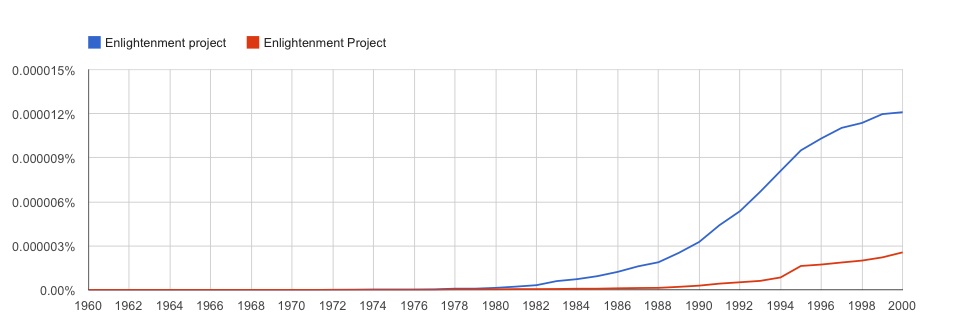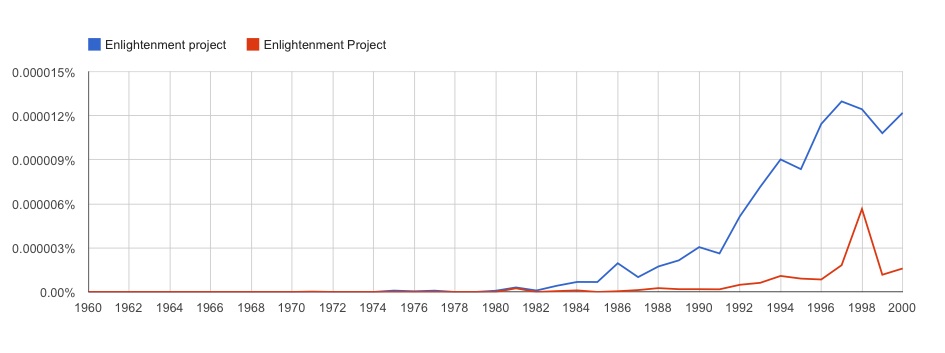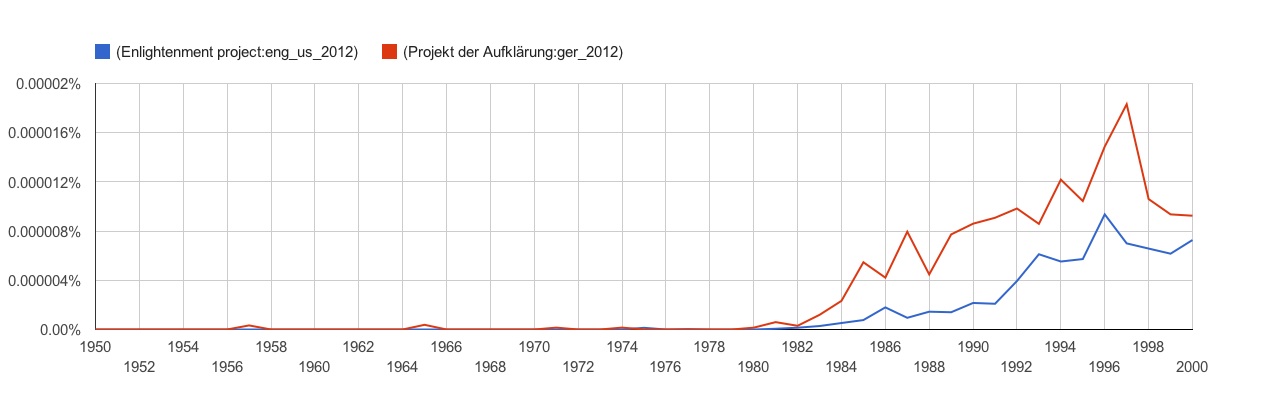
Whose Buttock? Which Enlightenment? – Thoughts on Anthony Pagden’s The Enlightenment and Why it Still Matters

PagdenAnthony Pagden’s The Enlightenment and Why It Still Matters (New York: Random House, 2013) is perhaps the most ambitious account of the period published by a major commercial press since Peter Gay’s two-volume survey from the 1960s. Like Gay, Pagden’s aim is to demonstrate the ways in which the Enlightenment made Europeans modern. And, in keeping with the current emphasis on global history, Pagden shows how Europeans became modern by learning what it was that they shared with the rest of the world. As a result, his book devotes considerably more attention than Gay did to the role of modern natural law theories in the development of the Enlightenment and features a fine discussion of the ways in which the attempt to articulate the “science of man” implied by these theories was informed by and tested against the strange peoples and stranger customs that voyagers across the Pacific encountered. And where Gay’s account culminated in an examination of the ways in which the Enlightenment inspired the creation of a republican government on the North American continent, Pagden traces the legacy of the Enlightenment down to the present, arguing that

although the central Enlightenment belief in a common humanity, the awareness of belonging to some world larger than the community, family, parish, or patria, may still be shakily primitive and incomplete, it is also indubitably a great deal more present in all our lives — whoever “we” might be — than it was even fifty years ago. “Global governance,” “Constitutional Patriotism,” globalization, multiculturalism are not only topics of debate; they are also, in many parts of the world, realities. Cosmopolitanism, expressed as a firm belief in the possibility of a truly international system of laws, has been the animating principle behind both the League of Nations and the United Nations and is the main assumption that underlies the Universal Declaration of Human Rights (413).

We are, he concludes,

inescapably, the heirs of the architects of the Enlightenment ‘science of man.'” For this, then, if for no other reason, the Enlightenment still matters (415).

In the face such an ambitious, informed, and energetic account of the Enlightenment it is perhaps pedantic to note that the book has a minor problem: it misplaces a buttock.1

On the Displaced Buttock

Recounting the sufferings inflicted on the protagonists of Voltaire’s Candide, Pagden observes,

Pangloss, his face half eaten away by syphilis, one buttock cut off, insists that, all appearances to the contrary, this world is nonetheless the ‘best of all possible worlds’ … (114).

He’s is right about Doctor Pangloss’s unflagging optimism and unrelenting syphilis. The lessons in “experimental physics” performed on the “very pretty and very pliable” servant girl by Pangloss’s “sufficient reason” (and let us pause here to ask: has anyone other than Voltaire ever used a philosophical concept as a euphemism for the male member?) result CandideOrientalismin his contracting a disease whose genealogy he traces and necessity he demonstrates. But Pagden is mistaken about the fate of Pangloss’s buttocks: at the end of the book, he still has both of them. On the other hand, the Old Lady had one of hers removed (and eaten) by besieged (and starving) Janissaries.
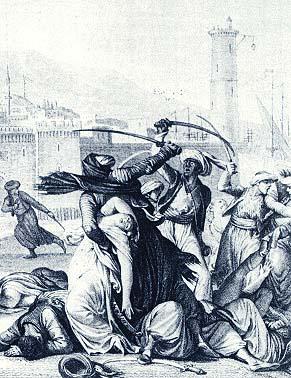
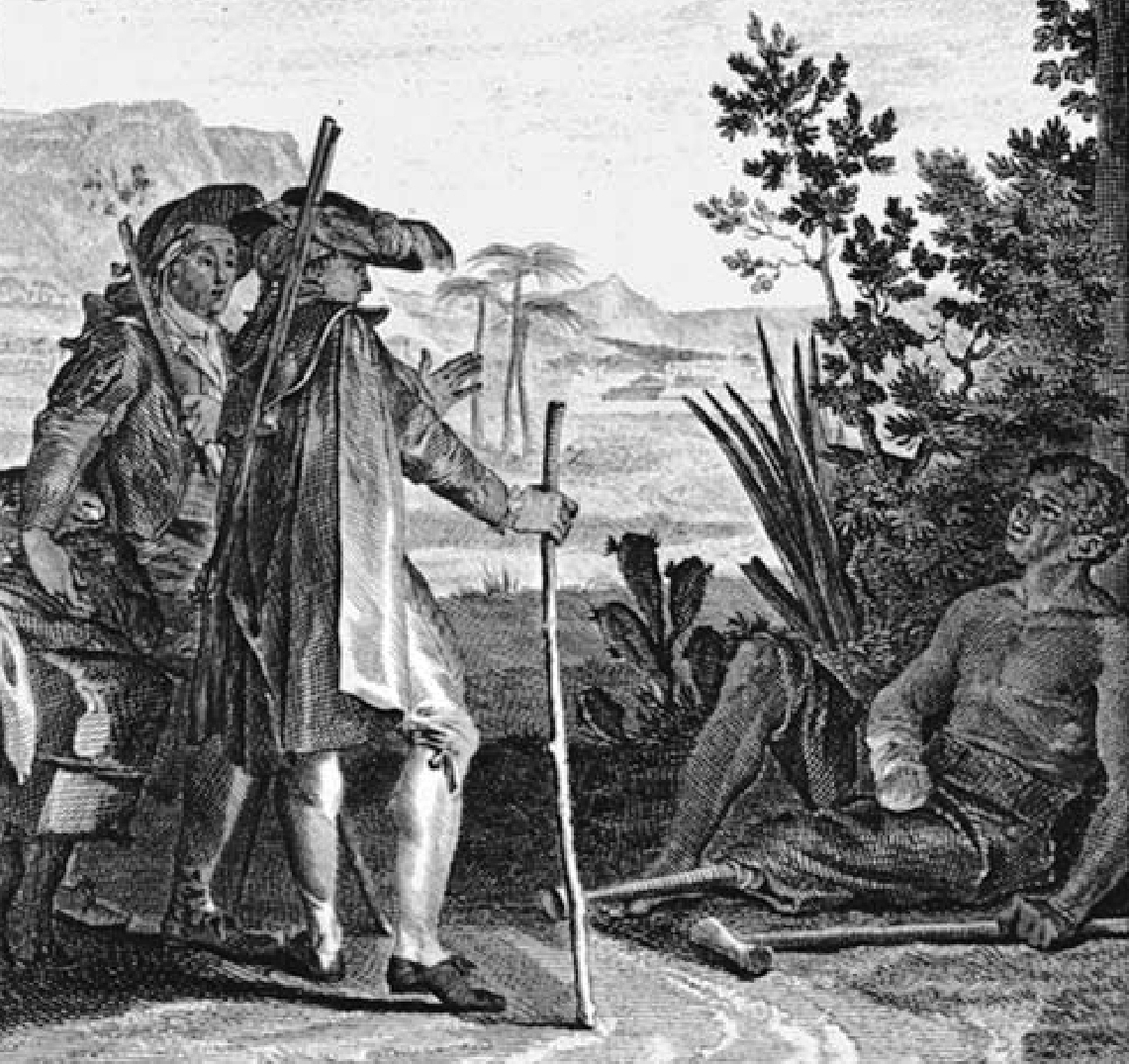
Given all that is going on in Candide, it is understandable that Pagden might lose track of a buttock. Catastrophes pile upon catastrophes and, in the larger scheme of things, the Old Lady’s loss, though obviously important to her, seems but a trifle. Things like this happen with appalling frequency in Candide: the slave that Candide and Cacambo meet in Surinam has lost both his left leg and his right hand (such, after all, is the price of sugar) and Cunégonde is gang-raped and disemboweled (though, somehow, not fatally) by Bulgar troops. The sufferings Candide witnesses would be unbearable were it not for the madcap rapidity with which Voltaire recounts them. The book reads like an attempt to imagine how the world might appear to an Angel of History wasted on amphetamines.
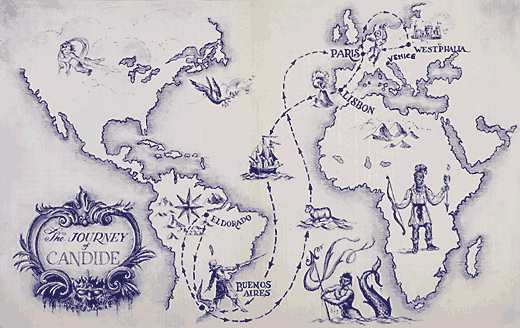
CandideJourney-1dappv1Like Candide, Pagden has a lot of ground to cover and, even though he has 400 pages to cover it, he needs to move rather quickly. Things are not made any easier by his having taken on the additional burden of not only providing an account of the Enlightenment, but explaining “why it still matters.” In that regard, Gay had it easier: Knopf gave him two volumes to explain what the Enlightenment was and, having completed that task, he went on to explore why it mattered in The Bridge of Criticism (a book that has remained out of print for far too long: reprint, please!). Gay also had the advantage of writing at a time when the field of eighteenth-century studies was, at least in retrospect, still in its infancy. We know a lot more about the Enlightenment now than we did in 1969, which makes Pagden’s achievement all the more impressive.

Why it Might Not be Such a Good Thing that the Enlightenment Still Matters

Gay began his first volume by (1) noting that the Enlightenment had no shortage of critics, (2) confessing that he’d enjoyed the “polemics” in which he’d been engaged while defending it from its conservative critics, and (3) suggesting that it was time “to move from polemics to synthesis.” Fat chance: when it comes to the Enlightenment, it’s always Ground Hog’s Day and every historian is Bill Murray. There would seem to be a fair number of people (not all of them on the Right) who are quite convinced that the Enlightenment surely does matter. Unfortunately, some of them have only the faintest understanding of what it actually involved.

For example, about a week after The Enlightenment and Why it Still Matters appeared, Penny Nance, the President and CEO of the conservative Christian organization “Concerned Women for America” turned up on the Fox News channel and (as I discussed in an earlier post) informed the Foxites that

the Age of Enlightenment and Reason gave way to moral relativism. And moral relativism is what led us all the way down the dark path to the Holocaust… Dark periods of history is what we arrive at when we leave God out of the equation.

Now, Penny Nance obviously knows considerably less about the Enlightenment than Pagden does, but she seems to be convinced that it still “matters.” She sees herself (or, at the very least, does a good job of making it appear as if she sees herself) as confronting a world that has been laid waste by an Enlightenment that, persistently and relentlessly, keeps on mattering. There is, then, one tiny point on which Nance and Pagden might agree: after some two and a half centuries, the Enlightenment still matters.

And there would seem to have a further point of agreement. Pagden’s aim is to trace how a set of ideas, born in the latter part of the seventeenth century, went on to transform

the most significant, most lasting insights available to the western philosophical tradition in such a way as to make them usable in a world from which God had been finally and irrevocably removed ….

In doing so, the Enlightenment “created the modern world”: it is “impossible to imagine any aspect of contemporary life in the West without it” (408). What Pagden sees the Enlightenment as having achieved is the very same thing that enables Nance to serve as President and CEO of a (tax-exempt?) organization devoted to undoing what the Enlightenment was allegedly trying to do: namely, creating a world in which God is no longer part of “the equation.” Their disagreement lies with whether the Enlightenment’s continuing to matter is a good thing. My reservations have to do with whether this “still mattering” business is a good thing — it might be nice if those of us who work on the Enlightenment could live the sort of quiet life lived by my colleagues in Classics, who study things that, while certainly interesting, are unlikely to turn up on Fox News.

While Nance is convinced that the Enlightenment was bent on removing God from “the equation,” there has been a fair amount of recent scholarship stressing the need to get Him back into the Enlightenment: consider, for example, the fine work that has been done by David Sorkin, Johathan Sheehan, Peter Harrison, Michael Printy, and others.2 Pagden is too good a historian to be unaware of the persistence of various forms of religious belief — many of them interesting, most of them utterly irrelevant for the present 3— during the Enlightenment or of the significant role of clergy, especially in Protestant Europe, in the circulation of enlightened ideas (it is, for example, perhaps significant that clergymen were well represented in the Mittwochsgesellschaft, the Berlin society of “Friends of Enlightenment” responsible for publishing the Berlinische Monatsschrift, an “enlightened” journal that periodically included sermons in its offerings). But The Enlightenment and Why it Still Matters tends to marginalize such matters.

Pagden notes that Hobbes insisted he was not an atheist, but then goes on to assure the reader that he “most probably was” (97).4 He grants that were few thinkers “who were 205px-Granville_Sharp_(Hoare_memoire)prepared to contemplate Smith’s ‘fatherless world’ entirely without flinching” (125), but he doesn’t have much to say about the flinchers: the Enlightenment whose history he is tracing does appear to involve them. In a discussion of Granville Sharp, the great opponent of the slave trade, he notes that “For all his devout Christianity, Sharp was as sincere a believer in equal rights for men and women as he was in equality between the races …” (228), thus implying that religious faith was an impediment to a belief in human rights. Likewise, we are told that “the Spanish Benedictine Benito Jerónimo Feijoo, who despite his profession and undoubted faith was in this respects (sic), as in many others, one of the most “enlightened” minds of the early eighteenth century … (265),” which suggests that Pagden assumes that, during the eighteenth century, faith and enlightenment were necessarily antithetical (and also suggests that Random House really needs to hire a few more proofreaders). Not the least of the problems with people like Penny Nance is that they have the capacity to make it seem as if Jonathan Israel’s “Radical Enlightenment” was the only Enlightenment that mattered.

Pagden contra MacIntyre

The prevalence of opinions of the sort that Nance was peddling on Fox helps to explain 178px-Alasdair_MacIntyrewhy Pagden found it necessary to begin his book with a brief discussion of critics of “the Enlightenment project” (16-20) and end it with a chapter on “Enlightenment and its Enemies” (373-415). Fortunately, he has abler critics than Nance with whom to argue: Alasdair MacIntyre plays a leading role in both discussions. Unfortunately, Pagden tends to minimize the differences between MacIntyre (who has some important points to make) and Jean-François Lyotard (who, as far as I can tell, doesn’t).

Pagden credits MacIntyre with having coined the “much-quoted and much abused phrase ‘the Enlightenment project'” (16) — as I’ve suggested in an earlier post, it’s not clear that this is true — and MacIntyre’s “extreme” and “historically eccentric” account of the Enlightenment (397) serves as the perfect foil for Pagden’s closing defense of his particular version of the Enlightenment. For Pagden, the great achievement of the Enlightenment was that it “made it possible for us to think … beyond the narrow worlds into which we are born, to think globally” (408). MacIntyre’s characterization of human beings as homo fabulans — creatures who tell stories — and his argument that our moral sensibilities are “essentially narrative ones” make him seem the very model of the modern counter-Enlightener.

Because the “moral sensibilities” of MacIntyre’s homo fabulans are “essentially narrative ones,”

the stories he tells are not about “humanity” or the cosmos, because although both may, in some sense, be said to have stories, none of them are very pertinent or compelling ones (398).

In other words, if MacIntyre is right, then stories we tell will deal with matters that are local, rather than global (398). Locked into these local narratives, we will be incapable of cultivating those cosmopolitan perspectives that allow us to understand other societies.

For in a world conceived in the way MacIntyre, and many other communitarians, conceive it, justice cannot possibly be “global,” because justice, too, can only ever be a matter of agreement among the members of the tribe, community, nation, and so on to which it applies. MacIntyre’s conception of humans as storytelling animals, and of human social lives as structured by narratives, is also the source of Jean-Francois Lyotard’s critique of what he calls the “cosmopolitical” (400).

With this peculiar coupling of MacIntyre and Lyotard, I fear that The Enlightenment and Why it Still Matters jumps the shark. In rapid succession we are told that the line of argument that Lyotard takes over from MacIntyre means that

When confronted with child marriage, slavery, castration, all I can do is stand aside and say, “I have no language with which I can describe, let alone judge, such behavior.” (401)

Which means that:

The true communitarian cannot, therefore, adequately explain how slavery, forced marriages, bearbaiting, or public executions ever came to be considered distasteful (402).

It is possible that Lyotard believes this sort of stuff, but MacIntyre doesn’t.

At the risk of picking nits, it is worth remembering that, though MacIntyre bears some (though, as I’ve suggested, not all) of the credit or blame for popularizing the term “Enlightenment project,” his concern in After Virtue was with one rather specific Enlightenment project. Chapter 5 of After Virtue is entitled”Why the Enlightenment Project of Justifying Morality Had to Fail.” Every subsequent right header in the chapter carries the title “Why the Enlightenment Project Had to Fail.” Nitpickers like me think this is a difference worth emphasizing. After Virtue is not suggesting that the Enlightenment somehow eradicated our ability to praise or to damn various practices. From the very start, MacIntyre makes it clear that we continue to employ moral terms. But we are, he insists, incapable of justifying the ways in which we use these terms. He argues that the alleged failure of the Enlightenment to provide a convincing justification of the moral distinctions that we continue to employ explains why our use of moral terms resembles the description of moral evaluation that emotivists provide. In hopes of providing a better account of how we might justify our use of value terms, he proposes that we go back to Aristotle and see how moral philosophy was once situated in a more ambitious account of virtues and practices.

There may be much that is problematic here and MacIntyre has been quite forthright in responding to his critics and in attempting to elaborate, in a variety of ways, the implications of his critique of the various projects that defined the Enlightenment.5 There is much here that friends of the Enlightenment may want to question (including, perhaps, the idea that “the Enlightenment” is the sort of thing that is amenable to “justification”). But nothing in what MacIntyre argues implies that he is incapable of explaining how slavery came to be seen as “distasteful,” much less that our “local narratives” are somehow unable to talk about “global” concerns. To conclude that, one would have to think that our languages are prison houses or windowless monads. Perhaps Jean-François Lyotard thinks they are.  MacIntyre doesn’t.

Back to the Buttock

In the introduction to his translation of Candide, David Wootton offers a brilliant discussion of the significance of the Old Lady in Voltaire’s tale.6 He argues that it is the story of her sufferings, which she recounts as Candide and his friends begin their voyage to the New World, that begins to free Candide from Pangloss’s incessant optimism and TitlePagetempers his beloved Cunégonde’s despair. As the characters begin to tell their stories, Voltaire’s sendup of “every tired convention of contemporary romances” is transformed into “a book about the educative and therapeutic power of storytelling.” The lesson of Candide, Wootton argues, is that most of the ways that we “talk about metaphysics, even about politics, is … worthless.” Pangloss exemplifies an enlightenment that, having managed to explain everything, winds up teaching us nothing. But in writing Candide, Voltaire discovered another way to talk about politics: he would learn “to tell stories of personal disaster,” stories “which inspired sympathy and indignation.”

Several years ago, I persuaded those who administer my university’s Core Curriculum to include Candide in the section of the humanities sequence that (briefly) considers the Enlightenment. After the book was added, a somewhat puzzled colleague who teaches in the Core asked me, “Is Candide an “Enlightenment” text?” Sensing that I was in for a strange conversation, I responded “Yes.”  He looked puzzled and then muttered, “It sure doesn’t seem like one.” All I could say was, “Well, I suppose a lot depends on what you mean by “enlightenment.”7

The sort of enlightenment in which Voltaire was engaged is rather different from the Enlightenment that Pagden presents. Pagden maintains that the cosmopolitan values that “most educated people, at least in the West, broadly accept” (407) are the result of a search for “a scientifically grounded set of premises for a universal law” on which “all reasonable, rational human beings could agree, no matter what their religious beliefs or national allegiances” (340). In this story, Samuel Pufendorf, Christian Wolff, Emer de Vattel, and Immanuel Kant take the lead. Voltaire figures in it as well, but mostly for his battles against religious dogma than for his 1770 tract On Perpetual Peace, which — in contrast to Kant’s more famous treatise on the topic — was concerned with religious toleration rather than cosmopolitan rights.

For Pagden’s critique of MacIntyre to work it is not enough to trace the ways in which the ideas of the various natural law theorists who loom so large in his account came to be appropriated by “an international intellectual elite, much like the kind constituted by the higher echelons of the academic world today” (323).8 MacIntyre is well aware that cosmopolitan elites — both in the eighteenth and the twentieth centuries — make use of a vocabulary in which “cosmopolitan rights” play a prominent role. His concern with such expressions is philosophical, not historical. His question is not whether these concepts have won out over their rivals but, instead, whether they deserved to win: that is, whether the heirs of Pufendorf, Wolff, Vattel, and Kant have been any more successful in providing compelling ways of justifying these rights than their eighteenth-century predecessors (who, it should be noted, tried to do this a number of conflicting ways).

My interest, on the other hand, is more historical than philosophical. It’s not at all clear to me that approaches like the one that Voltaire was taking in Candide (a phenomenally successful little book) were of less importance in making the modern world less brutal than it might have been than the approach taken by the spinners of those grand cosmopolitan narratives. After all, Pangloss was nothing if not cosmopolitan:  he was a disciple of Leibniz and Wolff.

Voltaire, as Wootton stresses, tended to focus on particular abuses — for example, his struggle to clear the name of the persecuted Huguenot Jean Calas and his long campaign against judicial torture. When compared to an “Enlightenment project” that marches from Pufendorf through Kant and onward to the Universal Declaration of Human Rights and the European Union, this obsession with specific outrages may, like the Old Lady’s concern for her missing buttock, seem rather parochial. But what MacIntyre and some of the other alleged “enemies of the Enlightenment” are suggesting is that explaining why various evils are, indeed, evil by deducing them from “a scientifically grounded set” of cosmopolitan principles may not be the only — or even the most effective — way of coming to see them as wrong.

Let’s close with this: In the Second Treatise, John Locke marshaled the standard natural law arguments against slavery, yet continued to serve the slave-holding Candide19proprietors of the Colony of Carolina.9 And, as Pagden is well aware, the author of The Interesting Narrative of the Life of Olaudah Equiano, or Gustavus Vassa, the African (1789) — though not particularly well-versed in natural law theories (and, even more inconveniently, an enthusiastic Methodist) — proved to be a uniquely effective opponent of slave trade. Friends of the Enlightenment are lucky to have enemies like MacIntyre: they help us to understand the diversity of enlightenments that have mattered.
On the other hand, I could easily do without Penny Nance.

  1. There is also an odd collision on p. 376 between the names of Johann Heinrich Tieftrunk (Kant’s disciple) and Arthur Hirsh (who translated Tieftrunk’s essay for my What is Enlightenment? collection) that results in the creation of a pupil of Kant’s named “Johann Heinrich Hirsch.”
  2. David Sorkin. The Religious Enlightenment : Protestants, Jews, and Catholics from London to Vienna. Princeton: Princeton University Press, 2008, Jonathan Sheehan. The Enlightenment Bible : Translation, Scholarship, Culture. Princeton, NJ: Princeton University Press, 2005, Peter Harrison. “Religion” and the Religions in the English Enlightenment. Cambridge England ; New York: Cambridge University Press, 1990, and Michael Printy, Enlightenment and the Creation of German Catholicism. Cambridge: Cambridge University Press, 2011.
  3. Time for my favorite story about Deists, which I posted to the 18th Century Discussion list back in August 2001 (i.e., a month before the World as We Know It was — temporarily? — suspended):One of the more peculiar road-side attractions in New England is the Traveler Book Restaurant, just over the Connecticut line from the Mass Turnpike in Union, Connecticut.  The first floor of the restaurant looks like it might have escaped from Twin Peaks (notty pine on the walls and lots of good pies in the kitchen).  Downstairs in the basement there’s a used book store, usually staffed by charming older women, who carefully hand-total every order and keep watch on the inventory.  …The book theme is carried over into the restaurant in two ways:  1) everyone who eats there gets to pick a free book from some special stacks in the entryway (I scooped up a copy of The Leopard) and 2) the walls are plastered with little shrines to authors (Steven King, Jackie Collins, Judy Blum, etc.) that, for reasons that aren’t entirely clear, the restaurant has decided to honor with a picture, a bibliographical note, a bibliography, and — usually — a letter to the restaurant from the author.After a long drive from the Philadelphia area, I found myself seated underneath Doctor Seuss while, on the opposite side of the table, my son was under the shrine to John Toland.  “Who’s John Toland?” he asked, and I explained that there were two of them:  the great Deist and the twentieth-century historian of Germany.  From the biography and the letter, it was clear that it was the latter who was being honored, but my son noted a problem in the bibliography:  the historian  Toland was being credited, not only with a biography of Hitler and various books on Germany, but with “Christianity Not Mysterious,” “Letters to Serena,” “Pantheisticon,” and so forth.  So, at the end of the meal, as the pies were being cleared away and the waitress asked how everything was, I explained that while the meal was fine, there were problems with John Toland’s bibliography.  She listened attentively as I explained their confusion of the two Tolands (probably more attentively than I deserved — driving too much for too long can make one rave a bit) and then she commented, “It’s amazing no one caught this before.” This allowed me to deliver a line that, as it escaped my mouth, struck me as something that one could spend a life-time waiting to get the chance to say:  “Well, I guess you don’t get many Deists in these parts.”
  4. For a good attempt to sort out Hobbes’ religious beliefs, see Richard Tuck,  “The Christian Atheism of Thomas Hobbes.” In Atheism from the Reformation to the Enlightenment, edited by Michael Hunter and David Wootton. Oxford University Press, 1992.
  5. The attempt that is most relevant for my own work is his 1995 essay, “Some Enlightenment Projects Reconsidered,” now available his Selected Essays, Volume 2, 172-185. in
  6. Voltaire, Candide and Related Texts translated, with an Introduction, by David Wootton (Indianapolis: Hackett Publishing, 2000) xx-xxiii.
  7. The nice thing about talking with colleagues is that I didn’t have to worry about whether to capitalize “Enlightenment”; I hear that Jacques Derrida wrote something about this.
  8. I’ve pondered whether it is fair to quote this passage, which I suspect is something that, viewed out of context, comes off as a bit smug. For reasons I can’t entirely explain, the sort of cosmopolitanism Pagden winds up defending strikes me as somewhat off-putting. Perhaps I’ve been corrupted by MacIntyre. Or maybe it’s that I always fly in coach.
  9. David Armitage, “John Locke, Carolina, and the ‘Two Treatises of Government’.” Political Theory 32:5 (2004): 602–627.
Posted in Uncategorized | Tagged , , , , , | Leave a comment

Making Sense of “Aufklärung” – Translating Kant, Part III

I began this series of posts more or less as a lark, thinking that I’d look at how my fellow translators of Kant’s response to the question “What is enlightenment?” handled the opening sentence. But this exercise turned out to be both less interesting and more interesting than I’d thought. The differences between the eight twentieth-century translations that I located are relatively minor: while there are bones to be picked about how this or that translator dealt with one or another of the words, I’m not sure this really amounts to much (except, possibly, the disagreements on what to do with the word Ausgang). What was considerably more interesting, at least for me, were the three earliest translations, which differ quite markedly.

Here, once again, are the first three translations of Kant’s opening sentence on my list:

  1. Enlightening is man’s emergence from his self-imposed nonage. John Richardson, in Kant, Essays and Treatises on Moral, Political, Religious, and Various Philosophical Subjects (London: William Richardson: 1798-99)
  2. A man is enlightened when he emerges from a state of self-imposed pupilage. Sarah Austin, Fragments from German Prose Writers (New York: Appleton, 1841)
  3. “Free Thought,” says Kant, “is the advance of man beyond the state of voluntary immaturity.” Otto Pfleiderer, The Development of Theology in Germany Since Kant translated under the author’s supervision by J. Frederick Smith (London: MacMillan & Co. 1890)

It seems to me that the differences here are of greater import than the variations in the later translations and also help fill in some of the gaps in my earlier research on Anglophone struggles to figure out just what it was that the Germans meant by “Aufklärung.”

For twentieth-century translators, it is obvious that “Aufklärung” should be translated as “enlightenment”  — indeed, at this point, it is difficult to think that it could be translated any other way. And there is also an almost irresistible tendency to assume that Kant’s answer can be read as an attempt to define the features of the historical period that we call “the Enlightenment.” This explains why Kant’s essay is almost always cited, if only in passing, at the start of almost every general account of the Enlightenment. What has tended, at least until relatively recently, to receive less attention are the circumstances of Kant’s writing the essay and what lessons might be drawn from them.1 The most important point to make about that context was that the essay was written as part of an attempt to clarify the features of a set of activities whose general character was far from obvious, both to the those whose asked and to those who answered the question “What is enlightenment?” In brief: this was an attempt to clarify a process, rather than define a period.

For much of the nineteenth century, translators were less than clear what the term Aufklärung designated. Richardson, working at a time when it was possible to find occasional essays still trying to explain what Aufklärung involved (the discussion dragged on into the early nineteenth century), correctly assumed that Kant used the word to refer to a process in which one was engaged: “enlightening” (i.e., clearing things up). But, by the middle of the century, Austin turned it into a condition that someone might attain (“A man is enlightened when …”) and, in the footnote I discussed in a previous post, suggested an alternative title for the essay that dispensed with the “very awkward word” Aufklärung altogether: “A plea for the liberty of philosophizing.” Finally, towards the close of the century, J. Frederick Smith decided that Aufklärung was a “terminus technicus that might best be rendered by pressing an English term from the early eighteenth century into service: “Free Thought.”

Two decades later, the following discussion of Kant’s essay appeared in Edward Caldwell Moore’s Outline of the History of Christian Thought Since Kant (London: Duckworth, 1912):

In 1784 Kant wrote a tractate entitled, Was ist Aufklärung? He said: “Aufklärung is the advance of man beyond the stage of voluntary immaturity” (25).

Moore was not unique in opting not to attempt a translation of Aufklärung at all: during the latter half of the nineteenth century this practice had the enthusiastic support of James Hutchinson Sterling, the author of the The Secret of Hegel and the subject of a number of previous posts on this blog. As I’ve discussed elsewhere, he insisted that Aufklärung was one of those German terms that was best left untranslated since it referred to something for which there was no precise English equivalent.

In the face of the Kant translations done by Richardson and Austin, Stirling’s claim seems quite peculiar, but it appears to have enjoyed some support among English translators of Hegel’s works. It is not until Baillie’s 1910 translation of the Phenomenology that “enlightenment” appeared as a translation for Aufklärung in a translation of one of Hegel’s works and the practice in translations of German histories of philosophy was to use such terms as “the Illumination” (and, in a few cases, the “Uplighting”) or simply to leave it untranslated.

What, then, explains why Richardson’s perfectly serviceable translation of Aufklärung (or, for that matter, Austin’s somewhat more problematic one) was ignored by these later translators? It’s possible that later translators were simply unaware of the Richardson and Austin translations. But the explanation may also rest with their assuming —  correctly, I think — that the term Aufklärung carried a different set of connotations in the works they were translating than it did in the text from Kant. As employed in Hegel’s lectures on the history of philosophy (and on the philosophy of history) and in those German histories of philosophy that he inspired, Aufklärung was used to refer to an historical period that was now complete, rather than a process in which one might still be engaged (as was the case for Richardson) or a state that one might attain (as it was for Austin). It also mattered that was already an English word for this period: “the Illumination.” Some translators used it; others were put off by its political connotations.

Perhaps the most peculiar strategy for dealing with Aufklärung was the one adopted by John Sibree in his 1857 translation of Hegel’s Lectures on the History of Philosophy. Opting to translate a German word with a French one, he explained,

There is no current term in English denoting that great intellectual movement which dates from the first quarter of the eighteenth century, and which, if not the chief cause, was certainly the guiding genius of the French Revolution. The word “Illuminati” (signifying the members of an imaginary confederacy for propagating the open secret of the day), might suggest “Illumination,” as an equivalent for the German “Aufklärung”: but the French “Éclaircissement” conveys a more specific idea.

As I’ve argued elsewhere, Sibree is a bit disingenuous. There was a “current English term” available, but he was reluctant (for the reason that he noted) to use it: “Illumination.” That he might want to avoid linking Hegel with those who embraced the idea that the French Revolution was the product of a conspiracy of Philosophes, Freemasons, and Illuminati, was understandable.  But his choice of Éclaircissement as an alternative baffled me until I tried comparing it to the other options.

An Ngram of the words Aufklärung, the Illumination, the Enlightenment, and Éclaircissement looks like this:

FourTermsThere are quite a few problems here. First (as usual) we are dealing with very few occurrences, so the fluctuations here likely amount to very little. Second, the samples that I looked at suggested that results for “the Illumination” may be distorted by such usages as “the Illumination of the Earth by the Sun.” Since the same may be true for “the Enlightenment” (e.g., “the Enlightenment of the native peoples”), I decided to try again, but subtract those phrases that continue with “of” from my searches for “the Illumination” and “the Enlightenment”. That produced a rather different looking Ngram (the usual caveat applies: small changes in small numbers of cases produce large changes):

FourTermsModified

These adjustments wipe out many of the occurrences of both “the Illumination” and “the Enlightenment,” but they do suggest that, during the 1880s, “the Enlightenment” begins to be used (admittedly, rarely) as a way of referring to an historical period (it is necessary to extend the Ngram into the first decades of the twentieth century to catch the big rise that occurs with the publication of Hibben’s The Philosophy of the Enlightenment. Equally striking is the relative frequency of Éclaircissement vis a vis the other alternatives at the time of Sibree’s translation.

Hence, Éclaircissement‘s appeal for Sibree may have been two-fold. In addition to its freedom from the political connotations of “the Illumination,” it was a term that did much the same work as Aufklärung, but without forcing him into the clumsiness of employing a circumlocution like “the clearing up.” The fact that English readers had a certain familiarity with the term, thanks to its appearance in a number of fictional works in the early part of the century, also argued in its favor. But it is not a term that would have ever occurred to a translator of Kant’s essay. Kant, after all, was talking about something — be it a process, an accomplishment, or an historical period — that had at least some presence in Prussia. But, since the discussion of Aufklärung in Hegel’s Philosophy of History focused on France and on the role of Éclaircissement in the years before the French Revolution, Sibree might have reasoned that it was the best of a bad lot of choices.

This left translators and commentators on Kant’s essay (especially those who adopted Hegel’s general view of the concept) a bit unclear as to what to do with Aufklärung. But by the opening decade of the twentieth century it was becoming more common to see the Enlightenment as a European, rather than exclusively French, event, an event in which Kant had a role to play. Once that had become clearer, it was possible to see Kant not only as part of “the Enlightenment,” but, indeed, as the author of a text that provided one of the more powerful discussions of what the Enlightenment involved. This may explain why no twentieth-century translator has begun a translation of the opening sentence with anything other than “Enlightenment is ….”

Enough about Aufklärung: in the next installment I’ll look at the marvelously contradictory notion of “selbstverschuldeten Unmündigkeit.

  1. I’ve summarized some of the problems in the way the Kant essay has been used in a 2011 article in the History of European Ideas and Anthony Pagden offers a sensible account of the circumstances surround its origins at the start of his The Enlightenment and Why it Still Matters (2013).
Posted in Uncategorized | Tagged , , , | 6 Comments

Kant for Kids (Notes on a Survivor)

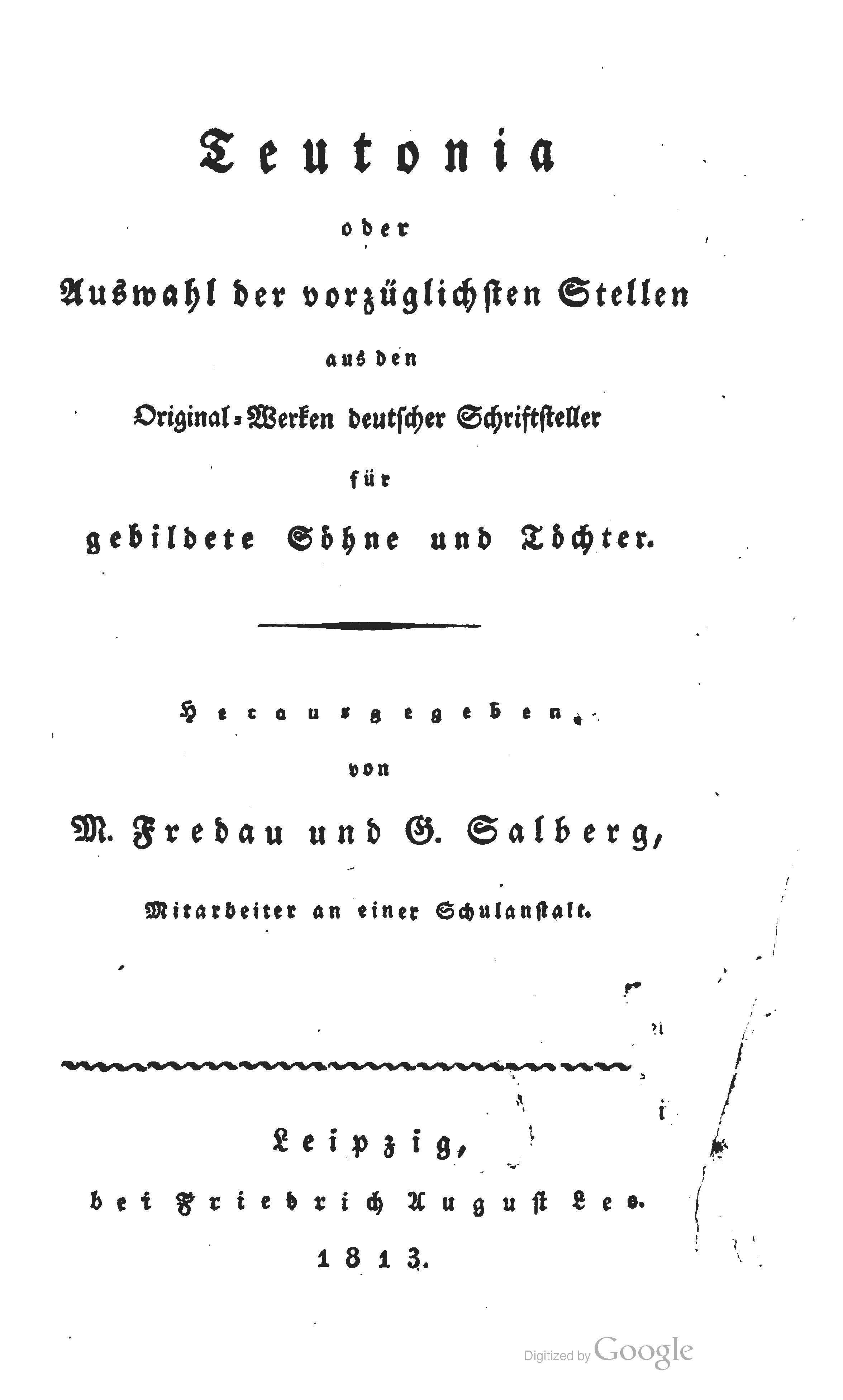
Tracing the reception of Kant’s phrase “selbstverschudeten Unmündigkeit” (“self-incurred immaturity” is the current consensus on how to translate it), I stumbled on one of those things that reminds us about the books, and the worlds, we have lost:Teutonia Title Page

This peculiar book, swept up into Google’s scanners during their sweep through the Bayerische Staatsbibliothek in Munich, is a survivor from a vanished world: a world in which a title like Teutonia could be attached, without irony or aggression, to a book that was edited by two Jewish pedagogues and intended for the education of “German boys and girls” .

Assembled by the rabbi, translator, and writer  Gotthold Salomon (1784-1862) and the teacher and writer Maimon Fraenkel (1788-1848), it consisted, as announced on its title page, of selections of passages from the works of the “most excellent” German writers. The short extracts are organized topically and the table of contents gives a hint of the ambitions of the collection:

  1. God. Providence.
  2. The Knowledge of the World and of Man
  3. The Destiny of Man
  4. Religion
  5. Freedom
  6. Virtue. Vice.
  7. Death. Immortality.
  8. Belief and Hope
  9. Reason and Truth
  10. Nature and Art
  11. Beauty. Taste.
  12. Love. Marriage.
  13. Friendship
  14. Women (Weibliches Geschlecht)
  15. Fortune and Misfortune
  16. Education and Culture
  17. Worldly Wisdom (Lebensweisheit)

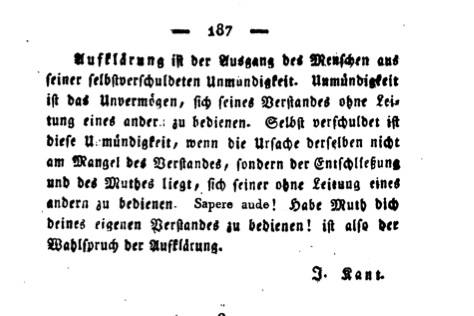
The seventh item in the section dealing with  “Reason and Truth” assembles a few passages from Kant, the last of which consists of the entire first paragraph of Kant’s essay on the question “What is enlightenment?”

Teutonia

Here, then, is one of the places where boys and girls from Jewish families, immersing themselves in what their families regarded as the culture to which they belonged, would have encountered Kant’s words.

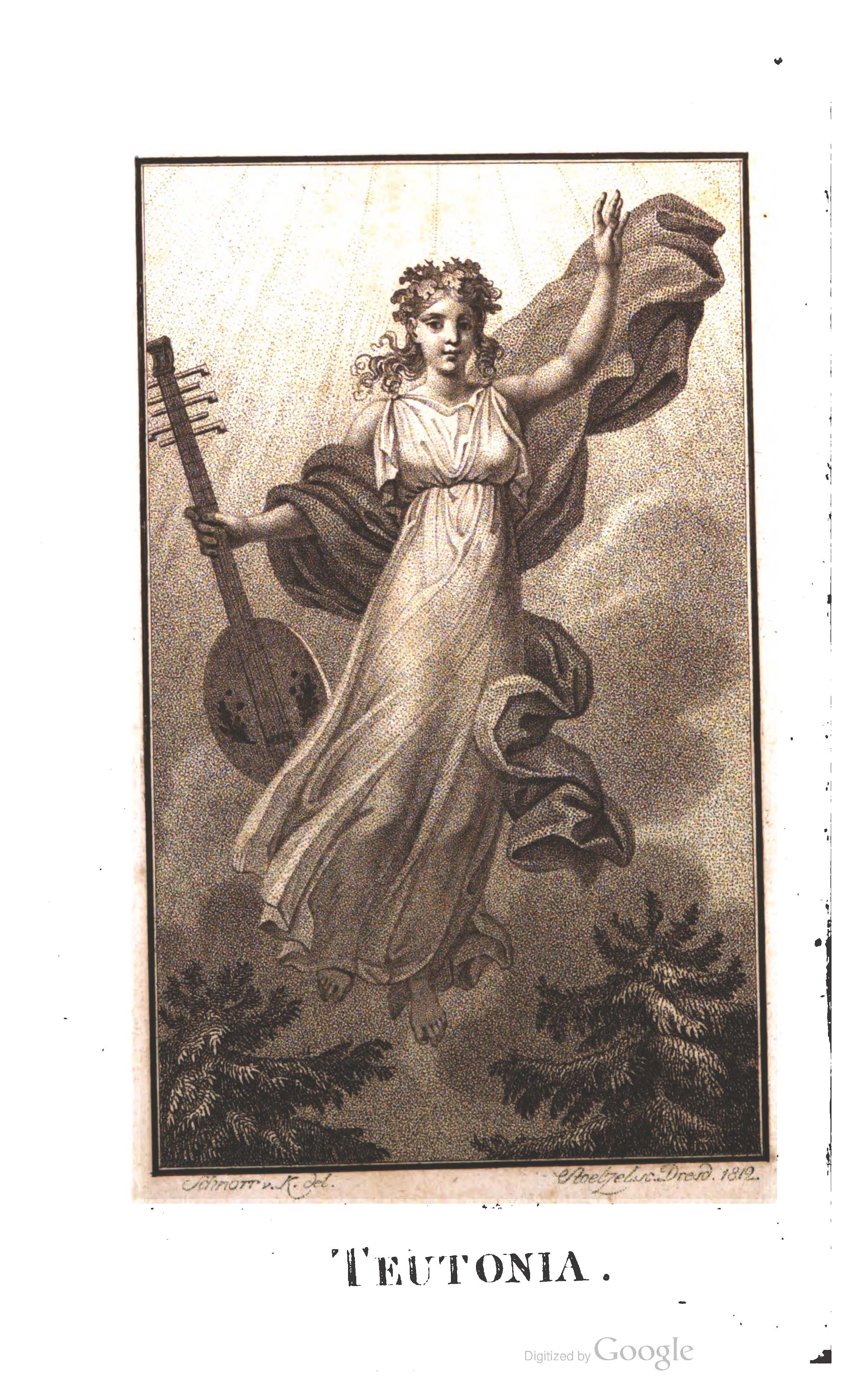
It’s hard to look at things like this without thinking about all that was to follow. It’s also hard to look at the frontispiece of the collection without thinking about what history does to relics like this.

Teutonia Front

Adorno famously wrote that Mahler turned “cliché” into “event.” Looking at this frontispiece I couldn’t help thinking about the way in which history turns kitsch into monuments.

Posted in Uncategorized | Tagged | 1 Comment

Translating Kant on Enlightenment: Two Nineteenth-Century Translations

As sketched last week, my plan had been to consider nine different translations of Kant’s essay on the question “What is Enlightenment?” and see how the translation of the crucial terms in essay’s opening sentence changed over the last two centuries. There was, however, a rather large gap between the first translation on my list (John Richardon, 1798-1799) and the second (Carl Friedrich, 1949). Since this gap spans the period that interests me the most, it occurred to me that I should try to fill it by looking beyond complete translations of Kant’s essay and seeing how the first sentence was translated when it was quoted in books written between 1800 and 1949.

This would simple enough to do: assuming that anyone who goes to the trouble of quoting the opening sentence of Kant’s essay will probably, at some point in their discussion, also quote Horace’s motto Sapere Aude!, I figured it would be enough to go to Google Books and search for books appearing during this period that contained the phrase “sapere aude” along with the word “Kant.” The results were not quite what I expected:  there turned out to be fewer works quoting Kant’s essay than suspected. This might be (1) testimony to the relative neglect of Kant’s essay during the nineteenth century or (2) the result of failings in my search strategy (e.g., people cited the opening sentence but typically didn’t cite the Horace quote) or (3) simply an artifact of peculiarities in Google’s scanning or metadata. But, on a happier note, I did turn up a translation of Kant’s essay that I’d forgotten about, along with one summary of the opening paragraph that is extensive enough to merit its inclusion on my list of translations.

The Revised List

Here, then, is my revised list, which incorporates two new translations (see items 2 and 3) of the first sentence (as before, if you know of any other examples, please let me know). I will discuss other partial translations and summaries in subsequent posts:

  1. Enlightening is man’s emergence from his self-imposed nonage. John Richardson, in Kant, Essays and Treatises on Moral, Political, Religious, and Various Philosophical Subjects (London: William Richardson: 1798-99)
  2. A man is enlightened when he emerges from a state of self-imposed pupilage. Sarah Austin, Fragments from German Prose Writers (New York: Appleton, 1841)
  3. “Free Thought,” says Kant, “is the advance of man beyond the state of voluntary immaturity.” Otto Pfleiderer, The Development of Theology in Germany Since Kant translated under the author’s supervision by J. Frederick Smith (London: MacMillan & Co. 1890)
  4. Enlightenment is man’s leaving his self-caused immaturity. Carl Friedrich, The Philosophy of Kant, (New York: Modern Library, 1949)
  5. Enlightenment is man’s release from his self-incurred tutelage. Lewis White Beck, in Kant, On History (Indianapolis: Bobbs-Merrill, 1963)
  6. Enlightenment is man’s emergence from his self-incurred immaturity. H. B. Nisbet in H. Reiss, Kant’s Political Writings (Cambridge University Press, 1970).
  7. Enlightenment is man’s emergence from his self-imposed immaturity. Ted Humphrey in Kant,Perpetual Peace and Other Essays (Indianapolis, Hackett, 1983)
  8. Enlightenment is our release from our self-imposed dependence. Leo Rauch and Lieselotte Anderson, in Kant, Foundations of Ethics (Millis MA: Agora Publications 1995)
  9. Enlightenment is mankind’s exit from its self-incurred immaturity. Schmidt, in What is Enlightenment? (Berkeley: University of California Press, 1996)
  10. Enlightenment is the human being’s emergence from his state of self-incurred minority. Mary J. Gregor, in Kant, Practical Philosophy, (Cambridge University Press, 1996).
  11. Enlightenment is the human being’s emancipation from its self-incurred immaturity. David Colclasure and Pauline Kleingeld, in Toward Perpetual Peace and Other Writings on Politics, Peace, and History (New Haven, Yale 2006)

So, I suppose we should get acquainted with our two new entries.

Sarah Austin’s Fragments

Somewhere in my earlier research I’d come across Austin’s translation and, indeed, thought that I’d written about it somewhere or other. But a search of my computer turned up nothing, so let me make amends immediately: Austin’s translation is just as significant as Richardson’s and every bit as strange. I’ll have more to say about her rendering of Unmündigkeit as “pupilage” in a later post (it seems to have influenced a few later commentators), but for now it will be enough to talk about the woman herself.

475px-Sarah-austin

Sarah Austin

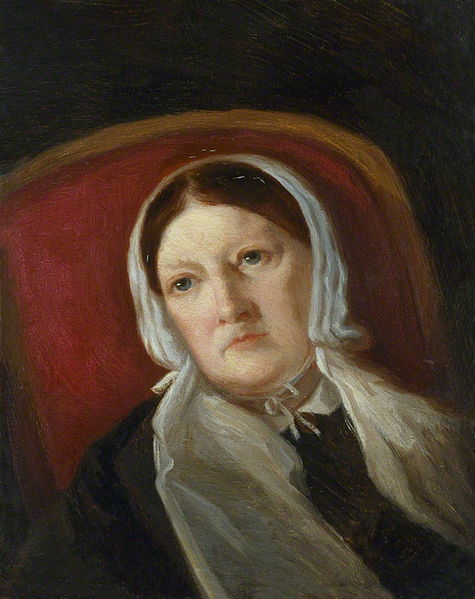
As the Wikipedia (which draws on the entries on her in the Dictionary of National Biography and the 1911 Encyclopedia Britannica article on her) informs us, she was one of the Norwich Taylors (Norwich turns out, as my brilliant colleague Arianne Chernock has shown, to have been a rather lively place, with a significant role in the history of women’s rights). Sarah Austin (1793-1867) was the youngest child of John Taylor, yarn maker, Unitarian, and contributor to the Norwich Cabinet, a radical political journal. She was one of six children and her family was closely connected to such important figures as Henry Crabb Robinson (who played a significant role in acquainting the English with German literature) and the jurist James Mackintosh (the author of Vindiciæ Gallicæ, one of the more important responses to Burke’s Reflections). Sarah seems to have been exceptionally well-educated in languages (she is said to have been “conversant in Latin, French, German and Italian”) and went on to marry the jurist and philosopher John Austin (1790-1859). They settled in Westminster and their circle of friends included John Stuart Mill and Jeremy Bentham.

There is much here that needs to be digested, but for now it may suffice to say that it is possible that Austin’s translation was the most important source for what a number of significant British thinkers knew about German literature in general and Kant’s discussion of the Enlightenment in particular (is there anybody doing any work on her?). It would be good to know more than I do about the publishing history of Richardson’s Kant collection and Austin’s collection of German texts (perhaps a quick visit to WorldCat would tell us something?), but it’s possible that it was hers was the translation of Kant’s essay that was being read for much of the nineteenth century.

J. Frederick Smith’s translation of Pfleiderer’s Development of Theology

The other example that I’ve added to the list is J. Frederick Smith’s translation of Otto Pfleiderer’s Development of Theology in Germany Since Kant (1890), a text that I hadn’t seen before. It might be worth reproducing the entire paragraph where Pfleiderer quotes Kant:

“Free Thought,” says Kant, “is the advance of man beyond the state of voluntary immaturity. By immaturity is meant, inability to use his own understanding except under the guidance of another. The immaturity is voluntary when the cause of it is not want of intelligence, but of resolution and courage to use it without another’s guidance Sapere aude! Dare to use thy own understanding! is therefore the motto of Free Thought.”

What we have here is a translation of the entirety of the opening paragraph of Kant’s article that follows neither of the previous translations and, as should be immediately apparent, has a novel way of translating the word “Aufklärung.”

Here’s what the Rev. James Wood had to say about Pfleiderer in the Nuthall Encyclopedia (1907) — which appears to be the Wikipedia’s source:

a philosophical theologian, born in Würtemberg, professor at Jena, and afterwards at Berlin; has written on religion, the philosophy of it and sundry developments of it, in an able manner, as well as lectured on it in Edinburgh in connection with the Gifford trust, on which occasion he was bold enough to overstep the limits respected by previous lecturers between natural and revealed religion, to the inclusion of the latter within his range.

Beyond this, I know nothing about Pfleiderer, but quite a bit of his work seems to have been translated during the nineteenth century (which probably has something to do with his having given a Gifford lecture), including an 1899 article in the American Journal of Theology. It also discusses the passage from Kant.

At the end of the last century Kant called his age the age of enlightenment, in the sense that men then began to pass from their self-imposed tutelage and resolved to use their own reason: “Sapere aude!” Dare to use your own mind!” This “motto of the age of enlightenment” has come to be the program for all the movements of our century in science, morality, law and politics.1

The translator of the article in the AJT is uncredited, but the handling of Aufklärung as “age of enlightenment” differs markedly from the way it is treated by J. Frederick Smith in his translation of The Development of Theology in Germany Since Kant. Smith had also been the translator of Pfleiderer’s 1885 Hibbert Lectures, so the claim that the translation of his 1890 book was done “under the supervision of” Pfleiderer may be worth taken more seriously than I was inclined to. Google serves up lots of J. Frederick Smiths, not all of them translators and, as far as I can tell, WorldCat doesn’t have a specific field of searching the names of translators (yet more evidence of the scandalous disregard in which the practitioners of this essential and demanding art are held). So, there’s not a lot more to say about him.

Except (if I may steal a trick from Steve Jobs), there’s one more thing.

Footnote Confessions

Both Austin and Smith inserted footnotes at the start of their translations in which they reflect on the peculiarities of the German word Aufklärung. These humble footnotes are, at least for the work that I’m trying to do, priceless: they provide us with the best evidence we have of the problems translators are having in making one language mesh with another. As a rule, good translators avoid doing this: if a translation is running properly, there’s no need to remind the reader of how many compromises are necessary in order to create the illusion that languages go into each other without any friction. From the little I’ve read of her work, Austin strikes me as an accomplished translator (I should stress that I’m not) and Smith, if we are to believe the title page, had that rarest of resources: an author who is willing to help. It’s significant, then, they found it necessary to explain their problems in finding an adequate English translation of Aufklärung.

Let’s work backwards. Here’s what Smith (perhaps aided by Pfleiderer) had to say about Aufklärung:

Any translation of this terminus technicus may mislead. From Kant’s authoritative definition of the thing, it appears that our English “Free-thinking” substantially represents it.

There is much here to ponder but, for now, it may be enough to note three points:

  1. To characterize Aufklärung as a terminus technicus suggests that this is a word that has ceased to be something with which English readers need trouble themselves: it’s not a part of everyday discourse, it’s not something that is in wide usage, it’s not even a controversial term. It’s the argot of a particular craft, in this case, theology.
  2. Thanks to Kant, who has provided the “authoritative definition of the thing,” we are no longer misled by what the term means: there’s an English equivalent available.
  3. The English equivalent is a term that reaches back into the early eighteenth century: “Free-thinking” (thank you, Anthony Collins!).

A half century earlier, Austin was considerably less at ease with what she found herself forced to do:

It is impossible, without greater deviation from the original than I feel myself justified in making, to avoid the use of this very awkward word, which is the exact translation of Aufklärung. A more significant title would be, “A plea for the liberty of philosophizing.”

What for Smith would become a terminus technicus that could easily be translated with an English term coined at the start of the eighteenth century was, for Austin, a “very awkward word.” Why “awkward”? Perhaps because, in her circle, the convention — which James Hutchison Stirling turned into something approaching a conviction — was to leave the German term untranslated? In any case, though the word was awkward, she found a solution.

Richardson began his translation of the sentence: “Enlightening is man’s emergence….” Austin shifted from the active to the passive voice and moved the collective to the singular: “A man is enlightened when ….” At the risk of making too much of her footnote, it seems as if she was not particularly pleased with this solution.  I think she was right to displeased.

For Kant Aufklärung was a process in which individuals were engaged;  in Austin’s translation it would seem that Kant was concerned with describing a state at which individuals have arrived:  that of having attained “enlightenment.”  This may help to explain why she found it necessary to translate Ausgang as “emerges” rather than “departure” or “exit” (her rendering of Unmündigkeit as “pupilage” may follow from this, but I’ll get to that in a subsequent post). Would it be too much to suggest that her handling of the opening sentence — indeed, her choice of how to translate the opening word of the sentence — forces her into a set of moves from which it will be hard for her translation to recover?

Having translated what she took to be an awkward term rather awkwardly, her footnote explained that to do anything else would require liberties with the text that she was unwilling to take. And then she offered a title that does a rather good job of suggesting what Kant was offering: “A plea for the liberty of philosophizing.”  Her footnote partly compensates for what she has done in her translation of the opening sentence and also reminds the reader of an even earlier thinker who was engaged in the same activity in which she takes Kant to have been engaged.  Where Smith sent his readers back to  Collins, Austin sent them back to Spinoza’s Tractatus Theologico-Politicus.

To be continued ….

  1. Otto Pfleiderer, “Religionless Morality,” The American Journal of Theology, Volume 3:2 (1899).
Posted in Uncategorized | Tagged , , | 7 Comments

Wieseltier on the Barricades

As an aspiring curmudgeon (and damn, it takes a lot of effort), I’d like to like Leon Wieseltier’s Brandeis commencement address — I mean, it’s really cranky and curmudgeony.  But there are some things that even a would-be curmudgeon can’t pull off.

I’d have remained blissfully ignorant of the advice that Mr. Wieseltier was giving to the graduates of Brandeis were it not for the fact that an historian whose work I respect had kind things to say about the following lines:

If Proust was a neuroscientist, then you have no urgent need of neuroscience, because you have Proust. If Jane Austen was a game theorist, then you have no reason to defect to game theory, because you have Austen.

I’m not inclined to be kind.  It strikes me that this just doesn’t make sense:  were Proust a neuroscientist, then it would seem that admirers of Proust should  be interested in learning more about neuroscience.  The same goes for the business about  Jane Austen:  were she, in fact, engaged in game theory (everybody please note the conditionals here, OK?) and if her work seems appealing, then it might be worth reading a few other game theorists.  (Let us pause for a moment to note how effortlessly Wieseltier slips the verb “defects”  into the second sentence,  as if to suggest that intellectual interests were like political commitments from which one dare not stray:  for him, as for the younger Bush, one is with us or against us).  Sometime around 1700 Europeans discovered that, rather than reading one book (e.g.,  the Good one), over and over again, there was something to be gained by reading a lot of them.  This suggests that though the addressees of Wieseltier’s philippic may “have” their Proust, there’s nothing to stop them from acquiring a few other books as well.  Or from spending some time in a lab.

Much of the heavy lifting in Wieseltier’s address (not that there’s a lot of heavy lifting here:  after all, it’s a commencement address) rests with his juxtaposition of  “science” and “scientism.”  In brief:  science is “a blessing” because it knows its place, while scientism is “a curse” because it doesn’t.  To clarify: scientism “gives scientific answers to non-scientific questions” and, of course, we know which are which because we’re humanists and, hence, can speak with confidence about everything’s and everybody’s place.

Reading the speech reminded me why I’ve come to find a certain breed of literary humanists increasingly creepy: in their world Western civilization is always under siege and the barbarians — armed with gadgets that glow in the dark — are never far from the gates.  Since I’ve been known to advise my students that it wouldn’t be a bad idea to take notes on computers (even, horror of horrors, in lectures)  and  (heaven forbid) have actually found the Google Ngram viewer to be moderately useful in making sense of how various nineteenth-century “humanists” attacked the Enlightenment, I know on which side of the gate I belong.  This, I suppose, makes me a scientist: after all, I know my place.

Finally there’s this:

Our reason has become an instrumental reason, and is no longer the reason of the philosophers, with its ancient magnitude of intellectual ambition, its belief that the proper subjects of human thought are the largest subjects, and that the mind, in one way or another, can penetrate to the very principles of natural life and human life. Philosophy itself has shrunk under the influence of our weakness for instrumentality – modern American philosophy was in fact one of the causes of that weakness — and generally it, too, prefers to tinker and to tweak.

I suppose I should be impressed that these two sentences manage to give a shout out to Max Horkheimer (“instrumental reason”!), to praise the ancients (always a smart move), to let us know what the “proper subjects” of our thought ought to be (John Wilkes prided himself on having  “no small vices,” and we, it seems, should take pride in having “no small thoughts”), and to dismiss “modern American philosophy” (would it be impolite to ask the speaker just which modern American philosophers he has in mind or —  better still —  request that he name five “modern American philosophers”?).

But I’m not impressed, just depressed.  If this is what passes for a defense of the humanities, things are even worse than I thought.  But maybe there’s some comfort in that:  it means that I’m making some progress with this curmudgeon thing.

Humanists of the world unite!  You have nothing to lose but your iPads!

Posted in Uncategorized | Tagged | 3 Comments

The Words We Have Lost: Translating Kant on Enlightenment

KantBMWhat might have been the most famous words ever written about the Enlightenment go like this: “Aufklärung ist der Ausgang des Menschen aus seiner selbstverschuldeten Unmündigkeit.”  The problem, however, is that the author of these words — Immanuel Kant (of course!) — wasn’t trying to answer a question about a period in history (i.e., “what is the Enlightenment?”) but was instead trying to clarify what was involved in the process or activity known as Aufklärung. This has become a particular hobby horse of mine. It strikes me that, the moment we start to think that Kant was engaged in an effort to define what “the Enlightenment” was all about, we lose track of what was going on in 1784 and what happened over the course of the next couple of centuries.

For Kant and his contemporaries, “enlightenment” denoted a set of projects and practices. By 1784 there was considerable confusion as to what counted and what didn’t count as a contribution to the “enlightenment of the citizenry.” Hence the question that Kant, along with many others, was attempting to answer in the flood of articles on the question that filled German periods over the next few years. To assume that these articles were an attempt to capture central features of a particular historical period prevents us from understanding just how confused people might have been around 1784 about what was and what wasn’t “enlightenment” and how long it took for these confusions to be replaced by a new set of confusions: disputes about what the historical period now known as “the Enlightenment” was all about. I think these two sets of confusions are related, but I’d like to keep them separate, if only to prevent yet more confusion. In looking at what Kant and his contemporaries were doing, I think it is essential that we realize that it is not the job of historians to resolve other peoples’ confusions — this is what philosophers do, when they’re not helping flies out of fly bottles. There’s nothing wrong with this (though I’d prefer that the flies stay in the fly bottles), but even those who are concerned with trying to resolve past confusions need to get clear on just what it was that earlier thinkers were confused about.

Putting Kant into English

It was in this spirit that, a couple of decades ago, I edited a collection of translations of a few of the German discussions of the question “What is enlightenment?” along with some later discussions of the controversy from the 1780s and subsequent attempts to answer Kant’s question. There were, after all, a lot of responses to the question besides Kant’s and it seemed to me that some of them — notably Moses Mendelssohn’s — were interesting in their own right. Others were useful in clarifying what seemed to be at stake in the debate and helped to understand Kant’s particular concerns (e.g., I think it helps to know that a fair amount of ink was being spilled at this point about issues involving the freedom of the press). My one regret is that I didn’t include the two essays from the Berlinische Monatsschift that prompted the question to what which Mendelssohn and Kant responded: Johann Erich Biester’s article questioning whether clergy were required at wedding ceremonies and Johann Friedrich Zöllner’s response to Biester, which included the famous footnote that launched the discussion. At the time when I was putting the collection together it wasn’t clear (at least to me) just how important and interesting disputes about the concept of marriage were about to become.

As part of the project, I decided to try my hand at translating Kant’s answer. Here’s how I handled the opening sentence: “Enlightenment is mankind’s exit from its self-incurred immaturity.” I didn’t spend much time looking at other modern translations, but I did consult John Richardson’s translation in his edition of Kant’s Essays and Treatises on Moral, Political, Religious, and Various Philosophical Subjects (London: William Richardson: 1798-99). My hope was to get a sense of how Kant sounded to eighteenth-century English readers and to try to keep some of that in my own translation. But it became clear, from the very first word, that this wasn’t going to be possible.  Richardson’s English was too foreign from ours: “Enlightening is man’s emergence from his self-imposed nonage.”

In the years since I did my translation, my admiration for Richardson’s has continued to grow. In retrospect, his rendering Aufklärung as “Enlightening” was a masterstroke. “Mental illumination” was the convention for translating the word that was adopted at the German Museum, the magnificent but ill-fated journal that translated a remarkable number of eighteenth-century German texts into English. “Mental illumination” is serviceable, but clumsy. “Enlightening,” on the other hand, perfectly tracks the way in which Kant was using Aufklärung and the oddness of using this word in this particular place — which kept me from doing something similar — now strikes me as just what we need: it makes it clear that we are dealing with a discussion of an activity, not a period. “Nonage” also works perfectly as a translation for Unmündigkeit and, as I mentioned in my Preface to the volume, it was a word that I would very much have liked to have had available to me.  But using “nonage” today would have been even odder than using “enlightening.”

The closeness of Richardson’s English to Kant’s German serves as a reminder that the vocabulary of the German enlightenment was not entirely foreign to translators like Richardson. According to Kant’s disciple Ludwig Heinrich Jakob, Richardson had studied Kant’s work during a stint at the university of Halle and two of his letters to Kant, written while he was living in Altenburg have survived.1 A few weeks ago it occurred to me that it might be mildly enlightening to slap together a blog post that would look at some of the ways in which the opening lines of Kant’s essay has been translated and see what might be said about them. I figured that, using Google’s Ngram Viewer, I could track the history of the various words that translators used and, perhaps, draw some enlightenment from this exercise. Rather quickly, though, what I was doing became too big (and too time-consuming) for a single post. So what follows will be the first of a series that moves, word by word (well, not every word) through the opening line of Kant’s response and explores the choices that different translators have made and what their choices might illuminate about the words, and the world, we have lost (think of it as my equivalent of making every recipe in Mastering the Art of French Cooking, except that it won’t take too long and will be much healthier).

Rounding up the Suspects

Let’s begin by collecting a few of the more readily available translations (please let me know if there are others that I’ve missed, which might be worth discussing):

  1. Enlightening is man’s emergence from his self-imposed nonage.
    John Richardson, in Kant, Essays and Treatises on Moral, Political, Religious, and Various Philosophical Subjects (London: William Richardson: 1798-99)
  2. Enlightenment is man’s leaving his self-caused immaturity.
    Carl Friedrich, The Philosophy of Kant, (New York: Modern Library, 1949)
  3. Enlightenment is man’s release from his self-incurred tutelage.
    Lewis White Beck, in Kant, On History (Indianapolis: Bobbs-Merrill, 1963)
  4. Enlightenment is man’s emergence from his self-incurred immaturity.
    H. B. Nisbet in H. Reiss, Kant’s Political Writings (Cambridge University Press, 1970).
  5. Enlightenment is man’s emergence from his self-imposed immaturity.
    Ted Humphrey in Kant,Perpetual Peace and Other Essays (Indianapolis, Hackett, 1983)
  6. Enlightenment is our release from our self-imposed dependence.
    Leo Rauch and Lieselotte Anderson, in Kant, Foundations of Ethics (Millis MA: Agora Publications 1995)
  7. Enlightenment is mankind’s exit from its self-incurred immaturity.
    Schmidt, in What is Enlightenment? (Berkeley: University of California Press, 1996)
  8. Enlightenment is the human being’s emergence from his state of self-incurred minority.
    Mary J. Gregor, in Kant, Practical Philosophy, (Cambridge University Press, 1996).
  9. Enlightenment is the human being’s emancipation from its self-incurred immaturity.
    David Colclasure and Pauline Kleingeld, in Toward Perpetual Peace and Other Writings on Politics, Peace, and History (New Haven, Yale 2006)

There are two places where everyone departs from Richardson’s choices: everyone translates Aufklärung as “Enlightenment” rather than “Enlightening” and everyone except for Lewis White Beck uses “immaturity” for Unmündigkeit. In contrast to his use of “tutelage” for Unmündigkeit (which is not the worst of choices), Beck’s decision to translate the important adjective selbstverschuldeten — which does a lot of work in Kant’s argument — as “self-incurred” seems to have caught on, though a few alternatives have been tried: Friedich attempts “self-caused”, while Humphrey and Rauch and Anderson use “self-imposed.”

Somewhat unexpectedly, the greatest variation involves what to do with Ausgang. Richardson’s use of “emergence” was followed by Humphrey and Gregor. I’m alone in opting for “exit,” and I still like it: it retains the rhythm of Kant’s opening (a three syllable noun followed by a two syllable noun) and, “Enlightenment” and “exit” parallel Aufklärung and Ausgang in starting with the same letter (small stuff, I know, but translation is nothing but an accumulation of small things, and I liked how it worked — besides it was how Michel Foucault’s translated Ausgang in his discussion of the essay). Two of the translations adopt “release,” which doesn’t work at all (what’s needed here is a word that implies an action on the part of the agent that is attaining enlightenment and “release” is much too passive). Friedrich used “leaving,” which is unobjectionable, I suppose, while Colclasure and Kleingeld use “emancipation,” which has many of the same problems as “release.”

And then there’s Menschen, which is probably the choice that has been most influenced by contemporary patterns of usage: up until 1983, everyone used “man’s,” then things became more complicated. Rauch and Anderson tried to avoid the issue of gender specificity by using “our,” which has nothing to recommend it, as far as I can see. Gregor, along with Colclasure and Kleingeld went for “the human beings.” And I, unrepentantly, used “mankind,” since anything else struck me as anachronistic (I made amends by following it with the neuter possessive “its”): there is every reason for us to avoid gender specific language when speaking of the species as a whole, but no reason at all to pretend that this was something that Kant or other male eighteenth-century writers would have done (like historians, translators are not in the business of getting flies out of fly bottles).

So, here we are: nine English translations and five German words. I hope to have something up about Aufklärung (including some tasty Ngrams) later this week.

  1. See Arnulf Zweig’s biographical note on Richardson in his translation of Kant’s Correspondence (Cambridge: Cambridge University Press, 1999) and the discussions in Stephen Palmquist, Four Neglected Essays by Immanuel Kant (Hong Kong: Philopsychy Press, 1994) and Guisippe Micheli’s introduction to the reprint edition of Richardson’s translation, Essays and Treatises (Bristol: Thoemmes, 1993).
Posted in Uncategorized | Tagged | 1 Comment

Poetry After Auschwitz – What Adorno Didn’t Say

At the beginning of April, while participating in the defense of an elegant and insightful dissertation on Osip Mandelstam, I stumbled over one of those statements that Adorno never said, but which lots of people think he did: namely, that is was “impossible to write poetry after Auschwitz.”  When my turn came to offer a few comments on the dissertation, I pointed out that what Adorno had said was that it was barbaric to write poetry after Auschwitz, not that it was impossible. And then I went on to note that, in any case, he later took it back, conceding that “perennial suffering has as much right to expression as the tortured have to scream.” What I didn’t say (mainly because I hadn’t really thought about it) was why he would retract a statement that he never made in the first place.

It’s probably easier to understand why Adorno is almost always misquoted (a collection of his various statements on Auschwitz and poetry is available on HerbertMarcuse.org)  than it is to understand why he made matters worse by behaving as if he’d written what he hadn’t.  It’s just easier to assume that Adorno said that it was “impossible” to write poetry after Auschwitz. It’s one of those things that we assume Adorno must have said because it spares us the difficulty of wrestling with what he actually said. The fact that it is possible to poetry after Auschwitz can be confirmed by pointing to all the poetry that has been written since Auschwitz. The barbarity of continuing to write poetry after Auschwitz requires a discussion of what counts as barbarism — which would force us to ask uncomfortable questions about how we go about distinguishing barbarism from culture.

The widely misquoted statement about poetry after Auschwitz comes at the close of “Culture Critique and Society,” the opening essay (originally written in 1949) in Prisms (a collection of essays published in 1955). The German reads:

Kulturkritik findet sich der letzten Stufe der Dialektik von Kultur und Barbarei gegenüber: nach Auschwitz ein Gedicht zu schreiben, ist barbarisch, und das frisst auch die Erkenntnis an, die ausspricht, warum es unmöglich ward, heute Gedichte zu schreiben. Der absoluten Verdinglichung, die den Fortschritt des Geistes als eines ihrer Elemente voraussetzte und die ihn heute gänzlich aufzusaugen sich anschickt, ist der kritische Geist nicht gewachsen, solange er bei sich bleibt in selbstgenügsamer Kontemplation.

Samuel Weber’s English translation — which is keenly aware that German sentences work differently than English ones and takes time to breathe — is scrupulously faithful to Adorno’s text, albeit at the price of leaving a sentence that almost begs to be quoted out of context, a reminder that (for translators as for everyone else) no good deed goes unpunished:

Cultural criticism finds itself today faced with the final state of the dialectic of culture and barbarism. To write poetry after Auschwitz is barbaric. And this corrodes even the knowledge of why it has become impossible to write poetry today. Absolute reification, which presupposed intellectual progress as one of its elements, is now preparing to absorb the mind entirely. Critical intelligence cannot be equal to this challenge as long as it confines itself to self-satisfied contemplation.

To belabor the obvious: “Cultural Criticism and Society” is about the practice of cultural criticism, not poetry. Its fear is that criticism now runs the risk of integration into the culture industry, where it serves as a sort of upscale advertising for cultural wares. The production of cultural goods that have status of things — which, according to Adorno, is not necessarily a bad thing (see his discussion of Beethoven’s final string quartet in the “Culture Industry” chapter of Dialectic of Enlightenment) — has now reached the point where everything, including spirit itself, is turning into a thing (which, to make things perfectly clear, is a bad thing). Therefore, critics should recognize what they’re up against, avoid playing the role of smug guides to the cultural goodies, and try to make sense of the difficulties that the poets are having (even — and, perhaps, especially — in those cases when the poets aren’t all that aware of it). This means that they need to talk about the society in which this poetry is being written.

Adorno retracted the statement that he never actually made at the start of Part III (“Meditations on Metaphysics”) of that Book Nobody Reads Anymore: Negative Dialektik. Here’s the German:

Das perennierende Leiden hat soviel Recht auf Ausdruck wie der Gemarterte zu brüllen; darum mag falsch gewesen sein, nach Auschwitz ließe kein Gedicht mehr sich schreiben. Nicht falsch aber ist die minder kulturelle Frage, ob nach Auschwitz noch sich leben lasse, ob vollends es dürfe, wer zufällig entrann und rechtens hätte umgebracht werden müssen. Sein Weiterleben bedarf schon der Kälte, des Grundprinzips der bürgerliche Subjektivität, ohne das Auschwitz nicht möglich gewesen wäre: drastiche Schuld des Verschonten.

Here’s what E. B. Ashton came up with:

Perennial suffering has as much right to expression as a tortured man has to scream; hence it may have been wrong to say that after Auschwitz you could no longer write poems. But it is not wrong to raise the less cultural question whether after Auschwitz you can go on living — especially whether one who escaped by accident, one who by rights should have been killed, may go on living. His mere survival calls for the coldness, the basic principle of bourgeois subjectivity, without which there could have been no Auschwitz; this is the drastic guilt put on him who was spared.

There is much to criticize in this translation, particularly the intrusive and overly chummy “you,” which robs the passage of what is most immediately at issue. It is not primarily a question about whether you, the reader, can go on living after Auschwitz, but rather one about the status of those who escaped by chance: for example, Theodor Adorno. There is one final sentence in this monstrously long paragraph that drives this point home:

Zur Vergeltung suchen ihn Träume heim wie der, dass er gar nicht mehr lebte, sondern 1944 vergast worden wäre, und seine ganze Existenz danach lediglich in der Einbildung führte, Emanation des irren Wunches eines vor zwanzig Jahre Umgebrachten.

Here’s Ashton’s translation (which, mercifully, drops the “you”):

By way of atonment he will be plagued by dreams such as that he is no longer living at all, that he was sent to the ovens in 1944 and his whole existence since has been imaginary, an emanation of the insane wish of a man killed twenty years earlier.

The target here is no longer the culture critics who, consciously or unconsciously, render services to the culture industry, but instead their critic, who had escaped.

Thanks to the publication of Adorno’s dream notebook, we know what sorts of things he was dreaming about during the years that were granted to him as a result of the lucky accident of not having been detained on one of his trips from England to Germany during the first years of his exile. At the end of March 1944 he recorded the following:

In an arena, under my command, a large number of Nazis were to be executed. They were to be beheaded. There was a hitch for some reason or other. To simplify matters it was decided to smash the skulls of each of the delinquents individually with a pickaxe. I was then informed that the victims were overwhelmed by an indescribable terror at the prospect of this uncertain and excruciating form of execution. I was myself so disgusted by this atrocity that I awoke feeling physically sick.1

Here we have a dream from an accidental escapee that manifestly lacks that “coldness” that, if we are to believe Negative Dialektik, made both Auschwitz and the afterlife of those who accidentally survived it possible. At night, Adorno would seem to be confirming the lesson that he had learned from Max Horkheimer’s account of the genesis of “bourgeois subjectivity”: it achievement comes at a terrible price.

Back in Germany, Adorno atoned for his survival by dreaming that he had not survived and that his life had been the hallucination of one who had been slaughtered in 1944.  But, in 1944, having found safety in Los Angeles, he found himself revolted by a dream in which he found himself exacting an atonement of a different sort. Could that same lapse of bourgeois coldness that allowed him to sympathize with the sufferings of the monsters who haunted his dreams (a sympathy that nurtured, if only in his dreams, a sense that he was not himself a monster) have explained why he might be willing to make amends for a statement that he never made?

  1. Adorno Dream Notes, trans. Rodney Livingstone (Cambridge: Polity, 2007) 26.
Posted in Uncategorized | Tagged | 8 Comments

Revisiting the “Enlightenment Project,” Inspired by Anthony Pagden and Armed with Some Ngrams

I turned in the last of my grades for the semester at the start of the week and was reminded, once again, that if April is the cruelest month, May — at least for academics — must be the kindest: a vast prospect for research, reading, and writing opens. September, for the moment anyway, remains little more than a distant threat. Conveniently enough, one of the books that I’m looking forward to reading turned up in my mailbox at the end of last week: Anthony Pagden’s The Enlightenment and Why it Still Matters.

A passing comment near the start of the book deals with one of my hobby-horses:

The now much-quoted, and much-abused phrase ‘the Enlightenment project’ was probably coined some thirty years ago by the Scottish philosopher Alasdair MacIntyre (about whom I will have more to say later). It was not meant to be complimentary.1

Back in 2000, I ranted a bit in an article in Political Theory entitled “What Enlightenment Project?” (the title was supposed to be snarky, but that doesn’t always come off in print and “Enlightenment Project? WTF?” hadn’t occurred to me). Drawing on Albert O. Hirschman’s typology of reactionary forms of rhetoric (Jeremy Adelman’s recent biography of the great man is high up on my summer reading list), I examined some of the mischief associated with the term. Yet, when the time came to figure out what to put in the field that WordPress provides for briefly describing the focus of a blog, I found myself employing a variant of the phrase. My alibi was that I figured I could discuss treatments of the Enlightenment as a “continuing project” without actually committing myself to the view that this way of talking makes much sense. Pagden’s brief discussion of this “much-quoted, and much-abused phrase” provides a chance to revisit the phrase and see what sense I can make of it.

This post will focus on Pagden’s account of the genesis of the phrase (other posts, on related issues, will likely follow — after all, it’s summer and time to ruminate). Pagden makes three claims, which I’d like to a bit more closely: the first has to do with the novelty of the phrase “the Enlightenment project,” the second has to do with its alleged originator, and the third with the evaluation that the term implies. In what follows, I’ll be lending support to the first of these claims but questioning the other two.

The Ascent of the “Enlightenment Project”

The suggestion that the phrase “the Enlightenment project” was coined “some thirty years ago” is one of those claims that cries out for an Ngram:

EPSmoothed

What we have here would seem to confirm Pagden’s account: around 1980, the phrase “Enlightenment project” began its ascent, with “Enlightenment Project” following in its wake. The latter may be capturing an emerging practice of treating both parts of the bigram as proper nouns, but may also be tracking the appearance of the phrase in the titles of book sections and articles. Either way, it would seem to capture the extent to which the phrase is turning into a term of art.

The results look a bit messier if smoothing is turned off, but the same general picture emerges. There is, however, one intriguing difference:

EPUnsmoothed

While smoothed version makes it appear as if the ascent of “Enlightenment project” began in 1980, what we see in the unsmoothed version is a small hiccup in 1980, with the steady rise commencing in 1982, the year after the appearance of MacIntyre’s book. This fits better with Pagden’s claim about MacIntyre’s role, but it opens the question of how the phrase was the being used prior to the publication of After Virtue. A search for occurrences of the phrase limited to 1980 turns up five examples:

  1. “The development of a universal, mathematically formulated science and its emergence as the model for all science and knowledge represents a culmination of the Enlightenment’s project.” David Held, Introduction to Critical Theory: From Horkheimer to Habermas (1980) p. 161.
  2. “John Wilkins, another Enlightenment project-director, who sought to fly to the moon, and who commissioned wings to be made for that purpose …” John L. Mahoney, The Enlightenment and English literature: Prose and Poetry of the Eighteenth Century, with Selected Modern Critical Essays(1980), p. 110
  3. “Yet this loss of substance does not justify Goudzwaard’s outright negation of the entire Enlightenment project — toward human rights, toward democracy and toward science and technology” and “I argue against Goudzwaard that Christians must not stand against the Enlightenment project.” Gregory Brown, “Faith in Progress or Christian Faith,”The Ecumenist: A Journal for Promoting Christian Unity 19:3 (March-April 1981) 43-48 p. 45 & 48.
  4. “Despite Maurice’s sympathy with the Enlightenment project of self-appropriation and self-possession, nevertheless he contended that the exaltation of the autonomous self-defining subject in the critical tradition was an abstraction as distorting and alienating as the older metaphysics had been.” Charles Davis, Community and Critique in Nineteenth-Century Theology (1980) p. 59
  5. (No text snippet provided), Koun Yamada, Gateless Gate: The Classic Book of Zen Koans (1980)

Small though this list may be, it remind us of at least two things. First, some of these examples take some pains to specify just which Enlightenment project the author has in mind. For Held, the “Enlightenment project” involves the “development of a universal, mathematically formulated science,” in the first of the examples from Brown, Goudzwaard (a Dutch theologian)2 is said to reject an “Enlightenment project” that was directed “toward human rights, toward democracy and toward science and technology,” and, according to Davis, Maurice (about whom, I have been able to learn nothing) is sympathetic towards an Enlightenment project that has to do with “self-appropriation and self-possession.”

As a crude way of tracking what, if any, differences there might be in usages of an “Enlightenment project” that is not further specified and one that is specified in the ways that our examples suggest, we can compare two NGrams: one for “Enlightenment project” and the other for “Enlightenment project of.” Here are the results (the smoothing is turned off):

EProjectOf

Were all the instances of “Enlightenment project” simply the start of a phrase that continued “Enlightenment project of,” the two lines would overlap. Obviously they don’t. But caution is advised in interpreting what we are seeing here:

  1. As always appears to be the case with the things I want to investigate, these are really puny numbers (I guess I should be doing what Google wants and constructing an Ngram that compares Albert Einstein, Sherlock Holmes, and Frankenstein). This might be reason enough to not to put much stock in any of these results.
  2. Not all instances of what we might call the “specified Enlightenment project” take the form of “Enlightenment project of” (e.g., only example #4 above would be captured by the Ngram for “Enlightenment project of.” As a result, it is likely that there are more invocations of “specified Enlightenment projects” than our Ngram is showing.
  3. Further, as example #3 illustrates, an author may initially specify what specific “Enlightenment project” is being discussed but then go on, for the remainder of the text, to employ the phrase “Enlightenment project” without a modifier. This, like the undersampling of “specified Enlightenment projects” noted in #2 would tend to reduce distance between the two lines.

Nevertheless, we may be on to something here. I can’t think of a good reason why the undercounting of “specified” uses of “Enlightenment project” should vary over time, but what we are seeing on the Ngram is a trend towards using “Enlightenment project” without spelling out just what it involves (though, once again, reservation #1 may still trump all other considerations). If this holds up, it would mean though invocations of the “Enlightenment project” increase, a specification of what it might involves are failing to keep pace.

The second thing that our five examples (four examples, if we leave Yamada out of the discussion) from 1981 suggests is that the phrase “Enlightenment project” is being used in at least three different disciplinary contexts: the first comes from a book on the Frankfurt School, the second is an editor’s note to one of the poems included in an anthology of literary texts from the eighteenth century,3 the third and fourth come from discussions in theology. While MacIntyre’s subsequent discussion of the “Enlightenment project” would be quite important for the context inhabited by the third and fourth examples, his work would appear to be rather alien to the tradition invoked in David Held’s study (true, MacIntyre wrote a book on Marcuse, but he made it clear that he didn’t think much of him). All of this is enough to wonder whether Pagden may have overlooked another possible candidate for “originator” of the term.

The Project of Enlightenment as the Project of Modernity

In 1997, the Swedish historian Sven-Eric Liedman offered the following account of the origins of the phrase “Enlightenment project.” It differs markedly from Pagden’s.

it was the German philosopher and sociologist Jurgen Habermas who, in 1980, first talked about ‘the Enlightenment Project’ and maintained that it had not lost its vitality and value.4

Liedman was alluding to the speech given by Habermas in September 1980 when he was awarded the Adorno Prize by the city of Frankfurt. The section of the speech that carried the title Die Projekt der Aufklärung began as follows:

The project of modernity as it was formulated by the philosophers of the Enlightenment in the eighteenth century consists in the relentless development of the objectivating sciences, of the universalistic foundations of morality and law, and of autonomous art, all in accord with their own immanent logic. But at the same time it also results in releasing the cognitive potentials accumulated in the process from their esoteric high forms and attempting to apply them in the sphere of praxis, that is, to encourage the rational organization of social relations⁠.5

So here we have another account of the “Enlightenment project” and Habermas’s use of the phrase, unlike MacIntyre’s, could hardly be read as “not meant to be complimentary.”

There are two peculiarities that should be noted at the outset:

  1. While the section carries the title Projekt der Aufklärung, the “project” that concerns Habermas in the speech itself is the one that the philosophes allegedly initiated: namely, “the project of modernity.”
  2. The German Projekt der Aufklärung presents its translators with the dilemma of whether or not to employ the definite article: the two existing translations opt for “Project of Enlightenment,” but they could also, with equal justification, have used “Project of the Enlightenment.” Or they could have reproduced the ambiguity by going with “The Enlightenment Project.”

So, it’s time for another Ngram, this one comparing the German and English terms:

GermEng

What’s clear from the Ngram is that the German literature is discussing the “Projekt der Aufklärung” slightly earlier than Anglophone publications are invoking the “Enlightenment project” and the German discussions go on to invoke it much more frequently, peaking around 1997 (which, lest we forget, marks the fiftieth anniversary of the publication of Dialectic of Enlightenment). I suspect the falling off of instances of “Projekt der Aufklärung” after that date tells us more about purchasing patterns in American libraries than it does about German usage.

What this doesn’t prove, however, is that all of those German discussions of the “Projekt der Aufklärung” are devoted to Habermas’s enlightenment project: since German academics are more likely to read English books than Anglophone academics are likely to read German ones, it stands to reason that a fair number of those discussions of the “Projekt der Aufklärung” will be dealing with MacIntyre. Nevertheless, as the example from David Held’s 1981 study suggests, readers interested in Habermas were already picking up the habit of invoking something called “the Enlightenment project” before the publication of After Virtue. (I should be able to provide first-hand testimony on this since David and I were both in the PhD program in Political Science at MIT in the 1970s, but I have no recollection of when I first heard the words “Enlightenment project.” I do, however, recall when I first heard the word “deconstruction,” but that’s a story for another day.)

This suggests that we might want to modify Pagden’s account of the origins of the phrase “Enlightenment project” and suggest that, while it did indeed come into fashion right about the time when he claimed it did,

  1. The credit (or blame) for the invention and popularization of the term would seem to belong to both Alasdair MacIntyre and Jürgen Habermas.
  2. While, for MacIntyre, it may appear as if the term “was not meant to be complimentary” (there may be more I want to say about this, though), for Habermas it clearly was.

What this suggests is that sometime around 1981 we begin to see the beginning of a dispute over what “the Enlightenment project” involved and whether or not it was a good thing. This alternative account has its appeal: among other things, it makes 1981 look rather like 1784, when any number of people were arguing about what “enlightenment” was and wondering whether it was always a good thing. Perhaps this explains why, around this time, I thought it might make sense to start looking at the German debate on the question “What is Enlightenment?”

  1. Anthony Pagden, The Enlightenment and Why it Still Matters, (New York, Random House, 2013) 16.
  2. There is a bibliography of his works in English here.
  3. A copy of the book is making its way to me through interlibrary borrowing.
  4. Sven-Eric Liedman, “The Crucial Role of Ethics in Different Types of Enlightenment (Condorcet and Kant),” in The Postmodernist Critique of the Project of Enlightenment, ed. Sven-Eric Liedman, Poznan Studies in the Philosophy of the Sciences and Humanities 58 (Amsterdam: Rodopi, 1997), 45-58, p. 45.
  5. Jürgen Habermas, “Modernity: An Unfinished Project,” in Habermas and the Unfinished Project of Modernity: Critical Essays on The Philosophical Discourse of Modernity, ed. Maurizio Passerin d’Entreves and Seyla Benhabib, trans. Nicholas Walker (Cambridge [England]: Polity Press, 1996), 44-46. For an earlier translation, see Jürgen Habermas, “Modernity versus Postmodernity,” trans. Seyla Ben-Habib, New German Critique, no. 22 (January 1, 1981): 8-9
Posted in Uncategorized | Tagged , , , | 2 Comments

How Isaiah Berlin Revised the “Two Concepts” (A Concluding Philological Postscript)

Having finished my three posts on the exchange of letters between Karl Popper and Isaiah Berlin, I’m ready to reward myself by rolling around in the some of the nGram catnip that I’ve been accumulating. But there’s one bit of unfinished business: a discussion of the differences between the 1958 edition of Berlin’s “Two Concepts of Liberty” and the version that was reprinted, eleven years later, as the third of his Four Essays on Liberty. While, at first glance, this would seem to be a rather tedious topic, it wound up being a good deal more interesting than I’d initially suspected. It has implications both for appreciating some of the challenges that “Two Concepts of Liberty” appears to have posed to its first readers and for understanding how Berlin understood what he was doing in this influential, if sometimes perplexing, essay.

The Two Versions of the Two Concepts

When I began the series of posts on Popper and Berlin I wasn’t at all concerned with the differences between the 1958 and the 1969 versions. Indeed, it didn’t occur to me that there were any. I worked from the 1958 text because — as I explained in my the first post — it’s the one I’ve owned for as long as I’ve been interested in political theory and it was the version Popper cited — by page number — in his letter (the fact that it is smaller and lighter than the Four Essays also had its appeal). But when I teach the essay, I use the 1969 version and several years ago I scanned that version so I could keep it on my iPad and refer to it in class. When I started to work on these posts, it occurred to me that, rather than transcribe the material that I wanted to quote, it would be easier to extract the text from my scan of the 1969 version and then paste it into the word processor I use when writing these posts. But I quickly began to notice that there were differences between what I’d copied and what I was seeing on the page in front of me.

I explain this in order to make it clear that I have not made an exhaustive investigation of the differences between the two versions. Some of the changes that I noticed are simply alternative ways of making the same point. For example, on p. 23 of the 1958 text, Berlin writes,

Cephalus, whom Plato reports as saying that old age alone has liberated him from the passion of love — the yoke of a cruel master — is reporting an experience as real as that of liberation from a human tyrant or slave owner.

In the 1969 version (p. 138) “Cephalus” is replaced by “Sophocles,” a distinction without a difference since Cephalus — that tedious blowhard and, on this occasion, name-dropper — is recounting something that Sophocles allegedly told him. But a few of the others had implications for the discussion between Berlin and Popper, which was what led me to them in the first place.

Since the “Two Concepts” lecture is generally regarded as Berlin’s most important work, it might be useful for someone to draw up a list of the differences between the two editions (perhaps the Isaiah Berlin Virtual Library might be interested in making such a thing available). But that is not even close to what I am offering here.

I will limit myself to noting three changes.

Conceptual Change: Historical, not Logical

The first change involves the insertion of a few words into a passage that appears at the second paragraph of the Section II of the lecture, the section in which Berlin begins his discussion of the concept of “positive freedom.” The paragraph in question (p. 16 of the 1958 version, pp. 131-132 of the 1969 version) prepares for the long preview of Berlin’s argument that follows in the next paragraph. The paragraph goes as follows (I’ve set the new material in boldface):

The freedom which consists in being one’s own master, and the freedom which consists in not being prevented from choosing as I do by other men, may, on the face of it, seem concepts at no great logical distance from each other — no more than negative and positive ways of saying much the something. Yet the ‘positive’ and ‘negative’ notions of freedom historically developed in divergent directions not always by logically reputable steps until in the end, they came into direct conflict with each other

These alterations are small, but by no means trivial. The passage, as originally formulated, began by granting that the “logical distance” between two concepts and closed by observing that the “development” of these two concepts pushes them in diverging directions. Berlin’s later additions clarify what kind of “development” he is proposing to trace — a historical development — and stress that the process driving these concepts apart is governed by something other than logic.

Berlin made a similar modification at the close of the third paragraph from the end of Section V (“The Temple of Sarasto”). Again, the new material is in boldface:

In this way the rationalist argument, with its assumption of the single true solution, has led by steps which, if not logically valid, are historically and psychologically intelligible, from an ethical doctrine of individual responsibility and individual self-perfection to an authoritarian state obedient to the directives of an élite of Platonic guardians. (p. 37, 1959; p. 152).

Again, the change drives home the point that the transformation Berlin is attempting to trace represents something quite different from the working out of the logical implications of a proposition.

In the introduction to Four Essays on Liberty Berlin explained,

While I have not altered the text in any radical fashion, I have made a number of changes intended to clarify some of the central points which have been misunderstood by critics and reviewers.1

The particular misunderstanding that Berlin would seem to be remedying with these changes is clear enough: they remind the reader that the transformation Berlin is tracing is historical, rather than a logical. What is somewhat less clear is why Berlin would have thought that this point needed emphasizing or which of his “critics and reviewers” might have misunderstood him in this way.

It may be relevant that, within five months of the delivery of the lecture, Berlin found it necessary to remind at least one critic of this point. The critic was Karl Popper. In his letter to Popper of March 16, 1959 explained,

The whole of my lecture, in a sense, is an attempt at a brief study or prolegomenon to the study — of the way in which innocent or virtuous or truly liberating ideas (’know thyself’ or sapere aude or the man who is free although he is a slave, in prison etc.) tend (not inevitably!) to become authoritarian & despotic and lead to enslavement and slaughter when they are isolated & driven ahead by themselves.2

The parenthetical interjection “not inevitably!” — like his additions to the 1969 version of “Two Concepts” — emphasizes that the transformation of the concept of “positive liberty” into something monstrous was neither logical nor inevitable.

Popper’s suggestion that it was possible to conceive of “a very different and very simple idea of positive freedom which may be complementary to negative freedom, and which does not need to clash with it” might have been motivation enough for Berlin to insist on this point in his response to Popper. The force of Popper’s critique was that it was (logically) possible to conceive a way of framing a concept of positive liberty that did not have the authoritarian implications that Berlin associated with the notion. Berlin’s response would seem to be aimed at reminding Popper that “Two Concepts” is not concerned with logical possibilities but rather with the “associations” that concepts have “accumulated” over the course of their historical development.

By the time that Berlin came to write the introduction to Four Essays on Liberty it would have been obvious to him that Popper was not the only reader who had read “Two Concepts” as an analysis of the differing implications of the concept of liberty, as opposed to an attempt to trace the diverging historical trajectory of two ways of talking about liberty. Two years before the publication of the Four Essays, the American political theorist Gerald MacCallum challenged Berlin’s notion that “we may usefully distinguish between two kinds or concepts of political and social freedom” and argued that

Whenever the freedom of some agent or agents is in question, it is always freedom from some constraint or restriction on, interference with, or barrier to doing, not doing, becoming, or not becoming something. Such freedom is thus always of something (an agent or agents), from something, to do, not do, become, or not become something; it is a triadic relation. Taking the format “x is (is not) free from (to do, not do, become, not become) z,” x ranges over agents, y ranges over such “preventing conditions” as constraints, restrictions, interferences, and barriers, and z ranges over actions or conditions of character or circumstance.3

MacCallum was aware that “disputes about the nature of freedom are certainly historically best understood as a series of attempts by parties opposing each other on very many issues to capture for their own side the favorable attitudes attaching to the notion of freedom.” But the point of his “triadic” conception of liberty was to clarify the ways in which the contestants in these historical struggles were engaged in modifying the content of the variables in a concept of liberty that remained, when properly analyzed, the same.

Berlin limited his response to MacCallum to a footnote that dissented from MacCallum’s suggestion and insisted,

A man struggling against his chains or a people against enslavement need not consciously aim at any definite further state. A man need not know how he will use his freedom; the just wants to remove the yoke. So do classes and nations.4

Berlin’s rejoinder is not without its shortcomings. It is easy enough to conceive of an individual who simply wants to be free from some burden, but does not go on to specify what he or she wants to do as an alternative (this is the strategy adopted by Melville’s Bartleby). It is, however, more difficult to conceive of political movements that simply want to be freed from some form of oppression but do not specify what they want to do or to be (e.g., they might explain that they wish to become “a self-governing people”). But the question, at least for Berlin, is an historical one, rather than a conceptual one and the possibility that, somewhere in the past, we can find movements that, like Bartleby, simply refuse to do something without specifying what it is that alternatives they would prefer, cannot be ruled out. We can analyze political statements using MacCallum’s triadic concept to our heart’s content, but what is ultimately at stake is the question of whether actual political and social movements have articulated their positions in the way that MacCallum’s matrix would suggest or whether they have tended “(not inevitably!)” to move to one of the two diverging conceptions of liberty whose history Berlin purports to be tracing.

The weakness that plagues Berlin’s account lies in the absence of anything resembling the historical account that the modifications made in the text of the “Two Concepts” suggests is needed. As I suggested in my previous post, we now know that he had attempted such a conceptual history in the Flexner lectures. But, he was unable to shape it into a form that he found satisfactory. And since very little of the historical narrative that he was trying to work out in the Flexner lectures made it into the “Two Concepts,” readers and critics might have been forgiven for thinking that Berlin was presenting a conceptual analysis, rather than a history of concepts: hence the need to set them straight.

Monists, All the Way Down

There is one last revision that I want to note before ending this postscript. It comes at the end of the final paragraph of Section V, which summarizes how a commitment to the idea that (1) “all men have one purpose, and one only, that of rational self-direction, (2) “that the ends of all ration beings most of necessity fit into a single universal harmonious pattern, (3), “that all conflict, and consequently all tragedy, is due solely to the clash of reason with the irrational or the insufficiently rational,” and (4) “finally, that when all men have been made rational, they will obey the rational laws of their own natures, which are one and the same in them all, and so be at once wholly law-abiding and wholly free” tends to lead “to despotism, albeit by the best or the wisest — to Sarastro’s temple in the Magic Flute — but still despotism, which turns out to be identical with freedom ….” In the version in Four Essays, the final sentence is modified with a deletion and an addition:

Can it be that Hume is right and Socrates and the creators of the central Western tradition in ethics and politics who followed him have been mistaken, for more than two millennia, that virtue is not knowledge, nor freedom identical with either? that despite the fact that it rules the lives of more men than ever before in its long history, not one of the basic assumptions of this famous view is demonstrable, or, perhaps, even true?

Popper’s letter had begun with a critique of this passage, noting that he considered himself a “rationalist” but had never accepted any of these principles and that he was “far from convinced that Socrates would have accepted your four basic assumptions, although I agree that Hume would have rejected them.” It would seem (at least as I read these changes) that Berlin’s modifications close the door on Popper’s attempt to persuade Berlin that there might be a way of salvaging both an alternative conception of positive liberty and a version of rationalism that was immune to the slide into despotism that Berlin sought to trace. Berlin eliminated the one point on which he and Popper (momentarily) agreed (namely, that Hume would reject these principles) and reinforced the notion that the entire tradition, beginning with Socrates, was wedded to what Berlin would come to call “monism.”

And, with this, my discussion of these exchanges between Berlin and Popper comes to a close.

cantip-action

Into the (nGram) Catnip

  1. Berlin, Four Essays on Liberty, pp. ix-x.
  2. Isaiah Berlin, Enlightening: Letters 1946-1960 Edited by Henry Hardy and Jennifer Holmes with the assistance of Serena Moore (London: Chatto & Windus, 2009) p. 681
  3. Gerald C. MacCallum, “Negative and Positive Freedom,” The Philosophical Review 76, no. 3 (July 1967): 312-313.
  4. Berlin, Four Essays on Liberty p. xliii.
Posted in Uncategorized | Tagged , , | 4 Comments

Berlin & Popper on Liberty & Enlightenment (Part III – Berlin’s Response)

I’ve devoted two previous posts to Karl Popper’s comments on Isaiah Berlin’s 1958 inaugural lecture “Two Concepts of Liberty,” as laid out in his letter to Berlin of February 17, 1959. This post will focus on Berlin’s response in his letter to Popper of March 16, 1959.1

Berlin’s response lines up neatly with Popper’s comments: one paragraph addresses Popper’s reservations about Berlin’s account of “rationalism” (which I discussed in my initial post on this topic), while a second responds to Popper’s request for an explanation of Berlin’s claim that Horace’s dictum sapere aude has served as a justification for totalitarian forms of rule (a discussion of this section of Popper’s letter was the focus of my second post). What I would like to do here, then, is to wind up my discussion of the exchange by examining Berlin’s response to Popper’s two objections (a subsequent postscript will deal with a few textual alterations in the Two Concepts lecture).

Reservations About “Rationalism”

In his letter to Berlin, Popper dissented from the characterization of “rationalism” Berlin offered in at the close of Section V of the Two Concepts lecture. What Berlin offers there looms large in Berlin’s account of the central philosophical commitments on which he saw the Enlightenment as resting. Here is how Berlin summarized these principles:

first, that all men have one true purpose, and one only, that of rational self-direction; second, that the ends of all rational beings must of necessity fit into a single universal, harmonious pattern, which some men may be able to discern more clearly than others; third, that all conflict, and consequently all tragedy, is due solely to the clash of reason with the irrational or the insufficiently rational — immature and undeveloped elements in life – whether individual or communal, and that such clashes are, in principle, avoidable, and for wholly rational beings impossible; finally, that when all men have been made rational, they will obey the rational laws of their own natures, which are one and the same in them all, and so be at once wholly law-abiding and wholly free.

Popper’s objection to this description of rationalism was simple enough: he saw himself as a rationalist but vehemently rejected these principles. So, there was at least one rationalist in the world who did not believe what Berlin claimed rationalists believed.

Berlin’s discussion of “rationalism” continued,

Can it be that Hume is right and Socrates mistaken, that virtue is not knowledge, and freedom not identical with either? that despite the fact that it rules the lives of more men than ever before in its long history, not one of the basic assumptions of this famous view is demonstrable, or, perhaps, even true?

Popper had problems with this as well:

when you say “Can it be that Hume is right, and Socrates mistaken”. I am far from convinced that Socrates would have accepted your for basic assumptions, although I agree that Hume would have rejected them.But much as I admire Hume, he was the founder of irrationalism, together with Rousseau. I hasten to add that he was infinitely better than Rousseau, and surely not a romantic. But his irrationalism was that of a disappointed rationalist; and a disappointed rationalist is a man who expected too much from rationality.

How, then, did Berlin respond to these objections? He began by assuring Popper that, “of course,” he had no intention of associating him with such beliefs. But he resisted Popper’s effort to distance Socrates from the broader “rationalist” tradition and questioned whether Hume was, in fact, the outlier Popper took him to be. Indeed, what Berlin would seem to be suggesting is that Popper turns out to be the outlier: as Berlin sees it, Hume was hardly alone in his excessive expectations about what rationality might accomplish. Here is the continuation of the passage quoted above:

Of course I do not suppose that you could ever have subscribed to any of the propositions listed on p. 39: but I do think that the classical rationalists from Plato & Aristotle to Descartes, Spinoza, Leibniz etc. could scarcely have denied them. What would Socrates have had against them? could he really have denied that all genuine questions had one true answer & one only, & that all rational men must, pro tanto, be capable of reaching perfect agreement on these answers? I think that Hume may have asked too much of rationality: but did Descartes or Aristotle ask less? I think they were genuinely mistaken about what being rational was: if my text implied that the alternative is rejection of reason in favour of some kind of Rousseau-ish état d’âme I have failed to convey my meaning.

It is possible that Berlin’s characterization of the thinkers he was criticizing as “classical rationalists” might have provided an opening for Popper to distinguish his “critical rationalism” from the line of (uncritical) rationalist running from “Plato & Aristotle to Descartes, Spinoza, Leibniz etc.” But much hangs on the question of who is included in Berlin’s “etc.”

The Two Lectures had explicitly linked Kant to this tradition, an interpretation that — for reasons discussed in the first of these posts — Popper clearly rejected. Further, Popper had already, in effect, answered Berlin’s question as to what objections Socrates could have had to the principles shared by Berlin’s rationalists: his letter to Berlin implied that the “Socratic way of life” was equivalent to the critical stance that Popper associated with Kant. As a result, it is difficult to see how Popper could have taken much comfort in Berlin’s insistence that he had no intention of implying that Popper would have subscribed to the premisses on which “rationalism” rested while, nevertheless, continuing to hold that Socrates (and, in all likelihood, Kant) embraced them. Whatever grounds Berlin might have had for distinguishing “classical” from “critical” rationalism remain, at best, elusive.

The remainder of Berlin’s response to Popper’s first objection does little to address the disagreement between them on the nature of “rationalism.” But it does help to clarify some of the ambiguities in the position that Berlin was staking out.

I feel at least as hostile to Rousseau as you do: I realise his vast influence, but dislike his very prose – or bad poetry – so deeply, that I feel I cannot do justice even to the original psychological aperçus which it occasionally contains. The last thing that I want to do is to hold open the door for romanticism and blind faith — what socialists in the nineteenth century used to can “fidéisme”. But unless the pretensions of “rationalistic” reason are seen in correct perspective, will the disappointment in which they end not always tend to bring grist to the irrationalist mill? will the effort to be “scientific” where this does not fit – by Russell, or Marxists, or various kinds of positivists – not inevitably drive the victims & their sympathisers into the arms of sceptics, cynics, Hegelians and other Charlatans? I think that you believe me liable to discredit too much – in my zeal to refute metaphysical rationalism, to cast suspicion on reason as such. Perhaps this is just. It is always more difficult to be positive & defend the good than negative & attack wickedness.

Berlin might be seen as making three moves here:

  1. Having reiterated his disagreement with Popper on the issue as to whether Socrates (and, by implication, Kant) are part of the tradition of “rationalism” that leads to disastrous consequences, he shifts the focus to a cluster of thinkers whose positions he and Popper are at one in rejecting: Rousseau, Russell, Marx, Hegel and assorted unnamed “sceptics,” “cynics,” and “Charlatans.” The result of this move is that, while Berlin remains a critic of a certain form of “rationalism,” he is able to assure Popper that he has no sympathy for the “irrationalists.”
  2. In developing this point Berlin makes use of what Albert O. Hirschman dubbed the “jeopardy” argument: a rhetorical move that maintains that the pursuit of an otherwise laudable end will, when pushed too far, undermine whatever progress has been obtained through the pursuit of such ends.2 This move allow Berlin to imply that there might, after all, be grounds for an alliance with Popper: certain forms of rationalism, by raising (as Popper himself had argued) unrealistic expectations about the power of reason, run the risk of driving disillusioned rationalists into the camp of the very thinkers that Popper (like Berlin) finds so treacherous. What distinguishes Popper’s rationalism from the sort of rationalism that Berlin is criticizing is that Popper, unlike the “classical rationalists” has tempered his expectations about reason.
  3. Having now indicated that, despite their apparent disagreement about rationalism he and Popper are actually allies, Berlin is able to conclude his response by apologizing for an excess of zeal in fighting their common enemies. This might serve as an excuse for Berlin’s treatment of Socrates and Kant: it is evidence of his excessive, albeit well-intentioned, zeal.

A Brief Note on Berlin and Negative Liberty

This last move may have broader applicability for the argument of the Two Lectures. In its zeal to point out the dangers associated with “positive liberty” it is too easy to assume that Berlin was staking out a sort of libertarian position in the “Two Concepts,” a position that defines “freedom” more or less along the lines laid out in the Mercantus Center’s reckoning of “Freedom in the 50 States” — a reckoning in which we residents of the Commonwealth of Massachusetts are seen as groaning under the yoke of oppression while our neighbors across the border in New Hampshire are happily pursuing the first of the two alternatives on their license plates. But, as John Holbo has recently noted in a nh2009comment on the Mecantus Index on Crooked Timber, the Index is engaged in precisely the sort of crude tallying up of negative liberties that Berlin himself had questioned in the long footnote from the “Two Concepts” that Holbo goes on to quote. In other words, Berlin’s critique of the excesses of “positive” liberty no more makes him an unapologetic defender of negative liberty, than his critique of the excesses of rationalism makes him an irrationalist. The same argument is sometimes made about his more general stance towards the Enlightenment: despite all his criticisms of the Enlightenment’s “monism” and despite his sympathetic readings of various “counter-enlighteners,” he was — at heart — a friend of the Enlightenment.3

“Of Course I Have Nothing Against Sapere Aude”

Popper’s second response to the Two Concepts lecture consisted of a counter-argument and a question. The counter-argument took the form an alternative conception of “positive liberty” that can be seen as cast in the terms of Kantian lines: adopt the maxim to think critically, i.e., “sapere aude.” Hence the simple question that he posed to Berlin: “what do you have against sapere aude?”

Berlin’s response was anything but simple. “Of course,” he began, “I have nothing against sapere cropped-minervahead3.jpgaude.” Of course, any sentence that begins with “of course” (including this one) is bound to invite suspicion and the fact that Berlin began both of his responses to Popper this way (“Of course I do not suppose that you could ever have subscribed to any of the propositions listed on p. 39”) suggests a certain defensiveness. Berlin goes on to lavish praises on Kant’s answer to the question “What is Enlightenment?”: “Kant’s essay on the notion of Enlightenment is moving and unforgettable.” But (of course?) the inevitable “but” arrives and we get back to business:

But in the days of Socrates sapere had not yet accumulated the association it acquired from being used as a weapon — the weapon — by every authoritarian and monopolistic doctrine that ever slaughtered people on its altars. By Kant’s time it was surely not enough to ask only for sapere — only for satisfaction of intellectual curiosity — or even knowledge in its widest sense. Kant himself has won immortal glory by stressing the very fact that a man might know & know & still be a villain. The whole of my lecture, in a sense, is an attempt at a brief study or prolegomenon to the study — of the way in which innocent or virtuous or truly liberating ideas (’know thyself’ or sapere aude or the man who is free although he is a slave, in prison etc.) tend (not inevitably!) to become authoritarian & despotic and lead to enslavement and slaughter when they are isolated & driven ahead by themselves.

Here, in a few complex sentences, we see Berlin’s stance towards the Enlightenment laid out in all its ambivalence. Admirers of Albert O. Hirschman have no doubt already noted that. once again, Berlin trots out the jeopardy trope: Horace’s advice turns out to be one of those ideas that, while “innocent or virtuous or truly liberating ideas” tends to produce disastrous results when “isolated & driven ahead by themselves.”

How exactly this is supposed to work could be summarized as follows:

  1. There is nothing inherently wrong with Horace’s maxim “sapere aude” (i.e., “satisfy your intellectual curiosity”): the dangers stem from the subsequent “accumulated association” that has been attached to the term.
  2. This subsequent “accumulated association” was acquired as a result of the concept’s having been used “as a weapon” in authoritarian politics.
  3. The use of the concept for such purposes is but one example of the way in which certain ideas “tend (not inevitably!)” to yield nasty results when they are “isolated & driven ahead by themselves.”

There is much to discuss here, but — in the interest of wrapping things up so that I can turn from the arduous task of unpacking Berlin’s sentences to the less demanding past-time of rolling around in nGram catnip — I’ll confine myself to a few points.

First, it is perhaps worth noting that Berlin raises no objections to the way in which Popper has decided to translate Horace’s (or is it Kant’s?) “sapere“: he accepts Popper’s suggestion that the term denotes “intellectual curiosity.” As I argued in my very first post on this blog, this is hard to reconcile with is hard to reconcile with either the literal translation of the Latin (what is needed here is “wisdom,” which has a somewhat broader reach than “intellectual curiosity)” or with the context in which Horace used the phrase (he is exhorting his friend not to delay moral reform). The reason for reiterating this seemingly pedantic point about the translation of sapere is that there are two different types of jeopardy arguments that Berlin could make and which one he deploys depends on how he chooses to read the maxim that Kant took over from Horace.

Using Popper’s definition would appear to support a jeopardy argument of the following sort: “intellectual curiosity,” pushed beyond a certain point, threatens to undermine previous achievements. But it difficult to see how the pursuit of more knowledge threatens the knowledge we have already obtained (e.g., more knowledge about subatomic particles may raise difficulties for particular theories, but we don’t see this as undermining scientific knowledge). On the other hand, it is not so difficult to see how relentless and unchecked attempts to satisfy our intellectual curiosity might threaten other values (for an argument of this sort, see Roger Shattuck’s book Forbidden Knowledge4). Had Berlin read sapere as referring to a something (i.e., “wisdom”) that is concerned not simply with the pursuit of “intellectual curiosity,” but also with other concerns (e.g., moral judgment, aesthetic sensibility, etc.) then he could have offered a jeopardy argument of a different sort. His rejoinder to Popper would be that, while there is nothing wrong, per se, in satisfying one’s “intellectual curiosity,” this pursuit (1) is only a part of what is involved in fulfilling Horace’s imperative and (2) it needs to be tempered by an awareness that neglecting these other concerns turns out to be “unwise.”

It is possible to catch a hint this line of argument when Berlin reminds Popper that Kant had been well aware of the danger of assuming that “intellectual curiosity” alone was enough to prevent the degeneration of “sapere” into manipulation (“Kant himself has won immortal glory by stressing the very fact that a man might know & know & still be a villain”). Pursuing this argument might have led Berlin to reflect on the role that Rousseau played in teaching Kant that knowledge and virtue did not always go hand in hand. As Kant explained,

I am myself by inclination a seeker after truth. I feel a consuming thirst for knowledge and restless passion to advance in it, as well as satisfaction in every forward step. There was a time when I thought that this alone could constitute the honor of mankind, and I despised the rabble who knows nothing. Rousseau set me right. This blind preference vanishes; I learn to respect men, and I should find myself far more useless than the common laborer if I did not believe that this view could give worth to all others to establish the rights of man.5

But, unfortunately, Rousseau has one, and only one, role to play in the argument that Berlin develops: he is the representative of the conception of (positive) liberty that allows compulsion to be presented as freedom.

One of the more peculiar features of the discussion of the phrase sapere aude in the Two Concepts is that Berlin’s concern lies not with the loss of the broader connotations that the phrase might once have had, but rather with the what it has gained over time: i.e., the “accumulated association” that it has taken on as a consequence of the uses to which it has been put. Much in this argument turns on what it means for a phrase to “accumulate” an “association.”

It is easy enough to come up with examples of previously “innocent” phrases that were subsequently tainted as a result of their use by political movements. For example, Walter Kaufmann once argued that when Nietzsche used the phrase “blond beast” he had lions in mind.6 With the rise of National Socialism and the repeated use of the phrase as a way of designating a certain racial ideal, Nietzsche’s phrase “accumulated” very different connotations: when we read it today we think of Nazi thugs, rather than lions.

While it is easy to see how such an argument might work for “blond beast,” it is a good deal harder to see how it can account for what allegedly happened with “sapere aude.” Berlin does not — and, indeed, could not — provide instances of the use of this phrase as “a weapon — the weapon” employed by authoritarians (e.g., Hitler may have talked about “blond beasts,” but he didn’t quote Horace). But this does not seem to be what Berlin had in mind when he spoke of an “accumulated association.” So let us try a different tack.

It is significant that Berlin’s reservations are not confined to Horace’s “sapere aude.” His letter to Popper offers Socrates’s “know thyself” as yet another example of one of those “innocent or virtuous or truly liberating ideas” that “tend (not inevitably!) to become authoritarian & despotic and lead to enslavement and slaughter when they are isolated & driven ahead by themselves.” He also mentions a third example: the idea that it is possible for a man to be “free although he is a slave.”

Readers of the “Two Concepts” (a group that, of course, includes Karl Popper) will recall that all three of these “innocent ideas” had played a role in Berlin’s argument: St. Ambrose’s statement that “A wise man, though he be a slave, is at liberty …” is quoted in Section III and “knowing oneself” is a prerequisite for the project of “self-realization” that Berlin takes up in Section IV, which also contains his first invocation of the phrase sapere aude. In saying that sapere aude have taken on an “accumulated association” Berlin is not making a claim about the history of a particular phrase, but is instead trying to capture something about the implications of the broader idea that Berlin sees this phrase, along with the phrases from Socrates and Ambrose, invoke: namely, the possibility of separating off a “rational self” that has the capacity for self-legislation and self-realization. Berlin’s concern, in other words, lies not with what has happened to a few “innocent phrases,” but rather with the trajectory of a few “innocent ideas,” all of which seem to be implicated in the creation of the potentially dangerous notion of “positive liberty.”

A Post Factum Prolegomenon

As I suggested in my initial post in this series, what Berlin needs to provide — if not here, then at some point — is a history that would trace how these “innocent” ideas were transformed into a “weapon” that was used to compel obedience. His letter to Popper would appear to concede the need for a history of this sort when it characterized the “Two Concepts” as “a brief study or prolegomenon” to such an account. But, as we now know, Berlin’s alleged “prolegomenon” was written after an extended, but incomplete, attempt at constructing such a history: his Flexner Lectures at Bryn Mawr College.

In these lectures the dangers that the “Two Concepts” lecture associates with Horace’s “sapere aude” had been associated with Rousseau’s insistence that compelling individuals to do what the general will dictates might, in fact, be seen not as compulsion but rather as liberation. This argument had been linked, at least in Berlin’s mind, with a commitment to those central principles of “classical rationalism” that Popper had seen as antithetical to his own understanding of “rationalism.” But just how all of this was supposed to fit together is not entirely clear — even to Berlin himself.

A letter from Berlin to Jacob Talmon dating from the December 30, 1952 helps clarify the problems Berlin faced in bringing the different threads of his argument together.7

Now I must sit down to the hideous task of writing a book. God knows, the awful shadow of Marx broods over the entire thing, and I do not know whether to put him in or keep him out, and I still feel terribly obscure and muddled about Rousseau. You and I think that he is the father of totalitarianism in a sense. Why do we think this? Because of the despotism of the general will What does he, in fact, say? He talks about (a) the necessity to keep out selfish and sectional interests, so that each man shall ask himself what is it right to do from the point of view of the community in general; this assumes that there is such a thing as a general interest or some courses of action which are better for entire societies than others, and this, although none too clear, obviously is in some sense valid; so far so good. One may raise questions about how one ever knows which course is best and then one may reasonably answer that Rousseau’s recommendations about eliminating selfish and sectional interests, as practical tips, have a certain value, at least in some situations, and that the difference between what is traditionally considered to be the right frame of mind for members of the English Parliament as against, say, American Senators, who quite openly represent territorial or economic interests, is a case in point. Again so far so good. Furthermore, everyone in the Assembly has the right to express his views as he pleases. Any suppression automatically breaks the social contract and destroys the general will, the Sovereign etc., so that liberty seems to be guaranteed. But once the decision has been reached the dissidence must form and this, I suppose, is the ordinary practice of all democratic assemblies, from Quaker meetings to Lenin’s Regional Central Committee and Politbureau.

Having reached this point in his elaboration of what Rousseau had said and, it would appear, having found it difficult to find much evidence to justify the picture of Rousseau as the “father of totalitarianism” (it is to Berlin’s credit that, though he finds Rousseau’s prose distasteful, his interpretation is rather charitable), he went on to ask,

What then do we complain of? Simply, (a) that Rousseau thinks that an absolutely objectively true answer can be reached about political questions; that there is a guaranteed method of doing so; that his method is the right one; and that to act against such a truth is to be wrong, at worst mad, and therefore properly to be ignored, and that all these propositions are false? (b) the mystique of the soi commun and the organic metaphor which runs away with him and leads to mythology, whether of the State, the Church, or whatever. Is this all? Or is there more to complain of? I don’t feel sure. The muddle is so great.

While both of these “complaints” will reappear in “Two Concepts,” it is not at all clear that Berlin actually needs both of them to explain why the “innocent” idea of autonomy became the weapon of choice for totalitarian regimes. The second complaint more than suffices: once the state is conceived as a collective subject, the idea of autonomy becomes a tool for domination. One of the advantages of such an explanation is that it eliminates the need to argue that every Enlightenment thinker was somehow committed to a rationalism of the sort that can be found in Leibniz and Wolff (or, alternatively, the need to restrict the corpus of “Enlightenment thinkers” to those who embrace these views and the reassignment of everyone else to something called the “counter-Enlightenment).

800px-Lammert_Karl_MarxThe explanation for why Berlin thinks he needs to insist that the Enlightenment was bound to a rationalism of this sort may have something to do with “the awful shadow” that Berlin found looming over the book that he would never write. In order to bring Marx into the picture, he was convinced that he needed to invoke his argument about “rationalism.” Indeed, as I noted in the first post in this discussion, the earliest appearance of Berlin’s 1939 study of Marx. Here’s what said there about the assumptions that Marx allegedly took over from the Enlightenment:

Reason is always right. To every question there is only one true answer which with sufficient assiduity can be infallibly discovered, and this applies no less to questions of ethics or politics, of personal and social life, than to the problems of physics or mathematics. Once found, the putting of the solution into practice is a matter of mere technical skill; but the traditional enemies of progress must first be removed, and men taught the importance of acting in all questions on the advice of disinterested scientific experts, whose knowledge is founded on reason and experience. Once this has been achieved, the path is clear to the millennium.8

It is difficult (at least for me) to read Marx as having thought that “every question” has “only one true answer”: there would seem to be any number of questions that Marx regarded as — at best — poorly posed (e.g., the value of commodities) or — at worst — utter nonsense (perhaps we could see “that’s nonsense” as counting as an answer to a question). It is even harder to see Rousseau signing onto this. However we understand the “general will,” it is clear that Rousseau does not see it as a single solution applicable to all political communities — different political communities have different common interests and, of course, the common interest of any individual community is not the same as the interest of all of its citizens: as Rousseau notes, were this not the case, politics would cease to be an art.

Final Solutions

In any case, Berlin seems to have had a deep and unshakeable conviction that much of the misery of the twentieth century can be traced to the belief that (to use the most concise of Berlin’s many different ways of putting it)

all genuine questions can be answered,that if a question cannot be answered it is not a question. … that all these answers are knowable … that all the answers must be compatible with one another … .9

The final section of the Two Concepts lecture (“The One and the Many”) opened with passage that leaned rather heavily on this point:

One belief, more than any other, is responsible for the slaughter of individuals on the altars of the great historical ideals — justice or progress or the happiness of future generations, or the sacred mission or emancipation of a nation or race or class, or even liberty itself, which demands the sacrifice of individuals for the freedom of society. This is the belief that somewhere, in the past, or in the future, in divine revelation, or in the minds of an individual thinker, in the pronouncements of history or science, or in the simple heart of an uncorrupted good man, there is a final solution.

The danger of spending looking too closely at passages like this is that it is all too easy (at least for me) to become unnecessarily concerned with rhetorical tricks like the positioning, at the very end of the second of these two sentences, of an “innocent term” that has now “accumulated” a truly monstrous “association.” Still, some resistance to what Berlin is doing here might be warranted.   The twentieth century was abundant enough in its slaughter that there is no need to be stingy in spreading the blame around: the rationale for the incineration of the residents of Hiroshima and Nagasaki appears to have rested on imperatives less lofty than the “great historical ideals” laid out in the opening sentence. There is little need for those of us who work in the area of intellectual history to try to corner the market on atrocities and no reason to think that big body counts are always the result of big ideas.

Popper may have had a better sense of where the problem lay.  In his letter to Berlin he suggested,

No doubt, the idea that anybody is wise, is dangerous and repugnant. But why should sapere aude be interpreted as authoritarian? It is, I feel, anti-authoritarian. When Socrates said, in the Apology, that the search for truth through critical discussion was a way of life (in fact, the best way of life he knew of) — was there anything objectionable in this?

He reiterated this point in his response to Berlin of March 21, 1959.

My main thesis can be summed up by saying: science has no authority; it can claim no authority. Those who claim authority for science, or in the name of science (the doctors, the engineers), misunderstand science. …All this is so important because without respect for science, for the search for truth, we cannot manage; and with too much respect (scientism) we cannot either ….10

To see problems as capable of solution is not the same thing as assuming that they will be solved, much less that they have now been solved. Nor does it mean, as Berlin sometimes seems to be saying, that we live in a world devoid of tragic collisions between opposing values. But adopting the stance that the world presents us with a myriad of problems does serve as a check on too early an exit from attempts to find solutions, achieve agreements, or find ways of living together. Not all disagreements are “tragic;” some of them are merely stupid and something stupidities are remediable.   There are times when enlightenment doesn’t  demand courage; sometimes it merely requires persistence.

  1. The relevant portions of the letter are available in the second volume of Berlin’s correspondence, Enlightening: 1946-1960, Edited by Henry Hardy and Jennifer Holmes with the assistance of Serena Moore (London: Chatto & Windus 2009) 680-682.
  2. Albert O. Hirschman, The Rhetoric of Reaction: Perversity, Futility, Jeopardy (Cambridge: Harvard University Press, 1991) .
  3. For an example of this line of argument, see Roger Hausheer, “Enlightening the Enlightenment,” in Joseph Mali and Robert Wokler, Isaiah Berlin’s Counter-Enlightenment (Philadelphia: American Philosophical Society, 2003) 33-50. At some point it would be interesting to take a closer look at the assumptions that drive the “enlightening the Enlightenment” trope.
  4. Roger Shattuck, Forbidden Knowledge (New York : St. Martin’s Press ; 1996 ), I hope to say something about this book in a future post.
  5. Akademie XX:44 (I’ve used Manfred Kuehn’s translation from Kant: A Biography p. 131-2),
  6. Walter Kaufmann, Nietzsche: Philosopher, Psychologist, Antichrist (Princeton: Princeton University Press , 1974) 225.
  7. Berlin, Enlightening: Letters II 354-355.
  8. Berlin, Karl Marx; His Life and Environment (London: T. Butterworth ltd, 1939). 44.
  9. Berlin, The Roots of Romanticism 21.
  10. I am obliged to the staff at the Hoover Institution Archives providing me with a copy of this letter, which resides in Box 276, Folder 10. I quote it here with the permission of the Karl Popper Library, Klagenfurt, Austria.
Posted in Uncategorized | Tagged , , , | 1 Comment